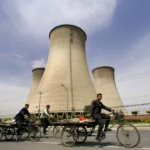
A critical energy artery in Central Europe was temporarily disabled in late March 2026, raising fresh concerns about the continent’s fragile post-Russian oil supply chain. The Transalpine Pipeline (TAL), which carries millions of tons of non-Russian crude from the Italian port of Trieste across the Alps to refineries in southern Germany, Austria, and the Czech Republic, suffered a three-day outage after the power supply to a key pumping station in Terzo di Tolmezzo, Italy, was severed.
While the operator later attributed the incident to routine pylon maintenance 12 km from the station, multiple independent sources—including German authorities—have described it as sabotage. The event went largely unreported for weeks, only surfacing publicly in early April amid heightened global energy tensions linked to Middle East conflicts. No fuel shortages reached consumers, but the episode exposed the vulnerability of Europe’s remaining import routes.
Pipeline Basics and Throughput Volumes
The TAL system, operational since 1967, stretches 753 km from the Marine Terminal in Trieste, Italy, through Austria to Ingolstadt, Germany. From there, it branches to major refineries:
Westward to the MiRO refinery in Karlsruhe (via the TAL-OR spur).
Eastward to Bayernoil facilities in Neustadt and Vohburg (via the TAL-NE spur).
Further connections supply the Schwechat refinery in Austria and, via the linked MERO pipeline, Czech refineries.
Design capacity is approximately 43 million tons of crude oil per year (roughly 850,000 barrels per day). Recent upgrades (TAL-PLUS project, completed in 2025) have boosted effective throughput by enhancing pump stations and flow rates.
Recent actual volumes:2022: 37.2 million tons (402 tankers unloaded at Trieste).
2025: Approximately 41.6 million tons discharged, with over 40 million tons transported year-to-date in some reporting periods.
Crude origins in recent years have been diversified: Kazakhstan (~30%), Libya (14%), Azerbaijan (11%), USA (11%), Iraq (10%), and supplies from more than 20 other countries. Russian volumes were already marginal before the EU embargo and had no meaningful impact on TAL operations.
Critical Role for German and Italian Refineries
The MiRO refinery (Mineralölraffinerie Oberrhein) in Karlsruhe—Germany’s largest, with a processing capacity around 310,000 barrels per day—is almost entirely dependent on TAL crude. It receives shipments via ship to Trieste, then pipeline (only ~1% from domestic German sources). MiRO supplies fuels and heating oil to roughly 10 million people daily, provides district heating to thousands of Karlsruhe households, and accounts for a significant share of Baden-Württemberg’s primary energy demand (reportedly around 45% in some assessments).
Bayernoil refineries in Bavaria were similarly affected. During the outage (approximately March 27–30, 2026), both MiRO and Bayernoil drew down on-site crude stocks to maintain operations. No gasoline, diesel, or jet fuel shortages occurred at filling stations, and inventories are now being rebuilt.
Italy, while less directly dependent on TAL for its own refining (it has domestic production and Mediterranean access), benefits from the pipeline’s role in regional stability. Trieste serves as a vital import hub, and disruptions ripple through shared European supply chains.
Europe’s Struggle to Replace Russian Oil
Since the 2022 invasion of Ukraine and subsequent EU sanctions, Russian crude imports to the bloc have plummeted—from ~25–34% of total EU/German supply pre-war to just 2.2% by 2025. Germany fully phased out Russian crude by early 2023.
Replacements have come from the United States, Norway, Kazakhstan, Libya, and others. However, these sources are not always a perfect fit:Many German and Central European refineries were historically configured for specific Russian or North African crudes.
TAL has become a lifeline for Mediterranean-sourced oil, but it is now under strain amid broader global disruptions (e.g., tensions around the Strait of Hormuz and reduced Middle Eastern flows referenced in recent geopolitical reporting).
Germany imports ~36% of its diesel needs and faces ongoing bottlenecks in jet fuel and diesel markets. Refineries have had to compete on global spot markets, driving up costs and margins. The EU’s January 2026 ban on refined products made from Russian crude has further tightened supply dynamics.
Economic and Refinery Implications
A prolonged outage could have triggered sharp price spikes in diesel, gasoline, and aviation fuel across southern Germany, Austria, and beyond—potentially forcing cancellations of summer travel and hitting logistics, manufacturing, and agriculture. Even the short disruption highlighted systemic risks:Refinery operations: Stock drawdowns are not sustainable long-term; extended loss of TAL flows would force costly alternative routing (e.g., via Rotterdam and Rhine barges) or reduced throughput.
Broader economy: Higher fuel prices feed into inflation, transport costs, and industrial competitiveness. Baden-Württemberg and Bavaria are economic powerhouses; energy shocks there affect the entire German and EU economy.
Energy security: The incident echoes past pipeline controversies (Nord Stream) and underscores Europe’s dependence on a handful of import routes in an era of geopolitical volatility.
German authorities, including the Federal Criminal Police Office (BKA), are investigating in coordination with Italian counterparts. The elevated threat level for critical energy infrastructure remains.
While the pipeline resumed normal operations by March 30 and no lasting damage occurred, the episode serves as a stark reminder: Europe’s shift away from Russian energy has not eliminated risks—it has simply redistributed them.
- Original X thread by
@Frank_Stones
(Francesco Sassi): https://x.com/Frank_Stones/status/2042878636374495478 (includes follow-up communique from TAL denying sabotage).
politico.eu - Politico EU: “Attack on oil pipeline in Italy threatened fuel supplies across southern Germany” (April 2026 reporting): https://www.politico.eu/article/attack-oil-pipeline-italy-threatened-fuel-supplies-across-southern-germany/
politico.eu
- TAL Pipeline official site (throughput data): https://www.tal-oil.com/en/news/tal-pipeline-over-37-million-tons-of-crude-oil-transported-in-2022
tal-oil.com
- Wikipedia / Global Energy Monitor (pipeline specs): https://en.wikipedia.org/wiki/Transalpine_Pipeline and https://www.gem.wiki/Transalpine_Oil_Pipeline
en.wikipedia.org
- MiRO Refinery details: https://www.miro-ka.de/en/about-miro/understanding-a-refinery
miro-ka.de
- Additional context on EU oil imports post-sanctions: European Council and Reuters reporting on shifts away from Russia (2024–2026 data).
consilium.europa.eu
Energy News Beat will continue monitoring developments as investigations proceed.
The post TAL Pipeline Connecting Germany and Italy May Have Been Sabotaged appeared first on Energy News Beat.