
In a significant development for global energy markets, Iran announced today that the Strait of Hormuz is now “completely open” to commercial shipping for the remainder of the fragile ceasefire period tied to the Lebanon truce. The announcement, made by Iranian Foreign Minister Abbas Araghchi, comes amid ongoing U.S. naval restrictions on vessels calling at Iranian ports and follows weeks of near-total disruption caused by the 2026 U.S.-Israel-Iran conflict that began on February 28.
At the time of writing this article, the Desh Suraaksha looked to be heading to the Strait from Oman. A Crude oil tanker is looking to be heading to India.
For the first time in nearly two months, oil tankers, LPG carriers, and other commercial vessels are expected to test whether safe passage can resume through the world’s most critical energy chokepoint. Pre-crisis, the strait handled roughly 20 million barrels per day of crude oil and products—about one-fifth of global seaborne oil and LNG trade—via an average of 100–140 vessel transits daily.
Dramatic Collapse in Traffic Over the Last 60 Days
Ship-tracking data from Kpler, Lloyd’s List Intelligence, and other sources show traffic plummeted more than 95% after February 28, with only a handful of mostly Iran-linked or sanctioned vessels continuing limited operations. From February 28 to April 12, just 279 ships transited the strait—averaging roughly 6.3 vessels per day compared to the pre-war norm of ~100.
March 2026 saw approximately 220 total vessel movements, while early April (through the April 8 ceasefire) remained in single digits on many days. Even after the ceasefire, only 45 additional ships had passed by April 12. Recent daily figures have hovered between 7–14 transits, with a slight uptick in the past week.
The chart below illustrates the stark trend over the past 60 days (February 17–April 17, 2026), based on aggregated reports from Kpler and industry sources:
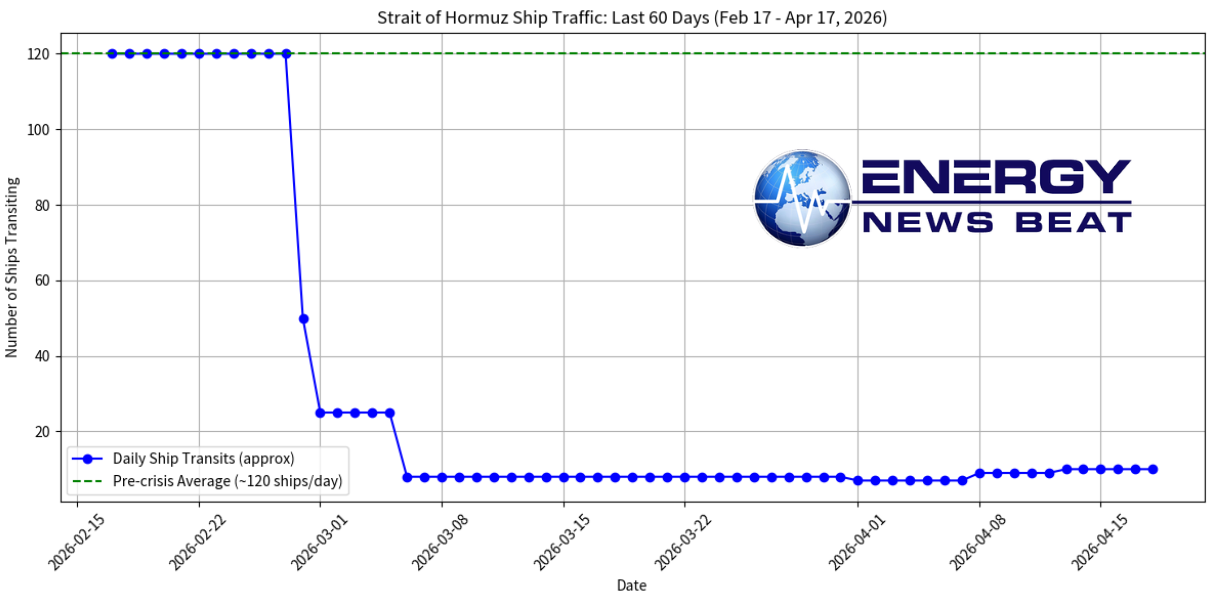
Note: Pre-crisis baseline shown for reference (~120 ships/day average). Actual daily figures varied; post-February 28 data reflect a rapid drop to low single digits amid attacks, mines, and IRGC restrictions.
Ship Types, Cargo, and Routes
Of the limited traffic that continued:
March 2026 breakdown (220 vessels total): 51% liquid tankers (crude oil and oil products) — ~111 vessels
37% dry bulk carriers — ~82 vessels
12% LPG tankers — ~27 vessels
(Negligible LNG or container traffic reported.)
Recent examples (mid-April 2026):
Iran-linked VLCCs such as Deep Sea, Sonia I, and Diona carried an estimated 5 million barrels of Iranian crude from Kharg Island, transiting eastbound (often with AIS disabled) toward Asian ports including Yantai and Dongjiakou in China.
Pakistan-flagged Aframax tanker Shalamar loaded ~450,000 barrels of crude at Das Island (UAE) and exited to Karachi.
Other transits included LPG carriers to India, product tankers (e.g., Peace Gulf MR tanker) to UAE ports like Hamriyah, and Iraqi crude on vessels such as Agios Fanourios I (to Vietnam) and China-flagged tankers like Cospearl Lake.
Dry bulk examples: iron ore carriers from Iranian ports to China.
Outbound traffic (Persian Gulf to Gulf of Oman/Asia) dominated at roughly 68%, reflecting Gulf exporters’ attempts to move cargoes despite risks. Inbound vessels were rarer and often limited to sanctioned or Iran-coordinated ships. Ports of origin included Iranian facilities (e.g., Kharg Island), UAE (Das Island), Iraq (Basrah), and others. Primary destinations: East Asia (China, India, Vietnam, Malaysia) and select regional Gulf ports.
Many transiting tankers were part of the “shadow fleet” or sanctioned vessels; compliant international operators largely stayed away due to war-risk insurance premiums (reviewed every 48 hours) and attack fears. At least 22 ships were attacked since late February, with over 200 tankers reported stranded inside the Gulf at peak disruption.
What the Reopening Means
Today’s announcement signals a potential return to normal flows, but analysts caution that full recovery will take time. The U.S. blockade on Iranian ports remains in effect, IRGC coordination is still required for safe lanes, and war-risk premiums are elevated. Early test transits today and in the coming days—particularly oil tankers carrying Iranian, Iraqi, or UAE crude—will be closely watched by energy traders and markets.
Oil prices reacted immediately, falling sharply on reopening news as traders priced in the return of roughly 20% of global supply.
Energy News Beat will continue monitoring real-time AIS data and Kpler updates as the situation evolves.
- Al Jazeera: “How many ships have passed the Strait of Hormuz…” (April 14, 2026) – https://www.aljazeera.com/news/2026/4/14/how-many-ships-have-passed-the-strait-of-hormuz-and-how-many-were-attacked
- Reuters multiple reports (April 14–17, 2026) on traffic and blockade – e.g., https://www.reuters.com/business/energy/us-sanctioned-chinese-tanker-passes-strait-hormuz-despite-us-blockade-data-shows-2026-04-14/
- Wikipedia: 2026 Strait of Hormuz crisis page – https://en.wikipedia.org/wiki/2026_Strait_of_Hormuz_crisis
- CNBC / Bloomberg / Lloyd’s List Intelligence citations via aggregated reporting
- Statista chart on ship traffic decline – https://www.statista.com/chart/35984/ship-traffic-in-the-strait-of-hormuz/
- Kpler, Vortexa, and Windward maritime intelligence summaries (cited across outlets)
- Additional context from StoneX, BOE Report, and IMF/UNCTAD-derived data
All data compiled from publicly reported ship-tracking platforms as of April 17, 2026. Real-time conditions may vary.
The post Oil Tankers and Traffic Test Hormuz Reopening appeared first on Energy News Beat.