
In the shadow of the ongoing U.S.-Israeli conflict with Iran — marked by the near-closure of the Strait of Hormuz and the largest oil supply disruption in modern history — Saudi Arabia stands out as a clear winner. While many Gulf producers face sharp production cuts, export halts, and economic contractions, the Kingdom under Crown Prince Mohammed bin Salman (MBS) is banking billions in extra oil revenue. This comes from a powerful combination of surging global oil prices and decades of strategic infrastructure planning.
A Bloomberg article published today highlights how MBS is scoring “unexpected wins” amid the chaos: surging oil prices paired with contingency planning have bolstered revenues, even as the war slowed growth and increased defense spending. Saudi Arabia’s Red Sea coast has emerged as a vital bypass corridor.
The Iran War Oil Shock: Context and Price Surge
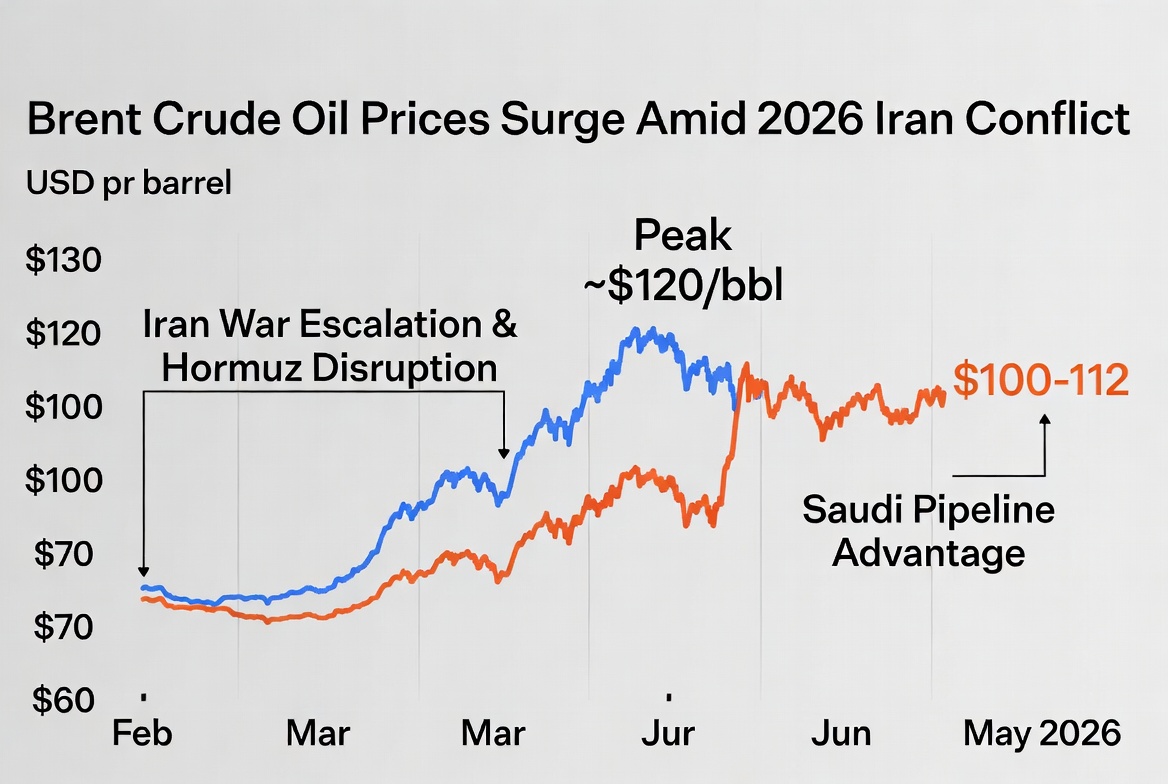
The conflict, which escalated sharply in late February 2026, led to Iranian threats and actions effectively shutting down most commercial traffic through the Strait of Hormuz — through which roughly 20% of global oil and LNG normally flows. Production across key Gulf producers (Saudi Arabia, UAE, Kuwait, Iraq) dropped by 6.7–10+ million barrels per day (mbpd) in March. Brent crude prices surged from around $70/bbl pre-war to peaks near $120/bbl, with levels remaining elevated around $100–112/bbl into May.
This created a classic price-vs-volume trade-off. Countries able to maintain exports captured windfall revenues; those without alternatives suffered deep losses.
Saudi Arabia: Infrastructure and Foresight Deliver Results
Saudi Arabia’s standout advantage is its East-West Crude Oil Pipeline (also known as Petroline), built in the 1980s during the Iran-Iraq War specifically to bypass Hormuz risks. With capacity expanded to 7 mbpd (including conversions), it has operated at or near full capacity during the crisis, routing crude from eastern fields to the Red Sea port of Yanbu.
This allowed Saudi Aramco to sustain roughly 5 mbpd in crude exports via the Red Sea, even as Gulf loadings collapsed. Some infrastructure damage occurred (e.g., attacks on facilities and a pumping station), but the system proved resilient.
Key financial results:
Aramco Q1 2026 net profit rose 25–26% year-on-year to approximately $32–33.6 billion, beating expectations. Higher prices more than offset lower volumes.
Revenue benefited from elevated crude, refined products, and chemicals prices.
Analysts estimate $25–50 billion in additional annual oil revenue for Saudi Arabia above 2026 budget assumptions (which used ~$65/bbl).
Weekly oil revenues rose around 10% despite export constraints.
MBS has leveraged this windfall while advancing ambitions to turn the Red Sea into a major trading and logistics hub. Long-term planning — maintaining and expanding bypass infrastructure, building fiscal buffers via the Public Investment Fund (PIF), and pursuing Vision 2030 diversification — is now paying dividends exactly when needed most.
How Other Gulf Producers Fared: A Stark Comparison
The war exposed a clear divide based on geography and prior infrastructure investment.
Oman emerged as another relative winner. With all its ports on the Arabian Sea (outside the Strait), its oil trade faced minimal disruption. Goldman Sachs noted weekly oil revenues nearly doubled for Oman as prices surged.
UAE showed partial resilience thanks to the existing Habshan-Fujairah pipeline (capacity ~1.5–1.8 mbpd), routing oil to the Gulf of Oman. However, it faced attacks on infrastructure, production cuts, and export challenges. ADNOC is now fast-tracking a new pipeline to double Fujairah export capacity by 2027. Overall performance was better than most, but lagged behind Saudi Arabia’s scale.
Kuwait, Qatar, and Iraq were hit hardest:
No meaningful bypass options for most exports.
Sharp production drops and storage constraints forced major curtailments.
Qatar (heavily LNG-dependent) declared force majeure; Ras Laffan facilities were damaged, with potential annual revenue losses up to $20 billion.
Revenue collapses were dramatic in March (e.g., ~73% for Kuwait, ~76% for Iraq in some reports).
IMF and other projections show significant 2026 GDP contractions: Qatar potentially -14% or worse, Kuwait and Bahrain several percent, with broader regional hits.
Summary Comparison Table (approximate impacts based on reports through mid-May 2026):
|
ountry
|
Production/Export Hit
|
Bypass Capacity
|
Revenue/Profit Trend
|
2026 GDP Outlook (approx.)
|
Key Factor
|
|---|---|---|---|---|---|
|
Saudi Arabia
|
Significant cuts, exports sustained
|
Strong (5+ mbpd Red Sea)
|
Aramco +25–26% profit
|
Mild contraction
|
Pipeline + scale
|
|
Oman
|
Minimal
|
Full (outside Hormuz)
|
Revenues nearly doubled
|
Least affected
|
Geography
|
|
UAE
|
Moderate cuts
|
Partial (~1.8 mbpd + expanding)
|
Mixed, some resilience
|
~-2%
|
Partial bypass
|
|
Kuwait
|
Severe (~30%+ drops reported)
|
None
|
Sharp revenue drops (e.g. 73% in March)
|
Significant contraction
|
No alternatives
|
|
Qatar
|
Severe (LNG especially)
|
None
|
Major losses (~$20bn/yr potential)
|
-10% to -15%+
|
LNG infrastructure damage
|
|
Iraq
|
Severe (southern fields hit hard)
|
Limited
|
Revenue collapse (~76% in March)
|
Significant hit
|
Exposure + attacks
|
Why Saudi Arabia’s Long-Term Planning Matters
The East-West pipeline was not a recent reaction — it was a deliberate contingency built generations ago and maintained/expanded over decades. Saudi investments in Red Sea ports, logistics, and spare capacity created optionality that others lacked. Combined with high prices, this turned a supply crisis into a revenue opportunity.
This resilience strengthens Saudi Arabia’s hand geopolitically and fiscally, providing resources for Vision 2030 projects, defense, and economic diversification even amid regional turmoil.
Risks and Outlook
The situation remains fluid. A sustained ceasefire or Hormuz reopening could ease prices and allow production recovery, but infrastructure damage (especially in Qatar and parts of Saudi/UAE) may take months to years to fully repair. Prolonged high prices support Saudi revenues but risk global demand destruction and recessionary pressures.
For now, Saudi Arabia’s combination of high prices + strategic infrastructure + fiscal prudence has delivered tangible wins — exactly as long-term planners intended.
Appendix: Sources and Links
- Bloomberg: “Saudi Crown Prince MBS Scores Unexpected Wins During Iran War” (May 25, 2026) — https://www.bloomberg.com/news/articles/2026-05-25/saudi-crown-prince-mbs-scores-unexpected-wins-during-iran-war
- Saudi Aramco Q1 2026 Results (various reports confirming ~25–26% profit rise) — Company statements and coverage via Reuters, CNBC, WSJ.
- Wikipedia: Economic impact of the 2026 Iran war (comprehensive summary with production drops, GDP estimates).
- Reuters, NYT, Goldman Sachs reports on Gulf divergences, pipeline capacities, and revenue impacts.
- IEA Oil Market Report (March 2026) on supply disruptions.
- Additional coverage: The Guardian, Semafor, House of Saud analyses on windfall estimates ($25–50bn for Saudi).
Charts in this article are data visualizations based on aggregated public reports. For interactive visuals or updates, visit Energy News Beat Channel.
This positions Saudi Arabia favorably in a volatile energy landscape — a masterclass in preparation for meeting opportunities. Stay tuned for further analysis on how these dynamics evolve.
The post Saudi Arabia Scores Billions in Added Oil Revenue Due to High Oil Prices and Long-Term Planning appeared first on Energy News Beat.