
In an era of surging global energy demand driven by AI, manufacturing resurgence, and geopolitical realities, Texas stands as the undisputed leader in American energy production, infrastructure, and innovation. The Lone Star State isn’t just keeping pace—it’s defining the future of reliable, affordable, and dominant energy. From record-breaking oil and gas output to a massive natural gas pipeline boom, explosive data center growth, expanding Gulf export hubs, and even the first new U.S. Gulf Coast refinery in nearly 50 years, Texas is powering America’s energy security while creating jobs and economic growth.
Governor Greg Abbott and state leaders have championed pro-energy policies that prioritize grid reliability, dispatchable generation, and infrastructure expansion. Initiatives like the Texas Energy Fund support new natural gas-fired power plants, while legislation such as Senate Bill 388 sets goals for 50% of new megawatts in ERCOT to come from dispatchable sources. These policies counterbalance intermittent renewables with the reliable baseload power essential for economic expansion. Texas continues to lead in renewables too—solar is projected to surpass coal in generation by 2026—but its all-of-the-above approach ensures the grid remains resilient amid record demand.
Nowhere is this dominance clearer than in the natural gas sector. As detailed in a recent thread by energy analyst David Blackmon (@EnergyAbsurdity), Texas accounts for over 66% of all planned U.S. natural gas pipeline capacity additions in 2026-2027—roughly 29.7 Bcf/d out of a national total of 44.9 Bcf/d. That’s more than double the next closest state. This marks the second major pipeline boom in just over a decade, fueled by exploding demand from record Permian Basin gas production (exceeding 21 Bcf/d), LNG exports, and the power sector.
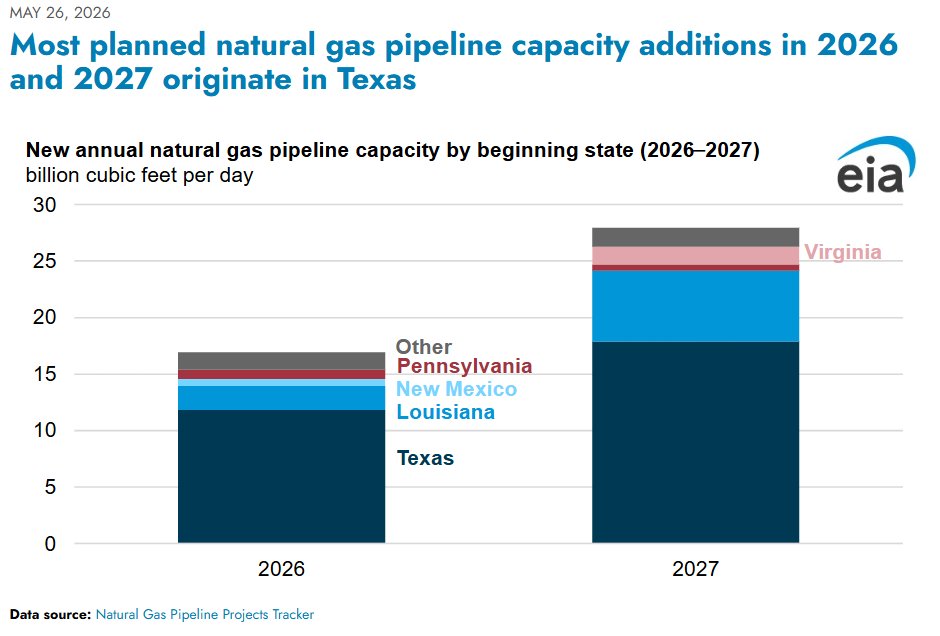
Major projects under construction highlight the momentum: the Blackcomb Pipeline (2.5 Bcf/d from Waha to Agua Dulce, targeting Q3 2026), the Hugh Brinson Pipeline (phased expansions adding up to 2.2 Bcf/d from the Permian to the Dallas-Fort Worth area), Rio Bravo, and others. These pipelines will ease bottlenecks like the Waha hub, reduce flaring, stabilize pricing, and deliver tens of billions in private investment. As Blackmon notes in his accompanying Daily Caller op-ed, this infrastructure is critical for energy security, jobs, and reliable power—proving that despite narratives claiming “fossil fuels are dead,” the world still needs more natural gas, and Texas is perfectly positioned to deliver it.
This pipeline surge directly supports another Texas growth story: the explosion of data centers. AI-driven demand is reshaping the grid. Data centers already consume about 8 GW in Texas, with projections soaring to over 40 GW by 2028—potentially quadrupling overall ERCOT peak demand by the early 2030s. Hyperscalers are turning to behind-the-meter natural gas solutions (such as those from VoltaGrid) and supporting over 130 proposed gas-fired plants (up to 58 GW potential). ERCOT forecasts show load growth accelerating, and Texas policies are responding with reforms to interconnection, reliability standards, and incentives for dispatchable power. The result? Texas is on track to become the world’s top data center market, powering the digital economy without sacrificing reliability.
Underpinning it all is Texas’s unmatched leadership in oil and natural gas production. In 2025, Texas set records with crude oil output reaching 5.85 million barrels per day (mb/d) in peak months and annual production topping 2.1 billion barrels—the first time surpassing that threshold. The state produces roughly 43% of U.S. crude and 30% of natural gas, with the Permian Basin as the global epicenter. Rig counts are rising, flaring intensity continues to drop sharply (down 50%+ since 2019 in Texas and the Permian), and upstream employment remains strong with average wages exceeding $133,000. This isn’t luck—it’s the result of geology, innovation in horizontal drilling and fracking, and a regulatory environment that encourages investment.
Texas’s export capabilities amplify this dominance. The Gulf Coast has become the nation’s premier energy export hub, with Texas ports handling massive volumes of crude, refined products, and LNG. Corpus Christi ranks among the top U.S. ports for crude exports, while LNG terminals like Cheniere’s Corpus Christi (with Stage 3 expansions), Golden Pass, Port Arthur, and Rio Grande LNG are ramping up. U.S. LNG exports hit records in 2025-2026, supplying allies in Europe and Asia and enhancing national security. These hubs turn Permian and Eagle Ford production into global energy assets, with pipeline projects feeding directly into them.
Adding to this infrastructure renaissance is the groundbreaking America First Refining project at the Port of Brownsville—the first new major U.S. Gulf Coast refinery in nearly 50 years. Announced in March 2026 with strong federal and state backing, the facility will process Permian Basin light shale oil into refined fuels, creating hundreds of direct jobs (with salaries from $80,000+) and delivering billions in economic impact. A $300 billion, 20-year deal underscores its scale. Set for groundbreaking in 2026 with operations targeted for 2028-2029, it strengthens domestic refining capacity, reduces reliance on foreign processing, and cements South Texas as an energy powerhouse.
Texas’s energy leadership isn’t accidental. It flows from pro-growth policies, private investment, world-class resources, and a pragmatic approach that values reliability alongside innovation. As David Blackmon aptly concludes, other states should watch and learn. While the rest of the nation debates energy policy, Texas is building the infrastructure, producing the molecules, and powering the future—securing American energy dominance for decades to come.
- David Blackmon (@EnergyAbsurdity) X Thread (May 31, 2026): https://x.com/EnergyAbsurdity/status/2061052784976203916 (and full thread with stats, images, and op-ed link).
- Blackmon Daily Caller Op-Ed: https://dailycaller.com/2026/05/30/opinion-texas-natural-gas-pipeline-boom-david-blackmon/
- EIA: Most planned natural gas pipeline capacity additions in 2026-2027 originate in Texas (May 2026): https://www.eia.gov/todayinenergy/detail.php?id=67707
- Texas Railroad Commission: Oil & gas production records and rig activity (2025-2026 data).
- TXOGA 2025 Energy & Economic Impact Report: https://www.txoga.org/2025eeir/
- Port of Brownsville: America First Refining announcement (March 11, 2026): https://www.portofbrownsville.com/port-of-brownsville-announces-america-first-refining-project-first-new-u-s-gulf-coast-refinery-in-nearly-50-years/
- Reuters, NPR, Bloomberg, and ERCOT reports on data center/power demand growth (2026).
- Additional policy context: Texas Public Policy Foundation Life:Powered agenda; legislative summaries from 2025 session (SB 388, SB 819, etc.).
All data drawn from public sources as of May 31, 2026. For the latest updates, visit Energy News Beat.
The post Texas Leads the Energy Dominance Movement appeared first on Energy News Beat.