
In a significant move to bolster energy security amid escalating geopolitical tensions in the Middle East, Japan’s JERA — the world’s largest buyer of liquefied natural gas (LNG) — has secured a landmark 20-year supply contract with Malaysia’s state-owned Petronas. The deal, announced today following high-level talks between Japanese Prime Minister Sanae Takaichi and Malaysian Premier Anwar Ibrahim, will deliver up to 2 million tons of LNG annually starting in 2028.
This long-term commitment underscores Japan’s aggressive push to diversify its LNG portfolio away from volatile Middle Eastern routes, particularly the Strait of Hormuz, where ongoing disruptions tied to regional conflicts have heightened global supply risks. Malaysia, already Japan’s second-largest LNG supplier, provides a stable, non-Hormuz-dependent source that aligns with Tokyo’s strategy to mitigate exposure to chokepoint vulnerabilities.“Amid growing uncertainty in the international energy situation, cooperation with Malaysia, a stable supplier of LNG to Japan, is becoming increasingly important,” Prime Minister Takaichi stated after the summit.
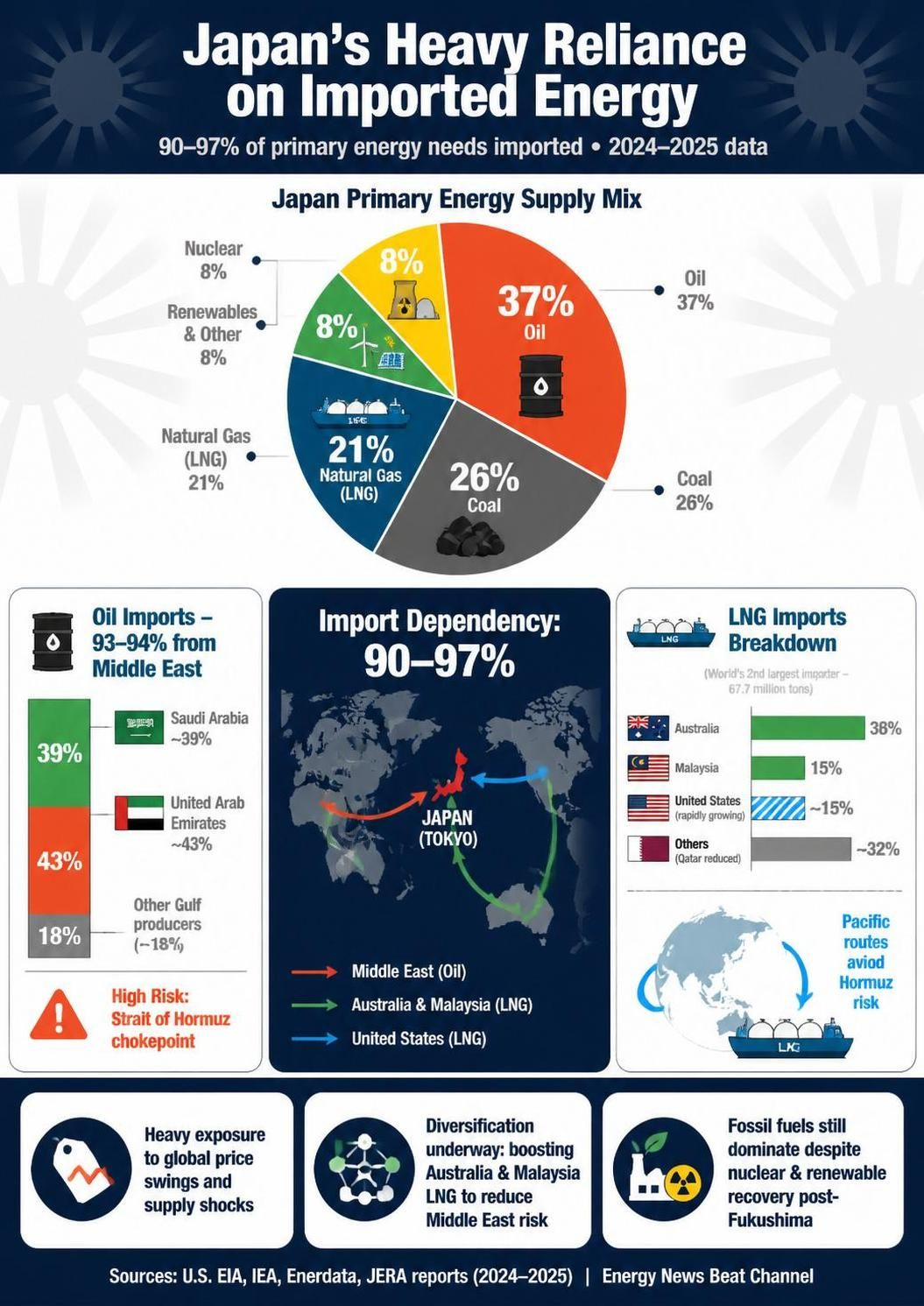
Japan’s Heavy Reliance on Imported Energy
Japan remains one of the world’s most energy-import-dependent nations, sourcing nearly 90-97% of its primary energy needs from abroad due to limited domestic resources. According to the latest available data:Oil accounts for approximately 37% of Japan’s total energy supply (2024 figures). Crude oil imports averaged around 2.5 million barrels per day in recent years, with 93-94% originating from the Middle East — primarily Saudi Arabia (around 39%), the United Arab Emirates (around 43%), and other Gulf producers. This heavy concentration makes Japan particularly exposed to any Strait of Hormuz disruptions, which handle over 20% of global oil trade.
Coal represents about 26% of the energy mix. Japan imported roughly 166 million tons of hard coal in 2024, mainly from Australia, Indonesia, and (to a lesser extent) Canada and Russia, following a sharp reduction in Russian supplies.
Natural Gas (LNG) makes up around 21% of primary energy and plays a critical role in power generation (roughly 34% of electricity mix alongside coal). Japan imported approximately 67.7 million tons of LNG in 2024, making it the world’s second-largest importer after China. Key suppliers include:Australia: ~38% (the dominant source)
Malaysia: second-largest, contributing around 15% (per recent reports, with the new deal set to strengthen this further)
United States: rapidly growing (reaching 6.5 million tons in 2024, with JERA planning to triple volumes to 5.5 million tons annually in coming years)
Qatar and others: sharply reduced shares due to diversification efforts
Nuclear and renewables have recovered somewhat post-Fukushima (now contributing to a more balanced mix), but fossil fuels still dominate, leaving Japan vulnerable to global price swings and supply shocks.
Strategic Shift Away from Hormuz Risks
The timing of the Petronas deal is no coincidence. Recent conflicts in the Middle East, including disruptions linked to the Israel-Iran tensions, have effectively raised alarms over the Strait of Hormuz — a critical artery for Gulf oil and LNG exports. Analysts warn that prolonged closures could spike global LNG prices to $25 per million British thermal units or higher, exacerbate Asian energy crunches, and force further reliance on coal-fired power.
Japan has already responded by ramping up coal generation and accelerating U.S. LNG contracts (non-Hormuz-routed). The Malaysia pact builds on decades of partnership dating back to 1983 and fits into broader bilateral ties upgraded to a Comprehensive Strategic Partnership in 2023, spanning finance, defense, AI, and semiconductors.
By locking in Pacific-sourced LNG from reliable partners like Australia and Malaysia, Japan is actively reducing its Middle East LNG exposure (down from 29% in 2013 to around 11% today). This diversification helps insulate against direct Hormuz risks while addressing rising summer demand for air-conditioning and potential LNG shortages.
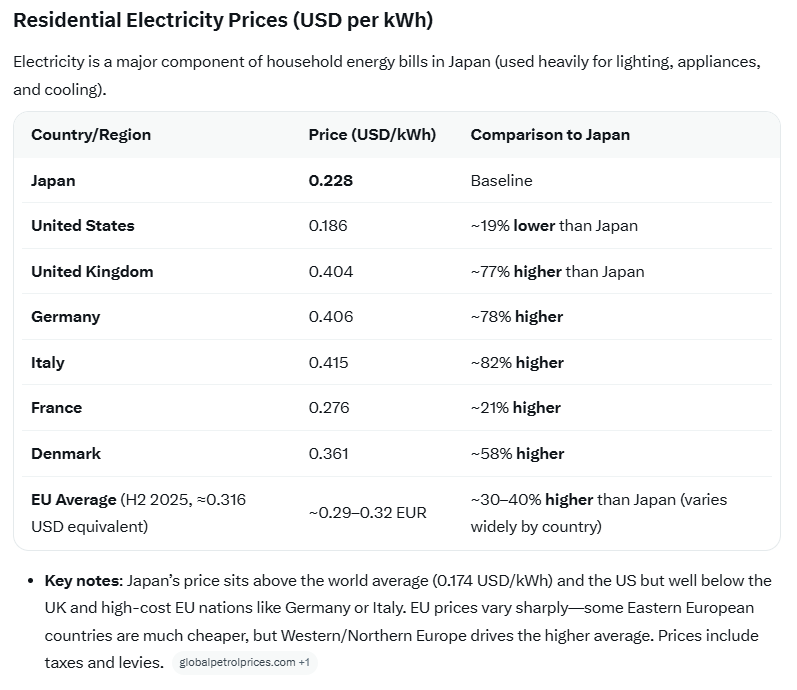
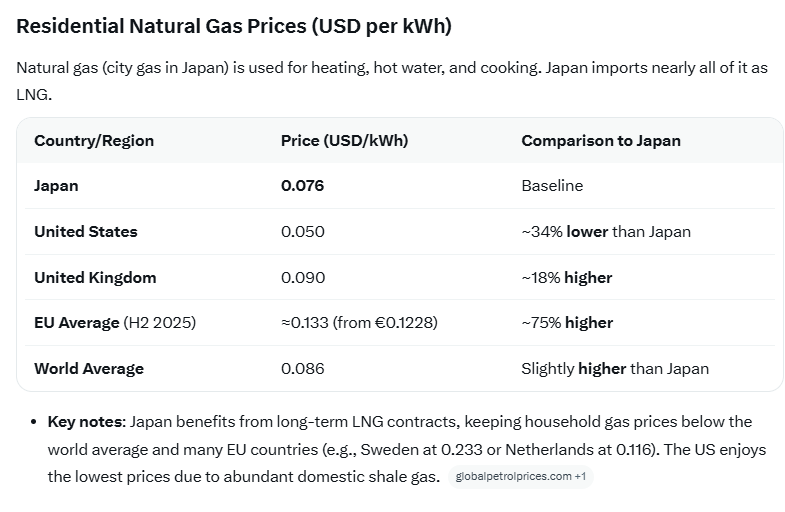
Price to Consumers Comparisons.
Even though Japan is a huge energy importer, its prices to consumers are still lower than those in the UK or the EU.
Market Implications
The deal comes as Asian LNG prices face upward pressure from EU storage needs, heat-driven demand, and Middle East uncertainties. JERA’s expanded portfolio — including the new Malaysian volumes — positions Japan to better navigate these headwinds. However, experts caution that while LNG diversification offers partial protection, oil imports remain heavily tied to the region.
This agreement highlights a broader trend: energy markets are pivoting toward stable, diversified suppliers to sidestep Hormuz vulnerabilities. For Japan, it reinforces energy security without derailing its long-term decarbonization goals, even as coal use provides a short-term buffer.
Energy News Beat will continue monitoring developments in this critical deal and its ripple effects across global LNG markets.
- Original OilPrice.com article (primary reference for the JERA-Petronas deal details and Prime Minister quote):
https://oilprice.com/Latest-Energy-News/World-News/Japan-Secures-Major-LNG-Deal-as-Energy-Risks-Mount.html (Published June 10, 2026) - U.S. Energy Information Administration (EIA) – Japan Country Analysis Brief (detailed import data, oil/LNG shares by source):
https://www.eia.gov/international/analysis/country/jpn - International Energy Agency (IEA) – Japan Energy Mix and Natural Gas data:
https://www.iea.org/countries/japan/energy-mix
https://www.iea.org/countries/japan/natural-gas - Enerdata – Japan Energy Information (2024 import volumes for oil, gas, coal):
https://www.enerdata.net/estore/energy-market/japan/ - IEEFA Australian Gas and LNG Tracker (June 2025 edition) – Latest LNG import shares by country (Australia 38%, US growth, Malaysia second):
https://ieefa.org/australian-gas-and-lng-tracker-june2025 - Reuters (via OilPrice reporting) on the deal announcement and Malaysia’s role:
https://www.reuters.com/business/energy/malaysias-petronas-signs-20-year-lng-supply-deal-with-japans-jera-2026-06-10/
Additional context on Hormuz risks drawn from public analyses by Zero Carbon Analytics, IEEFA, and Wood Mackenzie (2026 reports on supply disruptions). All data reflects the most recent publicly available statistics as of June 2026.
The post Japan Inks Major LNG Deal as Energy Markets Focus Away from Hormuz appeared first on Energy News Beat.