

AUSTIN, Texas — In a decisive move to protect residential electricity ratepayers amid Texas’s explosive data center boom, Governor Greg Abbott today directed the Public Utility Commission of Texas (PUC) and the Electric Reliability Council of Texas (ERCOT) to ensure that data centers fully fund their own electric infrastructure costs — preventing any of those expenses from being passed on to everyday Texans.
The directive, outlined in a formal letter to PUC Chairman Thomas Gleeson and ERCOT CEO Pablo Vegas, comes as Texas grapples with unprecedented demand from AI-driven data centers. ERCOT is currently tracking roughly 439 gigawatts of large-load interconnection requests — about five times the grid’s current peak demand — with approximately 89% tied to data centers. The state already hosts 335 operational data centers, with more than 248 additional projects under construction or planned.
Details of the Governor’s Announcement
Governor Abbott’s letter emphasizes that “the rapid scale of data center development requires oversight to ensure everyday Texans are not burdened with the costs of infrastructure driven by data center expansion.” The immediate directives are clear and time-bound:
The PUC must require data centers to fully fund all electric infrastructure costs (including transmission and distribution upgrades) needed to serve their operations, with zero of those costs shifted to residential ratepayers.
The PUC must initiate action to reduce residential ratepayers’ transmission costs by July 31, 2026.
PUC and ERCOT must jointly review their existing authorities, identify additional protective measures, and submit a joint memorandum to the Governor’s office by July 17, 2026, summarizing actions taken and any needed legislative fixes.
- Abbott also pledged to collaborate with the Texas Legislature in the 2027 session to codify these protections through new laws, including:
- Requiring data centers to add new generation capacity to the ERCOT grid rather than simply increasing demand.
- Mandating water-efficient closed-loop cooling systems for all new facilities.
- Requiring annual reporting of electricity and water usage data to the PUC.
- Phasing out outdated sales tax exemptions and other incentives for data centers (currently costing the state billions in foregone revenue).
- Implementing community protections such as setbacks, noise-reduction technology, and other best practices.
“Data centers must operate in ways that reduce costs for residential electricity customers, do not drain water needed for our communities, and take into consideration the needs of our neighborhoods,” Abbott stated in the accompanying press release.
What This Means for Texas Ratepayers and the Grid
Under traditional utility cost-allocation practices, the costs of new transmission and distribution infrastructure are often socialized across all ratepayers through higher transmission charges in ERCOT’s competitive market. This directive flips that model: data centers — which can consume as much power as small cities and operate with near-constant baseload demand — will now bear 100% of the incremental costs they create. This builds directly on Senate Bill 6 (passed in 2025), which already imposed financial commitments, screening fees, and curtailment requirements on large loads over 75 MW. The new directive accelerates and strengthens those protections with immediate PUC action and a roadmap for permanent legislative change. The goal: lower residential bills while maintaining Texas’s attractiveness for economic development.
Specific Impacts on Projects in Development, Already Approved, or in the Queue
Projects in development or in the ERCOT interconnection queue: These will face the heaviest impact. Developers must now demonstrate full upfront funding of any required grid upgrades, potentially adding tens or hundreds of millions in costs per large campus. Speculative or marginal projects may be abandoned or delayed as the financial bar rises. ERCOT’s massive queue (439 GW) is expected to see natural attrition as non-viable proposals drop out.
Already approved or interconnected projects: These are likely grandfathered under prior rules and SB 6 timelines, meaning no retroactive cost shifts. However, any future expansions or modifications could trigger the new full-funding requirements.
Future applications: New proposals will encounter stricter scrutiny, mandatory generation additions, water-efficiency mandates, and detailed usage reporting. The combination of higher capital costs, lost tax incentives, and operational requirements will likely slow the pace of approvals while ensuring only high-quality, grid-supportive projects advance. Local communities may gain stronger tools to address noise, water use, and land-use concerns.
Industry reaction has been measured so far. The Data Center Coalition noted that facilities already pursue many of these practices and emphasized the need for tailored, locally coordinated approaches.
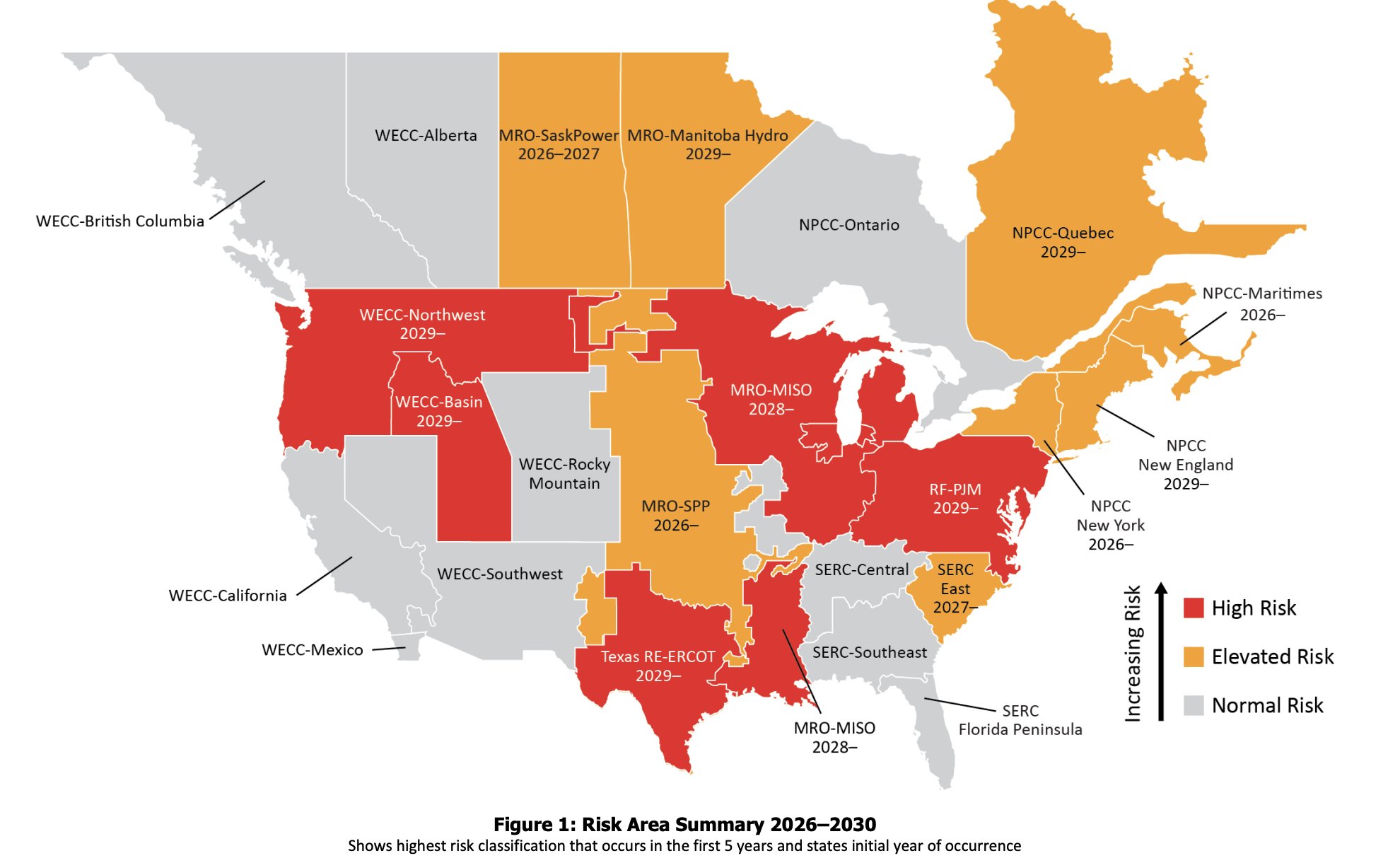
For most of the US, there is a huge red flag on emergencies potentially showing up to the grid by 2028 to 2029.
Is This Unique to Texas?
No — Texas is part of a growing national trend. Other states experiencing data center surges are adopting similar cost-allocation protections to shield residential customers: Arizona: Legislation (HB 2756) directs the state PUC to adopt rules preventing new grid connection costs for data centers from being shifted onto other retail customers.
Virginia (the current U.S. data center leader): The State Corporation Commission created a dedicated rate class for large customers (>25 MW), and lawmakers have introduced bills to investigate and block cross-subsidization of data center infrastructure costs. A JLARC study highlighted risks to residential bills.
Georgia: The Public Service Commission is developing rules requiring large-load customers (>100 MW) to pay their full share of transmission and distribution costs.
Texas’s approach stands out for its speed and breadth — combining immediate regulatory directives with aggressive 2027 legislative proposals — but the core principle of “user pays” for infrastructure is spreading rapidly as AI demand strains grids nationwide.
Looking Ahead
Governor Abbott’s directive strikes a balance: welcoming innovation and investment while refusing to let data center growth come at the expense of Texas families’ electric bills. With PUC and ERCOT required to report back within weeks and legislation on the horizon for 2027, the coming months will determine exactly how this policy reshapes one of the fastest-growing sectors in the state’s economy.
- Official Governor’s Press Release (June 10, 2026): https://gov.texas.gov/news/post/governor-abbott-directs-puc-and-ercot-to-shield-texans-from-data-center-infrastructure-costs
- Full Letter from Gov. Abbott to PUC Chairman Gleeson and ERCOT CEO Vegas (June 10, 2026): https://gov.texas.gov/uploads/files/press/Thomas_Gleeson_Pablo_Vegas_Data_Centers_Directive_Letter_to_PUC_ERCOT_FINAL.pdf
- Texas Tribune analysis (June 10, 2026): https://www.texastribune.org/2026/06/10/texas-greg-abbott-data-centers-regulation-sales-tax/
- MultiState summary of 2026 state data center legislation: https://www.multistate.us/insider/2026/2/20/state-data-center-legislation-in-2026-tackles-energy-and-tax-issues
- Background on Virginia and Georgia policies: Latitude Media (Feb. 26, 2025) and related reports.
Energy News Beat Channel will continue monitoring PUC/ERCOT responses and any early project impacts.
The post Texas Gov. Abbott Directs PUC and ERCOT to Shield Texans from Data Center and Infrastructure Costs appeared first on Energy News Beat.