
Phillips 66 Chairman and CEO Mark Lashier issued a clear warning on June 24, 2026, at the Reuters Global Energy Forum in New York: refining and petrochemical earnings face greater volatility due to ongoing uncertainty from disruptions in the Strait of Hormuz.
Lashier highlighted how uncertainty in crude supply and shipping lanes causes refining margins (crack spreads) to swing sharply in both directions. This shifts the story from simple crude price movements to a high-stakes margin game for refiners.
Phillips 66’s Strategy: Cost Discipline and Integration Pay Off
Lashier emphasized Phillips 66’s (PSX) proactive measures. The company has already removed about $1 per barrel in refining costs and is targeting $5.50 per barrel overall. It has also boosted high-value product yields and increased refinery utilization rates while lowering costs.
Integration provides a key competitive edge. PSX has fed North American crude into its East Coast facilities during price spikes and supplied refined products into the California market, which often relies on more expensive Asian-linked imports. Lashier noted the company is “well positioned to access Venezuelan crude,” signaling potential shifts in heavy crude supply dynamics.
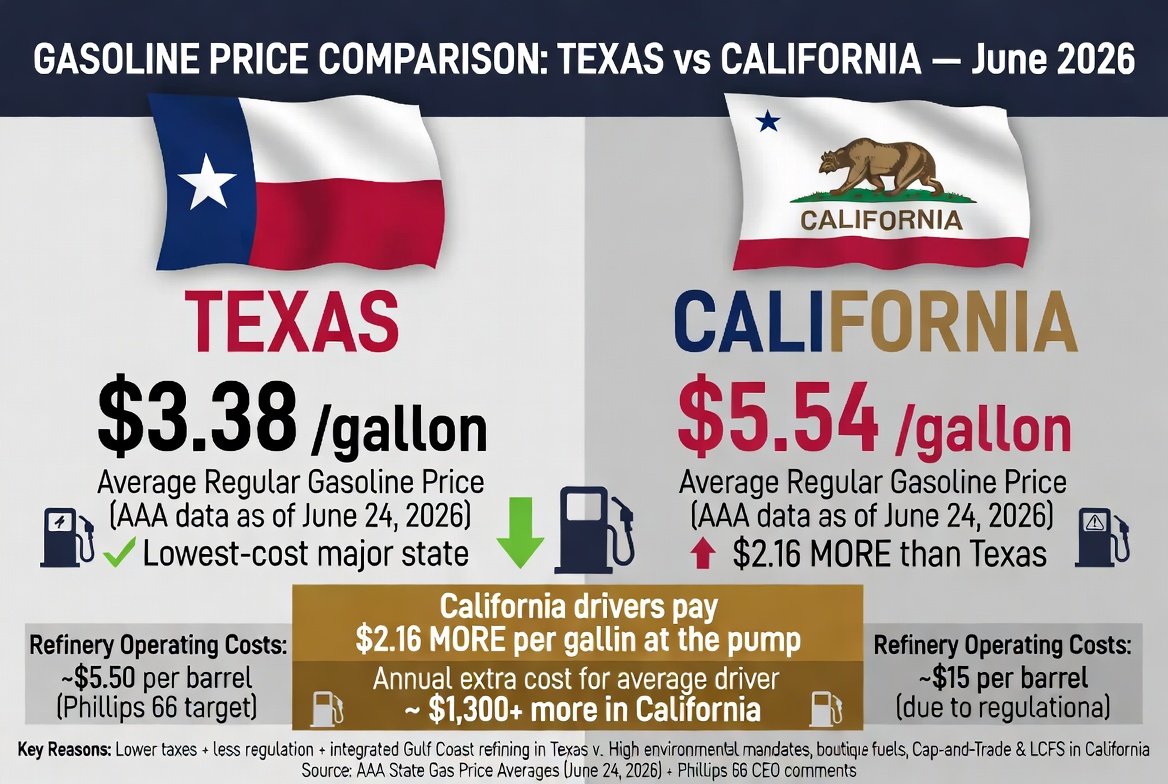
Texas Refineries: ~$5.50/bbl vs. California: ~$15/bbl
The stark contrast in operating costs was a focal point. While Phillips 66 targets $5.50 per barrel in its refining operations (largely Gulf Coast/Texas facilities), costs in California run around $15 per barrel — nearly triple in some cases.
This gap stems from regulatory overreach, not market fundamentals:California Air Resources Board (CARB) boutique fuel blends: California requires a unique reformulated gasoline to meet strict air quality standards. Producing this “boutique” blend is significantly more expensive than conventional gasoline used elsewhere.
Cap-and-Trade and Low Carbon Fuel Standard (LCFS): Refiners must purchase carbon allowances and LCFS credits, adding substantial per-barrel costs. These programs, part of the state’s aggressive net-zero push, effectively penalize fossil fuel production and refining.
Strict environmental compliance and fines: California’s South Coast Air Quality Management District and other agencies impose rigorous emissions rules. Violations can lead to heavy fines, operational restrictions, and costly retrofits. Refinery maintenance and expansions face lengthy permitting delays.
Net-zero policies and refinery closures: Decades of climate mandates and hostile regulatory environments have discouraged investment. Multiple California refineries (including Phillips 66 and Valero assets) have cited strict regulations as reasons for closures or reduced operations, tightening supply and raising costs.
In contrast, Texas benefits from:
- Much lower state gasoline taxes (~$0.20/gallon vs. California’s ~$0.61–$0.71/gallon plus surcharges).
- No boutique fuel mandates or equivalent carbon credit systems.
- Proximity to domestic crude (Permian Basin) and integrated Gulf Coast refining infrastructure.
- Business-friendly energy policies that support efficient operations and competition.
Taxes and regulatory costs in California alone add more than $1.30 per gallon — nearly double the national average.
What This Means for Consumers
Consumers in low-regulation states like Texas benefit far more quickly when crude oil prices fall. Recent data shows Texas statewide averages around $3.39/gallon, with spots as low as $2.39–$2.97 in some areas. National averages have dropped below $4 (to ~$3.93) amid easing Hormuz tensions and increased supply signals.
California drivers, however, continue paying premiums — recently averaging $5.56/gallon — due to layered regulatory and tax costs that do not adjust downward with crude prices. The state’s isolated market (no inbound pipelines; reliance on marine imports) amplifies volatility during any supply disruption.
This creates a two-tier system:
Lower-cost, integrated refiners (Texas/Gulf Coast) capture value and pass some savings to consumers during stable or falling crude periods.
High-cost, heavily regulated markets (California) see persistent price elevation and greater exposure to swings.
Longer term, reduced refining capacity from closures risks tighter supply, higher prices, and potential shortages — especially as demand transitions slowly under net-zero goals.newsweek.com
A Clear Lesson for President Trump’s Questions on Gasoline Prices
President Trump has repeatedly questioned why gasoline prices do not fall as quickly as crude oil prices — a classic “rockets and feathers” pattern documented in economic literature. Lashier’s comments and the Texas-California cost disparity provide a textbook explanation.
When crude drops (recently aided by Hormuz easing and a temporary U.S. license allowing Iranian oil sales through August 2026), refiners in low-cost regions can quickly adjust margins. In high-regulation states, however, Fixed regulatory compliance costs, carbon credit purchases, and boutique blending requirements remain elevated.
Taxes do not automatically decline with crude.
Reduced domestic refining capacity limits competitive pressure.
Political pressure on refiners (including recent DOJ investigations into alleged price gouging) addresses symptoms but ignores root causes: regulatory burdens and policy-driven cost inflation that prevent rapid pass-through of lower input costs to consumers.
The lesson is straightforward: energy policy matters. Pro-production, lower-regulation environments deliver faster relief at the pump. Overly aggressive net-zero mandates and regulatory layers create structural price floors and volatility that hurt everyday Americans — especially in states pursuing rapid fossil fuel phase-outs.
Bottom Line
Mark Lashier’s warning underscores that in a world of geopolitical supply risks (Hormuz), low-cost, integrated, and less-regulated refining wins. Phillips 66’s cost-cutting to $5.50/bbl positions it well. California’s ~$15/bbl reality — driven by regulatory overreach, fines, cap-and-trade/LCFS costs, and net-zero policies — serves as a cautionary tale of what happens when ideology overrides energy reality.
For consumers, the message is clear: policies that raise refining costs ultimately raise what you pay at the pump and make prices more volatile. The contrast between Texas and California proves it daily.
Appendix: Sources and Links
- Reuters: “Phillips 66 CEO warns of refining, petrochemical earnings volatility from Hormuz disruptions” (June 24, 2026) — https://www.reuters.com/business/energy/phillips-66-ceo-warns-refining-petrochemical-earnings-volatility-hormuz-2026-06-24/
- The Merchant Substack (Jack Prandelli) — “Trump’s 2-Front Squeeze On Pump Prices” (June 24, 2026) — https://themerchantsnews.substack.com/p/trumps-2-front-squeeze-on-pump-prices
- California Energy Commission: “What Drives California’s Gasoline Prices?” (Updated April 2026) — https://www.energy.ca.gov/what-drives-californias-gasoline-prices
- The Daily Economy: “Why California Gas Prices Are the Highest in America” (May 2025, relevant context) — https://thedailyeconomy.org/article/why-california-gas-prices-are-the-highest-in-america/
- X Post by
@jackprandelli
(June 24, 2026) summarizing Lashier comments — https://x.com/jackprandelli/status/2069909800008171729
- Additional context from EIA, GasBuddy, and state reports on taxes/regulations (2026 data).
This article draws from primary statements, official analyses, and market reporting for accuracy. Energy policy debates benefit from transparent data on costs and outcomes.
The post Phillips 66 CEO Mark Lashier warned of greater refining and petrochemical earnings volatility from Hormuz disruptions appeared first on Energy News Beat.