
The Refining Capacity Shortage and Demand Destruction Quest
Brent crude oil prices surged more than 3% today, breaking above $86 per barrel (reaching $86.06 in early London trading). This extends a sharp ~12% rally since Friday, driven by escalating geopolitical risks across key oil chokepoints and infrastructure.
The immediate spark came from Iranian cruise missile strikes on two UAE VLCC tankers — the Mombasa and Al Bahiyah — in the southern shipping lane of the Strait of Hormuz (within Omani waters). One Indian crew member was killed and eight others injured. The UAE strongly condemned the attack.
Russian Oil Assets Also Under Fire
Overnight, 11 more Russian vessels were hit in the Sea of Azov (5 tankers, 5 dry cargo ships, and 1 tug), bringing the cumulative total to 116 vessels struck.
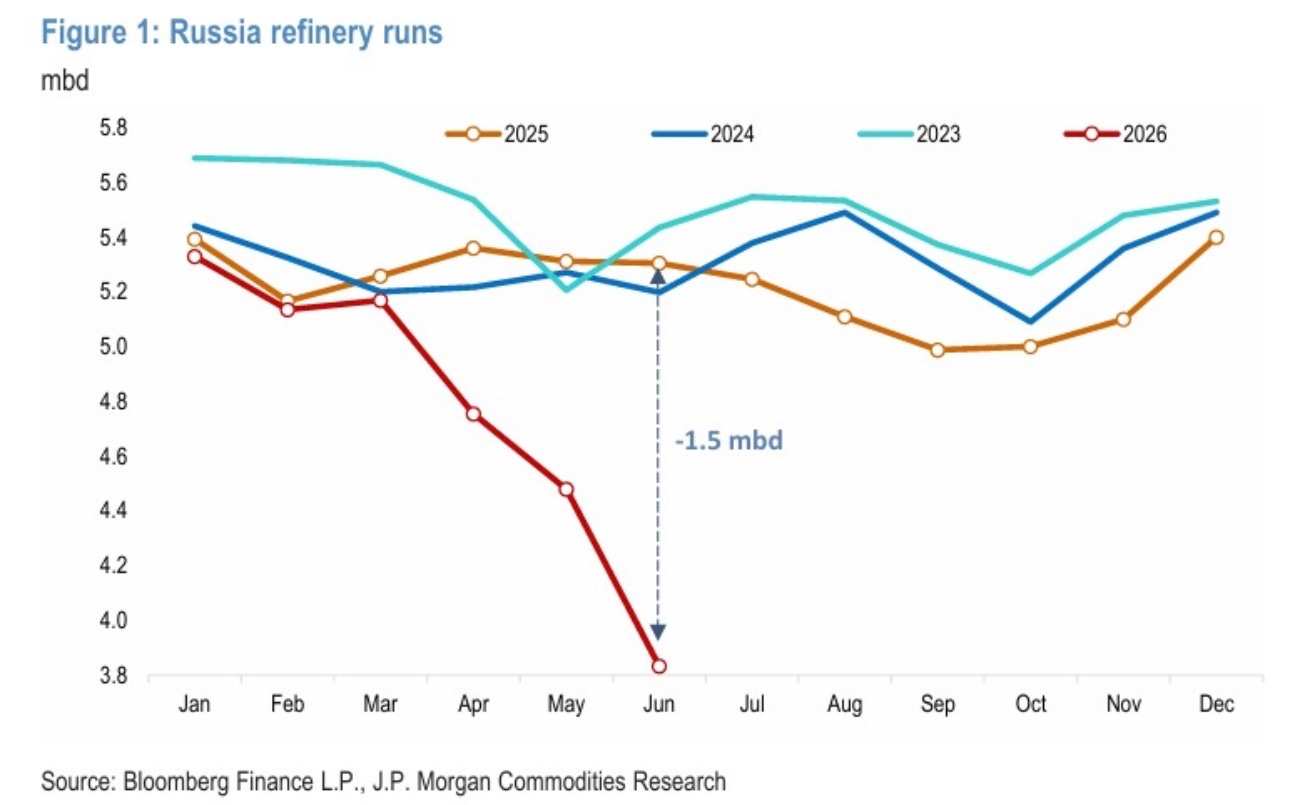
Ukrainian drone strikes have already knocked out roughly 2 million barrels per day of Russian refining capacity. Russian refinery runs crashed to just 3.8 million barrels per day in June — down 1.5 million b/d from early 2026 levels and far below the 5.0–5.7 million b/d range seen in prior years.
Major Russian refineries (including Omsk, Perm, Ufa, and others) have been damaged, leading to domestic fuel shortages, export bans on diesel, and even gasoline imports from India.discoveryalert.com.au
Fujairah and Bab el-Mandeb: The Next Potential Flashpoints
This risk is considered on par with a closure of the Bab el-Mandeb Strait (Red Sea chokepoint). Such a closure would severely disrupt Saudi Arabia’s exports — estimated at 5 to 7 million barrels per day — forcing tankers to reroute around the Cape of Good Hope. This adds weeks to voyages, requires far more vessels, and dramatically increases costs and insurance.britannica.com
These chokepoint threats (Hormuz + potential Fujairah + Bab el-Mandeb) compound an already fragile supply picture.
Taking the Saudi safety valve off of shutting the Bab el-Mandeb would hurt worse than a Brazilian. – just saying – only from what I have heard, not that I have had one.
The Factor Markets Are Missing: Severe Lack of Refining Capacity
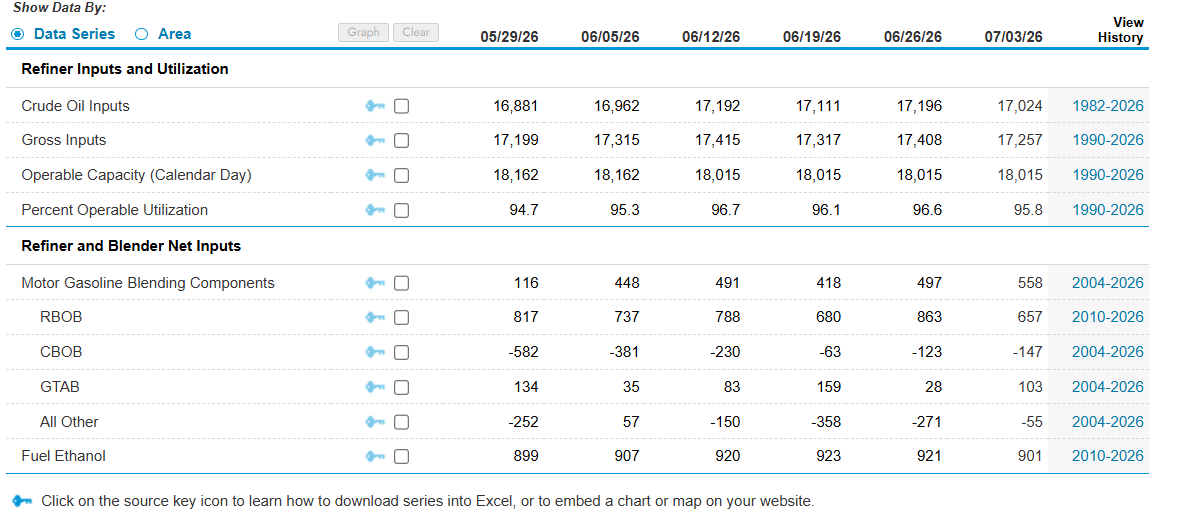
The next update from the EIA is tomorrow, and we will be looking at the numbers.
United States
US refinery utilization remains extremely high:
Week ending July 3, 2026: 95.8%
Recent peaks reached 96.7% and 96.6%
US operable crude distillation capacity is 18.2 million b/d (down ~250,000 b/d year-over-year). Summer is typically a lower-maintenance period, and current high runs show refiners operating near maximum sustainable levels with little buffer. They are not significantly behind on scheduled maintenance, but the system has minimal slack — any unplanned outages or delays would further tighten product supply.
Russia
The loss of ~2 mb/d of refining capacity is massive and structural in the near term. This directly reduces global availability of diesel, gasoline, and other refined products.
The result: crack spreads have surged. The benchmark US Gulf Coast 3-2-1 crack spread recently traded around $63 per barrel — an exceptionally wide level signaling strong product prices relative to crude.
When Does Demand Destruction Kick In — Especially With Wide Crack Spreads at Higher Oil Prices?
Wide crack spreads mean product prices are already elevated compared to crude. Consumers feel the impact first at the pump, in trucking, aviation, and petrochemical feedstock costs.
In a higher-price scenario (e.g., Brent pushing toward $100+ or even the $140 hypothetical):
Product prices would likely spike even more sharply due to the refining bottleneck.
Demand destruction (reduced consumption through behavioral changes, efficiency, or economic slowdown) would accelerate once prices sustain high levels.
However, constrained refining capacity acts as a floor under prices. Supply cannot easily increase, so shortages can persist even as demand begins to erode — leading to greater volatility rather than a smooth price decline.
Historically, meaningful demand destruction kicks in with sustained high prices, but timing depends on economic strength, alternatives, and duration. Right now, the combination of geopolitical risk + refining tightness delays full demand destruction while supporting higher prices and refining margins.
Bottom Line
Wide crack spreads confirm the product-side squeeze. This dynamic keeps upward pressure on prices and margins — even as higher crude levels would intensify demand destruction pressures.
Traders should closely monitor:
- Further escalation in Hormuz or Fujairah
- Developments around Bab el-Mandeb / Red Sea
- Weekly US refinery data and global product inventories
- Any signs of accelerating demand weakness
The refining and chokepoint squeeze is real — and it is not yet fully reflected in prices.
Working on some more Net Zero, Energy Policy, and Grid potential damage coming around the corner.
Interviewing Matt Lozack, Cofounder and CEO of Aalo Atomics, this morning, and will release it tomorrow. They just hit critical mass on their new test reactor, and this is huge. Looking forward to getting more nuclear reactors moving in the United States.
Also have several other oil execs and leaders lining up.
- Oilprice.com article on Brent surge and UAE tankers:
https://oilprice.com/Energy/Oil-Prices/Brent-Surges-Above-86-After-Iran-Strikes-Two-UAE-Tankers-in-Hormuz.html - Jack Prandelli X post on Russian refinery runs crashing to 3.8 mb/d:

- Jack Prandelli X post on 11 more Russian vessels hit in Sea of Azov:
- HFI Research X post on Fujairah vulnerability and Bab el-Mandeb comparison:
- EIA Weekly Refinery Utilization data:
https://www.eia.gov/dnav/pet/pet_pnp_wiup_dcu_nus_w.htm (and related weekly releases) - RBN Energy 3-2-1 Crack Spread data (as of July 13, 2026):
https://rbnenergy.com/market-data/3-2-1-crack-spread - The Merchant Substack on Russian refinery and infrastructure strikes:

- Additional context on Bab el-Mandeb and Saudi export risks (web sources referenced in analysis).
All information is current as of July 14, 2026. This article was first run on the Energy News Beat Substack.
Head over and subscribe to leave comments.
The post Brent Crude Surges Above $86 as Iran Strikes UAE Tankers in Hormuz, Russian Oil Infrastructure Takes More Hits, and Chokepoint Risks Mount appeared first on Energy News Beat.