

Heating oil opened the season at $6.04 a gallon, a record in EIA’s weekly data and 70% above last fall. The government expects oil-heated homes to spend 21% more this winter; the state energy-aid directors say closer to 50%. What is driving it, who gets hit hardest, where to find help, and what could still change. Again, this is a refinery crisis, not an oil crisis caused by decades of Green Energy policies shutting refineries down. Toss on the Ukraine war, and then the Iran war, and you have the current situation. As Stu Turley on the Energy News Beat Podcast has been saying, there are only two ways to bring down diesel, jet fuel, and gasoline (and now home heating oil), and those are to build more refineries or demand destruction. Simple. And because of regulatory overreach and Green New Deal policies, Blue States are 38% to 42% higher than Red States, have closed more refineries, and have no new ones. Texas has the first coming online in early 2027. And it will not solve the home heating oil issue. The team is verifying some of the numbers and will provide updates and mark updated figures when they’re updated.
The delivery truck is back, and so is the sticker shock
Somewhere in Massachusetts this week, an oil truck is backing into a driveway for the first fill of the season. If the tank is the standard 275 gallons and it’s close to empty, the bill at the state’s average price of $6.12 a gallon comes to about $1,683. Last October the same fill cost about $976 (EIA; ENB calculation). That gap, roughly $707, is what Gov. Maura Healey meant when she said many families “could pay as much as $700 more for a single fill-up” (WBUR).
Lisa Furman, who owns a home in Hancock County, Maine, expects to spend $3,400 on oil over the next 10 months, against the $1,500 she is used to. “Now you’re going to double my heating oil bill? This is just a slap in the face,” she told The Boston Globe. She earns too much for federal heating aid, so the extra goes on her credit card. “It’s this really weird, middle class place that I fall into.”
The first government price survey of the heating season, taken Monday, put residential heating oil at $6.04 nationally, up 70% from a year ago and the highest weekly price in EIA data going back to 1990, before adjusting for inflation (EIA). Maine was up 82%, Connecticut 76% and Pennsylvania 79%.
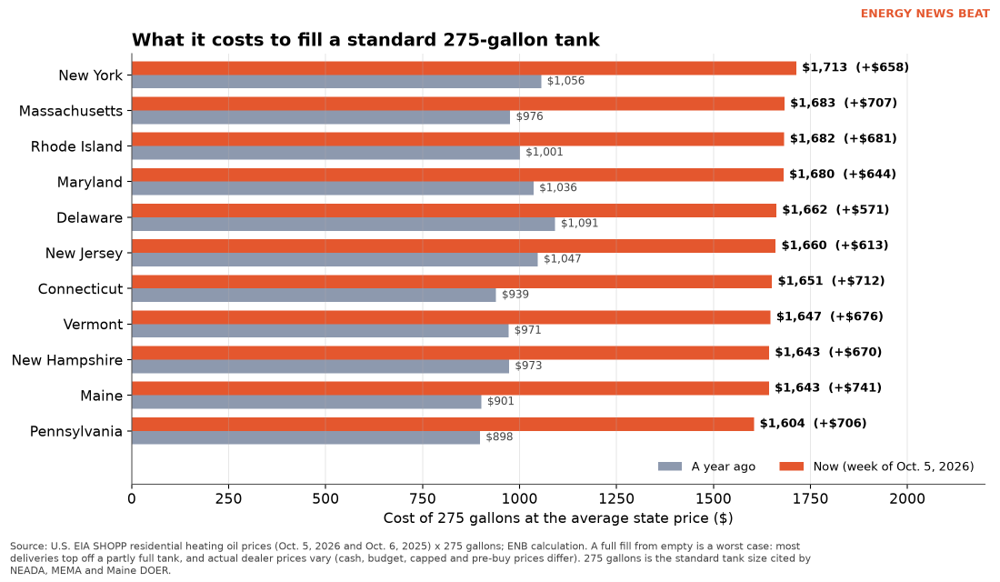
Chart 1. Cost of 275 gallons at each state’s average residential price, now vs. a year ago. Source: U.S. EIA Heating Oil and Propane Update; ENB calculation.
What this winter could cost
The U.S. Energy Information Administration expects heating oil to average $5.26 a gallon from November through March, up 34%. Because it also expects a milder Northeast winter, with 12% fewer heating degree days, it sees oil use falling 9%. Net result: the typical oil-heated home spends about $2,115, up 21% from $1,745 (EIA Winter Fuels Outlook; CNBC). Gas-heated homes should spend about 9% less, propane homes 3% less and electric homes 4% more.
The National Energy Assistance Directors Association, which represents the state officials who run federal heating aid, is gloomier. It now projects $2,627, up about 50%, with New England homes averaging $2,849 (NEADA). Two weeks earlier it had projected 31%. The gap is mostly timing: EIA assumes prices ease from today’s $6.04 through March, while NEADA leans on current prices (Appendix F).
Put it in monthly terms. EIA’s January oil bill alone is about $509, roughly half of what USDA says a thrifty family of four spends on a month of groceries, $1,023.70 (USDA). Spread over 12 budget-plan payments, EIA’s winter estimate works out to about $176 a month, up from $145. At NEADA’s number it’s about $219. And if the winter turns 10% colder than EIA assumes, its own estimate climbs to $2,332.
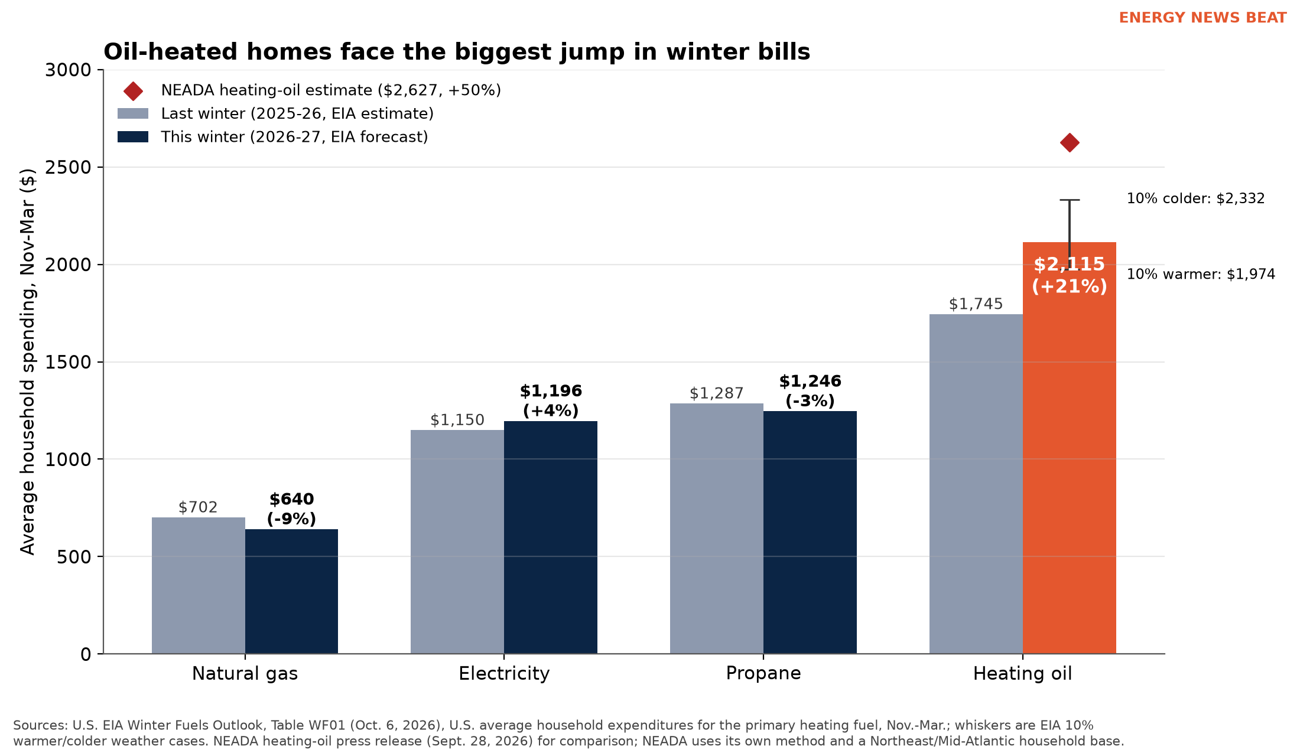
Chart 2. Average household winter spending by main heating fuel, last winter vs. this winter, with EIA weather cases and NEADA’s estimate. Sources: U.S. EIA Winter Fuels Outlook (Oct. 6, 2026); NEADA (Sept. 28, 2026).
Why heating oil, and why now
Heating oil and diesel are, for practical purposes, the same fuel. “The consumer, unfortunately, is going to be facing some severe sticker shock,” Andy Lipow of Lipow Oil Associates told CNBC. The Iran war and the squeeze on tanker traffic through the Strait of Hormuz, Ukrainian drone strikes on Russian refineries and Chinese export limits have all cut global supplies of diesel-type fuels (CNN via KION; ENB’s Hormuz coverage here). AAA’s national diesel average is $6.28 today, against $3.68 a year ago (AAA).
The cushion is gone. U.S. distillate stocks were 105.1 million barrels on Oct. 2, the lowest for that week in EIA data back to 1982. On the East Coast, where most heating oil is burned, stocks were 21.7 million barrels, about 30% below the 2021–25 average for the week (EIA; ENB calculation). EIA puts September at 32% below normal and expects East Coast stocks to stay 20% to 30% below average all winter (EIA). New England has no refineries of its own, so it relies on fuel shipped in by pipeline, tanker, barge and truck (MEMA).
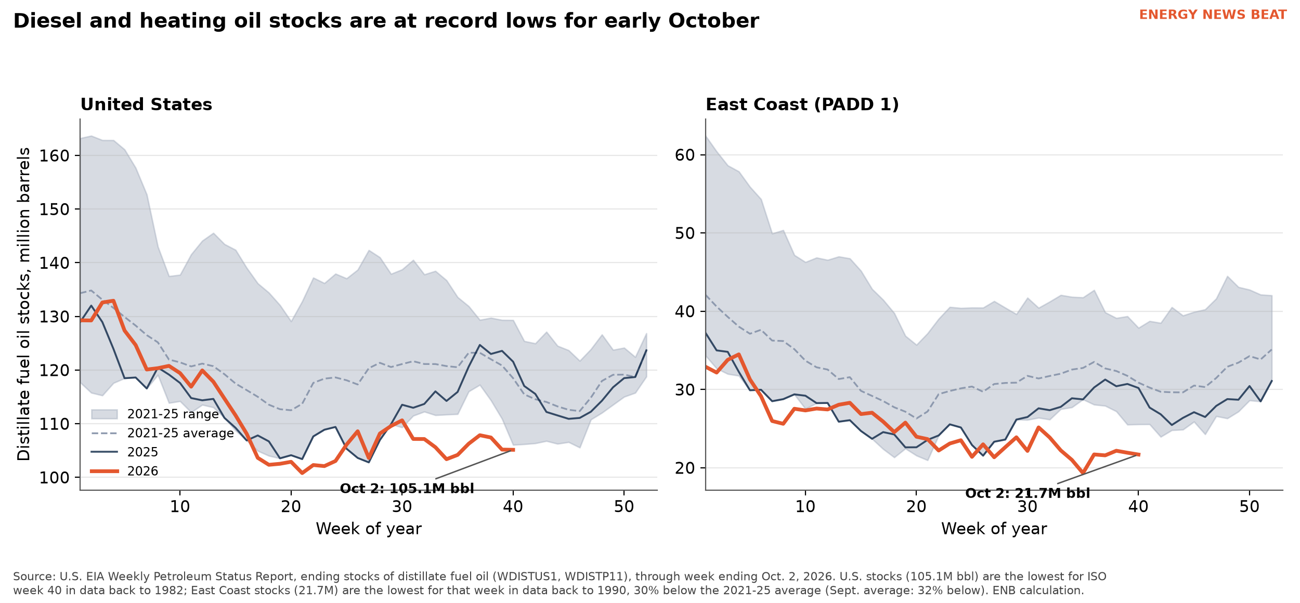
Chart 3. Distillate fuel oil stocks, U.S. and East Coast, 2026 vs. 2025 and the 2021–2025 range. Source: U.S. EIA Weekly Petroleum Status Report; ENB calculation.
Retail prices follow wholesale with a lag of four to six weeks, EIA says (EIA). New York Harbor ultra-low sulfur diesel, the wholesale benchmark, was $4.71 a gallon on Oct. 6, about double a year earlier (EIA). NYMEX November diesel futures settled at $4.6227 on Wednesday (FinancialJuice). Wholesale has eased from its mid-September peak of $5.37, but not by much.
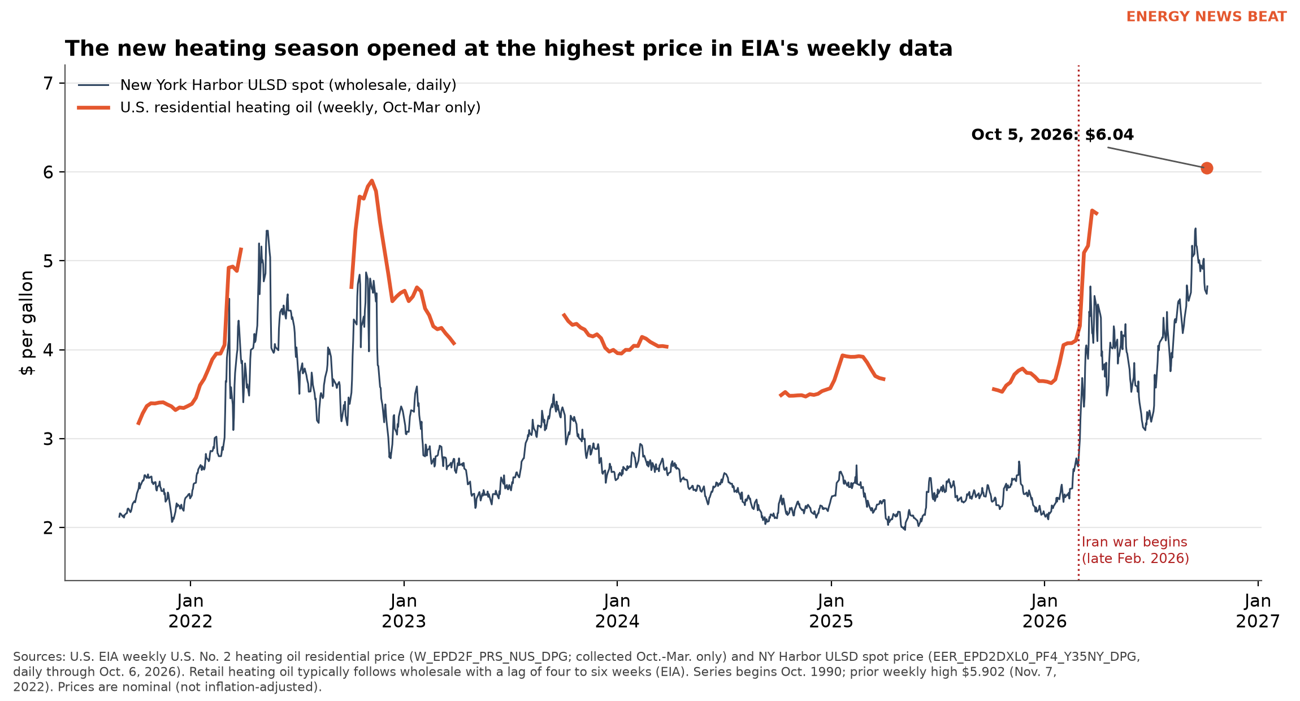
Chart 4. U.S. residential heating oil (weekly, heating seasons only) and New York Harbor ULSD spot (daily), Sept. 2021–Oct. 2026. Source: U.S. EIA.
A hurricane aimed at the Gulf refineries
Then there is Isaias. At 4 a.m. CDT today, the National Hurricane Center had it as an 80 mph hurricane about 420 miles south-southwest of the mouth of the Mississippi, still strengthening. NHC expects it to be a strong hurricane near the northern Gulf Coast Friday and to make landfall “late Friday or early Saturday” somewhere between Ocean Springs, Miss., and the Florida Panhandle, where hurricane warnings are up (NHC). Pensacola has a 69% chance of tropical-storm-force winds and Mobile 51%. New Orleans and Baton Rouge are not on the list, meaning odds below 3% (NHC).
Lipow told CNN about 2.7 million barrels a day of refining, 14% of U.S. capacity, sits in or near the projected path. ENB’s Oct. 7 storm story counted 1.73 million b/d, 9.6%, because it looked only at the six plants run by companies Reuters named (ENB). Counting every refinery from Baton Rouge to Mobile gives 2.50 to 2.59 million b/d, or about 14%, matching Lipow (Appendix H). With today’s track, Chevron’s 356,000 b/d Pascagoula plant is closest. As of this morning, no refinery shutdowns had been reported in the coverage ENB reviewed, while offshore producers had shut in about 25% of Gulf oil output (Argus; The Daily Energy).
Who gets hit hardest
Oil heat is a regional problem. About 82% of the nation’s 4.1 million oil-heated homes are in the Northeast (EIA). In Maine, 50% of homes heat mainly with fuel oil or kerosene. It’s 37% in New Hampshire, 35% in Vermont and Connecticut, and 20% in Massachusetts (Census ACS 2024).
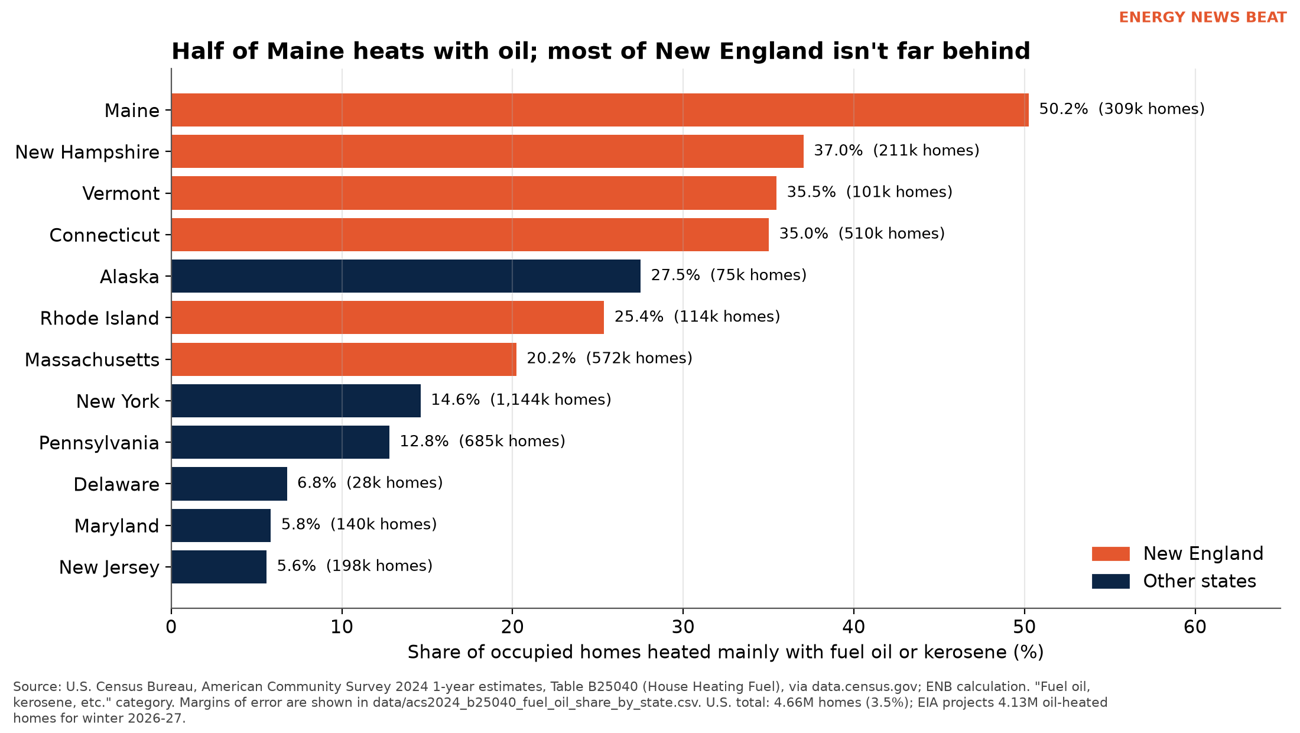
Chart 5. Share of occupied homes heated mainly with fuel oil or kerosene, top 12 states. Source: U.S. Census Bureau, ACS 2024 1-year, Table B25040.
People on fixed incomes have the least room. NEADA notes that the roughly 3.6% Social Security increase it expects in January “would not come close” to covering this jump, and it counts about 1.2 million low-income oil-heated households in the region (NEADA). In an AARP New York survey taken in February, before the war, 56% of utility-paying New Yorkers 50 and older said they had kept their homes uncomfortably cold (AARP New York).
In Aroostook, Washington and Hancock counties, the average federal heating award this season is about $700, said Jason Parent of Avec Community Action. At Maine prices that barely buys half a tank, and appointments are booked into January. “All signs point to this being the most challenging year we’ve had,” he told the Globe. Hard data on rural households specifically is thin; ENB found state-level shares, not county or rural breakdowns.
How consumers and investors see it
“Seniors on fixed incomes — they see a delivery come in at $6 a gallon, they can’t pay it all at one time. Just talk to our office.” — Charlie Uglietto, president of Cubby Oil and Energy, Wilmington, Mass. (GBH News)
At the kitchen table, the mood is grim. Matt Fitch, a software engineer in Pembroke, Mass., priced a switch to heat pumps at $75,000 and will absorb the oil bill instead: “We can technically afford it,” but “it comes out of other parts of the budget” (Globe). Michael Ferrante of the Massachusetts Energy Marketers Association called it the “most troubling scenario” he has seen in decades, (Globe). MASSCAP’s Joe Diamond worries families “probably wouldn’t be able to cover one tank of oil” even with aid (GBH). Maine Public Advocate Heather Sanborn told the Bangor Daily News: “this is likely to be a very tough winter for many Maine families.”
Traders see a market with no slack. Brent crude jumped about 3.7% to $103.93 this morning on Iran tensions and the storm, and WTI rose to $91.29 (Anadolu). “It’s the worst time something like this could happen in 25 years,” Mizuho’s Robert Yawger told CNN about Isaias. Lipow warned that lost refinery output “will have to come out of already low commercial inventories.” EIA, for its part, sees retail diesel easing to about $4.50 next year (EIA).
Where to get help
Federal aid is funded, but not yet flowing. A stopgap spending law keeps the government open through Dec. 11 (CRS) and requires HHS to send at least 90% of this year’s roughly $4 billion LIHEAP allotment to states by Nov. 1 (Sen. Reed). The federal LIHEAP Clearinghouse showed no fiscal 2027 release as of this morning; its latest notice was August’s final 2026 reallotment (LIHEAP Clearinghouse). The administration proposed eliminating LIHEAP in its 2027 budget, and the federal LIHEAP staff laid off in April 2025 has not been rehired, according to NEADA and a bipartisan House letter (Rep. Pappas). Twenty Senate Democrats and independents asked HHS on Oct. 1 to seek $3 billion more in emergency money (Sen. Sanders).
States are moving. Massachusetts declared an energy emergency Monday, raised oil-heat HEAP benefits 20% and created a one-time benefit of up to $680 for middle-income oil customers, with applications opening in December (Mass.gov; NBC Boston). Maine has taken HEAP applications since Aug. 3; New Hampshire and Vermont accept them through local agencies and online. New York and Pennsylvania open Nov. 2. Appendix D lists official links and phone numbers.
Talk to your dealer early. Dealers point customers to budget plans that spread payments out and to price-cap programs (GBH); in Vermont, more households locked in pre-buy prices this summer (Brattleboro Reformer). NEADA’s Mark Wolfe says “shopping around does pay off” (CNBC). The Energy Department says turning the thermostat back 7 to 10 degrees for eight hours a day can cut heating and cooling costs as much as 10% a year (DOE). More tips are in Appendix E.
What could change the outlook
- Emergency stocks. G7 nations agreed Oct. 2 to release 100 million barrels of diesel and crude; the IEA board is expected to set the details Oct. 14–15 (AJOT/Reuters; IEA). France is first, with 10 million barrels of diesel for its own drivers from November to January, about 110,000 b/d (Argus). Any help for New England would be indirect. Maine’s senators have asked the president to tap the 1-million-barrel Northeast Home Heating Oil Reserve ( King); ENB found no release announced.
- A brush with the Florida Panhandle spares most refining. A turn west, or flooding and power losses at Pascagoula or along the Colonial Pipeline, could hit East Coast diesel supply first (ENB, Oct. 7).
- Iran and Hormuz. A tanker was struck north of Qatar Wednesday, and Washington is weighing new strike options even as talks continue (Anadolu).
- The weather. NOAA sees a strong El Niño. EIA’s mild-winter estimate is $1,974; a cold one is $2,332 (EIA).
For now, the best move is the boring one: call the dealer, ask about a plan, and if money is tight, apply for help before the first cold snap.
Check out the World’s Greatest Podcast Show Notes at EnergyNewsBeat.co or EnergyNewsBeat.com. And subscribe to: The Energy News Beat Substack.
Appendix A. Sources (accessed Oct. 8, 2026, before 6:45 a.m. CT, unless noted)
Prices, outlooks and market data
- U.S. EIA, “EIA expects a mixed picture for winter fuel costs this year,” press release on the October STEO and Winter Fuels Outlook (Oct. 6, 2026). https://www.eia.gov/pressroom/releases/press593.php
- U.S. EIA, Winter Fuels Outlook 2026–27 (Oct. 6, 2026). https://www.eia.gov/outlooks/steo/report/perspectives/2026/10-winterfuels/article.php
- U.S. EIA, Table WF01 data file, Winter Fuels Outlook (wf01.xlsx, October 2026 STEO). https://www.eia.gov/outlooks/steo/report/perspectives/2026/10-winterfuels/wf01.xlsx
- U.S. EIA, Heating Oil and Propane Update (SHOPP), survey of Oct. 5, 2026. https://www.eia.gov/petroleum/heatingoilpropane/
- U.S. EIA, Weekly Heating Oil and Propane Prices, residential No. 2 heating oil by state (data series). https://www.eia.gov/dnav/pet/pet_pri_wfr_a_EPD2F_prs_dpgal_w.htm
- U.S. EIA, Weekly East Coast (PADD 1) Ending Stocks of Distillate Fuel Oil (WDISTP11), through Oct. 2, 2026. https://www.eia.gov/dnav/pet/hist/LeafHandler.ashx?n=PET&s=WDISTP11&f=W
- U.S. EIA, Weekly U.S. Ending Stocks of Distillate Fuel Oil (WDISTUS1), through Oct. 2, 2026. https://www.eia.gov/dnav/pet/hist/LeafHandler.ashx?n=PET&s=WDISTUS1&f=W
- U.S. EIA, New York Harbor ULSD No. 2 spot price, daily (through Oct. 6, 2026). https://www.eia.gov/dnav/pet/hist/LeafHandler.ashx?n=PET&s=EER_EPD2DXL0_PF4_Y35NY_DPG&f=D
- U.S. EIA, Heating oil explained. https://www.eia.gov/energyexplained/heating-oil/
- U.S. EIA, Refinery Capacity Report 2026 (capacity as of Jan. 1, 2026). https://www.eia.gov/petroleum/refinerycapacity/
- CNBC (Sarah Agostino), “Home heating oil prices are soaring — and users’ winter bills could rise 21%, federal outlook shows” (Oct. 7, 2026). https://www.cnbc.com/2026/10/07/home-heating-oil-costs-winter.html
- AAA, Gas Prices national averages (Oct. 8, 2026). https://gasprices.aaa.com/
- Anadolu Agency (Duygu Alhan), “Oil rises almost 4% amid Middle East tensions, US supply concerns” (Oct. 8, 2026). https://www.aa.com.tr/en/energy/oil/oil-rises-almost-4-amid-middle-east-tensions-us-supply-concerns/60113
- FinancialJuice, “NYMEX diesel November futures settle at $4.6227 a gallon” (Oct. 7, 2026; headline item). https://www.financialjuice.com/News/9795899/NYMEX-diesel-November-futures-settle-at-46227-a-gallon.aspx?xy=rss
- USDA FNS, Official USDA Thrifty Food Plan: U.S. Average, August 2026. https://fns-prod.azureedge.us/sites/default/files/resource-files/CostofFoodAug2026Thrifty.pdf
Hurricane Isaias and Gulf refining
- National Hurricane Center, Hurricane Isaias Public Advisory No. 7 (4:00 a.m. CDT, Oct. 8, 2026). https://www.nhc.noaa.gov/text/refresh/MIATCPAT4+shtml/080854.shtml
- National Hurricane Center, Hurricane Isaias Forecast Discussion No. 7 (4:00 a.m. CDT, Oct. 8, 2026). https://www.nhc.noaa.gov/text/refresh/MIATCDAT4+shtml/080856.shtml
- National Hurricane Center, Hurricane Isaias Wind Speed Probabilities No. 7 (0900 UTC, Oct. 8, 2026). https://www.nhc.noaa.gov/text/refresh/MIAPWSAT4+shtml/080855.shtml
- CNN (Matt Egan) via KION, “A major hurricane could cripple US refining when the world can least afford it” (Oct. 8, 2026). https://kioncentralcoast.com/money/cnn-business-consumer/2026/10/08/a-major-hurricane-could-cripple-us-refining-when-the-world-can-least-afford-it/
- Argus (Cunningham, Bridges), “US Gulf operators shut-in output before storm: Update” (Oct. 7, 2026). https://www.argusmedia.com/en/news-and-insights/latest-market-news/2887918-us-gulf-operators-shut-in-output-before-storm-update
- Reuters via Offshore Engineer, “Tropical Storm Isaias Forces Shell, Chevron to Curb Gulf Production” (Oct. 8, 2026). https://www.oedigital.com/news/543553-tropical-storm-isaias-forces-shell-chevron-to-curb-gulf-production
- The Daily Energy, “Hurricane Isaias Shuts In 25% of US Gulf Oil Output” (Oct. 8, 2026; secondary aggregator). https://thedailyenergy.com/hurricane-isaias-gulf-of-mexico-oil-shut-in/
- Energy News Beat, “Tropical Storm Isaias Threatens Gulf Oil and Refineries With Diesel Already Near a Record” (Oct. 7, 2026). https://energynewsbeat.com/big-oil-companies/tropical-storm-isaias-threatens-gulf-oil-and-refineries-with-diesel-already-near-a-record/
- Energy News Beat, “Iran’s Tanker Attacks Keep Pump Prices High Even as Gulf Oil Exports Rebound” (Oct. 6, 2026). https://energynewsbeat.com/crude-oil/irans-tanker-attacks-keep-pump-prices-high-even-as-gulf-oil-exports-rebound/
Emergency stocks and policy outlook
- Argus (Ben Winkley), “France to release 10mn bl of diesel in Nov-Jan” (Oct. 8, 2026). https://www.argusmedia.com/en/news-and-insights/latest-market-news/2888062-france-to-release-10mn-bl-of-diesel-in-nov-jan
- CNBC, France diesel reserves release amid protests (Oct. 8, 2026). https://www.cnbc.com/2026/10/08/france-diesel-reserves-protests.html
- IEA, Statement by IEA Executive Director on meeting of IEA Member governments on 7 October 2026. https://www.iea.org/news/statement-by-iea-executive-director-on-meeting-of-iea-member-governments-on-7-october-2026
- Reuters via AJOT, “IEA to decide details of G7 diesel and oil stocks release on October 14-15, sources say” (Oct. 6, 2026). https://www.ajot.com/news/iea-to-decide-details-of-g7-diesel-and-oil-stocks-release-on-october-14-15-sources-say
- Sens. Collins and King, letter urging release from the Northeast Home Heating Oil Reserve (Sept. 22, 2026). https://www.king.senate.gov/newsroom/press-releases/senators-collins-king-call-on-president-trump-to-release-home-heating-oil-from-northeast-reserve-as-prices-surge
- U.S. DOE, Northeast Home Heating Oil Reserve. https://www.energy.gov/hgeo/opr/northeast-home-heating-oil-reserve
Consumers, dealers and assistance groups
- The Boston Globe (Karyna Cheung), “‘This is just a slap in the face’: Home heating oil prices soar as household expenses reach a breaking point” (Oct. 6, 2026). https://www.bostonglobe.com/2026/10/06/business/home-heating-oil-prices/
- GBH News (Marilyn Schairer), “Expect high heating prices and volatility this winter” (Sept. 23, 2026). https://www.wgbh.org/news/local/2026-09-23/expect-high-heating-prices-and-volatility-this-winter
- WBUR/State House News Service, “‘Energy emergency’: Healey moves to blunt soaring heating costs as fuel prices rise” (Oct. 5, 2026). https://www.wbur.org/news/2026/10/05/healey-heating-bills-cost-cutting-assistance-oil
- WBUR Today newsletter (Miriam Wasser), winter heating bill predictions (Oct. 7, 2026). https://www.wbur.org/news/2026/10/07/massachusetts-winter-utility-bills-super-el-nino-oil-natural-gas-electricity
- NBC Boston, “Gov. Healey declares State of Energy Emergency in Mass.” (Oct. 5, 2026). https://www.nbcboston.com/news/local/gov-healey-declares-state-of-emergency-announces-winter-energy-relief/4025947/
- Bangor Daily News (Christopher Burns), “Maine’s heating oil prices are 80% higher than a year ago” (Oct. 2, 2026). https://www.bangordailynews.com/2026/10/02/business/business-energy/maine-heating-oil-prices-september-28-2026-survey/
- Maine Department of Energy Resources, Heating Fuel Prices (survey of Sept. 28, 2026). https://www.maine.gov/energy/heating-fuel-prices
- Massachusetts Energy Marketers Association, “What Has Caused the Increase in Heating Oil & Energy Costs?” (2026). https://www.massenergymarketers.org/_downloads/What_Has_Caused_the_Increase_in_Heating_Oil_Prices.pdf
- NEADA, “Heating oil costs expected to jump 50% this winter as global diesel prices surge” (embargoed to Sept. 28, 2026). https://neada.org/wp-content/uploads/2026/09/NEADA-Heating-Oil-Press-Release-Sept-25-2026A-1.pdf
- NEADA, “Winter heating costs projected to jump 8.7 percent” (Sept. 14, 2026). https://neada.org/wp-content/uploads/2026/09/Press-Release-Winter-2026-27-Heating-Costs.pdf
- NEADA, “LIHEAP Still Here, But Threats Loom”. https://neada.org/press/liheap-under-threat/
- WMUR, “Northeast and Mid-Atlantic heating oil costs expected to rise” (Sept. 2026). https://www.wmur.com/article/heating-oil-prices-surge-this-winter/73929348
- NEFI, “Senate Democrats Call for $7 Billion in LIHEAP Funding” (Oct. 6, 2026). https://nefi.com/news-publications/recent-news/senate-democrats-call-for-7-billion-in-liheap-funding
- AARP New York via PR Newswire, “New Yorkers Taking Drastic Measures To Afford Utility Bills” (Mar. 5, 2026; survey Feb. 4–11, 2026). https://www.prnewswire.com/news-releases/aarp-new-york-survey-new-yorkers-taking-drastic-measures-to-afford-utility-bills-302705806.html
- Brattleboro Reformer, “Geopolitical uncertainty means winter fuel pre-orders are increasing” (July 14, 2026; partly paywalled). https://www.reformer.com/business/geopolitical-uncertainty-means-winter-fuel-pre-orders-are-increasing/1569386
- WABI, “Aroostook nonprofit rebrands as Avec Community Action” (Sept. 23, 2026). https://www.wabi.tv/2026/09/23/aroostook-nonprofit-rebrands-avec-community-action/
- U.S. Census Bureau, ACS 2024 1-year, Table B25040 House Heating Fuel (data.census.gov). https://data.census.gov/table/ACSDT1Y2024.B25040
LIHEAP and federal funding
- CRS via EveryCRSReport, “Overview of Continuing Appropriations for FY2027 (Division A of P.L. 119-103)” (R49353). https://www.everycrsreport.com/reports/R49353.html
- Sen. Jack Reed, “As Home-Heating Season Approaches, Reed, Collins, Murkowski and Colleagues…” (Sept. 17, 2026). https://www.reed.senate.gov/news/releases/as-home-heating-season-approaches-reed-collins-murkowski-and-colleagues
- 31 senators’ letter to HHS Secretary Kennedy on quick LIHEAP release (Sept. 17, 2026; PDF via Sen. Hickenlooper). https://www.hickenlooper.senate.gov/wp-content/uploads/2026/09/final___liheap_quick_release_letter_to_sec_kennedy_91726.pdf
- Bipartisan House letter to HHS on timely LIHEAP delivery (Sept. 25, 2026; PDF via Rep. Pappas). https://pappas.house.gov/sites/evo-subsites/pappas-evo.house.gov/files/evo-media-document/09.25.2026-letter-to-hhs-to-ensure-timely-liheap-delivery.pdf
- Sen. Bernie Sanders, press release on $3 billion emergency LIHEAP request (Oct. 1, 2026). https://www.sanders.senate.gov/press-releases/news-sanders-19-senators-push-to-nearly-double-emergency-home-heating-assistance-after-trumps-war-with-iran-spikes-costs-for-americans/
- Sanders et al. letter to HHS Secretary Kennedy (Oct. 1, 2026; PDF). https://www.sanders.senate.gov/wp-content/uploads/Letter-to-HHS-Secretary-Kennedy-re-Increased-LIHEAP-Funding.pdf
- LIHEAP Clearinghouse home page (latest funding notice Aug. 13, 2026). https://liheapch.acf.gov/
- HHS ACF, Low Income Home Energy Assistance Program (program page; NEAR hotline). https://www.acf.gov/ocs/programs/liheap
- HHS ACF, Model Plan Application for LIHEAP Funding for FY2027. https://acf.gov/ocs/policy-guidance/model-plan-application-liheap-funding-federal-fiscal-year-2027-fy27
- Homepros News, “Lawmakers press for urgent release of low-income heating aid” (Oct. 2026; secondary). https://homepros.news/lawmakers-press-for-urgent-release-of-low-income-heating-aid/
State help programs and tips
- Mass.gov, Home Energy Assistance Programs (HEAP; Middle Income Heating Oil Relief). https://www.mass.gov/heatinghelp
- Citizens Energy, Emergency Winter Warmth Fund (URL as published by NBC Boston). https://citizensenergy.com/warmth
- MaineHousing, Home Energy Assistance Program (2026–27 season). https://www.mainehousing.org/programs-services/energy/energydetails/liheap
- MaineHousing, HEAP & LIAP agency contacts. https://mainehousing.org/programs-services/energy/liheap-agency-contacts
- NH Department of Energy, Fuel Assistance Program. https://www.energy.nh.gov/consumers/help-energy-and-utility-bills/fuel-assistance-program
- Vermont DCF, Seasonal Fuel Assistance. https://dcf.vermont.gov/benefits/fuel
- Connecticut, Energy Assistance (CEAP) portal. https://portal.ct.gov/heatinghelp
- New York OTDA, HEAP (returned HTTP 500 to ENB; URL from OTDA site structure). https://otda.ny.gov/programs/heap/
- New York myBenefits (online HEAP application, per Erie County DSS). https://www.mybenefits.ny.gov
- Erie County DSS, “HEAP Regular (Heating) Benefit Component tentatively scheduled to open 11/2/26” (Oct. 1, 2026). https://www3.erie.gov/socialservices/press/heap-regular-heating-benefit-component-tentatively-scheduled-open-11226
- Pennsylvania DHS, LIHEAP (2026–27 season). https://www.pa.gov/agencies/dhs/resources/liheap
- U.S. DOE Energy Saver bulletin, “Adjust Your Thermostat for Comfort and Savings” (Feb. 2, 2024). https://content.govdelivery.com/accounts/USEERE/bulletins/3883189
Access notes: EIA’s press release and the IEA statement timed out in ENB’s fetch tool and were read with a direct download. NY OTDA pages returned HTTP 500; NY HEAP dates come from Erie County DSS. Mass.gov returned 403 to a direct download but loaded through the fetch tool. DOE Energy Saver pages returned 404 (site reorganized); the thermostat tip is from DOE’s own Energy Saver bulletin. The Census API now requires a key; ACS data were downloaded from data.census.gov’s public table service. NYSERDA’s heating oil dashboard is a Tableau embed and could not be read as data. The New York Times story cited in the Sanders letter was not read. ENB’s own pages returned a redirect to the download tool; their URLs were confirmed through a search index.
Appendix B. Key figures
| Item | Figure | Source |
| U.S. residential heating oil, Oct. 5, 2026 | $6.042/gal; year ago $3.555 (+70%); highest weekly price in series since Oct. 1990 (nominal; prior high $5.902, Nov. 7, 2022) | EIA SHOPP |
| Massachusetts / Maine / New York, Oct. 5 | $6.119 / $5.974 / $6.230 | EIA SHOPP |
| Massachusetts state survey | $6.12 (Oct. 5) vs $3.53 a year earlier (+73%) | Mass. DOER via CNBC |
| Maine state survey | $5.96 (Sept. 28) vs $3.33 (+79–80%); record $6.02 week before | Maine DOER; BDN |
| 275-gallon fill, Massachusetts | $1,683 now vs $976 a year ago (+$707) | ENB calc. from EIA |
| EIA heating oil price, winter avg. | $5.26/gal (+34%); Nov $5.79 → Mar $4.84 | EIA WFO |
| EIA heating oil spending, winter | $2,115 vs $1,745 (+21%); warmer $1,974; colder $2,332 | EIA WF01 |
| EIA heating oil consumption | 402 gal vs 443 (−9%); Northeast HDD −12% | EIA WFO |
| EIA other fuels, winter spending | Gas $640 (−9%); electricity $1,196 (+4%); propane $1,246 (−3%) | EIA WFO |
| NEADA heating oil estimate | $2,627 vs $1,749 (+$878, ~50%); New England $2,849; Mid-Atlantic $2,429; earlier estimate +31.3% | NEADA, Sept. 28 |
| Oil-heated homes | 4.13M (EIA, 2026); 3.39M (82%) in Northeast; ACS 2024: 4.66M (3.5%) | EIA WFO; Census |
| U.S. distillate stocks, Oct. 2 | 105.1M bbl; 11% below 2021–25 avg; lowest for week 40 since 1982 | EIA; ENB calc. |
| East Coast distillate stocks, Oct. 2 | 21.7M bbl; 30% below 2021–25 avg (Sept. avg −32%); lowest for week 40 since 1990 | EIA; ENB calc. |
| EIA East Coast outlook | 32% below 5-yr avg in Sept.; 20–30% below through winter | EIA press release |
| AAA national, Oct. 8 | Diesel $6.2847 (year ago $3.6791); regular $4.3612 ($3.1156) | AAA |
| Crude, Oct. 8 (07:19 GMT) | Brent Dec $103.93 (+3.7%); WTI Nov $91.29 (+2.6%) | Anadolu |
| NY Harbor ULSD spot | $4.713 (Oct. 6) vs $2.303 a year earlier; $2.686 on Feb. 27; Sept. 16 peak $5.365 | EIA |
| NYMEX ULSD Nov. futures | $4.6227 settle, Oct. 7 | FinancialJuice |
| Isaias, 4 a.m. CDT Oct. 8 | Cat. 1, 80 mph, 979 mb, 23.3N 91.2W, ENE 9 mph; peak forecast 110 mph; landfall late Fri./early Sat.; hurricane warning Ocean Springs, MS to Bay/Gulf Co. line, FL | NHC Adv. 7 |
| Gulf offshore shut-ins | 511,619 b/d oil (25%) and ~350 MMcf/d gas (16%), 12:30 p.m. ET Oct. 7 | MMA via Argus |
| Refining near path | Lipow: 2.7M b/d (14%); ENB Oct. 7 six-plant set 1.73M (9.6%); ENB broad set 2.50–2.59M (13.8–14.3%) | CNN; EIA; ENB calc. |
| LIHEAP FY2027 | CR through Dec. 11; ~$4B; ≥90% to states by Nov. 1; no FY27 release posted as of Oct. 8 | CRS; Reed; Clearinghouse |
| Emergency stocks | G7: 100M bbl (Oct. 2); IEA board Oct. 14–15; France 10M bbl diesel Nov–Jan (~110,000 b/d); IEA: ~325M bbl released since March | Reuters/AJOT; IEA; Argus |
| Groceries benchmark | USDA Thrifty Food Plan, family of four: $1,023.70/month (Aug. 2026) | USDA |
Appendix C. State-by-state residential heating oil prices
| State / region | Oct. 5, 2026 | Oct. 6, 2025 | Change | 200 gal now | 275 gal now | NEADA winter cost | Homes on oil (ACS) |
| U.S. | $6.042 | $3.555 | +$2.49 (70%) | $1,208 | $1,662 | — | — |
| East Coast (PADD 1) | $6.055 | $3.566 | +$2.49 (70%) | $1,211 | $1,665 | — | — |
| New England (PADD 1A) | $6.037 | $3.476 | +$2.56 (74%) | $1,207 | $1,660 | — | — |
| Connecticut | $6.003 | $3.415 | +$2.59 (76%) | $1,201 | $1,651 | $1,901 → $2,798 | 35.0% |
| Maine | $5.974 | $3.278 | +$2.70 (82%) | $1,195 | $1,643 | $1,664 → $2,939 | 50.2% |
| Massachusetts | $6.119 | $3.548 | +$2.57 (72%) | $1,224 | $1,683 | $1,950 → $2,870 | 20.2% |
| New Hampshire | $5.976 | $3.538 | +$2.44 (69%) | $1,195 | $1,643 | $1,936 → $2,850 | 37.0% |
| Rhode Island | $6.116 | $3.639 | +$2.48 (68%) | $1,223 | $1,682 | $1,734 → $2,808 | 25.4% |
| Vermont | $5.989 | $3.532 | +$2.46 (70%) | $1,198 | $1,647 | $1,588 → $2,805 | 35.5% |
| Central Atlantic (PADD 1B) | $6.084 | $3.658 | +$2.43 (66%) | $1,217 | $1,673 | — | — |
| Delaware | $6.044 | $3.969 | +$2.08 (52%) | $1,209 | $1,662 | $1,347 → $1,983 | 6.8% |
| Maryland | $6.110 | $3.767 | +$2.34 (62%) | $1,222 | $1,680 | — | 5.8% |
| New Jersey | $6.037 | $3.808 | +$2.23 (59%) | $1,207 | $1,660 | $1,480 → $2,178 | 5.6% |
| New York | $6.230 | $3.839 | +$2.39 (62%) | $1,246 | $1,713 | $1,802 → $2,653 | 14.6% |
| Pennsylvania | $5.833 | $3.265 | +$2.57 (79%) | $1,167 | $1,604 | $1,435 → $2,113 | 12.8% |
| Lower Atlantic (PADD 1C) | $5.894 | $3.480 | +$2.41 (69%) | $1,179 | $1,621 | — | — |
| North Carolina | $5.823 | $3.263 | +$2.56 (78%) | $1,165 | $1,601 | — | 1.6% |
| Virginia | $5.948 | $3.646 | +$2.30 (63%) | $1,190 | $1,636 | — | 2.8% |
| PADD 2 | $5.742 | $3.324 | +$2.42 (73%) | $1,148 | $1,579 | — | — |
| Indiana | $5.758 | $3.435 | +$2.32 (68%) | $1,152 | $1,583 | — | 0.4% |
| Iowa | $5.680 | $2.919 | +$2.76 (95%) | $1,136 | $1,562 | — | 0.3% |
| Kentucky | $5.829 | $3.075 | +$2.75 (90%) | $1,166 | $1,603 | — | 0.6% |
| Michigan | $5.584 | $3.134 | +$2.45 (78%) | $1,117 | $1,536 | — | 0.8% |
| Minnesota | $5.737 | $3.501 | +$2.24 (64%) | $1,147 | $1,578 | — | 1.2% |
| Nebraska | $5.332 | $2.687 | +$2.65 (98%) | $1,066 | $1,466 | — | 0.3% |
| Ohio | $5.915 | $3.500 | +$2.42 (69%) | $1,183 | $1,627 | — | 1.5% |
| Wisconsin | $5.579 | $3.110 | +$2.47 (79%) | $1,116 | $1,534 | — | 1.1% |
Sources: EIA SHOPP weekly residential No. 2 heating oil prices; fills = price × gallons (ENB calculation); NEADA average household winter expenditure, 2025–26 → 2026–27; Census ACS 2024 B25040 share of occupied homes heated mainly by fuel oil/kerosene. State surveys: Massachusetts DOER $6.12 (Oct. 5; via CNBC); Maine DOER $5.96 (Sept. 28; range $5.00–$6.30, Down East average $6, per BDN); New York State $6.27 (week of Sept. 21–25, per NEADA). No Connecticut or Pennsylvania state survey was accessed; EIA figures are used.
Appendix D. Help directory (official sources only)
| Where | What and how | Official source |
| National | LIHEAP via your state; National Energy Assistance Referral (NEAR) hotline 1-866-674-6327, weekdays 9 a.m.–7 p.m. ET | HHS ACF |
| Massachusetts | HEAP: apply now; assistance period Nov. 1, 2026–Apr. 30, 2027; up to $103,049 for a family of four; est. $870–$1,450 for deliverable fuels such as oil. Middle Income Heating Oil Relief: up to $680, families of four $103,050–$171,749; applications open December 2026. HLC Housing Resources Hotline (Mass 211): 877-211-6277. Emergency Winter Warmth Fund: citizensenergy.com/warmth | Mass.gov; NBC Boston; Citizens Energy |
| Maine | HEAP applications Aug. 3, 2026 until funds run out or May 29, 2027; income limit $73,213 for four; apply online or through local Community Action Agency; ECIP crisis aid from Nov. 1. MaineHousing HEAP contact (877) 544-3271 | MaineHousing; agency contacts |
| New Hampshire | Fuel Assistance Program via local Community Action Agency; benefits $100–$2,177 (avg. $1,045); call 211 to find your agency; NH DOE (603) 271-3670. Tip: order fuel at least 10 days before you need it | NH DOE |
| Vermont | Seasonal Fuel Assistance, income up to 185% of federal poverty level; apply online, by mail or at a district office; 1-800-479-6151 | Vermont DCF |
| Connecticut | Connecticut Energy Assistance Program (CEAP) online application; Winter Protection Program against shut-offs | CT portal |
| New York | HEAP Regular benefit tentatively opens Nov. 2, 2026; apply at mybenefits.ny.gov (outside NYC) or local DSS | Erie County DSS; OTDA |
| Pennsylvania | LIHEAP opens Nov. 2, 2026; cash grants $200–$1,000; crisis grants; income limit $49,500 for four; hotline 1-866-857-7095 | PA DHS |
| Your dealer | Budget plans, price-cap programs, pre-buy contracts, payment plans | GBH; Reformer |
ENB lists phone numbers only where the official page displays them. Program details can change; confirm with the agency before applying. In Massachusetts, utilities can’t shut off heat over the winter under state law; the moratorium runs from October to the beginning of April (GBH). Heating oil is delivered by private dealers, so ask yours about payment plans.
Appendix E. Ways to trim the bill (with sources)
- Set back the thermostat. 7–10°F for at least eight hours a day can save as much as 10% a year on heating and cooling; start around 68–70°F when home and adjust (DOE Energy Saver).
- Seal air leaks and maintain the burner. DOE advises sealing leaks around windows and doors and maintaining heating equipment (CNBC, citing DOE).
- Shop around. Prices vary widely within states. Maine’s Sept. 28 survey ranged from $5.00 to $6.30 a gallon (BDN, citing Maine DOER); “Shopping around does pay off,” says NEADA’s Mark Wolfe (CNBC).
- Ask about budget and capped-price plans. Dealers offer price caps and budget plans that spread costs (GBH); Vermont dealers saw pre-buy demand rise this summer (Brattleboro Reformer). Read the terms: a cap may carry a fee, and a pre-buy locks in a price whether the market rises or falls.
- Call early, and talk to the office if you can’t pay at once. Cubby Oil’s Charlie Uglietto: “Just talk to our office. We’ll work with them” (GBH). NH DOE: order at least 10 days ahead, clear the path, mark the tank (NH DOE).
- Apply for help before you run low. Maine’s ECIP and Pennsylvania’s crisis grants cover households nearly out of fuel (Appendix D).
- Stay safe. Avec’s Jason Parent advises wearing layers indoors, warns that space heaters and makeshift heat can be fire hazards, and suggests staying with family or friends if the oil runs out (Globe).
- Compare fuels with care. Maine DOER publishes a dashboard comparing cost per million Btu across systems (Maine DOER); EIA cautions that switching fuels won’t necessarily lower a given household’s bill (EIA). One Massachusetts homeowner was quoted $75,000 for a heat-pump conversion (Globe).
Appendix F. Data gaps, conflicting figures and items that did not check out
- EIA +21% vs. NEADA ~+50%. EIA: U.S. average oil-heated home, price $5.26 season average (well below today’s $6.04), consumption −9% on a 12% milder Northeast. NEADA: Northeast/Mid-Atlantic homes, built on current high prices; it raised its estimate from 31.3% in mid-September. EIA’s colder case is +34%. Neither has been updated for the Oct. 5 survey; EIA’s next update comes with the November STEO.
- “Last winter” baseline. EIA’s October table puts last winter at $1,745; its April tracker said $1,749, the figure NEADA uses.
- NEADA state table. The household-count column appears garbled (e.g., New Jersey 1,329,400 and Delaware 247,800 oil-heated homes vs. ACS 198,050 and 27,950; Pennsylvania 32,800 vs. ACS 685,083), and some state totals don’t multiply out. ENB uses only NEADA’s per-household averages and its low-income subtotals.
- Year-ago Massachusetts price. CNBC $3.53; WBUR $3.51; GBH $3.52 (Sept. 22 comparison); EIA $3.548. Maine year-over-year: DOER ~79–80%; EIA 82%. Differences reflect survey dates and samples.
- Briefing item corrected: Maine’s survey now comes from the Maine Department of Energy Resources, not the Governor’s Energy Office.
- Briefing item corrected: CNN said forecasts call for Isaias to hit “just east of New Orleans.” NHC Advisory 7 (4 a.m. CDT) puts the warning area from Ocean Springs, Miss., to the Florida Panhandle and lists no New Orleans wind odds (<3%).
- Oil-heated home counts. EIA 4.13M (2026; CNBC rounds to 4.1M); ACS 2024 4.66M (“fuel oil, kerosene, etc.”); NEADA 4.36M. Definitions and years differ.
- Diesel at “$8 plus.” MEMA’s Ferrante told GBH truckers see “$8 plus.” AAA’s national average is $6.28; ENB did not use $8 as a figure.
- Social Security. NEADA’s “roughly 3.6%” is its expectation; the official 2027 COLA had not been announced.
- Seniors and rural homes. ENB found no current data on heating fuel by householder age or by rural/urban status. The AARP survey is New York-only, covers all utilities and predates the war.
- LIHEAP release and staffing. “No FY2027 release yet” rests on the Clearinghouse’s latest notice (Aug. 13) and lawmakers’ letters; HHS had not announced otherwise in sources ENB found. Staffing status comes from NEADA and the House letter, not HHS.
- No price estimate for Isaias. No forecaster ENB found put a cents-per-gallon figure on the storm. Refinery status after landfall is unknowable today.
- France’s release serves French motorists. ENB did not find an estimate of its effect on U.S. heating oil.
- ENB found no release announced after the Sept. 22 request; this is negative evidence.
- G7 split of crude vs. diesel and participating countries had not been published.
- State surveys not accessed: NYSERDA (Tableau dashboard), Connecticut, Pennsylvania; Massachusetts DOER data via news reports.
Appendix G. Methods and data files
Build: prep_data.py → make_charts.py → build_doc.py → LibreOffice headless PDF. Folder: /workspace/enb-heating-oil-winter/ (data/, charts/, raw/, render/). Times are U.S. Central (CDT, UTC−5) unless noted.
Chart 1 & App. C: data/state_heating_oil_prices_vs_year_ago.csv from EIA PET_PRI_WFR_A_EPD2F_PRS_DPGAL_W.xls (Oct. 5, 2026 vs Oct. 6, 2025). Fill = price × 200 or 275 gallons.
Chart 2: data/eia_wfo_expenditures_by_fuel.csv and eia_wfo_heating_oil_detail.csv from EIA wf01.xlsx (Seasonal WFO sheet); NEADA $2,627 from its release (data/neada_heating_oil_by_state_2026_27.csv).
Chart 3: data/eia_distillate_stocks_weekly.csv (WDISTUS1w.xls, WDISTP11w.xls, refreshed Oct. 8), distillate_5yr_range_by_week.csv, distillate_stock_summary.csv. Range by ISO week, 2021–2025. “Lowest since” compares ISO week 40 across all years in each series.
Chart 4: data/eia_us_residential_heating_oil_weekly.csv; eia_nyh_ulsd_spot_daily.csv; heating_oil_season_summary.csv.
Chart 5: data/acs2024_b25040_fuel_oil_share_by_state.csv from data/dc_b25040.json (ACSDT1Y2024.B25040).
Refinery reconciliation (App. H): data/refinery_exposure_reconciliation.csv using refineries_la_ms_al_gulfcoast_2026.csv (EIA Refinery Capacity Report 2026, copied from ENB’s Oct. 7 storm project) and U.S. operable capacity of 18,160,493 b/cd.
Wallet math: monthly budget = EIA winter spending ÷ 12. Grocery comparison = EIA January heating oil spending ($509) vs USDA Thrifty Food Plan, family of four ($1,023.70).
Snapshot: data/prices_snapshot_2026-10-08.csv (AAA, Anadolu, FinancialJuice, EIA). Raw pages in raw/ (NHC advisories, NEADA PDFs, news pages, EIA files, help pages).
Earlier EIA files in /workspace/enb-gulf-hurricane/data (Oct. 7) were superseded by fresh downloads; the distillate data were unchanged (week ending Oct. 2).
Appendix H. Hurricane Isaias: status used and refinery exposure
Status used: NHC Public Advisory 7 and Discussion 7, 4:00 a.m. CDT Thursday, Oct. 8. Center 23.3N 91.2W, about 420 miles SSW of the mouth of the Mississippi; maximum winds 80 mph; pressure 979 mb; moving ENE at 9 mph. Forecast peak 95 kt (110 mph) by 1 a.m. Friday, “just shy of major hurricane intensity,” then weakening under 40–50 kt shear before landfall; inland near 31.0N 87.6W (southwest Alabama) with 65 mph winds by 1 a.m. Saturday. Hurricane warning: Ocean Springs, Miss., to the Bay/Gulf County line, Fla.; storm surge warning: mouth of the Mississippi to the Steinhatchee River. Next complete advisory 10 a.m. CDT (NHC; discussion). Readers should check nhc.noaa.gov for later advisories.
| Location | 5-day chance of tropical-storm-force winds |
| Pensacola, FL | 69% |
| Whiting Field, FL | 61% |
| Mobile, AL | 51% |
| Destin, FL | 49% |
| Panama City, FL | 38% |
| Gulfport, MS | 23% |
| Montgomery, AL | 19% |
| Stennis, MS | 11% |
| Buras, LA | 10% |
| New Orleans / Baton Rouge, LA | not listed (<3%) |
| Definition | Capacity (b/cd) | Share of U.S. |
| ENB Oct. 7: six plants run by operators Reuters named | 1,734,593 | 9.6% |
| ENB Oct. 8: all LA Gulf Coast district plants in LA/MS/AL excl. Lake Charles area (New Orleans-Baton Rouge corridor + Pascagoula + Saraland) | 2,501,093 | 13.8% |
| Same plus inland MS/AL plants (Vicksburg, Tuscaloosa, Sandersville, Atmore) | 2,592,693 | 14.3% |
| Lipow Oil Associates via CNN (Oct. 8) | 2,700,000 | 14.0% |
Why the numbers differ: ENB’s Oct. 7 story counted only the six refineries run by Shell, Valero, Marathon, PBF and Chevron on the eastern Louisiana/Mississippi coast (1.73M b/d), matching a Reuters description. Lipow’s 2.7M b/d (14%) covers the New Orleans–Baton Rouge and Mississippi/Alabama regions. Adding ExxonMobil Baton Rouge (523,500), Placid Port Allen, Delek Krotz Springs and Vertex Saraland to the six gives 2.50M b/d (13.8%); adding small inland plants gives 2.59M (14.3%). The track has since shifted east, which lowers risk for the Mississippi River corridor and raises it for Pascagoula (356,440 b/d) and Saraland (88,000 b/d). Sources: EIA Refinery Capacity Report 2026; CNN; ENB, Oct. 7. Refinery status: no shutdowns or run cuts reported as of 6:45 a.m. CT in sources reviewed; Chevron said onshore facilities follow storm procedures (Argus).
The post Nearly $1,700 to Fill the Tank: The Heating Oil Shock Hits Northeast Kitchen Tables appeared first on Energy News Beat.