

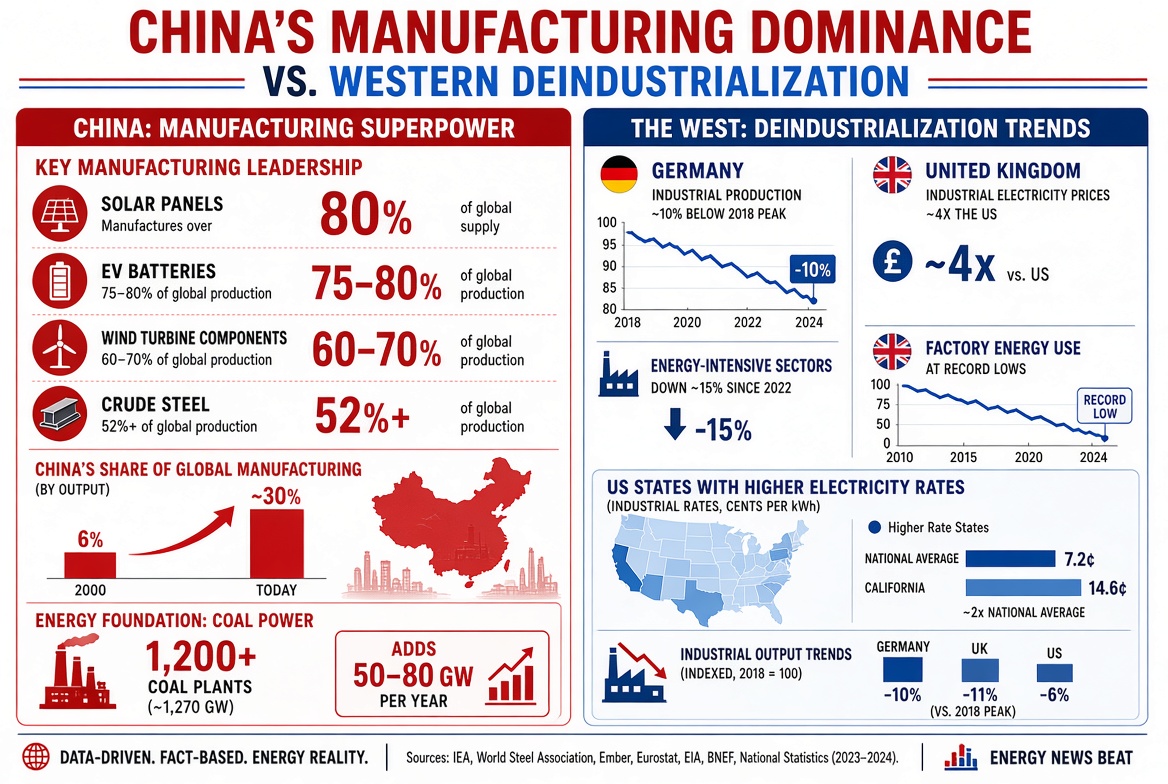
Peter Clack (@PeterDClack) recently put the central contradiction of the Western Net Zero project in plain terms: the green transition is now almost entirely dependent on hardware manufactured by the same industrial giant the West hoped to displace or outcompete. In a post that cuts to the heart of energy density, industrial policy, and geopolitical reality, Clack notes that China manufactures over 80% of the world’s solar panels, 75–80% of EV batteries, 60–70% of core wind turbine components, and more than half of global crude steel. This is not a side note. It is the structural outcome of decades of policy that prioritized intermittent generation targets and emissions accounting over energy density, reliability, and domestic manufacturing.X.
We highly recommend following Peter on X as he is a true independent thought leader and has solid output.
We’ll cover this and several other key stories on Tuesday’s Energy News Beat Stand Up.
China’s manufacturing output now exceeds that of the next 15 countries combined—larger than the US, EU, and Japan together. Its share of global manufacturing has risen from roughly 6% in 2000 to around 30%, while America’s fell from about 25% to 12% and Europe’s from 25% to 14%. To power this expansion, China continues adding coal plants at a pace of 50–80 GW per year and operates more than 1,200 coal plants totaling roughly 1,270 GW—more than half the world’s coal capacity—backed by a mining fleet four times larger than India’s. Leadership in Beijing treats heavy industry and steel as national security assets and has refused unilateral Net Zero shackles that would constrain its industrial base.X
International Energy Agency data reinforces the concentration: China holds more than 80% of manufacturing capacity across key solar PV stages (exceeding 95% for wafers in some assessments), dominates battery cell and component capacity (often cited in the 80–85% range for critical sub-components), and accounts for a large and growing share of wind turbine manufacturing and installations. Steel figures from the World Steel Association confirm China produces well over half of global crude steel output (on the order of 960+ million tonnes in recent full-year data). The West’s “clean” grid hardware is therefore built in a system that runs primarily on coal and expands it.Iea
Outsourcing Pollution, Not Eliminating It
The result is not a global reduction in industrial impact but a geographic and political relocation of it. Manufacturing solar modules, turbine components, battery cells, and the steel and copper that support them requires large amounts of energy, minerals, and chemical processing. Much of that activity occurs under Chinese coal power or in mineral supply chains (lithium, cobalt, nickel, graphite, rare earths, copper) concentrated in places with weaker environmental controls. Rare-earth processing, for example, has long involved acid leaching and toxic waste streams; cobalt and lithium extraction carry well-documented water, land, and community impacts in producing regions. China controls a dominant share of refining and processing for many of these materials.
Western accounts that celebrate falling domestic power-sector emissions while ignoring the embodied emissions and mining footprint of imported hardware miss the system boundary. Intermittent wind and solar still require massive material overbuild, grid reinforcement (BloombergNEF and others have cited multi-trillion-dollar grid costs), and backup. The physical hardware and the minerals behind it are produced elsewhere, often with higher local pollution intensity. Clack’s point is that this is not a free lunch—it is a transfer of industrial activity, emissions, and strategic leverage.
Deindustrialization Where Energy Costs Rise
While China expands, high energy costs and policy-driven scarcity are eroding industrial bases in places that adopted aggressive Net Zero pathways.
In Germany, industrial production sits roughly 10% below its 2018 peak. Energy-intensive sectors (chemicals, metals, glass, ceramics, paper, and related) have fallen more sharply—around 15% from early 2022 levels in official Destatis data, with some sub-sectors down substantially more. High electricity prices relative to the US and Asia, combined with the nuclear phase-out and Energiewende costs, have driven capacity cuts, plant closures or mothballing (including major names in steel and chemicals), and outward investment. Foreign direct investment into Germany has weakened, and a large share of industrial firms report plans to invest abroad primarily for cost reasons. European industrial electricity prices have run roughly twice US levels in recent comparisons.Cleanenergywire
The UK shows a similar pattern. Industrial energy consumption has hit record lows. Manufacturers face electricity prices reported at multiples of US levels (four times in some comparisons) and substantially higher than several European peers. Energy-intensive plants have closed or reduced output; petrochemical and related operators have cited energy costs and Net Zero-related policies as decisive. Factory energy use declines have coincided with offshoring and loss of competitiveness in steel, chemicals, and other foundational sectors.Themanufacturer
In the United States, the pattern is more regional. Analyses of electricity rates show a persistent and widening gap between “blue” states with aggressive renewable mandates, carbon pricing, nuclear and gas restrictions, and states with more conventional generation mixes. California and parts of New England have seen some of the fastest rate increases; residential and overall prices there run well above the national average (California often near or above double the average in recent data). These jurisdictions closed or constrained firm capacity while adding intermittent resources and associated infrastructure costs. Energy-intensive activity faces higher operating costs than in lower-price regions, contributing to relative industrial pressure even as national oil and gas production has remained strong in other states.Energybadboys.substack
Energy Density and the Limits of the Approach
Hydrocarbons still supply the large majority of global primary energy (on the order of 80%). Wind and solar remain a small share of primary energy despite decades of subsidies and deployment. They can contribute electricity under favorable conditions, but they do not deliver the continuous, high-temperature energy required for blast-furnace steel, chemical processes, heavy manufacturing, shipping, or aviation without massive overbuild, storage, and grid reinforcement—all of which intensify the material and import dependence Clack highlights.
The “different mindset” is straightforward: China prioritizes reliable baseload (including coal), scale manufacturing, and industrial capacity as strategic assets. Many Western jurisdictions have prioritized emissions targets and intermittent generation share, accepting higher system costs and import dependence. The observable outcomes are higher domestic energy prices, industrial contraction or offshoring in affected regions, and greater reliance on a rival that continues to expand coal and manufacturing.
Clack is on target. Treating Net Zero as an accounting exercise that simply relocates industrial activity and its associated impacts does not reduce overall pollution in any meaningful global sense, nor does it preserve the energy density and cost structure required for advanced industrial societies. Reliable, dense sources—hydrocarbons where appropriate and nuclear—remain the practical foundation for heavy industry and economic resilience. Policies that systematically raise costs and outsource the hard physical work of manufacturing produce the opposite of energy security or industrial strength.
Check out the World’s Greatest Podcast Show Notes at EnergyNewsBeat.co or EnergyNewsBeat.com. And subscribe to: The Energy News Beat Substack.
Appendices
At Energy News Beat we Make Appendices Great Again.
- Peter Clack post: https://x.com/PeterDClack/status/2109205623397376180
- Related Clack commentary on manufacturing transfer and coal: various posts on @PeterDClack; Energy News Beat note on related Clack material: https://energynewsbeat.co/energy-news-beat-publishers-note/the-economic-hollow-out-of-the-west-was-only-stage-one-of-globalisms-experiment-peter-clack/
- IEA Solar PV Global Supply Chains (China dominance across stages >80%, wafers near 95%): https://www.iea.org/reports/solar-pv-global-supply-chains/executive-summary
- IEA Renewables and manufacturing analyses (China share of capacity additions and manufacturing investment): https://www.iea.org/reports/renewables-2024/executive-summary and related Energy Technology Perspectives material
- World Steel Association crude steel data (China ~50%+ share, recent annual figures ~960 Mt): https://worldsteel.org/data/annual-production-steel-data/ and World Steel in Figures reports
- Destatis / Clean Energy Wire on German energy-intensive industry decline (~15% since early 2022, overall industrial production down ~10% from 2018 peak): https://www.cleanenergywire.org/news/energy-intensive-industries-germany-see-15-percent-production-fall-start-ukraine-war
- UK manufacturing energy cost comparisons (prices multiples of US levels, industrial energy use declines): The Manufacturer / related reports; Telegraph coverage of factory energy use
- Blue-state electricity rate analyses (Institute for Energy Research / Always On Energy Research “Blue States, High Rates” and related): https://www.instituteforenergyresearch.org/the-grid/blue-states-high-rates/ and associated state comparisons
- Critical minerals and environmental impacts: IEA Global Critical Minerals Outlook; Nature Communications mining reality check on Net Zero material needs; literature on rare-earth processing and battery mineral footprints
- McKinsey and BloombergNEF references on multi-trillion transition and grid costs appear in broader Clack commentary and secondary analyses of Net Zero capital requirements
All figures are drawn from the cited official statistical releases, IEA reports, industry associations, and contemporaneous economic reporting. Policies and costs continue to evolve; the structural dependence on Chinese hardware and the energy-price differentials in Net Zero-aligned jurisdictions remain the core documented pattern.
The post Net Zero and Green Energy Is Entirely Reliant on Hardware from a Different Mindset: Pollution Shifted, Industry Hollowed Out appeared first on Energy News Beat.