
In this wide-ranging Energy Realities Round Table discussion, hosts David Blackmon, Dr. Tammy Nemeth, and Stu Turley dive deep into the forces reshaping global energy markets. Triggered by record-breaking quarterly earnings from major oil companies—ExxonMobil, Chevron, Shell, and BP—the conversation expands to reveal a complex web of interconnected challenges: a critical global refining capacity shortage, Europe’s self-inflicted energy crisis through aggressive net-zero policies, geopolitical tensions affecting oil prices, and the strategic energy moves of major players like Qatar and China. The hosts examine how regulatory overreach, carbon taxes, and misguided renewable mandates are driving energy costs higher in developed nations while creating opportunities for more pragmatic competitors.
From Canada’s controversial pivot toward EU alignment to the resurgence of coal demand, this episode illustrates how political ideology and rational market forces are colliding—with real consequences for energy security, cost of living, and global competitiveness.

1. Major Oil Company Earnings & Profitability
The hosts discuss record quarterly profits from ExxonMobil ($16.5 billion in Q3), Chevron, Shell ($11 billion), BP, and TotalEnergies. The key insight is that refining segments—not crude production—are the main profit centers because of supply disruptions in the Middle East. The discussion covers what these companies will do with their profits: stock buybacks, debt reduction, and capital expenditure decisions.
The Atlantic Distillate Trap – covered some of this yesterday.
The oil market is telling two contradictory stories at once. Crude is abundant, discounted, and sitting in the Atlantic with nowhere urgent to go. Diesel (and middle distillates more broadly) remains tight in the same basin. American refining margins on diesel have stayed near record levels while Asian margins have collapsed. That gap is doing more to set the price at the pump, the truck stop, and the heating-oil delivery than the price of a barrel of crude.
Crude is not the constraint
OPEC’s World Oil Outlook 2026 put global crude distillation capacity at 103.3 million barrels a day as of January 2026, running at 80.8 percent utilization in 2025. Roughly 5.3 million barrels a day of new capacity is expected through 2030 against only about 0.3 million of closures. Spare capacity exists in the aggregate. It simply sits in the wrong places: utilization in Africa and Latin America was in the mid-to-high 50s percent in 2025, versus the low-to-mid 90s in the U.S. and Canada and the low 80s in Europe.
Physical evidence of abundance is easy to find. Saudi Arabia cut the November Official Selling Price for Arab Light to Asia to the widest discount versus Oman/Dubai since June 2020. Roughly a dozen October-loading Angolan and Nigerian cargoes remained unsold into late October; Angola’s Hungo traded at $19.60 under Dated Brent — the widest discount for any West African grade in fifteen years. Vortexa counted 415 laden VLCCs, the highest since late 2025. Crude is in the Atlantic, at a discount, and not racing to clear.
2. Refining Capacity Crisis
A critical theme throughout is the global shortage of refining capacity. The U.S. refineries are running at 83-98% capacity, which is unsustainable. Valero’s decision to restart an idle Texas refinery for $320 million (vs. an $11 billion new facility in Brownsville) illustrates the economics. The hosts emphasize that the only ways to lower fuel prices are demand destruction or increased refining capacity.
Valero to Buy, Restart Idled Texas Refinery as Fuel Rallies
Valero Energy Corporation (NYSE: VLO) has agreed to acquire LyondellBasell’s former Houston Refinery site for $320.5 million and plans to restart 165,000 barrels per day (bpd) of light sweet crude processing capacity by the end of 2027. The deal, announced October 30, 2026, expands Valero’s Gulf Coast refining footprint adjacent to its existing Houston plant amid elevated refining margins driven by global supply disruptions.BloombergSec
The approximately 700-acre facility sits on the Houston Ship Channel next to Valero’s Houston refinery (roughly 205,000–255,000 bpd capacity). It includes substantial infrastructure: about 13.5 million barrels of storage, marine docks, rail-loading facilities, and truck racks. The plant, one of Houston’s oldest, dates to 1918 and previously operated as a full-conversion refinery with capacity near 264,000 bpd.Seeking AlphaRbnenergy
LyondellBasell ceased refining operations in the first quarter of 2025 (shutdown process began in late January 2025 and was completed around February–March 2025), after earlier announcing plans to exit refining. The facility had been idled for roughly 19–20 months at the time of the deal announcement. Valero expects the acquisition to close by the end of 2026 (Q4 2026), subject to customary conditions including Hart-Scott-Rodino antitrust review. The company will assume environmental liabilities, pension costs, and related employee obligations.ReutersLyondellbasell
3. European Energy Policy & Refinery Decline
Europe has closed numerous refineries over 15 years, now down to approximately 72 refineries producing 20% below 2009 levels. The UK has only 4 refineries left. Windfall profit taxes and net-zero policies have discouraged investment in new production and exploration. The discussion includes concerns about renewable diesel mandates and their impact on traditional refining.
4. Oil Price Volatility & Middle East Negotiations
Oil prices dropped significantly (Brent from $117 to $106, WTI from $104 to $97) on speculation of a Middle East deal. The hosts are skeptical this deal will materialize, predicting prices will rebound once negotiations fail. They discuss the risk premium traders are pricing in.
5. Canada’s EU Associate Membership & Energy Policy
Dr. Nemeth provides detailed analysis of Mark Carney’s push for Canada to join the EU as an “associate member.” The concern is that regulatory alignment with Europe would burden Canadian businesses with EU bureaucratic requirements, making them uncompetitive with the U.S. market. This would force trade toward Europe instead of America. The discussion includes Canada’s carbon capture spending ($40-70 billion over 10 years) and the Pathways project.
6. LNG Markets & Qatar’s Strategy
Qatar is aggressively signing long-term LNG deals with U.S. companies (Cheniere through 2054, Woodside). This signals Qatar’s confidence in long-term LNG demand and hedging against Middle East instability. The hosts discuss Qatar’s geographic vulnerability through the Strait of Hormuz and why building alternative LNG infrastructure is prohibitively expensive.
7. Global Energy Realignment & China’s Rational Strategy
The hosts contrast China’s rational, strategic approach to energy resources (internal use, international leverage) with Western countries’ “irrational” policies (shutting down refineries, eliminating natural gas, closing nuclear plants). They argue China benefits from the green energy transition through rare earth minerals, solar panels, and wind blades.
8. Coal’s Resurgence
Despite net-zero commitments, coal demand persists. Canada quietly rescinded its thermal coal export ban, with Japan and South Korea (major importers from Australia, Indonesia, and Canada) continuing to rely on coal for reliable power generation.
9. Grid Stability & Energy Security Concerns
The hosts discuss grid vulnerabilities, including attacks on U.S. water treatment plants and substations. They recommend personal preparedness with backup power systems, referencing Texas’s experience during Winter Storm Uri.
We are working on simple configurations so people can get something set up. As David Blackmon pointed out, those with gas generators or solar generators were not panicking. I have been working on my home for a while and learned a lot along the way; I haven’t paid an arm and a leg, but I did waste some money trying to build systems that turned out to be cheaper to buy the right one that would meet your needs.
10. Election Impact on Energy Policy
The podcast concludes with a discussion of how upcoming elections could affect energy policy, particularly regarding refining capacity, fuel prices, and the cost of living tied to energy expenses.
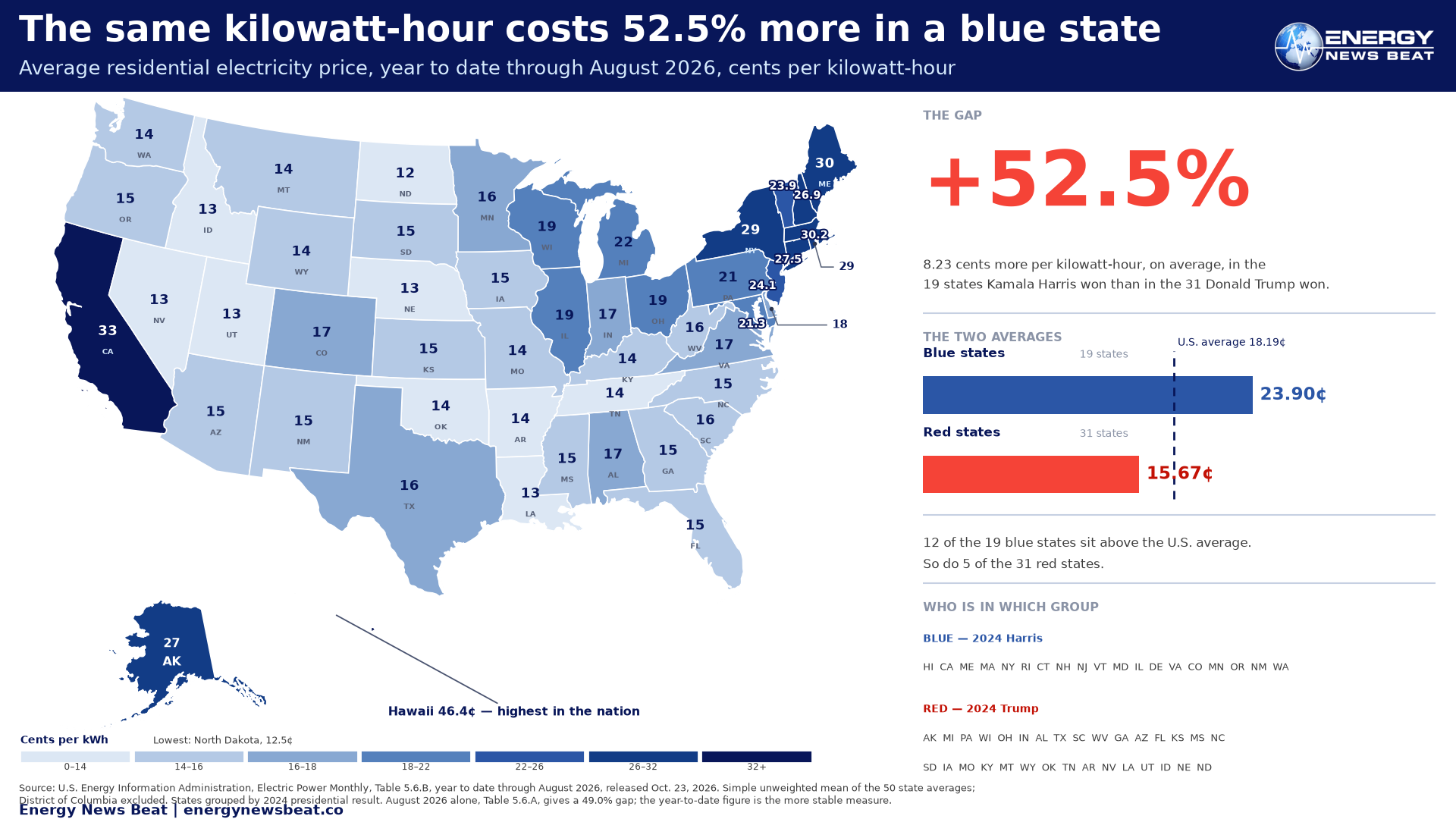
This was important, and people need to know that there is a premium that you pay when you vote Blue. Blue states pay 52% more in electricity prices and pay more for gas and diesel just because of the Net Zero policies.
Again, thanks to all our great energy warriors out there, we are working on several big reports and trying to get you ammunition for your discussion points.
If you have town halls or meetings, like Ann’s group, let me know, and we can try to pinpoint project problems that will help you.
Tomorrow, I have the Energy News Beat Stand Up, and it is a huge topic; then on
Wednesday we have Senator Alan Armstrong, Steve Reese, hosted by Rey Trevino, President of Pecos Energy and the Crude Truth Host, and me.
For Stu Turley on The Energy News Beat Substack:

For David Blackmon

For Tammy Nemeth
The post Energy Realities Round Table – What are Earnings Telling Us? appeared first on Energy News Beat.