

The election creates a real regulatory risk—not evidence of an imminent shutdown. Schools, households and investors need the distinction.
By Energy News Beat | Friday, November 6, 2026
Evidence in brief
| What is established | What is not established |
| Governor-elect; next term begins Jan. 1, 2027 | Official election certification was not verified. |
| Tougher permitting/enforcement proposals | An implemented statewide production shutdown |
| Oil +8.0%; marketed gas +11.3%, Jan–Aug 2026 vs. same 2025 months | A quantified future production, job or gasoline-price effect |
The stakes reach the kitchen table
For a New Mexico family, this is not just a fight between an environmental politician and oil companies. It is about a paycheck, a school budget, cleaner air and what remains affordable when energy gets expensive. The state’s oil engine is nationally important; damaging it would carry consequences far beyond a drilling pad.
But the evidence available Nov. 6 does not establish that Deb Haaland will ‘destroy’ production. It establishes something narrower and worth watching: a governor-elect promising tougher environmental oversight in a state still expanding output. Her own campaign healthcare plan identifies permitting and pollution controls—not a statewide production shutdown—as concrete policy tools. Those tools could change project economics. They are not yet her administration’s rules.
Governor-elect, not governor
The Albuquerque Journal reported that Haaland defeated Republican Gregg Hull on Nov. 3, citing unofficial results. The former Biden Interior secretary is governor-elect, not the incumbent; Michelle Lujan Grisham remains governor. This article does not treat the count as certified. Under Article V of the state constitution, the next term begins Jan. 1, 2027.
The strongest counter-evidence to a blanket-ban narrative comes from Haaland herself. In Capital & Main’s Oct. 29 campaign Q&A, she said: ‘I’m not going to come in and say, “We’re closing up the gas and oil industry and everyone who has a job, you’re just going to be out of a job.”’ The outlet says answers were edited for clarity and brevity.
That is not a promise of business as usual. Her healthcare platform calls for cumulative-impact assessments in permitting, stronger methane and air-toxics enforcement, more inspection capacity, and health-based buffers between new operations and schools, daycares, hospitals and homes. She also endorsed net-zero emissions by 2050 in the Q&A. A long-term emissions goal is not, by itself, a legal order to end oil production.
What she can actually change
Haaland would have meaningful leverage through appointments and agency priorities. The Oil Conservation Division director’s official job description says the governor appoints that official, who oversees well permits and enforcement and chairs the Oil Conservation Commission. Commission membership also includes designees of the independently elected land commissioner and the energy secretary; it is not simply three personal gubernatorial appointments.
Nor does federal acreage make an operator immune to state regulation. OCD’s federal-minerals notice says work on federal land or minerals requires both BLM and OCD approval. Air and water requirements add other channels. But a governor cannot simply cancel federal leases, take over tribal mineral decisions or erase private mineral ownership. The constitution assigns state trust-land management to the elected land commissioner; BIA describes separate tribal and individual Indian leasing processes.
The practical risk is slower or more expensive development under lawful permitting, enforcement and rulemaking—not a universal off switch. New requirements need an applicable legal basis; appropriations and statutory changes involve lawmakers, and contested actions can face administrative or judicial review. Effects would unfold through applications, investment decisions and replacement drilling, not automatically on inauguration day.
The Interior record needs a map—and a date
Haaland did restrict development as Interior secretary. Public Land Order 7923, effective June 7, 2023, withdrew approximately 336,404 acres around Chaco Culture National Historical Park from new mineral leasing and mining entry for 20 years, subject to valid existing rights. It expressly excluded non-federal interests. That was not a statewide ban, nor an order shutting existing lawful production across the Delaware Basin.
Its future is also contested. BLM’s 2026 review presented retention, full revocation and a smaller five-mile-buffer alternative; comments closed July 29. We located the proposal, not a final revocation decision. The current legal-status check remains a publication watchpoint rather than grounds to assume either permanence or repeal.
The ‘collateral damage’ warning circulating online is not Haaland’s statement. In the Nov. 5 Washington Free Beacon report, it is attributed to American Energy Institute CEO Jason Isaac, an industry-policy critic. Likewise, the ‘Indigenous Knowledge’ wording comes from an archived 2023 Interior announcement about Alaska, not proof that a New Mexico governor can ban all drilling.
Production is growing, not collapsing
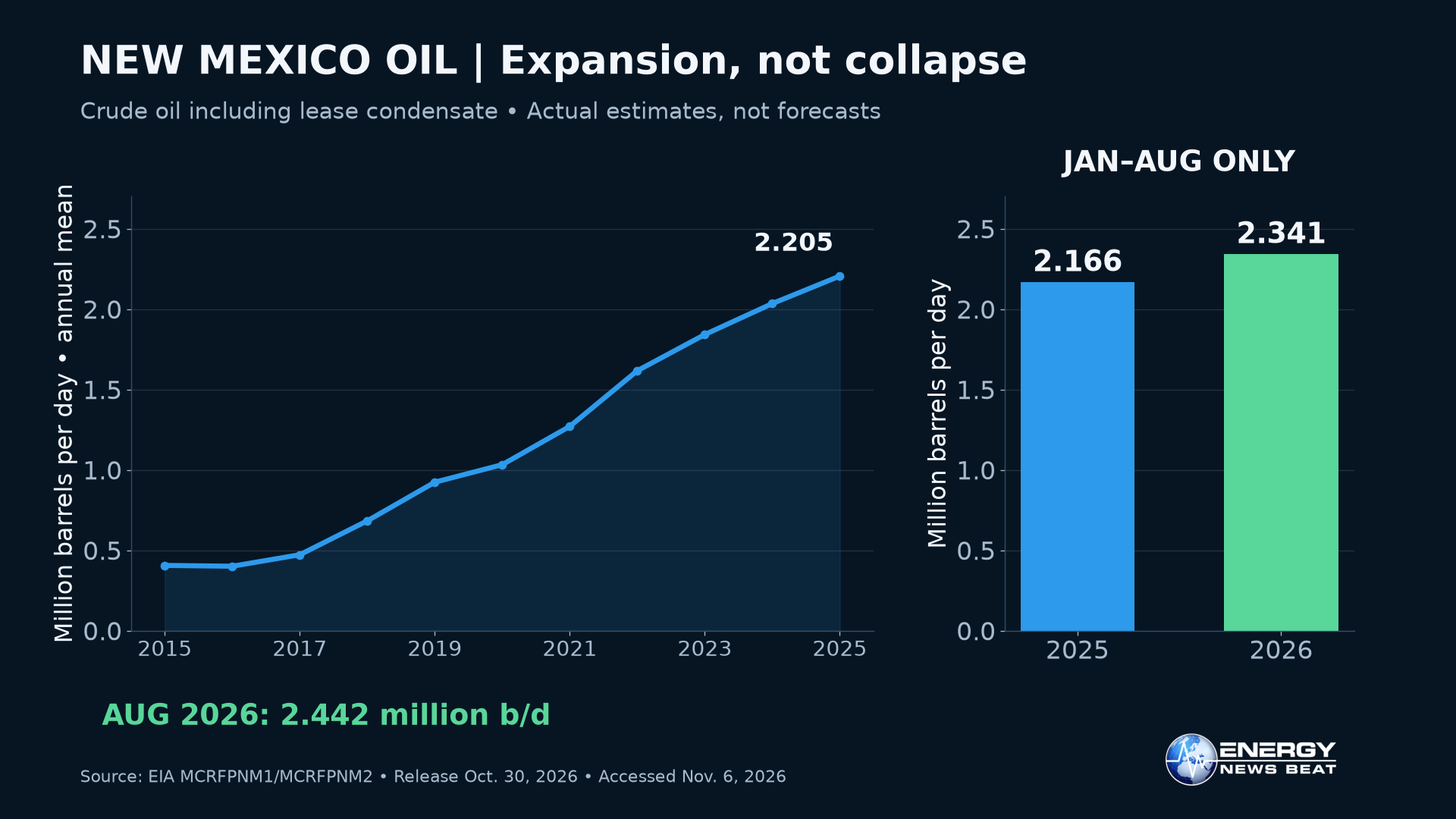
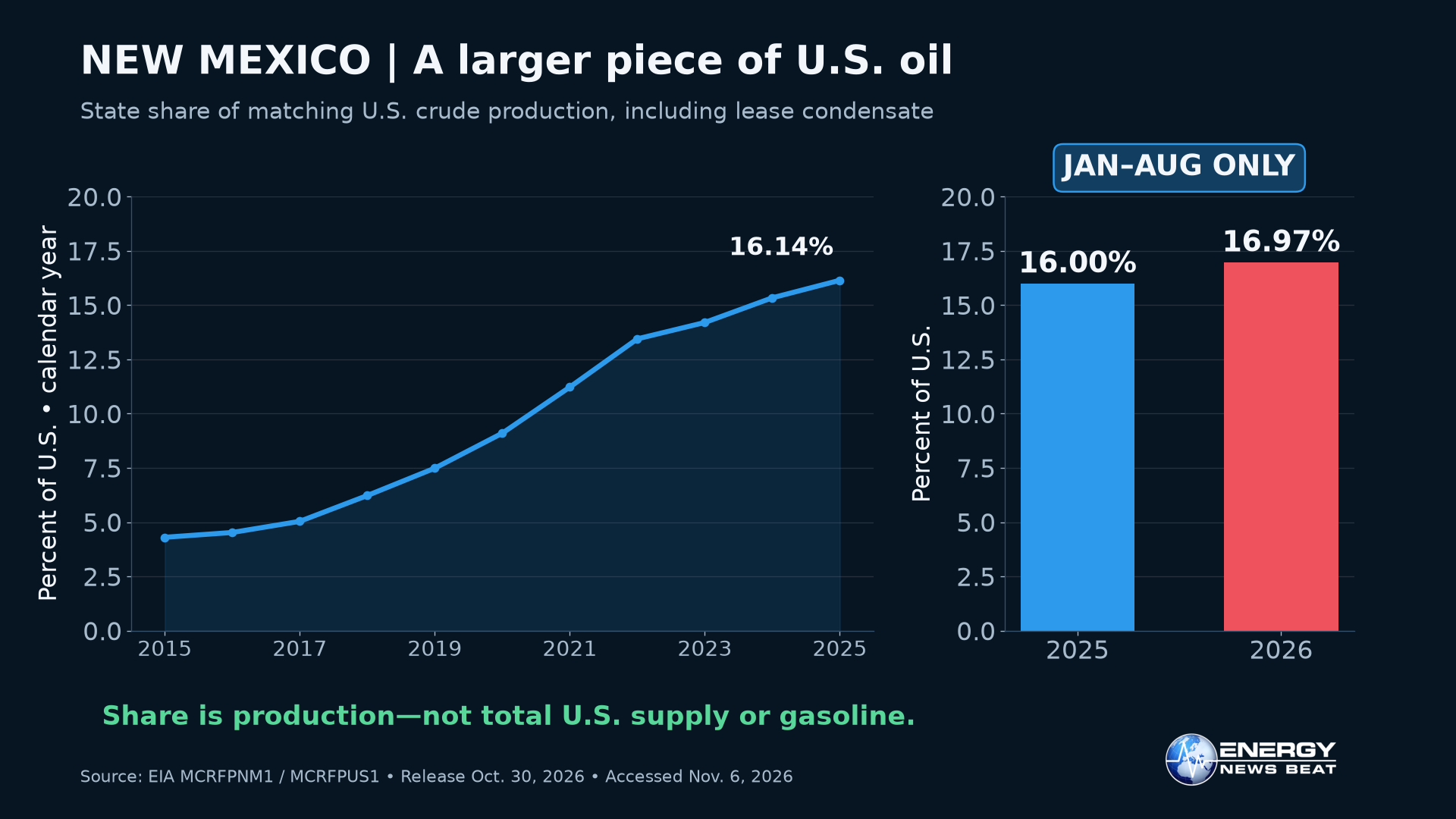
EIA’s October 30 release shows the scale of what is at stake. New Mexico produced about 804.9 million barrels of crude oil including lease condensate in calendar 2025—roughly 2.205 million barrels daily. Its share of matching U.S. crude production was 16.14%. It remains the second-largest producing state behind Texas in August 2026, the latest available month.
January–August 2026 oil output was 568.8 million barrels, versus 526.4 million in the same 2025 months: up 8.0%. August’s rate reached 2.442 million barrels daily. Comparing eight months with a full year would manufacture a decline that the comparable figures do not show.
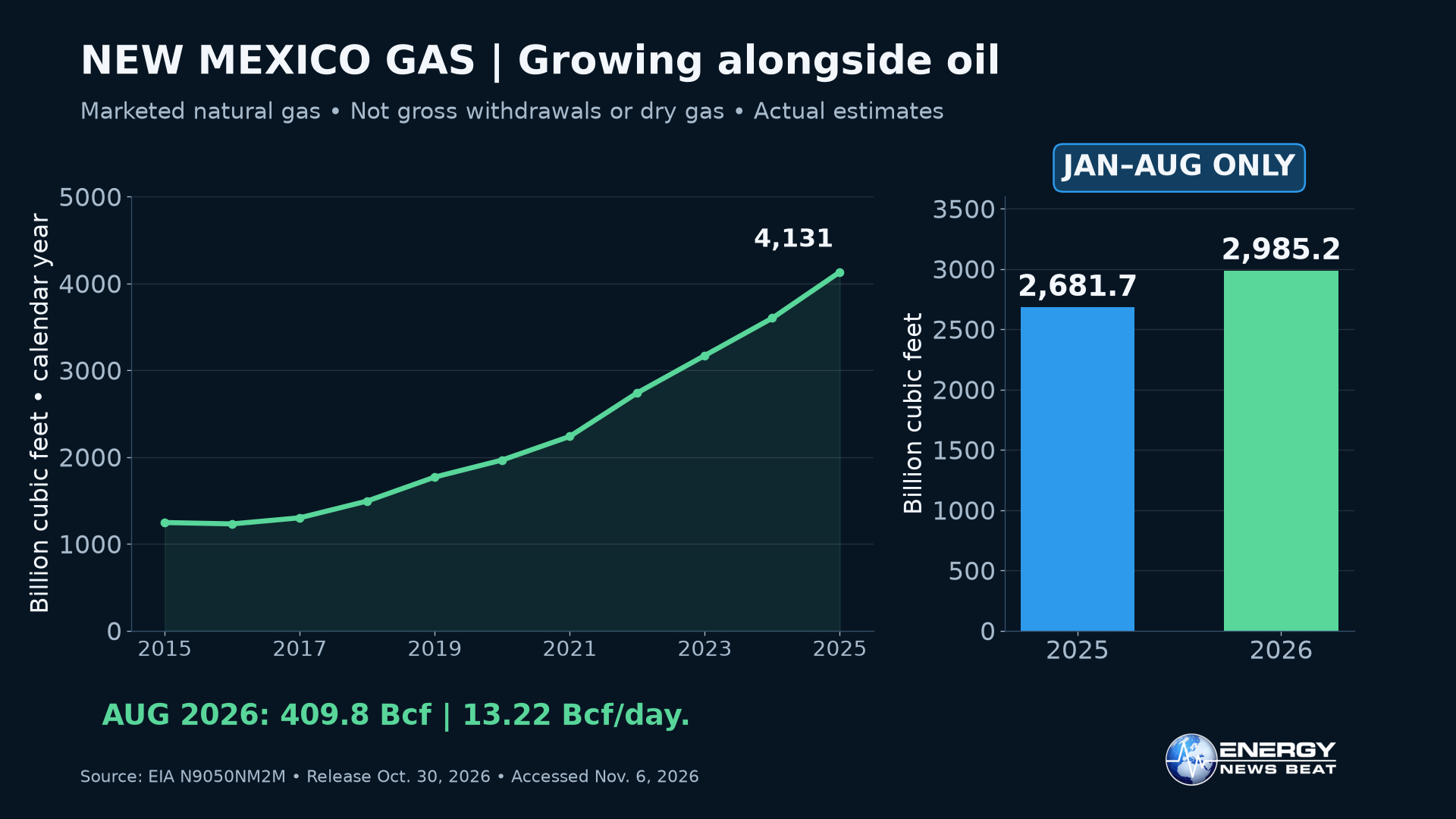
Marketed natural gas totaled about 4,131.0 billion cubic feet in 2025. January–August 2026 reached 2,985.2 Bcf, up 11.3% from the corresponding 2025 period; August alone was 409.8 Bcf, or 13.22 Bcf daily. These are marketed volumes, not gross withdrawals or dry gas. Monthly estimates and revisions matter.
That growth is counter-evidence to an inevitable-collapse claim, not proof that regulation is costless or that Haaland caused earlier gains. The Permian’s Delaware development crosses southeastern New Mexico and West Texas. Geology, well productivity, commodity prices, infrastructure and federal policy all shape the investment decision alongside state rules.
Investors: watch projects, not just personalities
Three current examples show exposure without pretending every Permian barrel is New Mexican. EOG’s November earnings presentation lists 395,000 net Delaware acres across the basin, not New Mexico-only acreage. Its Nov. 5 results also announced a Janus gas-processing expansion—evidence of ongoing investment plans, not a guarantee against policy risk.
Occidental’s Q2 presentation reports basin-wide Permian activity; its September 2026 New Mexico fact sheet describes its Texas–New Mexico footprint and EPA-approved Hobbs carbon-storage monitoring plan. ExxonMobil’s operations page likewise identifies West Texas and southeastern New Mexico; its Oct. 30 results cite Permian growth. Neither company’s basin-wide figures should be relabeled as state-only production or ownership.
ENB analysis: if New Mexico’s incremental permitting cost or uncertainty rises enough, Texas could win some future discretionary capital. That is a conditional thesis, not evidence that rigs or budgets have already fled because of this election. Track appointments, proposed rules, permit processing and company capital disclosures against commodity prices and comparable Texas projects.
The warranted answer today is no: the available evidence does not support predicting destruction. It does support serious scrutiny of how Haaland reconciles her health and climate agenda with the revenue engine her constituents rely on. Demand measurable rules and outcomes—not either a campaign reassurance or a
Stu’s Take
New Mexico families should not have to choose between a clean neighborhood and a school system with reliable funding. We need both, and that means getting the policy right rather than cheering a political team.
I would take Haaland at her word that she is not coming in to close the industry—and then hold her administration to the details. Show us the permitting standards, the timelines, the enforcement priorities and the cost. Protect people living next to operations, but do not make uncertainty the operating model for an industry that helps pay the bills.
Texas is an option for some future investment, not a magic replacement for every New Mexico resource or worker. Investors should watch where actual dollars go. Consumers should watch whether public services and dependable energy remain affordable.
My bottom line: ‘destroy’ is a question to test, not a verdict to announce. The accountability starts with what gets proposed and implemented after she takes office.
Appendix A | Source file & exact excerpts
Sources accessed November 6, 2026 (CST). Publication dates and data periods are stated below. Source quotations are excerpts, not endorsements of every assertion made by their authors. The article’s ENB analysis and proposed Take are not stakeholder quotations.
BLS • New Mexico employment page, accessed Nov.6,2026
Source excerpt: “Mining and Logging”
Sept.2026 preliminary 26.2 thousand jobs, seasonally adjusted. Broader category than direct oil and gas extraction; contextual appendix only, not an oil/gas direct job count.
https://www.bls.gov/regions/southwest/new_mexico.htm
Occidental • Q3 results schedule, 2026
Source excerpt: “Monday, November 9, 2026”
Q3 release is after Nov.6 cutoff; latest available quarterly presentation is Q2, supplemented by September New Mexico fast facts.
Occidental • Q2 2026 presentation, slide 24
Source excerpt: “Permian 2026 activity”
Reports basin-wide Permian/Delaware activity without isolating New Mexico. Basin-wide gross rigs, net rigs and production cannot be relabeled as New Mexico-only. Latest available quarterly results at this cutoff; Q3 scheduled Nov. 9.
Albuquerque Journal • Nov. 3, updated Nov. 4, 2026
Source excerpt: “Haaland will be sworn into office on New Year’s Day”
Reported election win; count described as unofficial. No vote shares used; no official certification claimed.
Secretary of State • 2026 election-results landing page
Source excerpt: “Unofficial Election Results”
Landing page contains stale 2021 instructions; not relied on to certify result. Live result search also returned a pre-election zero-count snapshot. Journal reporting carries the win.
https://www.sos.nm.gov/voting-and-elections/election-results/2026-election-results/
New Mexico constitution • Article V §1; XIII §2
Source excerpt: “terms of four years beginning on the first day of January next after their election”
Primary transition date; independently elected land commissioner controls state public lands subject to law. See PDF printed pp.47,166.
https://www.sos.nm.gov/wp-content/uploads/2025/01/NM_Constitution_-2025-for-SOS.pdf
Haaland campaign • Healthcare Policy Plan, p.23
Source excerpt: “require cumulative impact assessments when making permitting decisions”
Campaign primary document, not enacted policy. Also calls for inspection resources, real penalties and health-based buffers; no buffer distance specified here.
https://debhaaland.com/wp-content/uploads/2026/04/Healthcare-Policy-Plan-PDF-1.pdf
Capital & Main • Jerry Redfern, Oct. 29, 2026
Source excerpt: “If I’m the next governor, I’m going to make sure that those operations are clean and that they’re moving forward in the best possible way.”
Published Q&A; answers edited for clarity and brevity.
https://capitalandmain.com/where-the-candidates-for-new-mexico-governor-stand-on-oil-and-gas
EMNRD • OCD director job description
Source excerpt: “The position reports to the Cabinet Secretary of Energy, Minerals and Natural Resources and is appointed by the Governor.”
Appointments and enforcement channel, not a claim that all commissioners are appointed directly by governor.
https://www.emnrd.nm.gov/wp-content/uploads/OCD_DIRECTOR.pdf
EMNRD • Oil Conservation Commission
Source excerpt: “a designee of the Commissioner of Public Lands”
Three members: OCD director; land-commissioner designee; energy-secretary designee. Rulemaking/de novo review described; §§70-2-4,70-2-6,70-2-12.2,70-2-13.
https://www.emnrd.nm.gov/ocd/occ-info/
OCD • federal-minerals notice, Dec. 11, 2023
Source excerpt: “Prior to any work commencing on federal land or minerals, the Operator must have a Notice of Intent or APD approved by both BLM and OCD.”
Concurrent state/federal authority. Notice cites 19.15.7.9(C) NMAC; state/private work also needs OCD approval.
https://www.emnrd.nm.gov/ocd/wp-content/uploads/sites/6/NM-OCD-Authority-Notice-final.pdf
OCD • Federal/Indian APD guidance, pp.2–3
Source excerpt: “Approved APD from the Bureau of Land Management (BLM) (Form 3160-3)”
Procedural guidance, not a resolution of every tribal-jurisdiction issue; do not infer unrestricted state control over tribal minerals.
https://www.emnrd.nm.gov/ocd/wp-content/uploads/sites/6/APD-Federal-and-Tribal-Operator-Guidance.pdf
OCD • 19.15.14 NMAC amendment effective July 29, 2025, PDF p.4
Source excerpt: “The division may impose conditions on an approved permit to drill, deepen or plug back.”
The July 29, 2025 amendment retains permit conditions and requires cause for rejection. Older SRCA HTML omits the 2025 PFAS language and is not fully current text.
https://www.emnrd.nm.gov/ocd/wp-content/uploads/sites/6/19.15.14-amend.pdf
NMED • Boards and Commissions
Source excerpt: “The Board also hears appeals of air quality permits issued by NMED.”
EIB generally adopts NMED rules except groundwater/surface-water rules adopted by WQCC. Public hearing framework; no guaranteed outcome or timetable.
https://www.env.nm.gov/opf/boards-and-commissions/
BIA • Mineral Leasing on Individual Indian and Tribal Lands
Source excerpt: “Mineral owners may include both Tribal entities as well as individual Indian landowners.”
BIA, BLM, ONRR, BTFA roles; 25 CFR parts211/212/224/225. Tribal/private minerals are not a governor’s leasing portfolio.
https://www.bia.gov/service/leasing/mineral-leasing
Federal Register • PLO7923, 88FR37266, June7,2023
Source excerpt: “This Order does not apply to non-Federal interests within the boundaries of the area described herein.”
336,404.42 acres; 20 years; valid existing rights. Federal Register document 2023-12158. No claim that every acre in a geometric radius is federal or withdrawn.
BLM • proposed Chaco withdrawal revocation, 2026
Source excerpt: “The comment period will close July 29, 2026.”
Three alternatives; retention/full revocation/partial revocation beyond 5 miles. Primary proposal located; final revocation and current litigation disposition not established. Refresh before publication.
Interior • archived Sept.6,2023 Alaska announcement
Source excerpt: “based on the best available science and in recognition of the Indigenous Knowledge of the original stewards of this area”
Historical wording/context only. Page is archived/not updated. Does not establish current Alaska rules, nor New Mexico ban scope. Wider acreage/permit-percentage assertions from lead not repeated.
Washington Free Beacon • Thomas Catenacci, Nov.5,2026
Source excerpt: “New Mexico’s workers and families cannot afford to become collateral damage in a political fight over American energy.”
Attributed to Jason Isaac, American Energy Institute CEO—not Haaland. Lead’s broader scale-back forecast is reporter framing; not adopted as demonstrated effect.
EIA • New Mexico crude monthly volume MCRFPNM1
Source excerpt: “New Mexico Field Production of Crude Oil”
Thousand barrels;incl lease condensate. Main oil means/shares derive from volumes, not rounded daily rates.
https://www.eia.gov/dnav/pet/hist/LeafHandler.ashx?n=PET&s=MCRFPNM1&f=M
EIA • U.S. crude monthly volume MCRFPUS1
Source excerpt: “U.S. Field Production of Crude Oil”
Matching national definition/period. Annual production, not supply including imports or all petroleum liquids.
https://www.eia.gov/dnav/pet/hist/LeafHandler.ashx?n=PET&s=MCRFPUS1&f=M
EIA • crude production by state, October30,2026 release
Source excerpt: “Next Release Date: 11/30/2026”
August2026 is latest month shown. New Mexico2,442kb/d;Texas5,710kb/d;other states lower. Federal offshore is not a state.
https://www.eia.gov/dnav/pet/pet_crd_crpdn_adc_mbblpd_m.htm
EIA • marketed natural gas N9050NM2M
Source excerpt: “New Mexico Natural Gas Marketed Production”
Million cubic feet;divide by1,000 for Bcf. 2025 monthly sum 4,130.970 Bcf differs 0.001 Bcf from annual state table rounding; no false precision in body.
https://www.eia.gov/dnav/ng/hist/n9050nm2m.htm
EIA • U.S. marketed natural gas N9050US2M
Source excerpt: “U.S. Natural Gas Marketed Production”
Same marketed definition; 2025 monthly sum 43,229.111 Bcf. 2026 provisional estimates/revisions; no forecast substituted.
https://www.eia.gov/dnav/ng/hist/n9050us2m.htm
EIA • annual marketed production by state,2025
Source excerpt: “New Mexico”
2025 New Mexico 4,130,971 MMcf ranks third behind Texas 12,656,556 and Pennsylvania 7,675,792; Louisiana 3,813,990. New Mexico was fourth in 2024; no timeless rank implied.
https://www.eia.gov/dnav/ng/ng_prod_sum_a_EPG0_VGM_mmcf_a.htm
EIA • oil definitions/source notes
Source excerpt: “lease condensate recovered as a liquid from natural gas wells”
Crude includes lease condensate;field production excludes gas-plant liquids. Estimates/revisions and rounding cautions.
https://www.eia.gov/dnav/pet/TblDefs/pet_crd_crpdn_tbldef2.asp
EIA • gas definitions/source notes
Source excerpt: “Dry natural gas production equals marketed production less extraction loss.”
Marketed = gross withdrawals less repressuring, vented/flared and removed nonhydrocarbon gases;not dry or gross.
https://www.eia.gov/dnav/ng/TblDefs/ng_prod_sum_tbldef2.asp
State Land Office • Oct.15,2026 FY26 revenue release
Source excerpt: “Public Schools: $2.9 billion”
About $3.2 billion agency revenue earned; beneficiary attribution is not a same-year budget appropriation or immediate cash disbursement. FY2026 ended June 30, 2026.
State Land Office • administrative-services FAQ
Source excerpt: “Land Grant Permanent Fund”
Royalties/nonrenewable receipts and rentals/bonuses follow separate funds and distribution timing;do not add revenue earned to permanent-fund distributions as distinct economic output.
https://www.nmstatelands.org/divisions/administrative-services/administrative-services-faqs/
DFA • August26,2026 Consensus General Fund Outlook, slide35
Source excerpt: “O&G Revenue”
FY26 outlook: $3,143.6 million / $14,000.4 million recurring = 22.4536%. Official estimate, not audited final. All oil-related sales/income tax and legacy investment effects are not captured by this row; do not call 22.5% total dependence.
https://www.nmdfa.state.nm.us/wp-content/uploads/2026/09/August-2026-Revenue-Testimony.pdf
EOG • November2026 earnings presentation, slide9
Source excerpt: “395K Net Acres”
Delaware multi-state total, not New Mexico-only; planned 2026 net completions/rigs are not actual New Mexico counts. 160K belongs to Dorado, NOT Delaware.
https://filecache.investorroom.com/mr5ir_eogresources2/498/EOG_1126.pdf
EOG • Nov.5,2026 third-quarter results
Source excerpt: “we approved the expansion of our Janus gas processing plant in the Delaware Basin”
Management statement/planned expansion; not an election response or measured policy counterfactual.
Occidental • New Mexico Fast Facts, September2026
Source excerpt: “We have 1.4 million net acres, including premier Delaware and Midland Basin positions for our unconventional operations.”
Also lists 1.4 million net conventional Permian acres; neither is New Mexico-only. Do not equate basin Boe/d with oil-only or state-only. In the article, no Oxy acreage or production number is used.
https://www.oxy.com/siteassets/documents/publications/fast-facts/oxy_fast_facts_new_mexico.pdf
ExxonMobil • current Permian operations page
Source excerpt: “spanning West Texas and Southeast New Mexico”
Current company operations page; multi-state footprint, not a New Mexico-only quantity.
https://corporate.exxonmobil.com/locations/united-states/permian-basin
ExxonMobil • Oct.30,2026 third-quarter results
Source excerpt: “advantaged volume growth in Guyana, Permian, and Golden Pass LNG”
Latest company release as of cutoff; growth statement is not state-specific. Capital/forecast numbers not used.
Appendix B | Who controls what?
A jurisdiction guide, not legal advice. Existing rights remain subject to applicable law; not every permit application creates a vested right. Timing below describes causal stages, not a promised statutory deadline.
| Domain | Responsible authority | Power / timing / limit | Primary anchor |
| Federal minerals / BLM | Federal government leases and approves federal APDs; state OCD also requires approvals. | Governor influences state agencies, not federal lease ownership. Effect can arise at application/approval stages; no instant cancellation of all existing wells. | OCD federal-minerals notice; BLM PLO7923; 19.15.7.9(C) |
| State trust minerals | Elected commissioner of public lands has constitutional management authority. | Governor cannot substitute for elected commissioner. New leasing/conditions versus existing rights must be distinguished. | ConstitutionV§1,XIII§2 |
| Private minerals | Private owners/working interests; state drilling and environmental law applies. | No gubernatorial ownership takeover. Permitting, compliance and enforcement can affect timing/cost. | OCD notice; 19.15.14 NMAC |
| Tribal / allotted minerals | Tribes and individual mineral owners; BIA/BLM federal processes and applicable tribal law. | Not governor-controlled lease inventory. Jurisdiction depends on lands, parties and governing law; no blanket state veto claim. | BIA 25 CFR 211,212,224,225; OCD APD guidance |
| OCD / commission | Governor appoints qualified OCD director; OCC seats also include land-commissioner and energy-secretary designees. | Permit conditions/enforcement and rule proceedings. Administrative review and court challenges can affect implementation. | EMNRD director PDF; OCC §§70-2-4,6,12.2,13 |
| Air / water | NMED implementation; EIB air rules and WQCC water rules. Legislature sets statutory authority and funding. | Appointments/priorities matter; rulemaking and budgets require process. No quantified lag or output effect established. | NMED Boards and Commissions; campaign health plan |
| Market / investment | Operators allocate capital; commodity markets, geology, productivity and infrastructure matter. | New drilling can respond before or after policy implementation. Texas migration remains a conditional thesis, not a measured election effect. | EOG Nov. 5 results; Oxy Q2 slides; Exxon Q3 results |
Primary rule update: the July 29, 2025 amendment to 19.15.14.9–.10 adds PFAS-related certification and retains permit conditions and reasons for rejection. The older SRCA HTML is background only and omits this amendment. No unverified “20-day deadline” is asserted.
Policy status ledger
| Item | Status at this draft’s cutoff | What would change the conclusion |
| Haaland platform | Campaign proposals, not her administration’s enacted rules | Actual appointments, proposed/final rules, appropriations, permit outcomes |
| Chaco 2023 withdrawal | Documented original federal order with existing-rights/non-federal carve-outs | Final primary revocation decision/order or controlling litigation disposition; not verified here |
| 2026 Chaco review | BLM proposal; comment period closed July 29 | Retention, partial or full revocation—not yet established in retrieved primary records |
| Production figures | Released actual estimates, latest August 2026; subject to revision | New EIA release Nov. 30 or state/EIA revisions |
| Texas capital movement | ENB conditional thesis | Company project/capex disclosures, with price/geology controls—not an assumption |
Appendix C | Definitions, calculations & fiscal guardrails
Oil is EIA field production of crude including lease condensate, not all petroleum liquids. MCRFPNM1 and MCRFPUS1 report thousand barrels per month. Annual/YTD million barrels = sum / 1,000. Mean thousand barrels/day = monthly thousand-barrel total / calendar days. All 12 months are used for annual figures; Jan–Aug uses 243 days in both 2025 and 2026. Leap-year history uses 366 days.
Oil national shares use state and U.S. volume totals for identical periods. The separately downloaded daily-rate series MCRFPNM2/MCRFPUS2 are rounded to whole thousand barrels/day; their August reading supplies the displayed 2.442 million b/d. Differences between means reconstructed from rounded daily rates and monthly volume totals are not interpreted as economic changes.
Gas is marketed production. EIA defines it as gross withdrawals less gas used for repressuring, quantities vented/flared, and removed nonhydrocarbon gases. Dry gas further subtracts extraction loss. N9050NM2M/N9050US2M report million cubic feet; divide by 1,000 for Bcf. August2026NewMexico409.802Bcf /31=13.2194Bcf/day.
2025 oil: 804.949 million barrels / 365 = 2.205340 million b/d. Jan–Aug 2026 oil: 568.757 million barrels versus 526.389 million in 2025: (568.757 / 526.389 − 1) × 100 = 8.0488%, rounded 8.0%. Gas: (2,985.193 / 2,681.682 − 1) × 100 = 11.3179%, rounded 11.3%. Oil U.S. share 2025 = 804.949 / 4,986.606 × 100 = 16.1422%; Jan–Aug 2026 = 568.757 / 3,350.605 × 100 = 16.9748%.
Gas annual tables and monthly sums differ by rounding/revisions: 2025 state annual 4,130.971 Bcf versus monthly sum 4,130.970 Bcf; U.S. annual 43,229.110 Bcf versus monthly sum 43,229.111 Bcf. Article/charts consistently use monthly sums. 2025 marketed gas rank: third. Texas 12,656.556 Bcf, Pennsylvania 7,675.792 Bcf, New Mexico 4,130.971 Bcf, Louisiana 3,813.990 Bcf. In 2024 New Mexico was fourth; rank must be dated.
EIA release Oct. 30, 2026; next release Nov. 30, 2026. August 2026 is the latest available month in retrieved tables. 2026 estimates are provisional. Historical values can be revised; these are an access-date snapshot, not a frozen real-time vintage. No September–November 2026 production or full-year 2026 forecast is invented.
FY2026 ended June 30, 2026. DFA August 26 consensus outlook is an estimate: O&G Revenue $3,143.6 million divided by Total Recurring Revenue $14,000.4 million = 22.4536%. The denominator is not GDP, all government revenue or appropriations. The O&G row is not all industry-related sales/income taxes or legacy fund earnings.
SLO FY26: about $3.2 billion earned and $2.9 billion public-schools beneficiary are agency/trust figures—not automatic current-year classroom appropriations. Oil and gas royalties generally enter the Land Grant Permanent Fund; renewable rents/bonuses enter the Land Maintenance Fund, with operating costs and beneficiary distributions. Do not add SLO earned revenue and fund distributions as two separate production benefits.
Employment: the BLS New Mexico page, accessed in November, reports Sept. 2026 preliminary 26.2 thousand seasonally adjusted mining-and-logging jobs. That broader industry category must not be called direct oil-and-gas extraction employment. No job-loss number or industry-modeled direct/indirect/induced total is used.
Operator currentness: EOG November slide 9 is 395,000 NET Delaware acres, not gross or New Mexico-only; Dorado is 160,000. Oxy Q2 presentation (June 30 assets) reports basin-wide Permian/Delaware activity without isolating New Mexico; September New Mexico fact sheet is more recent but has different acreage figures. No unreconciled Oxy acreage comparison is used. Q3 Oxy results are scheduled Nov. 9, after this article. Exxon Oct. 30 Q3 release and operations page support exposure, not a New Mexico-only quantity.
Appendix D | Complete used production tables
Annual and comparable YTD summary. Oil totals are million barrels; daily rates are thousand barrels/day. Gas totals are Bcf marketed. Values rounded for display; machine-readable CSV retains calculation precision. Underlying monthly inputs follow in full.
| Period | NM oil MMbbl | NM oil kb/d | NM gas Bcf | U.S. oil MMbbl | U.S. gas Bcf | NM oil share % |
| 2015 | 148.096 | 405.74 | 1,245.145 | 3,443.219 | 28,772.044 | 4.3011 |
| 2016 | 146.633 | 400.64 | 1,229.648 | 3,242.281 | 28,400.048 | 4.5225 |
| 2017 | 172.304 | 472.07 | 1,299.731 | 3,421.619 | 29,237.827 | 5.0357 |
| 2018 | 249.297 | 683.01 | 1,493.081 | 4,004.845 | 33,008.867 | 6.2249 |
| 2019 | 336.995 | 923.27 | 1,769.087 | 4,502.390 | 36,446.919 | 7.4848 |
| 2020 | 377.883 | 1,032.47 | 1,965.532 | 4,153.695 | 36,520.827 | 9.0975 |
| 2021 | 463.781 | 1,270.63 | 2,237.166 | 4,133.115 | 37,337.860 | 11.2211 |
| 2022 | 590.110 | 1,616.74 | 2,739.314 | 4,389.672 | 39,329.457 | 13.4431 |
| 2023 | 672.246 | 1,841.77 | 3,169.432 | 4,734.697 | 41,037.735 | 14.1983 |
| 2024 | 744.621 | 2,034.48 | 3,599.782 | 4,855.658 | 41,383.893 | 15.3351 |
| Jan-Aug 2025 | 526.389 | 2,166.21 | 2,681.682 | 3,289.372 | 28,517.060 | 16.0027 |
| 2025 | 804.949 | 2,205.34 | 4,130.970 | 4,986.606 | 43,229.111 | 16.1422 |
| Jan-Aug 2026 | 568.757 | 2,340.56 | 2,985.193 | 3,350.605 | 29,903.479 | 16.9748 |
Monthly inputs | full chart calculation base
All months used to calculate 2015–2025 annual history and January–August 2026. Oil: thousand barrels/month (MCRFPNM1, MCRFPUS1). Gas: million cubic feet/month (N9050NM2M, N9050US2M). These are volumes, not daily rates. Complete underlying monthly observations are reproduced below.
| Month | NM oil 000bbl | U.S. oil 000bbl | NM gas MMcf | U.S. gas MMcf |
| 2015-01 | 11,409 | 290,697 | 99,852 | 2,420,352 |
| 2015-02 | 11,018 | 265,570 | 94,651 | 2,196,987 |
| 2015-03 | 12,997 | 296,966 | 105,693 | 2,443,119 |
| 2015-04 | 12,814 | 289,565 | 103,212 | 2,398,440 |
| 2015-05 | 13,230 | 293,440 | 107,073 | 2,442,713 |
| 2015-06 | 12,489 | 280,507 | 102,930 | 2,358,416 |
| 2015-07 | 12,580 | 292,509 | 104,436 | 2,444,753 |
| 2015-08 | 12,882 | 291,406 | 107,681 | 2,447,534 |
| 2015-09 | 12,470 | 284,127 | 106,667 | 2,383,531 |
| 2015-10 | 12,640 | 291,219 | 109,328 | 2,445,042 |
| 2015-11 | 12,428 | 279,838 | 104,847 | 2,356,237 |
| 2015-12 | 11,139 | 287,375 | 98,775 | 2,434,920 |
| 2016-01 | 11,737 | 285,613 | 94,728 | 2,435,375 |
| 2016-02 | 11,794 | 263,112 | 93,658 | 2,310,521 |
| 2016-03 | 12,590 | 282,588 | 104,259 | 2,441,976 |
| 2016-04 | 12,145 | 266,580 | 101,796 | 2,361,554 |
| 2016-05 | 12,181 | 274,213 | 104,054 | 2,412,475 |
| 2016-06 | 11,678 | 260,577 | 100,265 | 2,312,288 |
| 2016-07 | 12,146 | 268,919 | 104,706 | 2,408,915 |
| 2016-08 | 12,167 | 269,715 | 107,465 | 2,389,813 |
| 2016-09 | 12,020 | 256,592 | 104,161 | 2,297,402 |
| 2016-10 | 12,655 | 273,282 | 107,846 | 2,364,679 |
| 2016-11 | 12,487 | 267,470 | 102,881 | 2,307,494 |
| 2016-12 | 13,033 | 273,620 | 103,829 | 2,357,556 |
| 2017-01 | 12,980 | 275,355 | 103,551 | 2,339,431 |
| 2017-02 | 12,390 | 255,371 | 95,918 | 2,142,588 |
| 2017-03 | 13,705 | 284,542 | 109,006 | 2,425,799 |
| 2017-04 | 13,359 | 273,490 | 105,516 | 2,350,432 |
| 2017-05 | 14,313 | 285,275 | 111,930 | 2,428,739 |
| 2017-06 | 13,281 | 273,704 | 105,779 | 2,373,176 |
| 2017-07 | 13,852 | 287,296 | 110,783 | 2,477,573 |
| 2017-08 | 14,217 | 287,451 | 109,506 | 2,476,180 |
| 2017-09 | 14,983 | 285,814 | 109,187 | 2,438,213 |
| 2017-10 | 16,191 | 300,075 | 115,461 | 2,564,255 |
| 2017-11 | 15,842 | 303,043 | 109,054 | 2,558,771 |
| 2017-12 | 17,191 | 310,203 | 114,040 | 2,662,670 |
| 2018-01 | 16,764 | 310,454 | 113,442 | 2,618,315 |
| 2018-02 | 16,380 | 288,314 | 106,389 | 2,414,348 |
| 2018-03 | 19,055 | 324,946 | 117,719 | 2,704,217 |
| 2018-04 | 19,271 | 315,328 | 119,371 | 2,612,541 |
| 2018-05 | 19,985 | 323,929 | 123,558 | 2,730,667 |
| 2018-06 | 19,682 | 319,700 | 122,011 | 2,655,954 |
| 2018-07 | 20,632 | 338,569 | 128,945 | 2,799,146 |
| 2018-08 | 22,110 | 353,882 | 132,232 | 2,855,600 |
| 2018-09 | 22,009 | 343,977 | 128,133 | 2,808,817 |
| 2018-10 | 24,026 | 357,370 | 133,502 | 2,939,250 |
| 2018-11 | 23,861 | 357,313 | 129,926 | 2,894,098 |
| 2018-12 | 25,522 | 371,063 | 137,853 | 2,975,914 |
| 2019-01 | 25,097 | 368,720 | 137,940 | 2,974,830 |
| 2019-02 | 23,202 | 327,388 | 128,351 | 2,705,249 |
| 2019-03 | 26,719 | 369,866 | 144,805 | 3,008,808 |
| 2019-04 | 26,116 | 364,938 | 142,454 | 2,925,844 |
| 2019-05 | 27,758 | 377,210 | 147,013 | 3,046,445 |
| 2019-06 | 26,604 | 367,123 | 142,093 | 2,956,304 |
| 2019-07 | 27,637 | 369,661 | 149,002 | 3,071,698 |
| 2019-08 | 29,114 | 387,633 | 153,633 | 3,146,384 |
| 2019-09 | 29,687 | 378,411 | 151,917 | 3,056,535 |
| 2019-10 | 30,810 | 397,779 | 157,544 | 3,186,150 |
| 2019-11 | 31,523 | 390,570 | 154,545 | 3,133,926 |
| 2019-12 | 32,728 | 403,091 | 159,790 | 3,234,746 |
| 2020-01 | 33,253 | 399,389 | 164,351 | 3,257,533 |
| 2020-02 | 31,807 | 373,519 | 156,620 | 2,992,845 |
| 2020-03 | 34,872 | 397,348 | 170,710 | 3,192,036 |
| 2020-04 | 30,708 | 357,992 | 157,633 | 3,076,174 |
| 2020-05 | 26,287 | 301,755 | 148,275 | 2,942,912 |
| 2020-06 | 28,434 | 313,870 | 153,754 | 2,927,068 |
| 2020-07 | 30,690 | 341,743 | 166,015 | 3,026,780 |
| 2020-08 | 31,373 | 328,942 | 169,108 | 3,027,588 |
| 2020-09 | 31,099 | 329,290 | 166,508 | 2,957,168 |
| 2020-10 | 33,587 | 325,606 | 173,568 | 3,004,869 |
| 2020-11 | 33,015 | 337,081 | 169,407 | 2,998,371 |
| 2020-12 | 32,758 | 347,160 | 169,583 | 3,117,483 |
| 2021-01 | 33,870 | 346,166 | 173,924 | 3,105,581 |
| 2021-02 | 27,774 | 278,682 | 144,784 | 2,597,230 |
| 2021-03 | 36,148 | 353,006 | 180,642 | 3,136,068 |
| 2021-04 | 35,456 | 340,965 | 178,897 | 3,058,663 |
| 2021-05 | 38,279 | 354,575 | 187,958 | 3,158,085 |
| 2021-06 | 38,313 | 342,323 | 184,699 | 3,045,264 |
| 2021-07 | 40,375 | 354,311 | 195,871 | 3,176,507 |
| 2021-08 | 42,687 | 351,151 | 199,330 | 3,185,920 |
| 2021-09 | 40,888 | 329,118 | 194,265 | 3,104,078 |
| 2021-10 | 43,251 | 361,110 | 200,454 | 3,258,481 |
| 2021-11 | 43,198 | 356,475 | 195,247 | 3,188,958 |
| 2021-12 | 43,542 | 365,233 | 201,095 | 3,323,025 |
| 2022-01 | 42,880 | 355,611 | 202,816 | 3,201,112 |
| 2022-02 | 40,439 | 322,491 | 189,015 | 2,918,981 |
| 2022-03 | 47,081 | 368,942 | 223,947 | 3,284,763 |
| 2022-04 | 46,810 | 355,352 | 221,445 | 3,210,082 |
| 2022-05 | 48,909 | 365,257 | 228,546 | 3,319,380 |
| 2022-06 | 47,065 | 358,291 | 221,430 | 3,221,895 |
| 2022-07 | 50,471 | 373,048 | 234,177 | 3,355,846 |
| 2022-08 | 51,521 | 376,914 | 237,367 | 3,377,619 |
| 2022-09 | 51,933 | 373,617 | 238,649 | 3,319,341 |
| 2022-10 | 54,348 | 386,228 | 249,206 | 3,423,890 |
| 2022-11 | 52,617 | 375,225 | 240,317 | 3,317,599 |
| 2022-12 | 56,036 | 378,696 | 252,399 | 3,378,949 |
| 2023-01 | 57,469 | 392,444 | 256,446 | 3,448,064 |
| 2023-02 | 50,936 | 354,071 | 233,109 | 3,102,095 |
| 2023-03 | 58,047 | 399,675 | 269,691 | 3,483,701 |
| 2023-04 | 56,328 | 382,809 | 261,459 | 3,343,378 |
| 2023-05 | 56,761 | 395,525 | 266,391 | 3,483,606 |
| 2023-06 | 52,679 | 384,775 | 250,025 | 3,332,001 |
| 2023-07 | 54,579 | 401,320 | 265,368 | 3,469,330 |
| 2023-08 | 56,195 | 404,015 | 270,076 | 3,490,432 |
| 2023-09 | 54,626 | 395,980 | 263,037 | 3,384,676 |
| 2023-10 | 56,424 | 410,691 | 269,975 | 3,501,121 |
| 2023-11 | 57,349 | 400,306 | 272,530 | 3,439,912 |
| 2023-12 | 60,853 | 413,086 | 291,325 | 3,559,419 |
| 2024-01 | 57,842 | 389,080 | 275,593 | 3,460,684 |
| 2024-02 | 57,095 | 381,808 | 272,947 | 3,326,620 |
| 2024-03 | 62,379 | 409,074 | 296,149 | 3,479,219 |
| 2024-04 | 60,005 | 399,515 | 283,365 | 3,335,500 |
| 2024-05 | 61,993 | 410,837 | 293,740 | 3,451,996 |
| 2024-06 | 59,771 | 397,277 | 287,877 | 3,380,784 |
| 2024-07 | 62,770 | 410,101 | 306,809 | 3,537,833 |
| 2024-08 | 65,072 | 415,888 | 312,857 | 3,504,908 |
| 2024-09 | 62,357 | 396,844 | 305,128 | 3,368,078 |
| 2024-10 | 65,816 | 421,065 | 322,500 | 3,528,841 |
| 2024-11 | 63,879 | 404,728 | 312,475 | 3,415,560 |
| 2024-12 | 65,642 | 419,441 | 330,342 | 3,593,870 |
| 2025-01 | 62,972 | 408,165 | 319,972 | 3,532,009 |
| 2025-02 | 59,182 | 371,533 | 297,082 | 3,216,266 |
| 2025-03 | 68,026 | 419,327 | 347,727 | 3,655,231 |
| 2025-04 | 64,635 | 406,736 | 331,282 | 3,526,099 |
| 2025-05 | 67,381 | 419,593 | 337,636 | 3,637,573 |
| 2025-06 | 65,370 | 409,691 | 333,922 | 3,547,009 |
| 2025-07 | 69,287 | 425,444 | 355,935 | 3,690,277 |
| 2025-08 | 69,536 | 428,883 | 358,126 | 3,712,596 |
| 2025-09 | 68,454 | 417,498 | 355,509 | 3,587,953 |
| 2025-10 | 71,954 | 433,840 | 362,109 | 3,675,081 |
| 2025-11 | 68,928 | 417,798 | 359,085 | 3,648,204 |
| 2025-12 | 69,224 | 428,098 | 372,585 | 3,800,813 |
| 2026-01 | 65,652 | 412,451 | 359,890 | 3,693,462 |
| 2026-02 | 64,494 | 383,894 | 340,637 | 3,406,521 |
| 2026-03 | 71,360 | 425,494 | 370,777 | 3,783,873 |
| 2026-04 | 70,714 | 419,441 | 357,974 | 3,672,672 |
| 2026-05 | 74,467 | 428,136 | 374,433 | 3,780,437 |
| 2026-06 | 71,221 | 415,957 | 369,703 | 3,722,667 |
| 2026-07 | 75,132 | 432,327 | 401,977 | 3,893,427 |
| 2026-08 | 75,717 | 432,905 | 409,802 | 3,950,420 |
Appendix E | Unknowns & publication watchlist
Official final election certification was not verified; the article uses reported/unofficial result language. No appointed Haaland cabinet, transition order, new state ban or post-election permit reversal was established.
Final current Chaco revocation/litigation disposition was not verified. The original withdrawal and 2026 proposal are verified, different documents. Neither a definitive continuing restriction nor completed repeal is presented as new fact.
No implemented cumulative-impact standard, buffer distance, permit-processing change or appropriation has been attributed to her future administration. No quantified output path, capex flight, job loss, pump-price effect or utility-bill savings is established.
Historical production growth does not establish regulatory causality or immunize future output. Commodity prices, productive acreage, well-completion timing, pipelines and federal policy are confounders.
The post Will Deb Haaland Destroy Oil and Gas Production in New Mexico appeared first on Energy News Beat.