

The 75,000-barrel rule is real—but it is not an expansion ban. Here is where America should look for practical refinery gains.
By Energy News Beat | November 7, 2026
A refinery headline meets the family fuel budget
For families watching the gas pump and small businesses paying diesel bills, “expand the refinery” sounds like welcome relief. But Delek’s Tyler, Texas, story illustrates why Washington should explain exactly what it is buying: more crude-processing capacity, a different mix of fuels, or simply a promise to keep talking. Those are not interchangeable benefits.
Speaking in Tyler on October 13, Vice President JD Vance said the administration, working with Delek, “has used the Defense Production Act” to expand the refinery, according to Reuters. Reuters’ contemporaneous account quoted Vance saying, “We want millions of gallons of commercial grade and military-spec fuel to come out of this refinery in addition to what it’s already producing.” That reporting did not identify a funded increment, award amount or completion date. A project-level federal award or engineering scope has not been established here.
On the November 6 earnings call, CEO Avigal Soreq said, “Tyler is going to stay at 75,000 barrels a day of crude,” according to the published call transcript. He also said, “There is no material CapEx that we need to disclose,” while explaining that discussions concern shifting products. This is not evidence of a canceled, fully committed construction project. It is evidence that the political headline and the company’s stated crude rate are different.
The 75,000 rule: a real incentive, not a legal ceiling
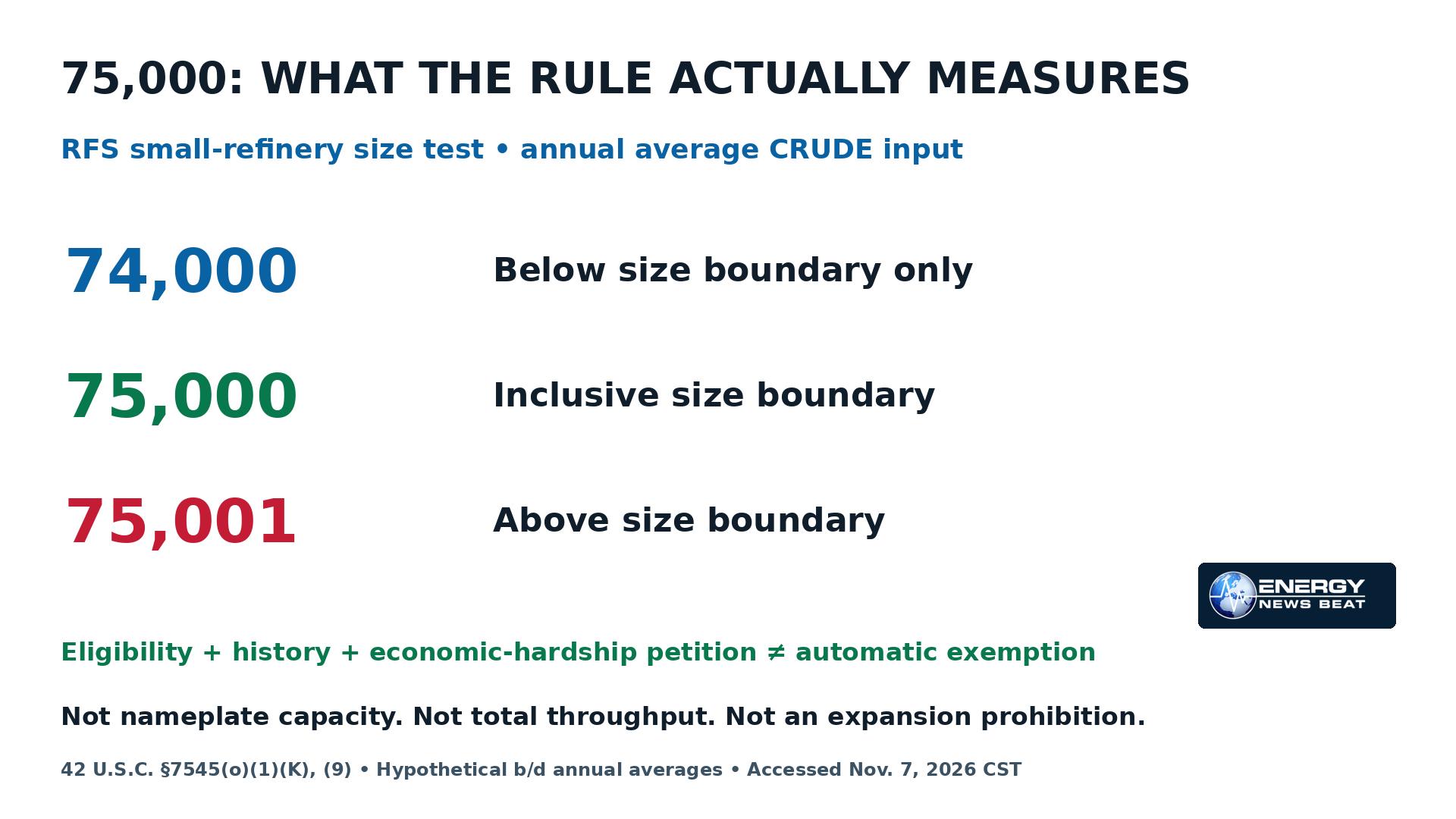
The important regulatory number is exactly 75,000—not 74,000. Clean Air Act section 211(o)(1)(K), codified at 42 U.S.C. §7545 defines a small refinery using average aggregate daily crude-oil throughput for a calendar year: total annual crude throughput divided by calendar days. The boundary is inclusive. A refinery averaging exactly 75,000 qualifies on size; one above it does not. This is an actual-input test at the refinery, not a company-wide nameplate-capacity cap.
That definition supports Renewable Fuel Standard small-refinery hardship relief. It does not prohibit building a larger crude unit or running above the threshold. Nor does being small automatically remove renewable-fuel obligations. EPA’s August 31, 2026 decision requires eligibility, including the initial blanket-exemption history, and a petition demonstrating disproportionate economic hardship; EPA consults the Energy Department. “Small refiner” provisions elsewhere should not be substituted for this facility-based RFS definition.
Timing matters. In Alon Refining Krotz Springs v. EPA, decided April 7, 2026, the D.C. Circuit rejected EPA’s use of 2023 throughput to deny 2024 exemptions sought in 2025. The regulation refers to the most recent full calendar year before seeking relief and the year sought—not automatically the year before the compliance year. Separately, the Supreme Court’s 2021 HollyFrontier decision allows an exemption extension after a lapse; it does not guarantee approval.
Losing access to potentially valuable relief can make incremental production less attractive. That is a plausible policy disincentive, not a demonstrated explanation for Tyler’s decision. Soreq’s quoted answer does not establish that causal link. Delek’s November 6 results report full 2025 exemptions for all its refineries and a $334.7 million reduction in its consolidated net RINs obligation from exemptions granted in the quarter. That is a company-wide accounting effect—not Tyler’s annual benefit or the cost of expanding one barrel.
Measure what actually comes out
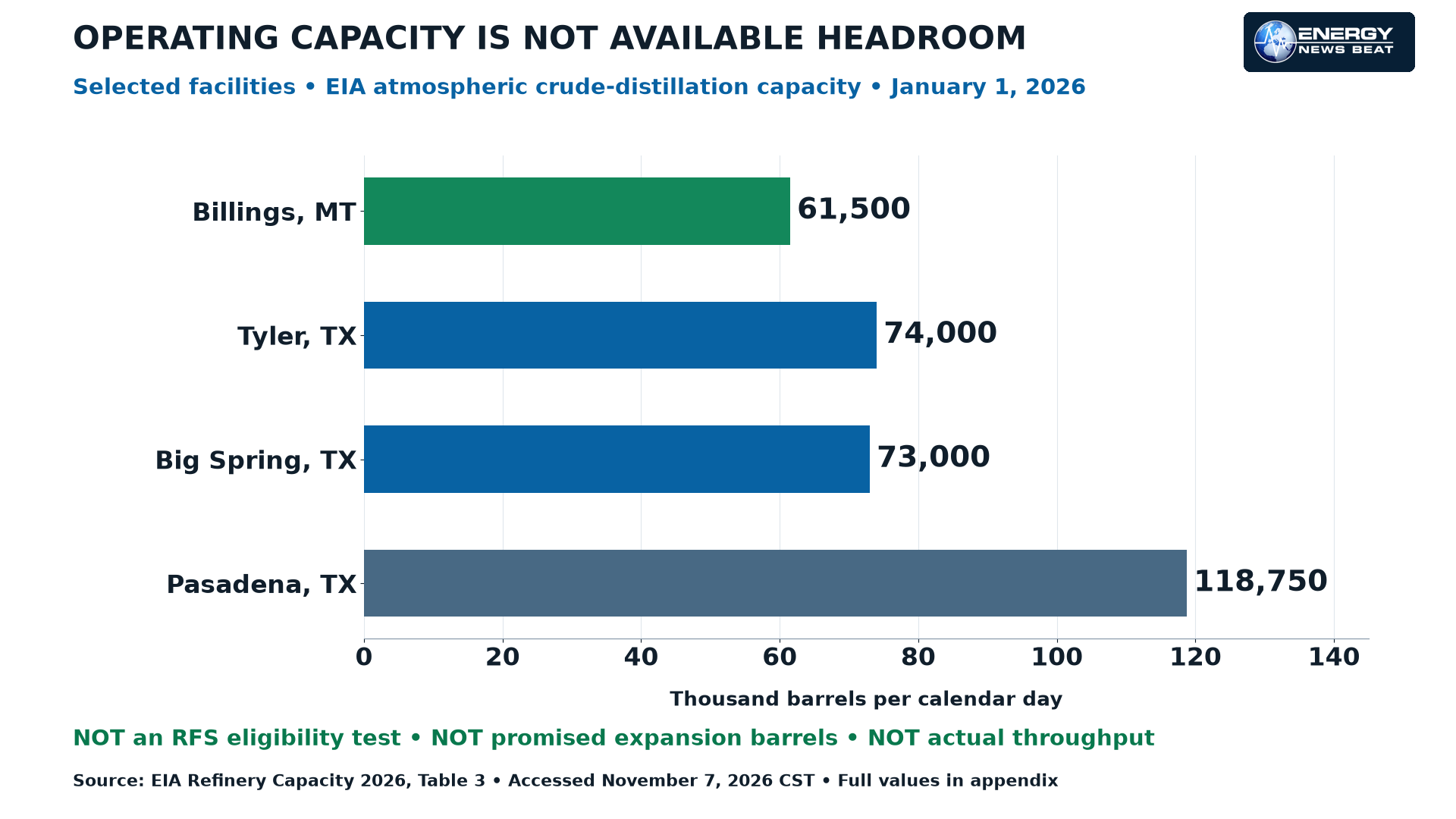
EIA’s January 1, 2026 facility table lists Tyler at 74,000 barrels per calendar day of operating atmospheric crude-distillation capacity and 77,500 per stream day. Soreq did not say whether his 75,000 figure refers to calendar-day capacity, stream-day capacity or actual crude runs, and no reconciliation with EIA’s figures has been established; the numbers should not be merged. Calendar-day capacity allows for normal interruptions; stream-day capacity describes operation under specified operating conditions. Neither is the statutory annual crude-throughput calculation.
Delek reports Tyler’s third-quarter 2026 crude input at 72,653 barrels per day, other feedstocks at 2,164, total throughput at 74,817 and production at 73,182. Gasoline was 37,261 and combined diesel/jet 32,351. Total throughput is not crude input, and diesel/jet is not diesel alone. A product-mix improvement can help a tight fuel market without adding crude capacity; it can also trade one product against another. No incremental Tyler fuel yield has been disclosed here.
Which facilities deserve a practical first look?
ENB’s first priority is operating-site reliability and documented bottlenecks—not a speculative list of empty refinery shells. Billings, Montana, operated by Par Montana under Par Pacific, is the strongest small-site screening candidate in this sample: EIA lists 61,500 calendar-day barrels of operating capacity, while Par’s 2025 company call describes logistics, lighter-crude, hydrotreating and jet/diesel opportunities. Its November 4, 2026 call transcript reports debottleneck projects underway. That supports diligence on identified equipment and product constraints, not an assured crude-capacity increase.
Tyler merits a narrower product-flexibility inquiry consistent with management’s actual statement. Big Spring, Texas, another Delek plant, deserves reliability follow-through rather than a presumed expansion: EIA lists 73,000 calendar-day capacity, and Delek reports third-quarter crude input of 72,719. A lower nine-month average is not evidence of free, permanently usable capacity. Ask what maintenance, crude quality, downstream processing and commercial limits explain the operating record.
Pasadena, Texas, owned by Chevron, is a useful larger-site benchmark, not a small-refinery exemption candidate inferred from size. Chevron’s December 2024 retrofit announcement described lighter-crude processing capability rising nearly 15% to 125,000 barrels per day, with added product flexibility. EIA’s later calendar-day capacity is 118,750. The lesson is integration of crude supply, process equipment and product outlets—not that every refinery can copy the same gain.
Existing-site expansion can be substantial without being quick. ExxonMobil’s Beaumont expansion started construction in 2019 and began operation in March 2023; the company reported $2 billion and 250,000 barrels per day of added capacity. This is counterevidence to treating small plants as the only route. It also shows why “fastest” must be tested project by project. No comparable fully permitted modular or greenfield project schedule is established here.
New plants are possible, too. EIA identifies Texas International Terminals in Galveston as the newest U.S. refinery: 45,000 barrels per calendar day, first operating in February 2022. That is a real small new-build example, not proof of a replicable fast modular project. Its startup date is not a permitting or construction duration. Without comparable committed schedules and costs, neither small greenfield construction nor an idle restart can be declared the fastest national answer.
A production agenda with receipts
First, publish a Tyler scope sheet: targeted fuels, net additional saleable output, funding instrument, capital commitment and milestones. Second, screen Billings, Tyler and Big Spring with operators for equipment-limited opportunities; require crude supply, hydrogen, electricity, water, sulfur removal, storage and pipeline or truck capacity checks before promising barrels. Rank projects by verified net fuel gains and execution readiness, not nameplate subtraction.
Third, EPA should administer hardship petitions predictably and explain the applicable throughput years. Congress—not an agency press release—would have to amend the statutory 75,000 definition. A carefully evaluated transition or graduated relief could reduce a cliff incentive, but lawmakers should disclose effects on renewable-fuel producers, other obligated parties, public costs and emissions. Separate air-permit and New Source Review requirements remain; RFS relief is not a blanket environmental waiver.
Finally, do not book idle or converted plants as ready supply. Phillips 66 says its Los Angeles refinery is idled and pursuing redevelopment; restarting it is speculative without an owner-backed plan, equipment assessment and permits. Rodeo converted to renewable fuels, so it is not spare petroleum capacity. Neither closure nor conversion means a site is dismantled; physical condition needs evidence. Fuel must reach the relevant regional market—Gulf Coast barrels do not automatically solve a West Coast shortage. For consumers, more reliable supply is a sound objective, not a guaranteed pump-price cut. For investors, separate recurring operations from exemption accounting and political announcements; this screening is not a securities recommendation.
Stu’s Take
America needs more dependable fuel supply, and I would start with the refineries and workers we already have. But I want a production plan, not another headline that turns into a debate over what “expansion” meant.
Delek’s Tyler explanation is a reminder to demand the basics: what equipment changes, which fuels increase, who pays, and when customers can actually receive the product? Billings deserves a serious look because the operator has described real bottlenecks. Tyler deserves an honest product-mix assessment. Big Spring deserves a reliability review—not invented spare barrels.
Congress should examine whether the RFS threshold discourages otherwise sensible growth. EPA should apply the law consistently, without pretending that a hardship petition is automatic or that it replaces air permits. Protecting workers, neighbors and family budgets requires transparent tradeoffs. My test is simple: show the net fuel gains, the delivered economics and the execution milestones before asking Americans to celebrate.
There is only two ways to reduce diesel and gasoline prices. 1: increase production or 2: lower demand. In our current political climate, the odds of getting refinery legislation is zero, and must be done through executive order, increasing the limit of 75,000 bpd on the small refineries as they are our cheapest way forward for more refining capacity. Do not forget we went from 300 refineries to 130 due to Blue State and Net Zero policies. So as the Blue wave rolls in, energy prices will keep going up. Just saying.
Appendix A | Threshold comparison and underlying chart data
All sources accessed November 7, 2026 (CST), unless separately stated. Capacity data are a January 1, 2026 snapshot, released June 26. Company disclosures are dated individually. Examples below are not facility operating plans. No forecast or national affected-refinery count is asserted.
| Measurement | Interpretation | Limit |
| 74,000 b/d annual crude average | Below size boundary only | Not automatic relief; history + hardship still required |
| 75,000 b/d annual crude average | Meets inclusive size boundary | Same additional eligibility requirements |
| 75,001 b/d annual crude average | Above size boundary | Not a small refinery for that calendar year; relief for that year is unavailable or invalidated. EPA also tests the most recent full calendar year before petitioning, which under Alon can be the same year. |
| 74,000 b/cd EIA capacity | A capacity estimate, not annual input | Cannot determine RFS eligibility |
| 80,000 b/d total throughput | May include non-crude feedstocks | Cannot determine annual crude average |
Threshold arithmetic: 75,000 × 365 = 27,375,000 barrels in a non-leap calendar year; 75,000 × 366 = 27,450,000 in a leap year. Divide annual crude barrels by all calendar days, including outage days. Source: 42 U.S.C. §7545(o)(1)(K).
| Facility / PADD | Operating b/cd | Operating b/sd | Idle b/cd / b/sd |
| Billings, MT / IV | 61,500 | 62,900 | 0 / 0 |
| Tyler, TX / III | 74,000 | 77,500 | 0 / 0 |
| Big Spring, TX / III | 73,000 | 74,000 | 0 / 0 |
| Pasadena, TX / III | 118,750 | 125,000 | 0 / 0 |
Source: EIA Refinery Capacity 2026, Table 3. Billings: PDF page 13 / printed page 11. Texas rows: PDF page 19 / printed page 17. b/cd = barrels per calendar day; b/sd = barrels per stream day. Chart uses only operating b/cd, no summing across different bases. These four sites were selected for article relevance and documented operating/project context; this is not an exhaustive U.S. screen.
| Tyler metric | Q3 2026 b/d | Meaning |
| Crude oil input | 72,653 | Observed crude only |
| Other feedstocks | 2,164 | Not included in crude-input threshold |
| Total throughput | 74,817 | Crude + other feedstocks |
| Gasoline production | 37,261 | Output, not crude input |
| Diesel/jet production | 32,351 | Combined category, not diesel alone |
| Petrochemicals / LPG / NGLs | 1,964 | Output |
| Other production | 1,606 | Output |
| Total production | 73,182 | Sum of output categories |
Source: Delek November 6 results, Refining Segment Selected Financial Information. Quarter ended September 30, 2026; 92 days. 72,653 + 2,164 = 74,817. 37,261 + 32,351 + 1,964 + 1,606 = 73,182. Nine-month crude 72,088 is not a full-year statutory average. No fuel-yield gain is calculated from these historical observations.
Appendix B | Evidence-ranked facility screening matrix
This ranking recommends where to perform diligence, not where an expansion is approved or economically feasible. Operating capacity does not establish RFS qualification. “Unknown” means no supporting figure has been established for this draft; it is not zero.
Billings, MT | 1 — documented bottleneck diligence
| Screening field | Evidence / constraint |
| Operator / geography | Par Montana LLC / Par Pacific; PADD IV |
| Dated capacity | EIA Jan. 1, 2026: 61,500 operating b/cd; 62,900 operating b/sd; zero idle in both columns. |
| Actual input | Current facility actual crude input not established here. Do not use capacity as actual. |
| Documented position | 2025 operator call describes logistics flexibility, lighter crude processing, expanded hydrotreating and jet/diesel capabilities; November 2026 published call transcript reports debottleneck projects underway. |
| Recommended next action / unknowns | Verify latest project list, executed versus remaining work, permitting, hydrogen/power and product evacuation. Net incremental crude and saleable fuel gains unknown. |
Sources: eia; par-call; par-transcript.
Tyler, TX | 2 — disclosed product-mix inquiry
| Screening field | Evidence / constraint |
| Operator / geography | Delek Refining LTD / Delek US; PADD III |
| Dated capacity | EIA Jan. 1, 2026: 74,000 operating b/cd; 77,500 operating b/sd; zero idle in both columns. |
| Actual input | Q3 2026 crude 72,653; other feed 2,164; total 74,817 b/d. Nine-month crude 72,088 b/d. |
| Documented position | CEO says Tyler is going to stay at 75,000 barrels a day of crude; no material capex to disclose; talks concern product shifts. CEO basis not specified; no reconciliation with EIA established. |
| Recommended next action / unknowns | Seek public project scope, net fuel yields, DPA instrument and permitting. No new crude increment committed in evidence reviewed. |
Sources: eia; dk-release; dk-call.
Big Spring, TX | 3 — reliability screen; expansion unproven
| Screening field | Evidence / constraint |
| Operator / geography | Alon USA Energy Inc / Delek US; PADD III |
| Dated capacity | EIA Jan. 1, 2026: 73,000 operating b/cd; 74,000 operating b/sd; zero idle in both columns. |
| Actual input | Q3 2026 crude 72,719; total 74,706 b/d. Nine-month crude 56,948 b/d. |
| Documented position | Operating facility; current company statement stresses full system online and smooth operations. Quarterly and YTD figures do not establish continuous available headroom. |
| Recommended next action / unknowns | Reconcile maintenance/outage effects and current unit limits before considering debottleneck capital. No sourced new expansion volume, cost or schedule. |
Sources: eia; dk-release; dk-call.
Pasadena, TX | Benchmark — documented retrofit announcement
| Screening field | Evidence / constraint |
| Operator / geography | Pasadena Refining Systems Inc / Chevron; PADD III |
| Dated capacity | EIA Jan. 1, 2026: 118,750 operating b/cd; 125,000 operating b/sd; zero idle in both columns. |
| Actual input | Current actual crude throughput is not established here. |
| Documented position | December 2024 release says the retrofit was completed and then expected phased startup through Q1 2025, with lighter-crude processing capability expected to rise nearly 15% to 125,000 b/d. Current operational completion is not independently verified. |
| Recommended next action / unknowns | Use feedstock/logistics integration as design lesson. Do not count the dated announcement as new future capacity or infer further expansion feasibility. |
Idle restart versus converted sites
Los Angeles, CA / Phillips 66 / PADD V — Idled; company pursuing redevelopment. Not a verified near-term restart candidate. Current available restart capacity, equipment condition, economics and timetable unknown. EIA records 2025 shutdown; historical capacity is not new supply. Company status record.
Rodeo, CA / Phillips 66 / PADD V — Converted to renewable fuels in 2024. Exclude from petroleum restart totals; company reported renewable-fuel startup, not spare crude-processing capacity. No reverse-conversion plan established. Company status record.
No dismantled site is recommended. There is no verified owner-backed near-term idle restart in this sample. Recommissioning a petroleum refinery, reversing a renewable conversion and building a modular or greenfield refinery are different projects; each needs its own permit, equipment, financing and logistics evidence.
Appendix C | Definitions, process and policy guardrails
Boundary examples are hypothetical legal arithmetic, not operating plans: in a 365-day year, 75,000 × 365 = 27,375,000 crude barrels; in a leap year, 75,000 × 366 = 27,450,000. Shutdown days remain in the denominator. An individual day or quarter above 75,000 does not alone establish failure of the annual test. Nameplate below the line does not prove qualification.
40 CFR 80.2 carries the small-refinery definition; 80.1441 governs exemptions, with paragraph (e)(2)(iii) addressing throughput-year verification. The April 2026 Alon opinion quotes and interprets the operative regulation. The most recent full calendar year before petitioning can coincide with the year for which relief is sought; do not impose an extra preceding compliance year by shorthand. Initial blanket qualification/history and hardship remain separate questions.
EPA’s August 2026 decision applies DOE matrix and other economic factors after the D.C. Circuit’s 2024 Sinclair IV decision rejected a sole-RFS-cause approach and inadequately supported complete cost-recovery reasoning. The Supreme Court’s 2025 Calumet venue ruling is not a substantive automatic-exemption ruling. This is a source-dated status summary, not a certification that every related case has reached final, unappealable disposition.
These are petroleum refinery facilities, not estimates of gasoline production. Crude-distillation capacity is an equipment capability; throughput is observed input; utilization requires matched input, capacity basis and period. Product yields depend on feed quality and downstream units; processing gains and non-crude inputs mean product barrels need not equal crude barrels. No capacity-minus-throughput difference is treated as a buildable increment.
PADD III is the Gulf Coast; PADD IV the Rocky Mountains; PADD V the West Coast. Regional refinery specifications, inventories and transport constraints matter. Moving crude or finished fuel can require pipelines, rail, trucks or marine logistics and appropriate specifications. No freight saving, local price effect, transport capacity or emissions benefit is quantified.
Candidate order is ENB advisory evidence ranking, not an engineering feasibility ranking: (1) documented operating-site bottlenecks, (2) explicitly discussed product changes, (3) reliability screening without an expansion commitment. Pasadena is a documented-retrofit announcement benchmark; Los Angeles is a speculative restart inquiry only; Rodeo is excluded as converted. No greenfield/modular project with independently comparable committed budget and schedule is established, so no universal fastest-path conclusion is claimed.
Before allocating capital or public funds, obtain owner-backed engineering studies and net saleable gasoline/diesel/jet balances; air/water/land-use permits; process safety and inspection records; crude and product contracts; hydrogen, power and water availability; sulfur/waste handling; construction/outage integration; labor and equipment availability; and financing. These are due-diligence requirements, not assertions that a named facility currently lacks each item.
Policy options: EPA can clarify and consistently administer petitions and lawful procedures, with DOE consultation and judicial review. EPA cannot rewrite Congress’s numeric definition or dispense with other laws merely by labeling a project small. Congress could debate a tapered transition or new numeric boundary, with budget, renewable-fuel, competitiveness and emissions effects. No particular replacement threshold is endorsed without impact analysis.
The original Delek call audio, original Vance speech and a project-level DPA award have not been authenticated here. Subsequent appeal status after the April 2026 Alon ruling has not been checked. Those limits do not establish a contrary outcome or a federal funding commitment.
Appendix D | Source list, exact excerpts and limitations
Access date: November 7, 2026 CST. Quotations below are exact short excerpts from the identified records or attributed published transcripts. They do not imply that every stakeholder prediction is independently established. The news analysis and proposed Take are ENB’s, not company or government quotations.
01. Bloomberg | authorized browser-note provenance | Will Kubzansky | November 6, 2026, 2:00 p.m. CST
Excerpt: “Tyler is going to stay at 75,000 barrels a day”
Source provenance from authorized browser notes; not independently re-verified by the reviewer. The substantive crude-rate quotation is supported separately by the published Delek call transcript. No RFS motive is attributed to this provenance record.
02. Delek November 6, 2026 call | published transcript
Excerpt: “Tyler is going to stay at 75,000 barrels a day of crude.”
Q&A response to Jason Gabelman; continues with no material CapEx and product shifts. Published transcription; original audio not authenticated in this draft. The 75,000 figure has no stated calendar-day, stream-day or actual-run basis.
03. Delek November 6, 2026 results | SEC Exhibit 99.1
Excerpt: “The SREs resulted in a reduction of our Consolidated Net RINs Obligation”
Exact phrase from Small Refinery Exemptions section; amount $334.7 million in Q3 2026. Full 2025 grants reported for all Delek refineries. Facility tables supply Q3/YTD actual inputs and output. Results are unaudited; full-year statutory averages are not derived from partial periods.
https://www.sec.gov/Archives/edgar/data/1694426/000162828026071294/dk-ex991earningsreleasex09.htm
04. Delek Q3 2026 earnings presentation | November 6
Excerpt: “Total Crude Throughput”
Slide 19 distinguishes Q4 crude guidance 270,000–290,000 b/d from total throughput 288,000–308,000; Tyler total 75,000–80,000 is NOT new crude-capacity guidance. Guidance is prospective.
https://s203.q4cdn.com/138381933/files/doc_financials/2026/q3/3Q_Earnings-PPT_vF.pdf
05. Reuters | October 13, 2026 announcement account
Excerpt: “We want millions of gallons of commercial grade and military-spec fuel to come out of this refinery in addition to what it’s already producing”
Reported Vance quotation, not an independently authenticated White House transcript. Award amount, capacity increment and completion date not supplied. Do not turn aspirational gallons into b/d capacity.
06. Texas Railroad Commissioner Wayne Christian statement | October 14, 2026
Excerpt: “The project is expected to increase production of commercial-grade and military-specification fuels.”
Contemporaneous state-government reaction corroborates announced intent, not a federal award or engineering commitment. Commissioner statement, not White House primary speech.
https://www.rrc.texas.gov/news/christian-praises-trump-s-announced-texas-refinery-expansion/
07. 42 U.S.C. §7545(o)(1)(K) and (9) | U.S. Code text; read with EPA August 2026 decision
Excerpt: “does not exceed 75,000 barrels”
Definition specifies total calendar-year crude throughput divided by calendar days; inclusive boundary. Section (9) establishes temporary exemption and hardship petitions, DOE consultation and statutory 90-day action deadline. Per refinery, not aggregate corporate capacity.
https://www.law.cornell.edu/uscode/text/42/7545
08. EPA-420-R-26-017 | August 31, 2026
Excerpt: “a refinery must not exceed an average aggregate daily crude oil throughput of 75,000 bpd in the year for which the refinery is seeking an exemption”
Size/initial-exemption eligibility discussion and Appendix A grants; 18 full, 11 partial, 3 denied and 2 ineligible 2025 petitions. Decisions are year-specific, not a promise for 2026. Other economic factors matter; no sole-cause RFS requirement after Sinclair IV.
https://www.epa.gov/system/files/documents/2026-08/420r26017.pdf
09. EPA | Renewable Fuel Standard Exemptions for Small Refineries
Excerpt: “disproportionate economic hardship”
Program overview; read alongside April 2026 court opinion. Its abbreviated prior-year language must not be read as an automatic compliance-year-minus-one test.
https://www.epa.gov/renewable-fuel-standard/renewable-fuel-standard-exemptions-small-refineries
10. D.C. Circuit | Alon Refining Krotz Springs v. EPA | April 7, 2026
Excerpt: “the most recent full calendar year prior to seeking”
Opinion PDF pp2–3 and discussion of 40 CFR 80.1441(e)(2)(iii). Denials vacated/remanded: 2024 relief sought in 2025 did not require 2023 size compliance. Not a general waiver of size eligibility or a future grant.
https://www.govinfo.gov/content/pkg/USCOURTS-caDC-25-01187/pdf/USCOURTS-caDC-25-01187-0.pdf
11. Supreme Court | HollyFrontier Cheyenne v. Renewable Fuels Assn. | June 25, 2021
Excerpt: “even if it saw a lapse in exemption coverage in a previous year”
Syllabus describes extension holding; no continuous-uninterrupted exemption requirement. Not authority for automatic exemptions or exceeding statutory size.
https://www.supremecourt.gov/opinions/20pdf/20-472_0pm1.pdf
12. EIA | Refinery Capacity 2026 | released June 26, 2026; as of January 1
Excerpt: “Capacity of Operable Petroleum Refineries by State as of January 1, 2026”
Table 3, PDF pp13/19 (printed pp11/17): Billings Par Montana and Texas sites. All chart bars use operating atmospheric crude-distillation calendar-day capacity; idle column zero for these four. Stream-day values separate. Sample is purposive, not a national affected-refinery count.
https://www.eia.gov/petroleum/refinerycapacity/refcap26.pdf
13. Par Pacific | Q3 2025 company call transcript
Excerpt: “expanded hydrotreating capacity and enhanced jet and diesel production capabilities”
Company transcript identifies work categories; timing and completion of individual projects require current confirmation.
14. Par Pacific | November 4, 2026 published call transcript
Excerpt: “debottlenecking projects that are underway”
Current management discussion as transcribed by Motley Fool; not independently authenticated original audio. No incremental crude increase, project cost or guaranteed fuel increase is adopted in this article.
15. Chevron | Pasadena retrofit release | December 10, 2024
Excerpt: “expand the processing capacity of lighter crudes by nearly 15 percent to 125,000 barrels per day”
Company release; lighter-crude processing basis, not silently calendar-day EIA capacity. The December 2024 release said the retrofit was completed and phased startup was then expected through Q1 2025. Current operational completion is not independently verified; this is not a new 2026 project.
16. ExxonMobil | Beaumont startup release | March 16, 2023
Excerpt: “Construction on the Beaumont expansion began in 2019”
Company reports $2 billion and 250,000 b/d added capacity; March 2023 startup. Its more-than-630,000 total processing description is not substituted for EIA’s later calendar-day distillation number.
17. Phillips 66 | current Los Angeles refinery status page
Excerpt: “the Phillips 66 Los Angeles Refinery has been idled”
Company pursuing site redevelopment. Does not establish dismantling or an owner-backed restart. EIA shutdown record corroborates distinction from operating capacity.
https://www.phillips66.com/refining/los-angeles-refinery/
18. Phillips 66 | Rodeo milestone | April 15, 2024
Excerpt: “is now producing only renewable fuels”
Conversion of San Francisco/Rodeo petroleum operation. Renewable output is not crude input and not petroleum spare capacity.
https://www.phillips66.com/newsroom/rodeo-renewed-milestone/
19. EPA | Learn About New Source Review
Excerpt: “New Source Review”
Air-permitting program separate from RFS. Applicability depends on project and emissions; no project-specific permit clearance or prohibition inferred here.
https://www.epa.gov/nsr/learn-about-new-source-review
20. EIA | When was the last refinery built in the United States? | January 1, 2026 capacity basis
Excerpt: “started operating in February 2022”
Texas International Terminals, Galveston: newest U.S. refinery, 45,000 b/cd. FAQ table lists built 2021/first operated 2022; not a permitting duration, construction-start date or modular project cost. Existing facility, not incremental future capacity.
https://www.eia.gov/tools/faqs/faq.php?id=29
Appendix E | What would change this assessment?
A published federal DPA award, primary speech record and engineering scope could clarify what Washington actually committed. Current reporting does not supply a verified capacity increment, dollar award or completion date.
Soreq said Tyler is going to stay at 75,000 barrels a day of crude, without specifying the measurement basis; a later owner-approved project would be new evidence, not proof that a previous firm project was canceled. Product balance and net saleable fuel gains remain unspecified.
Current unit engineering and completed-work records could strengthen or weaken the Billings, Tyler and Big Spring screens. No new buildable crude increment or current idle restart volume is quantified.
RFS outcomes remain compliance-year-specific and exposed to administrative action and litigation. This draft does not certify the final disposition of every related case or make a 2026 facility-exemption prediction.
The post Product Shift, Not More Crude: Delek’s Tyler Reality Check appeared first on Energy News Beat.