

Colleges that stayed invested collected the energy rally, Bloomberg reports. Harvard’s October climate update omitted the fossil-fuel percentage last published as under 2%. MIT, which refused to divest, returned 10.3%. SpaceX, more than oil, drove several of the top fiscal 2026 results.
Princeton University’s investment company ended its voluntary ban on publicly traded oil and gas stocks on June 1, 2026. The trustee rule on thermal coal and tar sands stayed in place. Vincent Tuohey, Princo’s president, said the change would give the office “greater flexibility” in running an endowment that funds aid and research.
Energy stocks, measured by the Energy Select Sector SPDR Fund (XLE), have returned about 162% since the end of 2019, with dividends reinvested, through Nov. 23, 2026. A $10,000 stake would have grown to about $26,205. The S&P 500, measured by SPY, returned about 147% over the same span. Bloomberg reported Tuesday that colleges that stayed invested in fossil fuels collected that rally. Jim Dunn, chief executive of Verger Capital, which manages Wake Forest’s endowment, told Bloomberg, “When some endowments were stepping away from energy, we stayed invested.”
Some campuses that announced fossil-fuel exits wrote in exceptions from the start, later stopped publishing a percentage, or, in Princeton’s case, reversed the public-stock ban. MIT, which refused a blanket fossil-fuel divestment in 2015, returned 10.3% in fiscal 2026. Harvard, which said in 2021 that remaining fossil-fuel funds would run off, returned 27.1%. SpaceX, more than oil, drove several of the top results.
Energy paid off after a long, ugly stretch
From early 2014 through the end of 2020, XLE lost about 43%, while SPY gained about 134%, by Energy News Beat’s calculation from Yahoo Finance adjusted closes. In calendar 2020 alone, energy fell about 33%. In the five calendar years 2021 through 2025, XLE returned about 185%, or 2.85 times its starting value, the calendar window closest to Bloomberg’s description of S&P 500 Energy almost tripling over five years; over the trailing five years to Nov. 23, XLE returned about 149%. In the fiscal year ended June 30, 2026, the same year colleges use, XLE returned about 29.2% and SPY about 22.2%.
Over the five fiscal years ended June 2026, energy returned about 137% and the S&P 500 about 87%. A sector fund is a rough public-market proxy, not a map of any one endowment’s private oil-and-gas book.
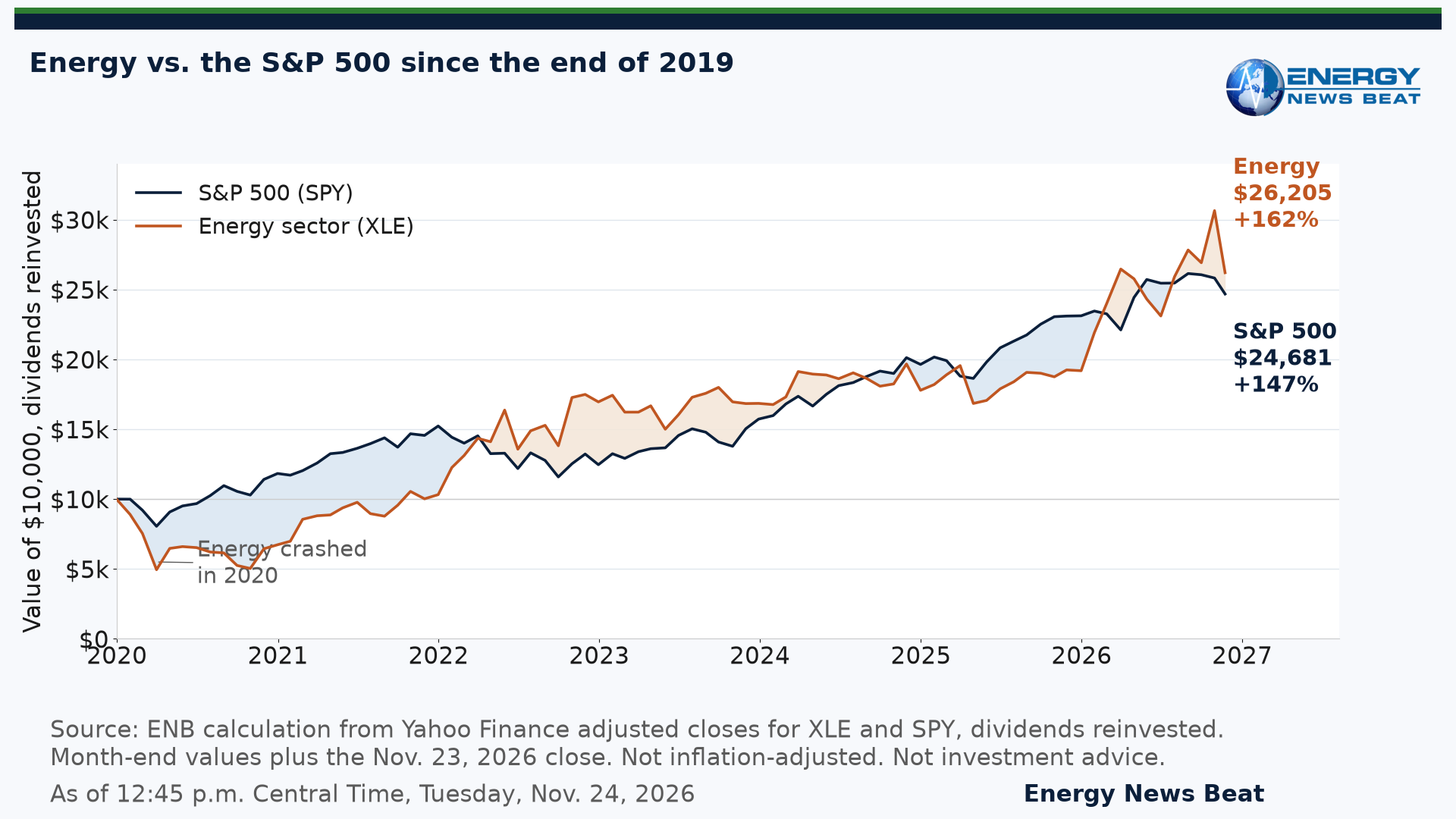
Schools that stayed invested collected the rally. So did some that left.
Bloomberg reported that Wake Forest’s endowment, $2.58 billion at June 30, 2026, returned 22.4% in fiscal 2026, against a 17% Cambridge Associates median Bloomberg cited, and that Dunn estimated energy added about 2.5 percentage points. Washington University in St. Louis, which stayed invested, posted a 37.3% return on its managed endowment pool. Its chief investment officer told Bloomberg the natural-resources book rose 49%. TIFF, summarizing university statements, said SpaceX and Cerebras accounted for about half of WashU’s gain. The University of North Carolina system returned 37.8%, and TIFF reported that UNC attributed about half of that growth to SpaceX. Rice University, Bloomberg said, kept a 12% natural-resources target; it had not published a fiscal 2026 return.
Schools that restricted fossil fuels were not left behind. Harvard’s endowment returned 27.1%, to $68.0 billion, and paid out $2.6 billion, nearly 40% of operating revenue. Yale returned 26.3%. Princeton returned 23.7% — almost all of that year still under the public oil-and-gas ban, which ended June 1, 29 days before the June 30 fiscal close. Brown returned 19.6%, Columbia 18.3%, and Cornell 16.9%. Among 64 early reporters tracked by Commonfund as of mid-November, the median was 17.8%. The seven schools with disclosed SpaceX stakes had a 27.1% median, versus 17.2% for the other 57.
MIT stayed in and returned 10.3%.
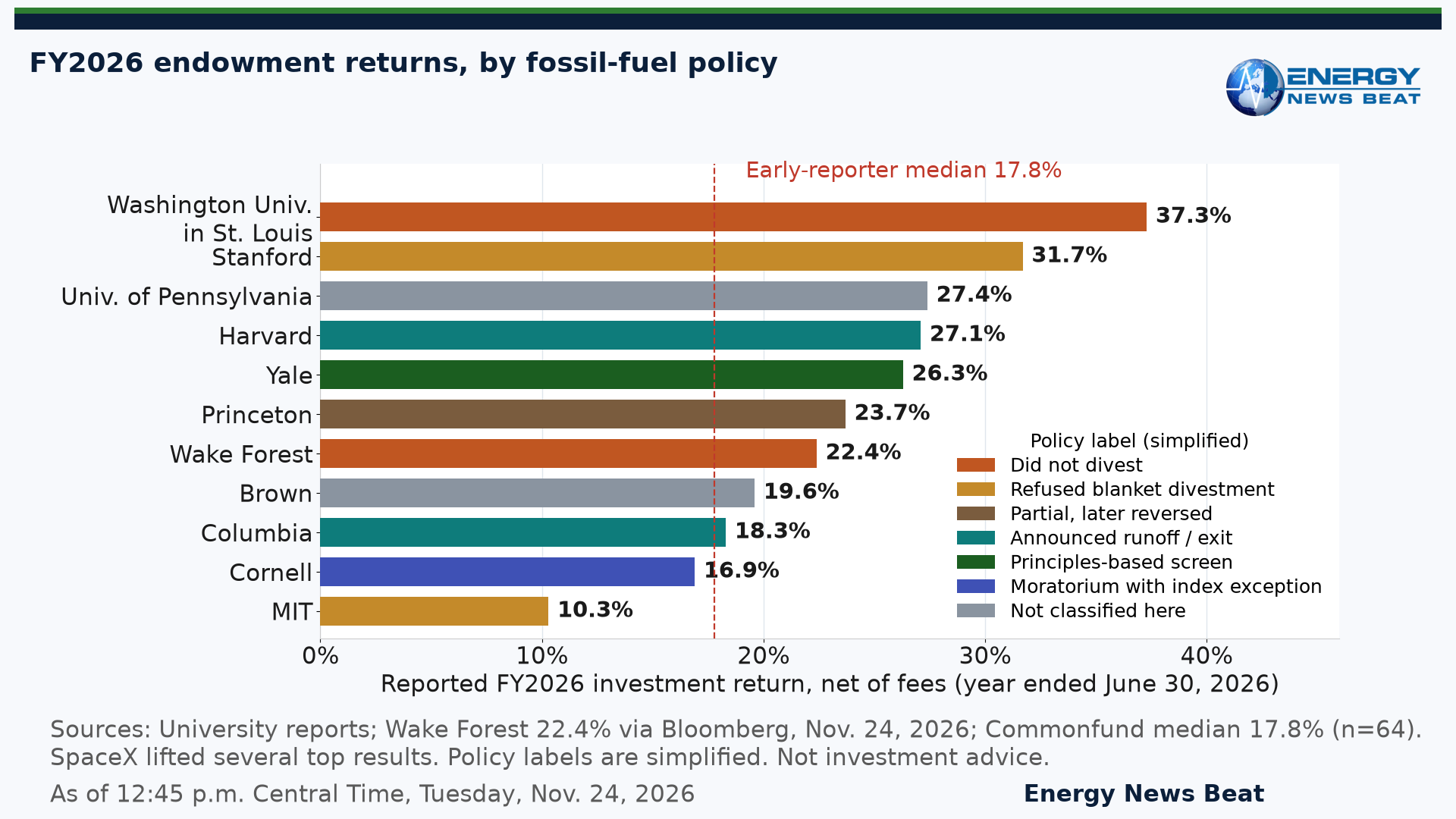
Three records: a reversal, a missing percentage, and an exception in the fine print
Princeton is the cleanest documented reversal. In 2022, Princo voluntarily moved to eliminate holdings in publicly traded fossil-fuel companies. On June 1, Tuohey wrote that it was “not obvious” the earlier approach had moved the endowment meaningfully closer to net-zero, and that major energy companies may not be “out of bounds” for a net-zero portfolio. He set a net-zero endowment goal for 2046. President Christopher Eisgruber’s 2022 line, quoted in the same letter, is that when Princeton sells shares, “somebody else is buying those shares.” Raf Basas, a Princeton junior who co-leads Sunrise Princeton, told Bloomberg, “If Princeton claims to value sustainability, it ought to divest from fossil fuels.”
Harvard’s issue is disclosure, not a published U-turn. In 2021, President Lawrence Bacow said remaining fossil-fuel funds would run off and that Harvard did not intend to make new investments in funds focused on the sector. A 2024 climate report said private-equity funds focused on fossil exploration and development were under 2% of the endowment in fiscal 2023. The October 2026 climate update left that percentage out and said a “forward-looking analysis” offered a clearer view. A company spokesperson declined to provide the figures, the Harvard Crimson reported. The same article said HMC is still in some funds tied to the sector, including an energy pool that owns shares in Sable Offshore, and estimated Harvard owns roughly 60% of that fund, based on tax returns. HMC has not published a 2026 fossil-fuel percentage to confirm or contradict that reporting.
Cornell’s 2020 move was carefully scoped. The trustees imposed a moratorium on new private equity and bond vehicles focused on fossil fuels, then about 4.2% of long-term investments, and said that book should dwindle as older funds mature. The policy, the university said, “does not apply to indexed and other public equity mandates, such as the S&P 500,” because Cornell cannot change an index or tell those managers to exclude particular stocks.
Cost estimates exist. They run both ways, and they are estimates.
Two often-cited papers on the cost of divestment were funded by the Independent Petroleum Association of America, and both are estimates. Bradford Cornell, in a 2015 study, put a risk-adjusted shortfall at about 0.23% a year across five universities and an annual cost of about $107.8 million for Harvard at its 2015 size. Hendrik Bessembinder, in a 2016 paper, estimated frictional costs of 2% to 12% over 20 years even if pre-cost returns matched. Those are model results, not audited losses.
Official pension figures are estimates, too, and they do not all run one way. CalSTRS has estimated that its thermal-coal restriction reduced returns by about $444 million from July 2017 through June 30, 2025. CalPERS staff, citing Wilshire, have reported that active divestment policies since a 2021 review subtracted about $1.475 billion through June 30, 2026, while the thermal-coal screen, from inception, added about $782 million. Endowment payouts matter — Harvard’s $2.6 billion and Brown’s $357 million support operations — but the public data do not show a direct, isolated link from a fossil-fuel policy to tuition or pension checks.
Neda Jafar of Kimmeridge told Bloomberg, “Groups that were on the sidelines are trying to figure out a way to come back.” Luis Viceira of Harvard Business School told the same reporter, “Endowments face a trade-off like any other investor when they constrain themselves.” Madison Condon of Boston University School of Law offered the other side: “There’s strength in numbers.” A long energy slump and stranded-asset risk are reasons a fiduciary might still limit the sector.
Consumer and Investor Views
Consumer View. If you pay tuition, donate, or live in a state whose public pension has a fossil-fuel rule, you are entitled to a straight account of the policy and the latest holdings figure. Ask whether a “divestment” covers private funds only, or also the index funds most people already own. A strong endowment year can support aid and research. It does not prove, on the public record, that staying in oil cut anyone’s bill, or that leaving raised it.
Investor View. This is not investment advice. Energy had a brutal 2014–2020 stretch and a powerful rebound after 2020. A sector ETF is a rough proxy, not a map of any one school’s private energy book. Fiscal 2026 was also a SpaceX year. Read the policy, the exceptions, and the last disclosed percentage. Treat a missing percentage as a fact in its own right.
Timeline
Key dates in the energy rebound, the campus policies, and the documented reversals and gaps.
Early 2014 through December 2020. Energy, measured by XLE, lost about 43%; the S&P 500, measured by SPY, gained about 134%, by Energy News Beat’s calculation from Yahoo Finance adjusted closes.
May 22, 2020. Cornell’s trustees impose a moratorium on new private fossil-fuel funds. The policy does not apply to index and other public-equity mandates.
September 2021. Harvard says remaining fossil-fuel funds will run off and that it does not intend to make new investments in funds focused on the sector.
- Princo voluntarily moves to exit publicly traded fossil-fuel companies. The NACUBO average college return is −8.0%. Bloomberg later reported that Rice’s energy and natural-resources book rose 39% that year.
June 30, 2023. Harvard Management Company later reports fossil-exploration private-equity funds at under 2% of the endowment as of this date.
June 1, 2026. Princo ends the voluntary ban on publicly traded oil and gas stocks and sets a 2046 net-zero endowment goal. The coal and tar-sands rule remains.
June 11, 2026. SpaceX’s initial public offering marks up long-held private stakes weeks before the June 30 fiscal close.
June 30, 2026. Fiscal 2026 ends. XLE’s total return for the year is about 29.2%; SPY’s is about 22.2%.
October 2026. Universities report fiscal 2026 results, including Harvard’s 27.1% and MIT’s 10.3%. Harvard’s climate update omits the fossil-fuel percentage.
November 17, 2026. Commonfund reports a 17.8% median among 64 early reporters; schools with disclosed SpaceX stakes had a 27.1% median.
November 24, 2026. Bloomberg’s Janet Lorin reports that colleges that rejected fossil-fuel divestment collected the energy rally.
Caveats and what would change the story
Several facts should sit beside the returns. SpaceX’s June 2026 initial public offering marked up long-held private stakes and lifted several of the highest fiscal 2026 results; UNC and Washington University each credited about half of their gains to it, and Stanford and Harvard also disclosed stakes. WashU’s 37.3% is not an energy-only result. Schools that restricted fossil fuels still had strong years: Harvard 27.1%, Yale 26.3%, and Princeton 23.7%. MIT, which refused blanket divestment, returned 10.3%. Energy fell about 43% from early 2014 through 2020.
The Cornell and Bessembinder papers are estimates, funded by the Independent Petroleum Association of America. Official CalSTRS and CalPERS figures are also estimates. Wake Forest’s 22.4% return, the 17% Cambridge Associates median, the 2.5-point energy contribution, and the interviews quoted above are reported by Bloomberg. XLE and SPY figures are Energy News Beat calculations from Yahoo Finance adjusted closes, dividends reinvested, not inflation-adjusted, through Nov. 23, 2026. Princeton’s 23.7% covers a year almost entirely under the public-stock ban. Rice had not published a fiscal 2026 return. Commonfund’s 17.8% is a median of 64 early reporters, not the full NACUBO-Commonfund study, due in February 2027. This article makes no causal claim about tuition or pension checks. This is not investment advice. As of 12:45 p.m. Central Time, Tuesday, Nov. 24, 2026
Stu’s Take
Princeton’s investment office ended its voluntary ban on publicly traded oil and gas stocks on June 1, 2026, while the trustee rule on thermal coal and tar sands remains. Energy, measured by the Energy Select Sector SPDR Fund, has returned about 162% since Dec. 31, 2019, through Nov. 23, 2026, with dividends reinvested. Bloomberg reported that Wake Forest returned 22.4% in fiscal 2026. Washington University in St. Louis posted a 37.3% managed-pool return; TIFF, citing the university, said SpaceX and Cerebras accounted for about half of that gain. Harvard’s endowment returned 27.1%. Harvard’s October 2026 climate update omitted the fossil-fuel percentage last published as under 2% as of June 30, 2023. Cornell’s May 22, 2020, moratorium does not apply to index and other public-equity mandates. MIT, which refused a blanket divestment, returned 10.3%. Commonfund’s median among 64 early reporters was 17.8%.
Sources
Primary and named secondary sources used in this article. Endowment returns are from the named university unless a secondary source is stated. Energy and S&P 500 total returns are Energy News Beat calculations from Yahoo Finance adjusted closes. Quoted remarks from Dunn, Jafar, Viceira, Condon, and Basas are short quotations from Bloomberg and are attributed to Bloomberg. Source dates and access are Tuesday, Nov. 24, 2026, Central Time, unless a source carries an earlier date.
- Bloomberg, Janet Lorin, “Rejecting Fossil-Fuel Divestment Paid Off for These Colleges,” Nov. 24, 2026, 4:30 a.m. Central Time. Wake Forest fiscal 2026 return 22.4% versus a 17% Cambridge Associates median; Dunn estimate that energy added 2.5 percentage points; Verger Capital manages the Wake Forest endowment; Washington University natural-resources book +49%; Rice 12% natural-resources target and 2022 energy/natural-resources +39% versus a typical college −8%; Kimmeridge raising an energy fund aimed at endowments. Short quoted remarks by Jim Dunn, chief executive of Verger Capital; Neda Jafar of Kimmeridge; Luis Viceira; Madison Condon; and Raf Basas, a Princeton junior who co-leads Sunrise Princeton. https://www.bloomberg.com/news/articles/2026-11-24/rejecting-fossil-fuel-divestment-paid-off-for-these-colleges
- Princeton University Investment Company, Vincent Tuohey, “Update on Net-Zero Endowment Goal,” June 1, 2026. Discontinues the voluntary divestment from publicly traded oil and gas companies; trustee-mandated thermal-coal and tar-sands dissociation remains; net-zero endowment goal for 2046; “greater flexibility”; “not obvious” that the earlier approach moved the endowment meaningfully closer to net-zero; major energy companies may not be “out of bounds.” Quotes President Eisgruber, 2022: “When Princeton sells shares in a company, somebody else is buying those shares.” https://princo.princeton.edu/update-on-net-zero-endowment-goal/
- Princeton Alumni Weekly, “Princeton Reverses Course on Fossil Fuel Divestment,” June 1, 2026. 2022 voluntary elimination of publicly traded fossil-fuel holdings; coal and tar-sands dissociation is separate. https://paw.princeton.edu/article/princeton-reverses-course-fossil-fuel-divestment
- The Daily Princetonian, “Princeton University Investment Company walks back divestment from publicly traded oil and gas companies,” June 1, 2026. https://www.dailyprincetonian.com/article/2026/06/princeton-news-adpol-princo-discontinues-divestment-publicly-traded-oil-gas-companies
- Princeton Alumni Weekly, “Princeton’s Endowment Returns 23.7%, Grows to $42.3 Billion,” covering the fiscal year ended June 30, 2026. Official five-year return 6.7%; 10-year 11.3%. https://paw.princeton.edu/article/princetons-endowment-returns-for-2026-grows-to-42-billion
- Harvard Management Company, Message from the Chief Executive Officer / fiscal 2026 annual report. Endowment return 27.1%; value $68.0 billion; distributions $2.6 billion, nearly 40% of annual operating revenue. https://www.hmc.harvard.edu/wp-content/uploads/2026/10/FY26_HMC_Annual_Report.pdf
- Harvard University, Fiscal Year 2026 Financial Report. Confirms the 27.1% return, $68.0 billion value, and $2.6 billion payout. https://finance.harvard.edu/sites/g/files/omnuum12671/files/2026-10/FY26%20Financial%20Report.pdf
- Harvard Management Company, Net-Zero update, October 2026. Replaces prior percentage disclosures of fossil-fuel and climate-transition exposures with a “forward-looking analysis.” https://www.hmc.harvard.edu/net-zero/
- The Harvard Crimson, Megan L. Blonigen, “Harvard Resumes Climate Updates After Skipping Report Last Year, Omits Fossil Fuel Investment Figures,” Oct. 16, 2026. The 2024 report put fossil-exploration private-equity funds under 2% of the endowment in fiscal 2023; those percentages are absent in 2026; a spokesperson declined to provide the figures; the paper reported a remaining energy-fund holding that owns shares in Sable Offshore and estimated Harvard owns roughly 60% of that fund, based on tax returns. https://www.thecrimson.com/article/2026/10/16/harvard-2026-endowment-climate-report/
- Lawrence S. Bacow, “Climate Change: Update on Harvard Action,” Sept. 9, 2021. Remaining legacy fossil-fuel fund investments placed in runoff; no intended new investments in funds focused on fossil-fuel exploration or development. https://www.harvard.edu/president/news-and-statements-by-president-bacow/2021/climate-change-update-on-harvard-action/
- Cornell Chronicle, “Cornell announces moratorium on fossil fuel investments,” May 22, 2020. Moratorium on new private equity and bond vehicles focused on fossil fuels, then about 4.2% of long-term investments. “The new policy does not apply to indexed and other public equity mandates, such as the S&P 500.” https://news.cornell.edu/stories/2020/05/cornell-announces-moratorium-fossil-fuel-investments
- Cornell University, “University endowment gains 16.9% in FY 2026,” Oct. 29, 2026. Value about $13.6 billion; $494 million contribution to operations. https://www.statements.cornell.edu/2026/20261029-university-endowment.cfm
- MIT News, “MIT releases financials and endowment figures for 2026,” Oct. 2, 2026. Pooled investments returned 10.3% in the fiscal year ended June 30, 2026; endowment $29.2 billion excluding pledges; 10-year annualized return 11.7%. https://news.mit.edu/2026/mit-releases-financials-and-endowment-figures-1002
- MIT, “A Plan for Action on Climate Change,” Oct. 21, 2015. The Institute declined a blanket fossil-fuel divestment. https://web.mit.edu/climateaction/ClimateChangeStatement-2015Oct21.pdf
- Washington University Investment Management Company, Endowment Facts. Managed Endowment Pool fiscal 2026 return 37.3%; endowment market value $17.5 billion and MEP $19.2 billion as of June 30, 2026. https://endowment.wustl.edu/about/endowment/
- Yale News, “Yale reports investment return for fiscal 2026,” Oct. 27, 2026. Return 26.3%; value $54.5 billion. https://news.yale.edu/2026/10/27/yale-reports-investment-return-fiscal-2026
- Yale News, “New principles regarding fossil fuels guide Yale’s endowment,” April 16, 2021. https://news.yale.edu/2021/04/16/new-principles-regarding-fossil-fuels-guide-yales-endowment
- Brown University, “With 19.6% investment return, Brown endowment continues record support for academic priorities,” Oct. 9, 2026. Value $9.5 billion; $357 million to operations. https://www.brown.edu/news/2026-10-09/brown-endowment-return-2026
- Columbia University announcement of its fossil-fuel investment policy. https://news.columbia.edu/news/university-announcement-fossil-fuel-investments
- Chief Investment Officer / AI-CIO, “Columbia University Endowment Posts 18.3% Fiscal Year Return.” The 18.3% figure is reported here and is consistent with Commonfund’s early-reporter table. https://www.ai-cio.com/news/columbia-university-endowment-posts-18-3-fiscal-year-return/
- The Stanford Daily, “Stanford reports 31.7% return on investment,” Sept. 29, 2026, and Higher Ed Dive, Nov. 2, 2026. Merged-pool return 31.7%, as reported by The Stanford Daily and Higher Ed Dive. Stanford’s 2020 trustee statement on the climate transition is a separate primary. https://stanforddaily.com/2026/09/29/stanford-reports-return-on-investment/
- Stanford trustees, June 2020, commitment to accelerate the transition to net-zero greenhouse-gas emissions; the university declined a blanket fossil-fuel divestment. https://news.stanford.edu/stories/2020/06/trustees-commit-accelerating-transition-to-net-zero-greenhouse-gas-emissions
- Commonfund, Tim Yates, “FY2026 Endowment Returns: A Strong Year and a Widening Gap,” Nov. 17, 2026. Median 17.8% among 64 institutions that had publicly reported; range 9.6% to 37.8%; seven institutions with disclosed SpaceX exposure, median 27.1% versus 17.2% for the other 57; UNC 37.8%; Ivy median 21.7%. The full NACUBO-Commonfund Study of Endowments is due in February 2027. https://www.commonfund.org/research-center/articles/fy26-endowment-returns-a-strong-year-and-a-widening-gap-commonfund
- Commonfund, FY2026 endowment-returns PDF of the same article. https://www.commonfund.org/hubfs/00-Commonfund.org/03%20Research%20Center/Articles/2026/2026-1117-Endowment-Returns/FY26-Endowment-Returns.pdf
- TIFF, Anne Duggan, “FY26 Endowment Performance Drivers.” UNC and WashU each returned about 37%; UNC reported about half of its 37.8% growth came from SpaceX; WashU said SpaceX and Cerebras accounted for about half of its 37.3% growth. SpaceX initial public offering June 11, 2026. https://www.tiff.org/fy26-endowment-performance-drivers/
- NACUBO, press release on the fiscal 2025 endowment study. Equal-weighted average return 10.9% in FY2025; 657 institutions; $944.3 billion in assets; $33.4 billion withdrawn. Prior-year averages used in this article: FY2022 −8.0%, FY2024 11.2%. The same release’s 7.7% figure is the 10-year average. https://www.nacubo.org/Press-Releases/2026/US-Higher-Education-Endowments-Report-Stable-Returns-Increase-Spending-to-33-4-Billion-in-FY25
- Total Real Returns, SPY vs. XLE total-return chart for Dec. 31, 2019, through Nov. 23, 2026, used as a cross-check of Energy News Beat calculations from Yahoo Finance adjusted closes. The dated URL shows XLE +162.05% and SPY +146.81%. https://totalrealreturns.com/n/SPY,XLE?start=2019-12-31&end=2026-11-23
- Yahoo Finance, historical adjusted closes for the Energy Select Sector SPDR Fund (XLE) and SPDR S&P 500 ETF (SPY). https://finance.yahoo.com/quote/XLE/history/
- Bradford Cornell, “The Divestment Penalty,” 2015, posted by the Independent Petroleum Association of America. Estimated risk-adjusted annual shortfall of about 0.23% across five universities; annual cost of about $107.81 million for Harvard at its 2015 size. Funded by IPAA; treat as an estimate. https://www.ipaa.org/wp-content/uploads/2016/12/THE-DIVESTMENT-PENALTY.pdf
- Hendrik Bessembinder, “Frictional Costs of Fossil Fuel Divestment,” 2016, posted by IPAA. Estimated frictional costs of 2% to 12% over 20 years even if pre-cost returns matched. Funded by IPAA; treat as an estimate. https://www.ipaa.org/wp-content/uploads/2016/12/Bessembinder-Report-FINAL.pdf
- CalSTRS, Portfolio Restrictions Report, September 2025. Official best-effort estimate: thermal-coal restriction cost about $444.05 million from inception in July 2017 through June 30, 2025. https://www.calstrs.com/files/2ac72982a/INV+2025-09+Item+03.02+-+Portfolio+Restrictions+Report.pdf
- CalPERS, Investment Committee item, November 2026, Wilshire analysis. Active divestment policies since the March 2021 review: about −$1.475 billion through June 30, 2026. Thermal-coal screen from inception: about +$782 million. Official consultant estimates. https://www.calpers.ca.gov/documents/202611-invest-agenda-item07e-01-a/download?inline=
- Wake Forest University, Consolidated Financial Statements, June 30, 2026 (audited). Endowment net assets $2.58 billion at June 30, 2026. https://prod.wp.cdn.aws.wfu.edu/sites/141/2026/11/2026-WFU-Financial-Statements.pdf
Key Excerpts
Vincent Tuohey, Princo, June 1, 2026. As part of our revised approach, I am discontinuing our voluntary divestment from all publicly traded oil and gas companies. The Trustee-mandated decision to divest from thermal coal and tar sands companies remains in effect. … What is clear is that our revised approach will give Princo greater flexibility in managing an endowment whose resources are critical for financial aid and scientific research.
Christopher Eisgruber, 2022, as quoted in the June 1, 2026, Princo letter. [D]ivestment, no matter how carefully designed, will not take a single molecule of carbon out of the atmosphere. When Princeton sells shares in a company, somebody else is buying those shares.
Jim Dunn, Verger Capital, to Bloomberg, Nov. 24, 2026. When some endowments were stepping away from energy, we stayed invested.
Lawrence S. Bacow, Sept. 9, 2021, as summarized from the official statement. Harvard said it had no direct investments in fossil-fuel exploration or development, did not intend to make new investments in funds focused on the sector, and would allow remaining legacy limited-partner holdings to run off.
Harvard Management Company, October 2026 climate update. Prior Climate Reports measured this activity by reporting transition strategy and fossil fuel exposures as a percentage of the total endowment. HMC believes the forward-looking analysis described above offers a clearer view of both potential climate impact and commercial opportunity.
The Harvard Crimson, Oct. 16, 2026. HMC spokesperson Patrick S. McKiernan declined to share the endowment-specific figures.
Cornell Chronicle, May 22, 2020. The new policy does not apply to indexed and other public equity mandates, such as the S&P 500, where typically the university may be one of hundreds or thousands of investors and does not have the ability to alter an index’s composition or direct managers to include or exclude particular securities.
Commonfund, Nov. 17, 2026. The seven institutions with disclosed SpaceX exposure (six shown above) have a median return of 27.1% versus 17.2% for the other 57.
Luis Viceira, to Bloomberg, Nov. 24, 2026. Endowments face a trade-off like any other investor when they constrain themselves.
Madison Condon, to Bloomberg, Nov. 24, 2026. There’s strength in numbers.
Data Tables
Table A shows Energy News Beat total-return calculations for XLE and SPY. Table B lists reported fiscal 2026 endowment returns used in the article and in Chart 2. Table C records the documented policy actions discussed in the body. Table D collects cost estimates, with funder and “estimate” labels. Figures are rounded as in the article except where a more precise decimal is shown.
Table A. XLE and SPY total returns, dividends reinvested
| Window | XLE | SPY | As of / end date |
| Dec. 31, 2019, through Nov. 23, 2026 | +162.05% | +146.81% | Nov. 23, 2026 close |
| Fiscal year ended June 30, 2026 | +29.15% | +22.21% | June 30, 2026 |
| Five fiscal years ended June 30, 2026 | +136.53% | +86.66% | June 30, 2026 |
| Calendar years 2021 through 2025 | +185.01% (2.85x) | +95.39% | Dec. 31, 2025 |
| Early 2014 through Dec. 31, 2020 | about −43.22% | about +134.26% | Jan. 2, 2014, start; Dec. 31, 2020 end |
| Calendar 2020 | −32.67% | +18.33% | Dec. 31, 2020 |
Source: Energy News Beat calculations from Yahoo Finance adjusted closes, cross-checked against Total Real Returns. Not inflation-adjusted. A $10,000 stake at year-end 2019 would have grown to about $26,205 in XLE and $24,681 in SPY through Nov. 23, 2026. The five calendar-year window is the closest match to Bloomberg’s “almost tripled over five years” wording. Not investment advice.
Table B. Reported fiscal 2026 endowment returns, year ended June 30, 2026
| School | FY2026 return | Policy label (simplified) | Source |
| Washington University in St. Louis (MEP) | 37.3% | Did not divest | WashU IMC |
| UNC system | 37.8% | SpaceX benchmark; not an energy case | Commonfund (return); TIFF (SpaceX share) |
| Stanford (merged pool) | 31.7% | Refused blanket divestment | Stanford Daily / Higher Ed Dive |
| University of Pennsylvania | 27.4% | Not classified here | Commonfund early-reporter table |
| Harvard | 27.1% | Announced runoff | HMC / Harvard FY26 report |
| Yale | 26.3% | Principles-based screen | Yale News, Oct. 27, 2026, and April 16, 2021 |
| Princeton | 23.7% | Partial, later reversed (June 1) | Princeton Alumni Weekly |
| Wake Forest | 22.4% | Did not divest | Bloomberg, Nov. 24, 2026 |
| Brown | 19.6% | Not classified here | Brown, Oct. 9, 2026 |
| Columbia | 18.3% | Announced runoff / exit | AI-CIO, consistent with Commonfund |
| Cornell | 16.9% | Moratorium with index exception | Cornell, Oct. 29, 2026 |
| MIT | 10.3% | Refused blanket divestment | MIT News, Oct. 2, 2026 |
| Commonfund early-reporter median (n=64) | 17.8% | — | Commonfund, Nov. 17, 2026 |
| Schools with disclosed SpaceX stakes (n=7) | 27.1% median | — | Commonfund |
| Other early reporters (n=57) | 17.2% median | — | Commonfund |
Fiscal years end June 30. Policy labels are simplified. SpaceX’s June 11, 2026, IPO lifted several top results; WashU said SpaceX and Cerebras accounted for about half of its gain (TIFF, citing the university). Princeton’s 23.7% covers a year almost entirely under the public-stock ban. Rice had not published a fiscal 2026 return. Not investment advice.
Table C. Documented policy actions discussed in the article
| Date | Action |
| May 22, 2020 | Cornell moratorium on new private fossil-fuel funds; index and public-equity mandates excluded |
| Sept. 9, 2021 | Harvard places remaining fossil-fuel funds in runoff and says it does not intend new sector-focused fund investments |
| 2022 | Princo voluntarily eliminates publicly traded fossil-fuel holdings; trustee coal/tar-sands rule is separate |
| As of June 30, 2023 | Harvard reports fossil-exploration private-equity funds under 2% of the endowment (published 2024) |
| June 1, 2026 | Princo ends the voluntary public oil-and-gas ban; coal/tar-sands rule remains; 2046 net-zero goal set |
| June 11, 2026 | SpaceX initial public offering |
| October 2026 | Harvard climate update omits the fossil-fuel and climate-transition percentages |
| Nov. 24, 2026 | Bloomberg reports that colleges that stayed invested collected the energy rally |
Sources as cited in the Sources list.
Table D. Cost estimates, labeled as estimates
| Item | Figure | Funder / status |
| Bradford Cornell, 2015, risk-adjusted shortfall | about 0.23% a year across five universities; annual Harvard cost about $107.8 million at 2015 size | Estimate; IPAA-funded |
| Hendrik Bessembinder, 2016, frictional costs | 2% to 12% over 20 years | Estimate; IPAA-funded |
| CalSTRS thermal-coal restriction | about −$444 million, July 2017–June 30, 2025 | Official best-effort estimate |
| CalPERS active divestment since 2021 review | about −$1.475 billion, through June 30, 2026 | Official consultant (Wilshire) estimate |
| CalPERS thermal-coal screen, inception through June 30, 2026 | about +$782 million | Official consultant estimate; a positive contributor |
These figures are estimates. This article does not claim that divestment raised tuition or reduced pension checks. Not investment advice.
The post Princeton Dropped Its Oil-Stock Ban in June. Energy Stocks Have Returned 162% Since the End of 2019. appeared first on Energy News Beat.