

In a move that continues to underscore Beijing’s strategic shift away from U.S. dollar assets amid geopolitical tensions and diversification efforts, China has steadily reduced its holdings of U.S. Treasuries. The latest official data from the U.S. Treasury’s TIC report confirms China’s holdings stood at $693.3 billion at the end of February 2026, down slightly from $694.4 billion in January and marking a long-term decline of roughly 50% from its peak of over $1.3 trillion in 2013.
While not a single massive “dump” in February (a modest $1.1 billion reduction), the trend reflects deliberate de-risking. Reports from early 2026 indicated Chinese regulators urged banks to limit or scale back exposure to U.S. Treasuries, citing concentration risk and market volatility. But what’s a few billion between friends, as we say on the Energy News Beat Podcast.
This policy nudge, combined with ongoing sales, sends a clear signal: China is reallocating reserves toward harder assets like gold and reducing reliance on U.S. debt.
Here is a chart of China’s recent U.S. Treasury holdings trend (February 2025 – February 2026):
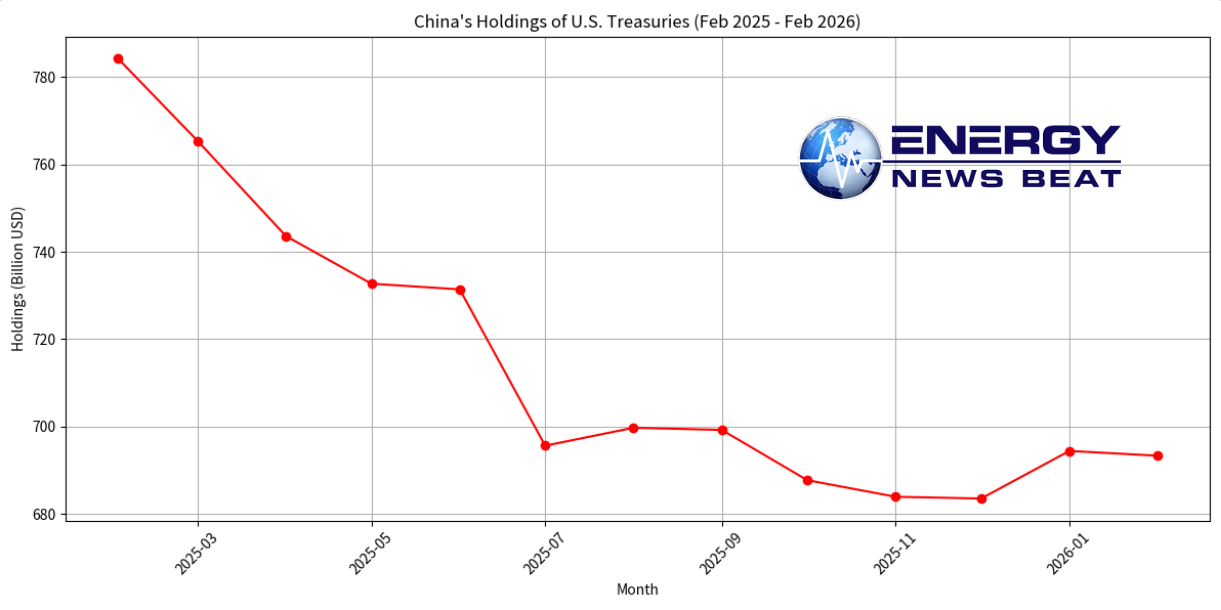
The data shows a clear downward trajectory through 2025, with minor fluctuations in late 2025–early 2026, but the overall pattern of divestment is unmistakable. Over the past decade-plus, China has shed hundreds of billions, now ranking as the third-largest foreign holder behind Japan and the UK.
China’s Gold Buying Surge: The Flip Side of the Coin
Simultaneously, China’s central bank (PBOC) has been aggressively accumulating gold. As of the end of March 2026, the PBOC extended its gold-buying streak to its 17th consecutive month, adding 5 tonnes in March alone to reach approximately 2,313 tonnes officially reported (around 74.38 million fine troy ounces).
Gold now accounts for roughly 9% of China’s foreign exchange reserves. This mirrors a broader global central-bank trend but is particularly pronounced in Beijing’s case, serving as a hedge against dollar assets and geopolitical risks.
The Strait of Hormuz Factor: How Long Can China’s Economy Hold?
The ongoing 2026 Strait of Hormuz crisis—sparked by escalation in the Iran conflict—adds another layer. The strait, through which ~20% of global oil and LNG flows, has seen repeated closures, reopenings, and restrictions as of mid-April 2026, with traffic plummeting over 95% from pre-crisis levels and recent Iranian gunboat actions reported.
China is somewhat insulated compared to other major importers. It maintains massive strategic and commercial crude stockpiles (estimates range from ~900 million to 1.4 billion barrels, covering roughly 3–7 months of net imports depending on drawdown rates and commercial buffers). Beijing has also diversified aggressively toward Russian supplies via pipelines and discounted seaborne cargoes.
Short-term (weeks to a couple of months), China can sustain its economy by drawing reserves, rerouting, and leveraging preferential access for some Chinese-flagged tankers (as Iran has prioritized yuan-denominated trade with Beijing). Prolonged closure beyond 3–4 months, however, would pressure costs, global export demand (China’s manufacturing relies on stable energy for trading partners), and supply chains—potentially shaving growth amid already cautious domestic recovery.
Will This Negatively Impact U.S. Stock Markets on Monday?
China’s gradual Treasury reductions have been priced in for months and represent a small slice of total foreign holdings (now ~7% of the $9.49 trillion held by foreigners). Markets have largely shrugged off the latest TIC data.
The bigger near-term driver for U.S. equities on Monday, April 20, will be oil volatility tied to the latest Hormuz developments. Recent brief reopenings triggered sharp oil drops (>10% in some sessions), boosting risk assets; renewed restrictions could reverse that.
Expect a mixed open: energy stocks may face pressure on any de-escalation hopes, while broader indices could benefit from lower fuel costs. Overall negative spillover from China’s Treasury moves alone is minimal; geopolitics and Fed signals will dominate.
Oil Prices Outlook
Oil remains highly sensitive. Brent and WTI have seesawed wildly since the February conflict onset, spiking above $100 at peaks before pulling back on ceasefire/reopening hopes. Renewed Hormuz restrictions as of April 18 could push prices higher again in the near term, though any sustained diplomatic progress would cap upside.
Key Companies to Watch for Investors on Monday
Energy sector focus amid oil swings:
ExxonMobil (XOM) and Chevron (CVX): Major integrated players positioned to weather volatility; upstream exposure benefits from higher prices.
Shell (SHEL) and BP: Global majors with Middle East ties; watch for refining margins.
Shale/upstream: EOG Resources (EOG), Matador Resources (MTDR) – sensitive to WTI moves.
Midstream: Enterprise Products (EPD), Kinder Morgan (KMI) – stable cash flows from volumes.
Also monitor any China-exposed industrials or gold-related plays if the de-dollarization narrative heats up.
What Consumers Should Look For
At the pump and in wallets: Any oil price relief from Hormuz stabilization could ease gasoline prices (already volatile in recent weeks). Watch for knock-on effects in groceries, plastics, and heating costs if disruptions linger. Broader inflation from energy remains a risk, but short-term relief is possible if diplomatic progress holds.
Appendix: Sources
- U.S. Department of the Treasury TIC Data (Major Foreign Holders): https://ticdata.treasury.gov/resource-center/data-chart-center/tic/Documents/slt_table5.html
- Trading Economics / Treasury Data: https://tradingeconomics.com/united-states/foreign-treasury-holdings-china
- Wolf Street / TIC Analysis (April 2026): https://wolfstreet.com/2026/04/15/the-largest-foreign-holders-of-us-treasury-securities-and-the-basis-trade-april-2026-update/
- Reuters on China Gold Purchases (April 2026): https://www.reuters.com/world/asia-pacific/chinas-central-bank-maintains-gold-buying-17th-month-2026-04-07/
- Gold.org China Market Update: https://www.gold.org/goldhub/gold-focus/2026/04/china-gold-market-update-seasonal-demand-rebound-march
- AP News / Reuters on Strait of Hormuz Status (April 2026 updates): https://apnews.com/live/iran-war-israel-trump-04-19-2026 and related coverage.
- Dallas Fed / Kiel Institute analysis on Hormuz economic impacts: https://www.dallasfed.org/research/economics/2026/0320 and https://www.kielinstitut.de/fileadmin/Dateiverwaltung/IfW-Publications/fis-import/01b7c020-27e6-4096-8cc5-e037738d2058-KPB_206.pdf
- Reuters / Bloomberg reports on China oil reserves and Hormuz resilience.
All data as of latest available reports through mid-April 2026. Markets move fast—monitor official TIC releases and energy news for updates.
The post China Sending a Clear Signal and Dumps U.S. Treasuries appeared first on Energy News Beat.