
Doomberg stops by, and we solve the global oil crisis. – We did not really solve the world’s oil problems, but boy, we sure covered them.
In this Energy Newsbeat podcast episode, hosts Stu Turley and Doomberg dive deep into the interconnected crises reshaping global energy markets and geopolitics. From contested claims about oil flowing through the Strait of Hormuz to Putin’s stranglehold on European natural gas supplies, the conversation reveals how misinformation, geopolitical brinkmanship, and exponential technological change are colliding to create unprecedented uncertainty.
Against this backdrop of energy scarcity and conflict, the hosts explore how artificial intelligence is driving explosive new demand for power, forcing a reckoning between renewable energy mandates and grid reliability. Through sharp analysis and candid debate, they argue that understanding energy flows—and who controls them—is essential to predicting everything from European political upheaval to the viability of AI infrastructure investments. It’s a masterclass in connecting the dots between commodity markets, military strategy, and the future of human civilization.
Shout-out to Dave, one of our great subscribers, for commenting on the live feed.

In a recent interview on Mario Nawfal’s platform, energy researcher and Peak Prosperity founder Chris Martenson delivered a stark assessment of the U.S. Strategic Petroleum Reserve (SPR). Drawing on Department of Energy (DOE) documents, including the Long-Term Strategic Review, Martenson argued that official statements about remaining capacity mask a far more constrained reality.
I found Doomberg’s opinions on Chris Martenson and his insights very entertaining. And I agree that Chris Wright would be the one to know what the bottom of the SPR would be, as he has access to the data. Secretary Wright is one of my most trusted people on the planet. Period.
The reserve is approaching practical limits on what can be responsibly withdrawn without permanently damaging storage infrastructure or sacrificing future strategic capacity.
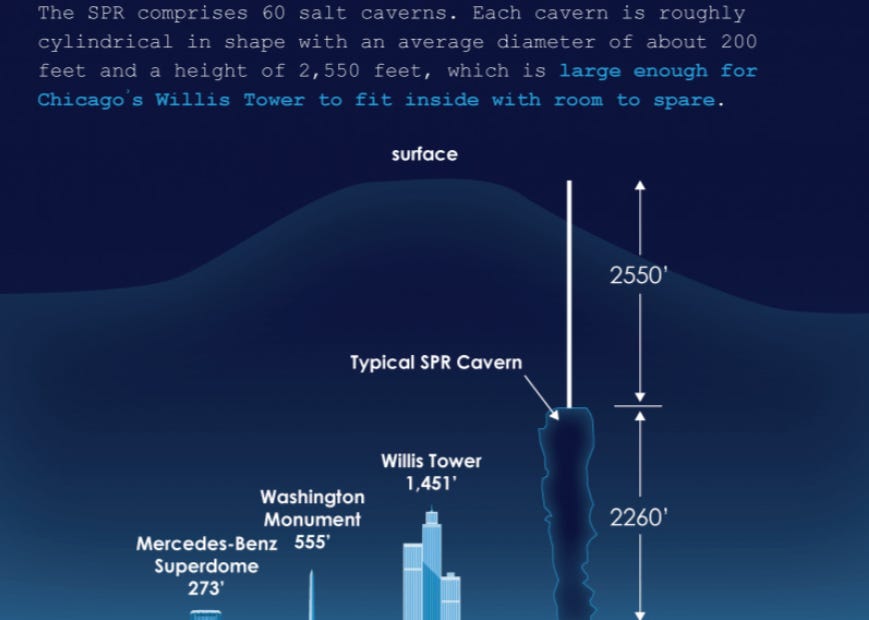
As of the week ending July 31, 2026, SPR crude stocks stood at 304.8 million barrels—the lowest level since 1983—after steady weekly draws. Martenson noted the inventory had dropped 300 million barrels below in subsequent reporting. The authorized storage capacity is approximately 714 million barrels across roughly 60 salt caverns at four Gulf Coast sites (Bryan Mound, West Hackberry, Big Hill, and Bayou Choctaw).
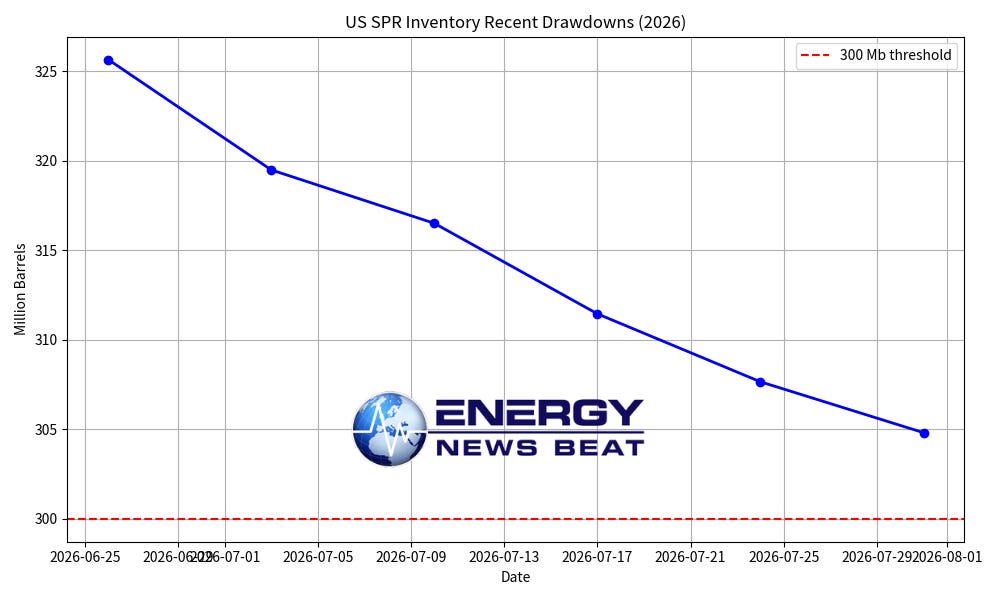
Key Numbers Chris Martenson Highlighted on SPR Levels and Usable Oil
Martenson repeatedly contrasted DOE public messaging with the physical and engineering constraints of the cavern system:
Total design capacity: ~713–714 million barrels.
Single-cycle (also called ESR or “single-use”) caverns: roughly 130 million barrels. These early caverns, created from old salt mines beginning in the mid-1970s, can be drawn down only once. Once emptied, they cannot be reliably refilled or reused for oil storage without major (and often impractical) reconstruction.
Minimum residual (“ullage” or residual blanket) required to protect cavern integrity: about 10% of capacity, or ~71 million barrels. Going lower risks structural damage, reduced future drawdown rates, or permanent loss of storage volume due to salt creep and brine issues.
DOE statements have referenced the ability to draw to ~70 million barrels or claimed hundreds of millions of barrels remain available for extended use (e.g., figures around 243 million barrels in some messaging). Martenson called these “bizarre” and disconnected from operational reality.
His calculations of responsibly available oil have varied slightly with inventory levels and assumptions but consistently show far less headroom than official totals:
At inventories near 311 million barrels, subtracting the 130 million barrels in single-cycle caverns and applying the 10% minimum to the remainder left roughly 123 million barrels of usable oil without permanent damage.
Earlier detailed analysis (drawing on the DOE’s own 123-page Long-Term Strategic Review) put usable oil at ~105 million barrels after accounting for single-cycle volumes, minimum residuals, creep losses, and other constraints. At then-prevailing draw rates of ~9 million barrels per week, that implied only 11–12 weeks of runway (into early-to-mid September under those assumptions).
The real “bottom” of available oil that can be used without irreversible harm, in Martenson’s framing, is therefore not the theoretical residual of ~70 million barrels. It is substantially higher—closer to the combination of single-cycle volumes plus protected residuals in the multi-cycle caverns (often cited in the 180 million barrel range or higher depending on exact inventory and which caverns remain full). Drawing the single-use caverns would permanently shrink the SPR’s future capacity. Continuing aggressive draws risks slower extraction rates as pressure and cavern dynamics degrade.
How the SPR Is to Be Refilled
The SPR is refilled primarily through two mechanisms:
Direct purchases by the DOE on the open market.
Exchanges (the more common tool in recent emergency releases): Companies “borrow” SPR oil and are contractually obligated to return the volume plus a premium (Martenson has cited terms requiring roughly 1.2 barrels returned for every barrel taken in recent arrangements). This creates future demand—e.g., 110 million barrels withdrawn could translate into ~133 million barrels of future obligation. Spread over a year, that alone adds roughly 0.3 million barrels per day of global demand pressure.
Martenson noted that adversaries (particularly Iran in the context of ongoing regional tensions and Strait of Hormuz dynamics) effectively influence the timeline. As long as global inventories trend toward “tank bottoms” and physical tightness persists, the U.S. cannot easily pause draws to begin rebuilding without accepting higher prices or supply stress. Refilling while markets are tight would itself tighten them further. The Iranians, in his view, can simply wait for the reserve to empty under current policy, dictating when the U.S. can afford to start refilling.
Implications for Consumers and the Real Bottom
For American consumers, the SPR has functioned as a short-term buffer against price spikes from geopolitical shocks. Aggressive draws have helped suppress futures prices relative to what physical market tightness (Red Sea, Libya, Russia, Hormuz-related disruptions) would otherwise produce. Martenson described the futures market as increasingly “fake” relative to the real cost of obtaining physical barrels.
Once the responsible bottom is reached—whether defined as the point at which single-cycle caverns must be touched or the multi-cycle residual floors are approached—the buffer disappears. Any new disruption then transmits more directly into pump prices, diesel costs, and broader inflation. Refill obligations add future demand at a time when global inventories are already low. The strategic reserve becomes less of an insurance policy and more of a one-time political tool, leaving the U.S. more exposed to adversary timing and market realities.
In short, the official inventory number (~300 million barrels and falling) may overstate the amount of oil that can still be pulled without long-term self-harm.
Consumers face the prospect of higher and more volatile energy prices once that buffer is exhausted, with fewer tools left to smooth shocks.
The bottom line: Secretary Chris Wright has never given me any reason to doubt anything he has ever been involved in, and I implicitly trust his judgment on the appropriate levels.
Just recorded a really fun podcast with Steven Wang, CEO of Jackery, and it has some great nuggets about home energy security. He was in China for the interview, and it was a blast. I will roll that one out Thursday or Friday.
Shout-out to our great sponsors:

A shout-out to Steve Reese and the Reese Energy Consulting group for sponsoring the Podcast https://reeseenergyconsulting.com/.

Data2 if you have any business systems, can you trust A? Well, they have the patent on validation. . https://data2.zoholandingpage.com/energy
And we have WellDatabase and use their critical tools for the Weekly Rig Report on Energy News Beat. Https://welldatabase.com/
Appendix: Sources and Links
- Mario Nawfal interview posts featuring Chris Martenson (August 11, 2026):
 Chris Martenson argues that Washington made a catastrophic strategic error by assuming it could maintain “escalation dominance” over Iran while drawing down the Strategic Petroleum Reserve. His warning: Iran can simply wait. As global inventories fall toward “tank bottoms,”
- and related threads/quoted videos.
- Chris Martenson X posts analyzing SPR constraints, single-cycle caverns, and usable volumes (June–August 2026), including detailed breakdowns referencing DOE documents: e.g.,
- ,
- , and related threads.
- Peak Prosperity analysis: “How Much Longer Can the SPR Be Drained?” (based on DOE Long-Term Strategic Review): https://peakprosperity.com/how-much-longer-can-the-spr-be-drained-spoiler-september/
- EIA Weekly Stocks of SPR Crude Oil: https://www.eia.gov/dnav/pet/pet_stoc_wstk_a_epc0_sas_mbbl_w.htm (data through week ending July 31, 2026: 304.809 million barrels).
- DOE SPR Quick Facts and capacity details: https://www.energy.gov/hgeo/opr/spr-quick-facts (authorized capacity ~714 million barrels).
- DOE on SPR sales and exchanges: https://www.energy.gov/ceser/spr-sales-and-exchanges and
https://www.spr.doe.gov/
- Bipartisan Policy Center explainer on SPR operations and recent inventory: https://bipartisanpolicy.org/explainer/how-the-u-s-strategic-petroleum-reserve-works/
- Related Mario Nawfal/YouTube segments with Martenson transcripts discussing the 70 Mb claim, 130 Mb single-use caverns, and 10% residual (July 2026 episodes).
- GAO reports on SPR infrastructure and planning limitations (referenced in broader context of operational constraints).
Data and interpretations are drawn from publicly available DOE/EIA figures and Martenson’s published analyses of those documents as of mid-August 2026. Inventory levels continue to be updated weekly by the EIA.
The post Doomberg and the New Oil and Gas Markets Post Hormuz appeared first on Energy News Beat.