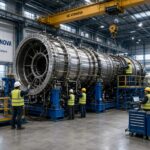
Order a heavy-duty gas turbine from GE Vernova today, and it will not arrive until 2031. That production reality, confirmed on the company’s July 22, 2026, earnings call, sits beneath nearly every ambitious AI data-center power plan announced in recent years. GE Vernova closed the second quarter with a combined gas-power equipment backlog and slot-reservation agreements of 116 GW—up from 100 GW in the prior quarter and 83 GW at the end of 2025. Management expects the total under contract to reach at least 125 GW by year-end. Of the current 116 GW, roughly 53 GW represents firm equipment backlog while 63 GW consists of paid slot reservations.
This is not a story about natural-gas prices. Henry Hub spot prices hovered around $2.79/MMBtu in mid-August 2026, with full-year averages near $3.31—unremarkable by recent standards. The constraint is manufacturing capacity and the specialized supply chain behind it.
The Manufacturing Bottleneck, Not the Fuel
Global manufacturing capacity for heavy-duty gas turbines sits at only 60–70 GW per year, according to Wood Mackenzie, while outstanding orders have reached roughly 110 GW. Second-quarter 2026 orders alone hit a record 38 GW (up 71% year-over-year), with the United States accounting for about half. Lead times for new combined-cycle plants have stretched from 3.5 years in 2023 to roughly five years today, and up to seven years for some heavy-duty frames.
The choke points are structural. Hot-section castings—the blades and vanes that endure extreme temperatures—come from a limited set of specialized foundries. Skilled welders, machinists, and installation contractors were laid off during the lean 2010s and have not been fully replaced. Even when a production slot exists, qualified field labor remains scarce. Turbine prices themselves are projected to reach $600/kW by the end of 2027, a 195% increase from 2019 levels. Average combined-cycle project costs have already climbed to around $2,157/kW.
Siemens Energy closed its fiscal third quarter with a 69 GW firm gas-turbine backlog after booking 15 GW and shipping 6 GW; lead times run three years or more. Mitsubishi Heavy Industries reported a 35 GW backlog for large-frame turbines alone (up from 23 GW a year earlier), with deliveries scheduled between 2028 and 2030. The three manufacturers together dominate the market, yet their combined output cannot keep pace with the surge.
AI’s Power Appetite Meets Reality
Goldman Sachs projects U.S. data-center power demand rising from 31 GW in 2025 to 41 GW in 2026 and 66 GW in 2027. Scheduled capacity additions accelerate to 36.3 GW in 2027 alone—more than the entire industry’s annual manufacturing capacity. By then, data centers could represent 8.5% of U.S. peak summer demand, up from 4.1% today. Only a fraction of announced projects are expected to materialize on schedule; Goldman assumes 50–60% of near-term capacity will arrive on time.
In the United States, natural gas remains the fastest practical option for firm, dispatchable power. Hyperscalers and developers are increasingly turning to behind-the-meter and captive generation to bypass multi-year grid interconnection queues. Texas, the PJM region, and other markets have seen audits, pauses on speculative interconnections, and capacity-auction shortfalls. PJM’s July 2026 auction for 2028/2029 cleared at the $325/MW-day FERC cap for a third consecutive year, still falling 6,831 MW short of reliability requirements and attracting only 525 MW of new generation.
Elsewhere the mix differs. China continues to rely heavily on coal for data centers while rapidly adding renewables. Europe leans on renewables paired with nuclear and storage, supported by stricter clean-power requirements for data centers. Japan, Korea, and parts of the Middle East and Southeast Asia are pursuing combinations of gas, nuclear, and renewables. Nuclear restarts (Three Mile Island, Palisades) and new small modular reactor agreements by Microsoft, Google, Amazon, Meta, and others are accelerating, but most will not deliver meaningful capacity before the early 2030s. Reciprocating engines, aeroderivative turbines, fuel cells, and delayed coal/gas retirements are filling some near-term gaps, yet many of those order books are also full into 2028.
Implications for Consumers and Investors
Consumers face upward pressure on electricity rates. Capacity shortages and soaring equipment costs feed into utility rate cases and capacity markets. Higher wholesale prices and the need for new transmission and generation infrastructure ultimately appear on residential and commercial bills. Regions with tight markets such as PJM and parts of Texas are already seeing elevated capacity prices that signal scarcity.
Investors confront a two-sided picture. Turbine manufacturers—GE Vernova, Siemens Energy, and Mitsubishi Heavy Industries—enjoy pricing power, healthy free cash flow from customer deposits on slot reservations, and multi-year revenue visibility. Services and aftermarket opportunities will expand as the installed base of high-capacity-factor machines grows. Conversely, AI hyperscalers and data-center developers face delayed timelines, higher capital costs, and the risk that only a portion of announced campuses come online as planned. Utilities, independent power producers, and engineering-procurement-construction firms with secured turbine slots stand to benefit; those without face project deferrals. Capital is also flowing toward nuclear, geothermal, long-duration storage, and alternative generation technologies that can partially substitute for scarce heavy-duty turbines.
What Major Manufacturers Can Do
The manufacturers are not idle. GE Vernova plans to raise annualized gas-turbine output from roughly 20 GW currently toward 24 GW by 2028 and 30 GW by 2030, largely within its existing manufacturing footprint, while investing in generator production. Siemens Energy is adding manufacturing units (targeting roughly 50 large gas turbines) and expanding transformer capacity 50% by 2030; it has also announced a $1 billion U.S. investment. Mitsubishi intends to double large-frame capacity by fiscal 2030 relative to 2024 levels and is investing hundreds of millions in Japan and U.S. operations.
Beyond simple capacity additions, companies are:
- Using slot-reservation agreements with deposits to manage demand and generate working capital.
- Being selective on projects to protect margins and delivery reliability.
- Investing in specialized foundries, additive manufacturing for bottleneck components, and workforce training/recruitment to rebuild the skilled-labor pool.
- Expanding services and maintenance offerings that will generate long-term revenue as the new fleet ages.
- Exploring modular and aeroderivative solutions that can be produced or delivered faster for certain data-center applications.
Even aggressive expansion will take years to close the gap. The industry remembers the last boom-and-bust cycle of the early 2000s, when excess capacity led to factory closures and lost skills. Manufacturers are therefore expanding cautiously, prioritizing sustainable rather than speculative growth.
The Road Ahead
The AI race is no longer constrained primarily by chips or algorithms; reliable, scalable power has become the binding limit. Gas turbines remain the most deployable firm-power solution in the near term for the United States, yet the manufacturing pipeline cannot meet 2027 demand. Countries and companies that secure equipment early, accelerate nuclear and alternative pathways, streamline permitting and interconnection, and invest in grid flexibility will gain an edge. Those that do not will see projects delayed, costs escalate, and competitive positions erode.
For the Energy News Beat audience, the 116 GW backlog is more than a corporate statistic. It is a clear signal that the physical infrastructure of the energy system is now pacing the digital economy—and that manufacturing reality, not fuel price, is the decisive variable.
Appendix: Sources and Links
- OilPrice.com – “The Gas Turbine Shortage Just Became AI’s Biggest Constraint” by Michael Kern (Aug 22, 2026): https://oilprice.com/Energy/Energy-General/The-Gas-Turbine-Shortage-Just-Became-AIs-Biggest-Constraint.html
- Utility Dive – “GE Vernova gas turbine backlog climbs to 116 GW” (July 23, 2026): https://www.utilitydive.com/news/ge-vernova-gas-turbine-backlog-climbs-to-116-gw/826039/
- Utility Dive – “Siemens Energy’s gas turbine backlog nears 70 GW…”: https://www.utilitydive.com/news/siemens-gas-turbine-backlog-nears-70-gw-as-company-expands-manufacturing/827390/
- Utility Dive – “Mitsubishi’s large-frame gas turbine backlog reaches 35 GW”: https://www.utilitydive.com/news/mitsubishi-gas-turbine-backlog-earnings/827761/
- Wood Mackenzie – “Gas turbine prices soar 195% as market faces supply-demand crisis” (April 1, 2026): https://www.woodmac.com/press-releases/gas-turbine-prices-soar-195-as-market-faces-supply-demand-crisis/
- Goldman Sachs insights on U.S. data-center power demand (referenced across reporting)
- GE Vernova Q2 2026 earnings materials and webcast (July 22, 2026)
- PJM Interconnection 2028/2029 Base Residual Auction results
- IEA reports on Energy and AI (2026)
- Additional supporting coverage from Turbomachinery Magazine, CompressorTECH², Nikkei Asia, BloombergNEF project-cost data, and regional capacity-auction reports.
The post GE Vernova’s Gas Turbine Backlog Hits 116 GW. What Does This Mean for the AI Market? appeared first on Energy News Beat.