
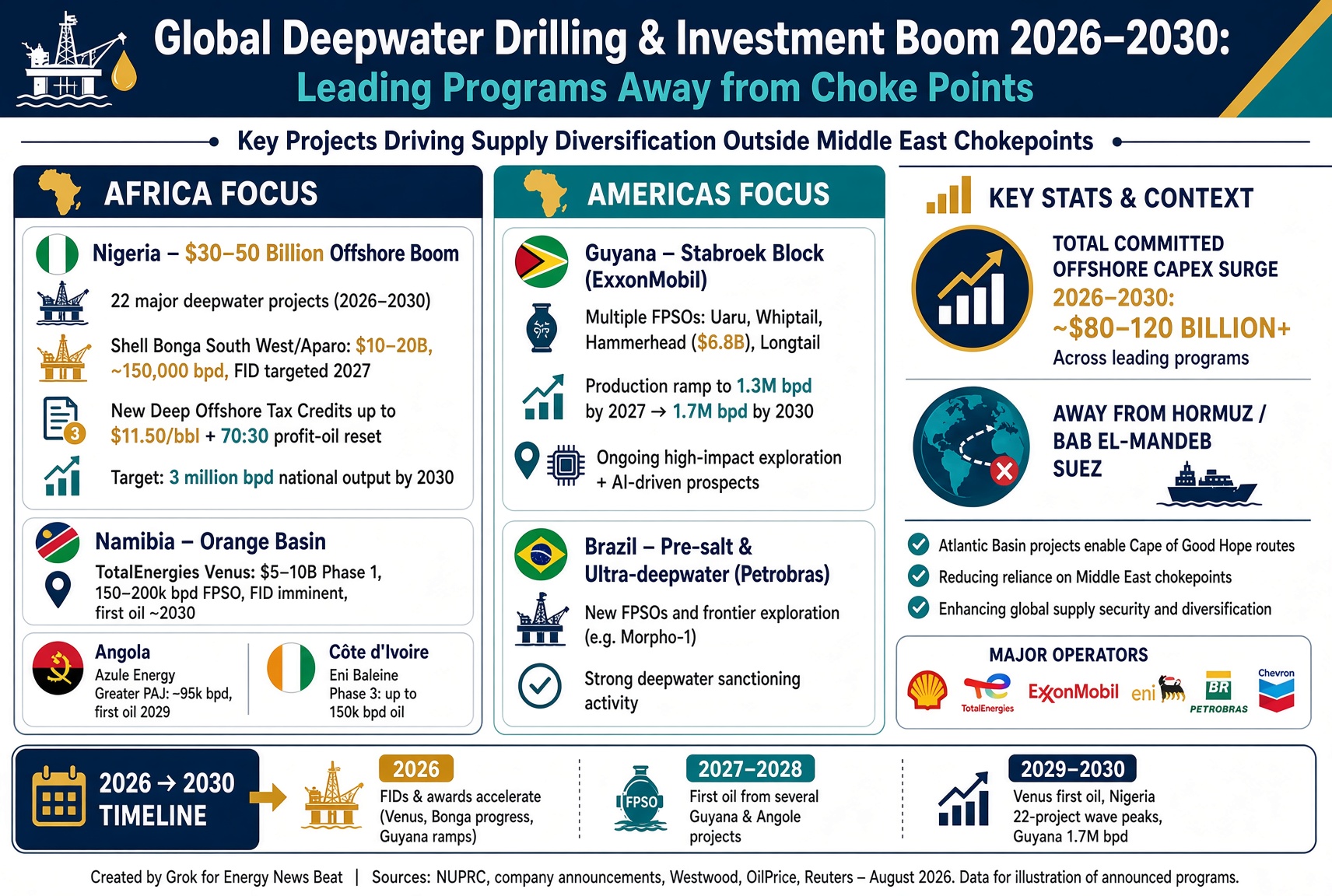
Nigeria is positioning itself at the forefront of a global shift in oil and gas investment, targeting up to $50 billion in new offshore projects that could help diversify supplies away from the world’s most vulnerable maritime chokepoints. The Nigerian Upstream Petroleum Regulatory Commission (NUPRC) has highlighted that new incentives for offshore oil and gas developments have the potential to attract $50 billion in investment. These incentives form part of a broader deep-offshore framework recently approved by President Bola Tinubu, designed to replace project-by-project negotiations with transparent, rules-based fiscal terms. The framework aims to restart long-stalled capital-intensive developments and is expected to support 22 major offshore projects coming on stream between 2026 and 2030.
Annual investment in Nigeria’s oil and gas sector had slumped from $26 billion in 2014 to around $2 billion in recent years. Production has shown recovery: total oil output rose from 1.48 million barrels per day (bpd) in February 2026 to 1.735 million bpd in June, and Nigeria exceeded its OPEC+ quota of 1.5 million bpd for a third consecutive month in July (1.505 million bpd crude plus 170,000 bpd condensate). The country targets 2 million bpd within two years via NNPC and 3 million bpd by 2030.
A flagship project under the new framework is Shell’s long-delayed Bonga South West/Aparo (BSWAP) development. Estimates for the project range from approximately $10 billion to $20 billion; it is expected to produce around 150,000 bpd of oil plus associated gas once online, with a final investment decision targeted for 2027 and a dedicated FPSO. Shell and partners have already advanced expressions of interest for the vessel. Additional activity includes Shell’s HI gas project and other field development plans, with the NUPRC reporting more than $57 billion in approved field development plans since 2024.
Global context: New drilling programs beyond traditional flashpoints
Nigeria’s push coincides with a broader acceleration in offshore sanctioning and high-impact exploration outside the Middle East. Global offshore field development committed capital has surged, with Westwood recording a near-doubling of FIDs in the first half of 2026 and forecasts of more than $137 billion in total offshore investment for the year.
Key concurrent programs include:
Guyana (ExxonMobil-led Stabroek Block): Multiple successive FPSO developments (Uaru, Whiptail, Hammerhead at ~$6.8 billion, Longtail gas-condensate project, and evaluation of a ninth FPSO). Production is scaling toward 1.3 million bpd by 2027 and potentially 1.7 million bpd by 2030. ExxonMobil continues active exploration, including AI-assisted prospect identification and new wells.
Namibia (Orange Basin): TotalEnergies’ Venus project (partners QatarEnergy, Impact Oil & Gas, NAMCOR) is advancing toward FID, with Phase 1 capex estimated at $5–10 billion, recoverable resources of ~750 million boe initially (field potential higher), and first oil targeted around 2030. An FPSO of 150,000–200,000 bpd capacity is in competitive tender. The basin has drawn significant high-impact well activity.
Angola and Côte d’Ivoire: Azule Energy’s Greater PAJ project (Blocks 31/31/21) was sanctioned, targeting ~95,000 bpd peak and first oil in 2029. Eni’s Baleine Phase 3 offshore Côte d’Ivoire will raise oil output toward 150,000 bpd. TotalEnergies continues development and exploration in Angola, including Kaminho.
Brazil and other Atlantic/Latin American plays: Petrobras remains highly active in pre-salt and ultra-deepwater, with new FPSOs and exploration (including Morpho-1). Argentina’s Vaca Muerta and additional South American activity add further non-OPEC growth.
These projects involve major international oil companies—Shell, TotalEnergies, ExxonMobil, Eni, Chevron, Petrobras, and national partners such as NNPC, NAMCOR, and QatarEnergy—alongside service providers for FPSOs, subsea systems, and drilling.
Relationship to global oil chokepoints
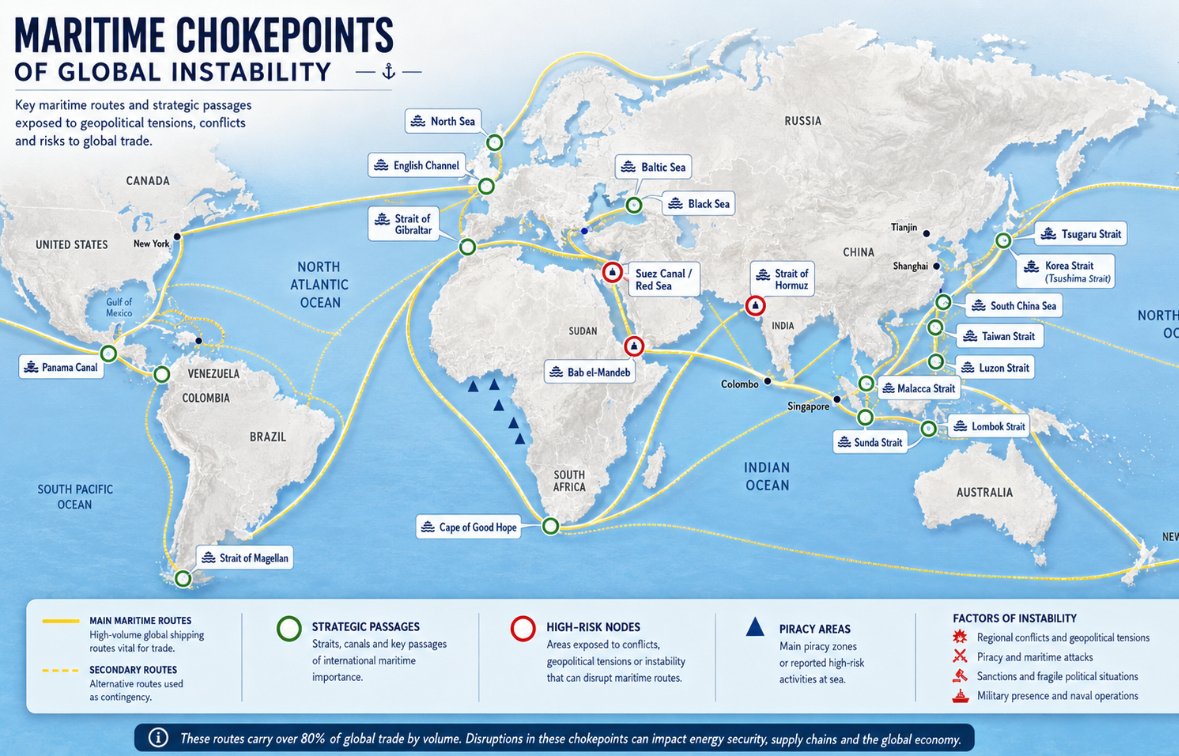
The world’s primary oil transit chokepoints—Strait of Hormuz (historically ~20 million bpd), Strait of Malacca, Bab el-Mandeb, Suez Canal/SUMED, and others—remain critical vulnerabilities. In 2026, conflict-related disruptions sharply reduced Hormuz flows (to under 5 million bpd in parts of the year) and elevated risks at Bab el-Mandeb as alternative routing increased.
Nigeria’s deepwater assets, along with those in Namibia, Angola, Côte d’Ivoire, Guyana, and Brazil, sit in the Atlantic basin. Crude from these regions can move to Europe, the Americas, or Asia via the Cape of Good Hope without transiting Hormuz, the Red Sea, or Suez. This geographic advantage supports energy security by reducing concentration risk in the Persian Gulf and adjacent waterways. Gulf producers themselves are expanding pipeline bypasses (Saudi East-West, UAE Fujairah routes), but new Atlantic production adds genuine volume diversification rather than mere rerouting of existing Middle East barrels.
Implications for consumers and investors
For consumers, expanded non-chokepoint supply should improve long-term resilience against geopolitical shocks. Near-term price volatility linked to Middle East disruptions can be moderated as these projects ramp (most first oil in the late 2020s to early 2030s). Greater geographic diversity reduces the risk of simultaneous supply interruptions cascading into sustained high prices or shortages of refined products.
Investors gain exposure to multi-decade, high-margin deepwater and frontier developments. Majors with strong positions in Guyana, Namibia, Nigeria, and Brazil offer growth trajectories less tied to OPEC quota politics. Offshore contractors (FPSO builders, subsea specialists, drillers) benefit from the surge in sanctions and awards. Risks include project execution delays, cost inflation, eventual market oversupply if demand softens, and residual security or fiscal challenges in host countries. Capital discipline remains essential; the current cycle favors projects with competitive breakevens and local content benefits.
Nigeria’s combination of regulatory reform, production recovery, and proximity to established Atlantic shipping lanes positions it to capture a meaningful share of the capital seeking secure, scalable barrels outside traditional flashpoints. If the 22-project pipeline and Bonga South West advance as planned, Africa’s largest oil producer can help anchor a more resilient global supply map for the next decade.
Appendix: Sources and Links
- https://oilprice.com/Latest-Energy-News/World-News/Nigeria-Eyes-50-Billion-Offshore-Oil-and-Gas-Investment-Boom.html
- https://dailytrust.com/nigeria-eyes-50bn-investments-from-22-offshore-projects/
- https://www.reuters.com/business/energy/nigeria-targets-up-50-billion-offshore-oil-gas-investment-by-2030-regulator-says-2026-08-06/
- https://www.reuters.com/business/energy/nigeria-approves-deep-water-oil-investment-framework-aimed-unlocking-50-bln-2026-08-11/
- https://statehouse.gov.ng/president-tinubu-approves-landmark-deep-offshore-investment-framework-to-unlock-up-to-us50-billion-in-new-investment/
- https://businessday.ng/energy/article/nigeria-targets-50bn-offshore-boom-as-projects-gather-pace/
- https://africa.businessinsider.com/local/markets/africas-top-oil-producer-targets-dollar50-billion-offshore-comeback-as-it-battles/yvg1m0t
- https://epcintel.com/insight/nnpc-moves-to-unlock-20bn-bonga-southwest-aparo-development-104
- https://www.africanpeacemagazine.com/shell-launches-search-for-150000-bpd-fpso-as-bonga-south-west-project-races-toward-2027-decision/
- https://www.oedigital.com/news/542194-deepwater-fids-set-to-drive-sub-saharan-africa-production-growth
- https://splash247.com/offshore-project-sanctioning-nearly-doubles-as-operators-ramp-up-spending/
- https://www.offshore-mag.com/field-development/article/55364023/top-5-projects-to-watch-operators-advance-field-development-plans
- https://www.marketwatch.com.na/market-watch/totalenergies-eyes-july-fid-on-venus-nmh014264-3015-17644
- https://www.marketwatch.com.na/market-watch/hanwha-ocean-sbm-offshore-battle-for-10bn-venus-fpso-nmh012781-3015-15645
- https://epcintel.com/insight/exxonmobil-sanctions-68-billion-hammerhead-project-offshore-guyana-55
- https://oilnow.gy/news/guyana-flagged-as-hotspot-as-majors-target-ultra-deepwater-to-close-300-billion-barrel-gap-wood-mackenzie/
- https://www.eia.gov/beta/international/regions-topics.php?RegionTopicID=WOTC
- https://www.rigzone.com/news/how_much_oil_transited_through_worlds_chokepoints_in_2q-12-aug-2026-184358-article/
- https://globalenergymonitor.org/research/what-moves-gulf-crude-when-hormuz-strait-cant
- https://energy-oil-gas.com/news/why-gulf-states-are-racing-to-bypass-the-worlds-biggest-oil-chokepoint/
- Additional supporting coverage from Reuters, Businessday NG, OilPrice.com earlier articles, Westwood Global Energy Group analyses, and company announcements referenced in the above.
The post Nigeria looks to lead the oil and gas investment boom away from choke points appeared first on Energy News Beat.