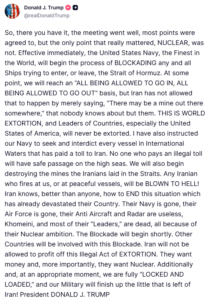
In a sharp escalation following the collapse of direct U.S.-Iran peace negotiations in Pakistan, President Donald Trump has ordered the U.S. Navy to enforce an immediate blockade in the Strait of Hormuz. The directive specifically targets vessels that pay or attempt to pay illegal tolls to Iran’s Islamic Revolutionary Guard Corps (IRGC), which has been operating a de facto “toll booth” system to control traffic through the world’s most critical energy chokepoint. Trump’s announcement came hours after Vice President JD Vance’s delegation left Islamabad without a deal. The president stated that “no one who pays an illegal toll will have safe passage,” framing the blockade as a direct enforcement of freedom of navigation and a response to Iran’s violation of ceasefire terms that were supposed to reopen the strait.

The move marks a significant shift from earlier warnings. Just days ago, Trump had publicly cautioned Iran against charging fees on tankers, posting on Truth Social: “There are reports that Iran is charging fees to tankers going through the Hormuz Strait — They better not be and, if they are, they better stop now!” He had even floated the idea of a U.S.-Iran “joint venture” to manage tolls, but reports of the IRGC’s vetting process and multimillion-dollar demands on select vessels prompted the harder line.
Qatar Announces Partial Resumption of Navigation
Adding to the fluid situation, Qatar’s Ministry of Transport announced that maritime navigation will resume for all vessel types in Qatari waters and approaches to the Strait of Hormuz. Starting Sunday, April 12, operations will run from 6 AM to 6 PM local time, following U.S. Central Command (CENTCOM) efforts to clear Iranian mines. Qatari officials described the step as a confidence-building measure amid ongoing communications to fully reopen the waterway.
While not a full reopening, the announcement signals improving conditions for Gulf energy exporters, particularly Qatar’s LNG fleet, which had been largely sidelined during the crisis.
Pakistan Talks Collapse: No Agreement Reached
The U.S.-Iran face-to-face negotiations in Islamabad, mediated by Pakistan and lasting nearly 21 hours, ended without a breakthrough. Vice President Vance confirmed the failure, noting that disagreements centered on Iran’s nuclear program, sanctions relief, and control of the Strait of Hormuz. Iranian media cited “excessive” U.S. demands, while U.S. officials emphasized that Tehran rejected key red lines. The fragile two-week ceasefire now hangs in the balance.
Blockade Tactics vs. Capturing Kharg Island: Strategic Trade-Offs
Military analysts are closely watching how the U.S. enforces the blockade. A naval quarantine focused on intercepting toll-paying vessels offers a lower-risk alternative to more aggressive options, such as seizing Iran’s primary oil export terminal at Kharg Island.Blockade approach: U.S. forces can interdict tankers at sea—outside the range of most Iranian shore-based systems—effectively choking Iran’s oil revenue without putting ground troops at risk. This mirrors past sanctions enforcement (e.g., against Venezuelan oil) and directly counters the IRGC’s toll system while upholding freedom-of-navigation principles.
Kharg Island option: Capturing or disabling the island would cripple nearly all of Iran’s ~1.6 million barrels per day (bpd) of crude exports. However, experts warn it would require suppressing air defenses, neutralizing naval threats, and holding the facility—exposing U.S. forces to drones, missiles, and potential high casualties. A sea-based blockade of Kharg-loaded tankers achieves similar economic pressure with far less risk.
The Trump administration appears to have chosen the blockade route as a calibrated lever to force compliance without immediate escalation to full-scale assault on Iranian territory.
Oil Market Implications: Saudi Bypass Pipeline Provides Critical Buffer
Global oil markets remain on edge, but a key mitigating factor is already in play. Saudi Arabia’s East-West Pipeline (Petroline) is now operating at its full 7 million bpd capacity, rerouting crude from the Gulf to the Red Sea port of Yanbu. Roughly 5 million bpd of that volume is available for export, with additional refined products moving through the system.
This bypass—built decades ago precisely for scenarios like the current crisis—has allowed Saudi Aramco to maintain robust exports despite the Hormuz disruptions. The UAE’s Fujairah pipeline provides another incremental outlet. Combined, these alternative routes offset a significant portion of the roughly 20 million bpd that normally flows through the strait.
Price outlook: Short-term volatility is expected as traders digest the blockade news and the fragile ceasefire.
The Saudi bypass and partial Qatari reopening should prevent a total supply shock, capping upside risk compared with a full Strait closure.
However, any escalation—such as Iranian retaliation or expanded U.S. interdiction—could still drive prices higher, especially if insurance premiums and war-risk surcharges remain elevated. Analysts will watch Brent and WTI closely in the coming days for signs of sustained premium or rapid stabilization.
Energy News Beat will continue monitoring tanker tracking data, pipeline throughput, and any official statements from the White House or Tehran for further developments.
Appendix: Sources and Links
- Trump warns Iran on tolls and announces blockade: The Hill, Bloomberg, Reuters (April 9–12, 2026)
https://thehill.com/policy/international/5825224-donald-trump-iran-strait-of-hormuz-tolls/
https://www.bloomberg.com/news/articles/2026-04-09/trump-warns-iran-not-to-charge-fees-for-ships-transiting-hormuz - Qatar resumption announcement: Al Arabiya, social media updates from Qatari authorities (April 2026)
https://english.alarabiya.net/News/gulf/2026/03/16/qatar-says-communications-ongoing-to-ensure-strait-of-hormuz-is-fully-opened - Pakistan talks failure: NBC News, Reuters, AP (April 12, 2026)
https://www.nbcnews.com/world/iran/live-blog/live-updates-trump-iran-hormuz-israel-lebanon-ceasefire-talks-pakistan-rcna285140 - Kharg Island analysis: CSIS, ABC News (March–April 2026)
https://www.csis.org/analysis/if-trump-strikes-iran-mapping-oil-disruption-scenarios - Saudi East-West Pipeline at full capacity: Reuters, Bloomberg (March 28, 2026)
https://www.reuters.com/business/energy/saudi-pipeline-pumping-7-million-bpd-oil-bypassing-hormuz-bloomberg-news-reports-2026-03-28/
Energy News Beat delivers independent, market-focused coverage of global energy developments. Follow us for real-time updates on oil, gas, and geopolitics.
The post President Trump Orders Blockade of Ships Paying Tolls to IRGC appeared first on Energy News Beat.