Dr. Matthew M. Wielicki on X has some fantastic points and we recommend following him. Oh, and he was a guest on the Energy News Beat Podcast.
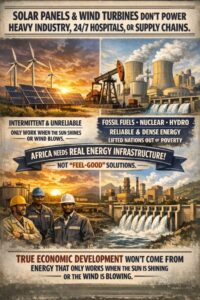
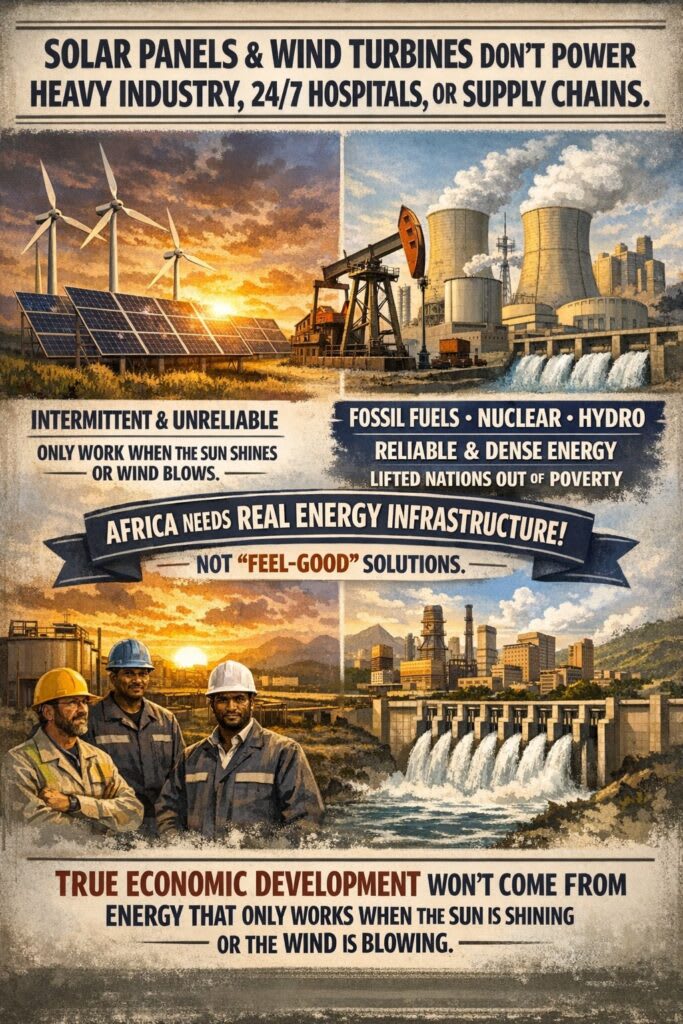
Dr. Matthew Wielicki cut to the heart of the matter in his recent post: “Solar panels and wind turbines don’t power heavy industry, 24/7 hospitals, or supply chains. Reliable, dense energy sources like fossil fuels, nuclear, and large-scale hydro are what lifted every industrialized nation out of poverty, not intermittent renewables. If the goal is true economic development, countries need real energy infrastructure, not feel-good solutions that only work when the sun is shining or the wind is blowing.”
He’s right—and the data backs him up. The current Levelized Cost of Energy (LCOE) metric, the one endlessly cited by renewable advocates, is fundamentally broken for policy-making. It measures only the lifetime cost of a single plant divided by the electricity it produces. It ignores the massive system-wide costs that wind and solar impose on the entire grid: intermittency, backup requirements, grid resiliency upgrades, energy storage mandates, and the accelerated wear-and-tear on dispatchable natural gas and coal turbines that must ramp up and down to balance the weather-dependent output.Until we redefine LCOE to reflect true system costs—including grid resiliency and forcing wind and solar developers to pay for the storage and balancing services they require—American families and businesses will continue paying higher electricity bills while policymakers chase the illusion of “cheap” renewables.
The Flawed LCOE Narrative vs. Real-World Pricing
Official reports still trumpet wind and solar as the cheapest new-build options. The latest Lazard LCOE+ analysis shows unsubsidized utility-scale solar at $38–$217/MWh and onshore wind at $37–$86/MWh—often beating new natural gas combined-cycle plants on paper.
IRENA’s 2024 data echoes this, with global weighted-average LCOE for onshore wind at $34/MWh and solar PV at $43/MWh.
But these numbers are misleading because they treat wind and solar as if they were dispatchable baseload resources. They are not. Wind and solar capacity factors in the U.S. average only ~34% for wind and ~23–25% for solar.
When the sun sets or the wind dies, the grid still needs firm power—usually from spinning gas or coal turbines that must stay online or ramp rapidly.
Subsidies, Curtailment, and the “Paid Not to Produce” Distortion
Wind and solar already receive enormous federal subsidies—Production Tax Credit (PTC) for wind and Investment Tax Credit (ITC) for solar—that have totaled tens of billions annually and continue to distort markets. These credits allow developers to bid negative prices into wholesale markets, flooding the grid with power when it isn’t needed and driving down (or even negative) prices for everyone else.
Curtailment is exploding. In California’s CAISO alone, over 3.4 million MWh of renewables were curtailed in 2024—an increase of 29% year-over-year, mostly solar. Texas’s ERCOT has seen similar spikes. In some cases, contracts or market rules effectively compensate producers for not generating, or the subsidies continue to flow even when output is wasted. This is the opposite of efficient pricing. Reliable plants that can produce on demand are forced to back down or cycle inefficiently, while subsidized intermittent sources get paid anyway.
The Hidden Costs: Grid Resiliency, Storage, and Turbine Wear-and-Tear
Intermittent resources don’t pay their fair share for the services they demand from the rest of the system:
Backup and balancing: Grid operators must keep gas and coal plants spinning as reserves. NREL studies on high-renewable penetration show increased cycling costs of $35–$157 million per year in some regions—translating to $0.5–$1.3/MWh in added operations and maintenance for thermal plants. Every extra start-up, ramp, and shutdown shortens equipment life and raises maintenance bills that ultimately hit ratepayers.
Storage and resiliency: Wind and solar cannot provide the 24/7 reliability the grid demands without massive battery backup. Lazard’s own LCOE+ shows solar + storage jumping to $50–$131/MWh and wind + storage to $42–$114/MWh. Yet today, developers rarely bear the full cost of firming their output. Ratepayers and dispatchable generators subsidize it through ancillary service markets and grid upgrades.
Transmission and integration: Billions are spent on new high-voltage lines to connect remote wind and solar farms—costs not assigned back to the intermittent generators in most LCOE calculations.
Studies that attempt to capture these “Levelized Full System Costs” or “Value-Adjusted LCOE” show the picture changes dramatically. When backup, storage, grid balancing, and resiliency are properly allocated, the true cost of high wind/solar penetration often exceeds that of reliable dispatchable sources.
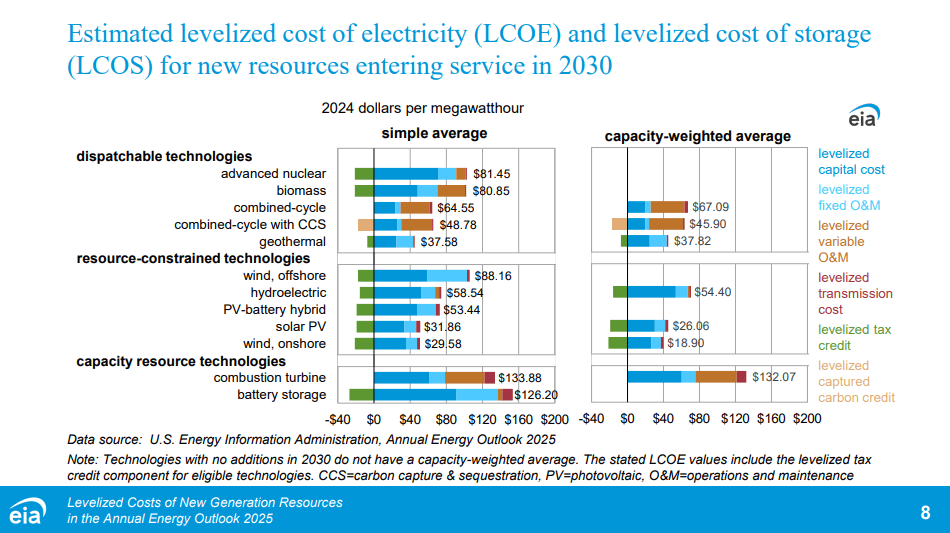
In the EIA Report for 2025, Has Issues
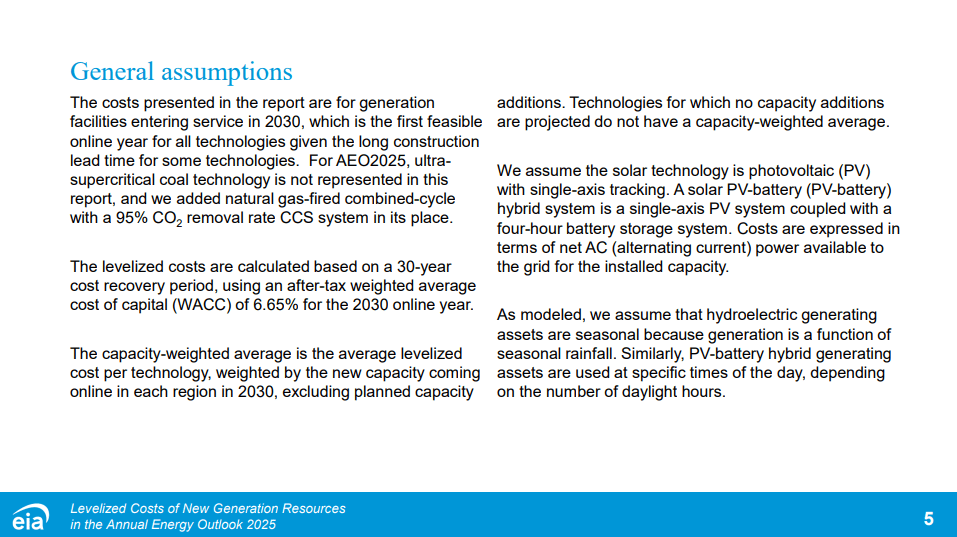
“General assumptions on pricing on a 30 Year cost recovery period.”
Wind turbines and solar panels don’t last 30 years, and we have seen that Warren Buffett was right. Wind and Solar don’t have land reclamation in their projects, as they are insolvent on day one if it’s added, and they don’t pay for grid reliability. The magic number for wind farms is 8 years. Rate payers get increases, as the funding had allowed for “name plate” upgrades to systems, and then those are going to start running out. I had a whistleblower call, and they gave me stats that were shocking at 3 years, and until court cases are finished, I can not print those numbers. Let’s just say we are not told the true cost of wind.
Wind and solar will start seeing huge requests for rate increases over the next 5 years as subsidies wind down.
Grid managers need to start looking at this problem today and plan accordingly.
On page 8 of the report, after resources enter in 2030, there are some issues that appear to be set up for higher prices. “Levelized Captured Carbon Credits” really needs to go away, as carbon capture is really not capturing pollution, but a wealth transfer in my opinion. Natural Gas and Coal plants that have scrubbers and capture particulate matter and harmful gases are actually better for the environment when you calculate in the amount of fossil fuels used in building the wind, solar, and additional grid improvements just to get them on the grid.
The Solution: Redefine LCOE to Include Grid Resiliency—and Make Renewables Pay Their Share
The fix is straightforward and market-friendly:
Update the LCOE metric to a “Levelized System Cost of Energy” that includes integration, balancing, storage, and resiliency charges.
Require wind and solar projects to procure or pay for firming: Developers must either co-locate sufficient storage, sign firming contracts with dispatchable generators, or pay a grid-resiliency fee that covers the incremental wear and tear and ancillary services their intermittency imposes.’
Phase out market-distorting subsidies that allow negative bidding and unpriced curtailment.
This isn’t anti-renewable—it’s pro-rational economics. When developers internalize the full cost of their technology, the market will naturally select the optimal mix: renewables where they make sense (with storage), and reliable baseload where it delivers the lowest system cost. The result? Fewer forced cycling events on gas and coal turbines, lower overall maintenance and replacement costs, reduced curtailment waste, and—most importantly—lower electricity prices for American consumers and industry.
Dr. Wielicki’s point is clear: feel-good intermittent solutions cannot replace the dense, reliable energy infrastructure that built modern civilization. By redefining LCOE to reflect reality, we stop subsidizing the problem and start solving it. Energy News Beat has long argued for honest accounting in energy markets. It’s time policymakers listened—before the hidden costs of the current approach become even more painfully obvious on your next electricity bill.
Check out Dr. Matthew Wielicki’s Substack:

Appendix: Sources and Links
- Dr. Matthew Wielicki’s X post (March 31, 2026):
- Lazard Levelized Cost of Energy+ (June 2025): https://www.lazard.com/media/uounhon4/lazards-lcoeplus-june-2025.pdf
- IRENA Renewable Power Generation Costs in 2024: https://www.irena.org/-/media/Files/IRENA/Agency/Publication/2025/Jul/IRENA_TEC_RPGC_in_2024_2025.pdf
- EIA Annual Energy Outlook 2025 – Levelized Costs of New Generation Resources: https://www.eia.gov/outlooks/aeo/electricity_generation/pdf/AEO2025_LCOE_report.pdf
- NREL studies on cycling costs of fossil plants with high renewable penetration (example reports): https://www.nrel.gov/docs/fy12osti/55433.pdf and related flexible operation analyses
- Additional context on curtailment, subsidies, and system costs from industry reports (CAISO, ERCOT, and think-tank analyses such as Texas Public Policy Foundation grid cost studies).
We have lots of upgrades, guests, and work underway for the sponsors, patrons, and subscribers. Thank you all!
Our great Sponsors:

A shout-out to Steve Reese and the Reese Energy Consulting group for sponsoring the Podcast https://reeseenergyconsulting.com/.

A shout-out to our New Sponsor, Data2 – We will be running an AI Centered Series and have lots of data rolling out!. https://www.data2.ai/resources/the-decision-lag-
The post The Redefining of Levelized Cost of Energy Needs to Be Implemented to Lower Energy Prices appeared first on Energy News Beat.