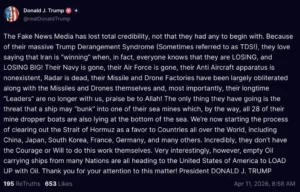
In a significant development for global energy security, the United States has initiated military operations to clear and secure the Strait of Hormuz, with U.S. Navy vessels now transiting the critical waterway amid ongoing tensions with Iran. This move comes as commercial shipping traffic remains a fraction of normal levels despite a fragile two-week ceasefire, and as high-stakes peace talks between the U.S. and Iran open in Pakistan.
President Donald Trump addressed the situation directly on Truth Social, announcing that the U.S. is “starting the process of clearing out the Strait of Hormuz” as a service to global markets and energy-dependent nations. In the post, Trump highlighted that Iran’s minelaying capabilities have been degraded (with reports of 28 vessels sunk or neutralized) and emphasized that U.S. military ships, aircraft, and personnel will remain in position until full, safe, and unrestricted access is restored. He reiterated that any deviation from the ceasefire agreement—such as continued tolls or restrictions—would trigger stronger action, stating, “If they are [charging fees], they better stop now!” and warning that “the ‘Shootin’ Starts’” otherwise.

BREAKING: US ships are CLEARING the Strait of Hormuz right in Iran’s face during negotiations, with reports of ships directly crossing the Strait
President Trump PROMISED it would open and says we’re now clearing it out “as a favor to countries all over the world”
“We’re… pic.twitter.com/Xmgp97Ce3x
— Eric Daugherty (@EricLDaugh) April 11, 2026

Verification of Ship Transits and Current Traffic
Ship-tracking data from MarineTraffic, Kpler, Lloyd’s List Intelligence, and the Joint Maritime Information Center (JMIC) confirm that commercial traffic through the Strait of Hormuz has been severely throttled since Iran restricted passage in late February 2026 during the U.S.-Israel-Iran conflict. Pre-war averages exceeded 100–140 vessels per day, with roughly 20% of global oil and LNG flows passing through the chokepoint.
As of April 9–11, 2026:Only 7–11 vessels per day have transited (well under 10% of normal).
Recent examples include the Greek-owned bulk carrier NJ Earth, Liberia-flagged Daytona Beach, and a small number of dry bulk carriers and one oil products tanker.
Tanker traffic remains particularly low, with just a handful of oil/chemical carriers crossing since the ceasefire.
U.S. military transits have resumed as part of the clearing effort. Reports confirm U.S. Navy vessels have passed through the strait in recent days, supporting escort operations and minesweeping. The U.S. has positioned assets, including the 31st Marine Expeditionary Unit and carrier strike group elements, in the region to facilitate safe passage for commercial shipping. Earlier planning for allied escorts (involving the U.K., France, and others) is now transitioning into active U.S.-led operations.
Iran has maintained some control, requiring vessels to route near its territorial waters and, in select cases, imposing tolls (reportedly ~$1 per barrel, payable in crypto to bypass sanctions). The White House and Trump have disputed these fees as violations of the ceasefire.
The Pakistan Peace Talks Context
U.S.-Iran peace negotiations opened this weekend (April 11, 2026) in Islamabad, Pakistan, mediated in part by Pakistani officials. Vice President JD Vance is leading the U.S. delegation. Iran is leveraging its residual control over the strait as a major bargaining chip. Key sticking points include full reopening of Hormuz without tolls or restrictions, nuclear issues, and proxy conflicts.
What If Peace Talks Fail—but the U.S. Militarily Clears the Strait?
Even if diplomatic efforts collapse, successful U.S. military clearance (via escorts, minesweeping, and deterrence) would dramatically alter the energy landscape:
Oil Market Response: Expect a sharp price decline. The conflict-driven disruption has kept crude elevated (with analysts citing an $82 floor and potential for $100+ if prolonged). Full secure transit would restore ~20% of global supply flows almost immediately, flooding the market with previously stranded tankers (over 400 waiting offshore). Risk premiums would evaporate, likely sending Brent and WTI lower by $10–20 per barrel in the short term, depending on inventory levels and OPEC+ response.
In the longer term, prices would stabilize as normal trade resumes, though a full infrastructure recovery (damaged fields, ports) could take months.
Insurance Companies and Affordable Coverage:
War-risk premiums have surged to 1–5%+ of hull value (e.g., millions per large tanker, versus pre-crisis rates of 0.1–0.25%). Military escorts and a secured corridor would rapidly de-risk the route, allowing insurers (including Lloyd’s of London syndicates) to lower or normalize premiums. This would make passage economically viable again for mainstream operators, unlocking the backlog of 426+ tankers and restoring liquidity to global energy trade.
In short, military clearance provides a credible backstop: diplomacy may be preferable, but secure transit by U.S. forces would deliver the energy market relief the world needs now.
Energy News Beat will continue monitoring MarineTraffic data, official statements, and market reactions in real time. Stay tuned for updates on the Pakistan talks and oil price movements.
All information verified as of April 11, 2026, from public reporting and official statements.
- Trump Truth Social posts and threats (various dates March–April 2026): https://truthsocial.com/@realDonaldTrump (referenced in Reuters, Fox News, NYT coverage).
- Shipping traffic data: MarineTraffic, Kpler, Lloyd’s List Intelligence, JMIC reports (April 8–11, 2026) – e.g., https://www.marinetraffic.com (summarized in Reuters: https://www.reuters.com/world/middle-east/shipping-traffic-through-hormuz-virtual-standstill-despite-ceasefire-data-shows-2026-04-09/).
- U.S. Navy escorts and military presence: USNI News, CNN analysis (March–April 2026).
- Pakistan peace talks: USA Today, CBS News, TWZ (April 11, 2026): https://www.usatoday.com/story/news/world/2026/04/11/iran-strait-of-hormuz-control-peace-talks-pakistan/89533760007/.
- Oil market and insurance implications: Energy News Beat prior coverage, JP Morgan/Goldman Sachs notes (referenced in ENB podcasts/substack).
- Wikipedia summary of 2026 Strait of Hormuz crisis (for timeline): https://en.wikipedia.org/wiki/2026_Strait_of_Hormuz_crisis.
- Additional reporting: BBC, Al Jazeera, New York Post, Axios, gCaptain (March–April 2026).
Energy News Beat – Independent. Unbiased. Energy First.
The post U.S. Begins Clearing the Strait of Hormuz with Military Ships Passing Through appeared first on Energy News Beat.