
The Strait of Hormuz remains the world’s most critical — and most contested — energy chokepoint. Roughly one-fifth of global oil and LNG trade normally flows through its narrow waters. Yet since the U.S.-Israel military campaign against Iran began in late February 2026, traffic has collapsed to a fraction of pre-war levels, sending shockwaves through energy markets.
Conflicting narratives dominate the headlines. Iran insists it still controls the strait and will only reopen it under “Iranian arrangements.” The Trump administration counters that no single nation controls it, the U.S. is ensuring freedom of navigation, and Iran’s military has been crippled. Independent analysis and shipping data paint a more nuanced picture: limited traffic continues, but under high risk, with Iranian coordination playing a visible role and U.S. efforts paused for negotiations. Insurance markets reflect the uncertainty — traditional Lloyd’s of London underwriters remain extremely cautious, while a U.S.-backed facility led by Chubb has stepped in selectively.
Here’s a fact-based breakdown of who controls what, the damage to Iran’s capabilities, recent ship movements, insurance realities, Iran’s economic endurance, and the looming convergence of paper and physical oil prices.
Iranian Claims vs. Trump Administration Statements
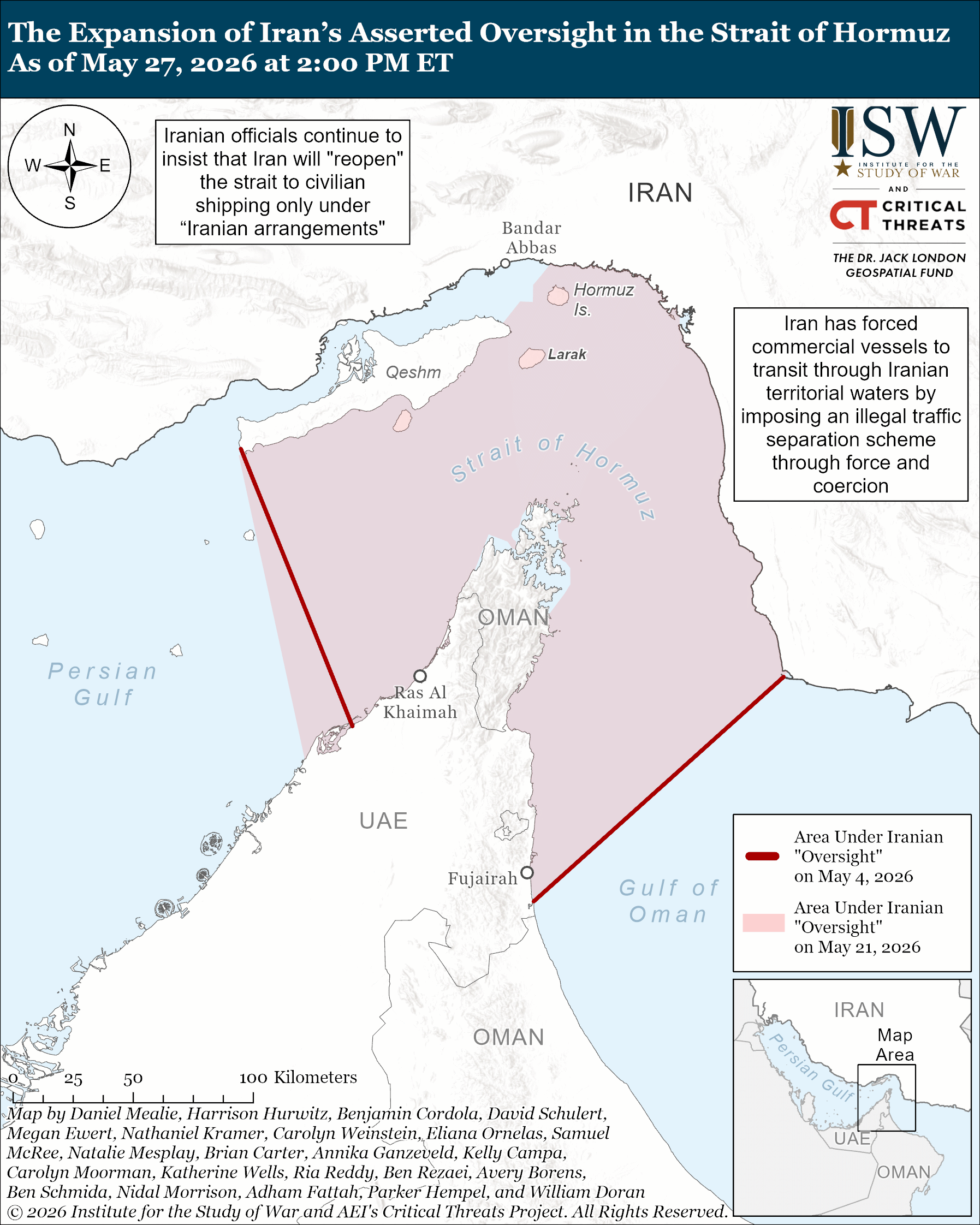
On May 27, 2026, the Institute for the Study of War (ISW) reported that senior Iranian officials continue to frame control of the Strait of Hormuz as a “strategic necessity and core element of Iranian deterrence” against the U.S. and Israel. Tehran insists it will “reopen” the strait to civilian shipping only under “Iranian arrangements” — meaning maritime traffic must pass through Iran’s traffic separation scheme with explicit Iranian approval. ISW notes this directly contradicts the U.S. demand for unrestricted freedom of navigation and would set a dangerous precedent.
Iranian state media and officials portray the situation as a “military victory” that must now be converted into political gains, including leverage in any final deal with Washington. They highlight Iran’s ability to coordinate vessel transits and continue reconstitution efforts at sites like the Yazd Missile Base, even during the April 2026 ceasefire.
The Trump administration tells a different story. President Trump stated on May 27: “Nobody’s going to control it. It’s international waters. The strait’s going to be open to everybody,” and the U.S. will “watch over it.” Earlier warnings from Trump were blunt: Iranian forces targeting U.S. ships would be “blown off the face of the Earth.”
Defense Secretary Pete Hegseth has repeatedly declared that U.S. operations (including the short-lived “Project Freedom” to escort stranded vessels) demonstrate that Iran “doesn’t control the strait.” The administration paused escort operations in early May to pursue a broader deal but maintained the naval blockade of Iranian ports.
Both sides acknowledge a fragile ceasefire since April, but public statements and leaked draft agreements show deep disagreements over sequencing: Iran wants sanctions relief and blockade lift before nuclear talks; the U.S. insists on verifiable nuclear curbs first.
Ship Traffic in the Last Few Days: The On-the-Ground Reality
Pre-war daily traffic averaged over 100 vessels carrying ~20 million barrels of oil and products. Since the conflict escalated, volumes have plummeted to 5–10% of normal levels, with periods of near-standstill.
Recent data (mid-to-late May 2026) shows modest movement but still far below normal:
Iran’s IRGC claimed coordination of 26 vessels in a 24-hour period around May 20, using Iranian-designated routes.
Shipping trackers (Kpler, LSEG, MarineTraffic) reported ~10 ships per day in recent 24-hour windows — including small cargo ships, chemical tankers, and a handful of supertankers. Three Chinese tankers exited with ~6 million barrels of crude after months of delay.
Many vessels still load at Iranian ports in defiance of the U.S. blockade or follow Iranian instructions. U.S.-flagged or escorted transits have occurred sporadically, but the overall picture remains one of severely constrained, high-risk passage.
In short, the strait is not fully closed, but it is not freely open either. Iran exerts practical influence over routing and approvals for many transits; the U.S. claims oversight through military presence and selective escorts. Neither side has achieved unchallenged dominance.
Insurance Markets: Why Lloyd’s of London and Chubb Have Been Cautious
Early in the crisis, Lloyd’s of London and major Protection & Indemnity (P&I) clubs dramatically expanded the “high-risk” zone to cover the entire Persian Gulf. War-risk premiums skyrocketed (up to 5x or more), and some cover was withdrawn or made case-by-case only. The primary driver was safety concerns — Iranian missiles, drones, and fast-attack boats remain a credible threat.
The U.S. government responded with an unprecedented reinsurance backstop: the International Development Finance Corporation (DFC) launched a $20 billion (later expanded to $40 billion) facility, with Chubb as lead underwriter alongside other U.S. insurers (Travelers, Liberty Mutual, Berkshire Hathaway, AIG, Starr, CNA). This provides war hull, P&I, and cargo cover for vessels transiting under U.S.-approved conditions.
Despite this, broad commercial issuance from traditional Lloyd’s syndicates has remained limited. Insurers cite persistent Iranian reconstitution of missile capabilities (confirmed by satellite imagery at Yazd) and the risk of renewed escalation. Shipowners continue to avoid the strait unless absolutely necessary, proving that even available coverage does not eliminate the physical threat. Iran’s viable ability to target tankers is exactly why private-market appetite stays suppressed.
How Long Can Iran Hold Out Without Oil Revenue?
Iran’s economy is heavily sanctioned and oil-dependent. Pre-war exports were ~1.5 million barrels per day (bpd). The U.S. blockade halted most new loadings from Iranian ports.
Iran had 160–170 million barrels of oil already afloat (pre-blockade cargoes) that can generate revenue until roughly August 2026.
Onshore storage and limited production can continue for 1–2 months before forced curtailments.
Analysts estimate Iran can sustain a near-total export halt for several months before severe fiscal pressure forces major concessions, though the regime has historically shown resilience under sanctions.
Longer term, prolonged closure would compound existing economic contraction (projected 10% GDP shrinkage from the war).
Oil Prices: Paper vs. Physical Convergence Likely Next Month
The disconnect between futures (“paper”) and spot/physical (“wet”) barrels has been extreme. Physical spot prices for immediate-delivery crude hit records near $150/bbl at peaks, while futures lagged due to ceasefire hopes.
As of late May, Brent futures have traded in the $90–$110 range with swings tied to negotiation headlines. Analysts widely expect convergence in June 2026 if the strait does not fully reopen: the paper market will snap upward to reflect physical reality (backlog, storage constraints, and reduced Gulf exports). The International Energy Agency and market participants have flagged this “rubber-band” effect repeatedly.
For the Trump administration, sustained high energy prices (and U.S. gasoline around $4.50+/gallon) create mounting political pressure ahead of midterm considerations, even as the White House touts military and negotiating “successes.”
The Expansion of Iran’s Asserted Oversight Says it all
The fact that the Iranian IRGC has extended its “Control Zone” to include the UAE pipeline exit in the Gulf of Oman outside the Strait of Hormuz tells you they are not going quietly into the night, and this is going to be a much longer problem.
Bottom Line: Truth Lies in the Data, Not the Soundbites
Iran retains meaningful operational influence over the strait and credible deterrent capabilities, as evidenced by its coordination of recent transits and missile reconstitution. The U.S. has demonstrated military presence and selective escorts but has paused major operations to pursue a deal and maintains that no one “controls” the waterway. Shipping data confirms the strait is functionally restricted — not fully open for free navigation — and insurance markets are pricing in ongoing Iranian risk.
The real test comes in the weeks ahead: whether a final U.S.-Iran agreement materializes before physical oil realities force paper prices higher and test political endurance on both sides.
As Stu Turley on the Energy News Beat Podcast has said, there will only be peace in the Middle East when the Venezuelan-Style Controls are placed on the oil revenue. The U.S. is still controlling Iraq’s oil money through the Fed, and it was not set up correctly. That was fixed with the Venezuela controls under Secretary Bessant.
Watch oil paper prices converge with physical prices over the next 30 days.
- Institute for the Study of War Iran Update Special Report (May 27, 2026): https://understandingwar.org/research/middle-east/iran-update-special-report-may-27-2026/ [post:0]
- CNN, NPR, PBS, NYT, Reuters, Al Jazeera, and other major outlets reporting Trump statements and ship traffic (May 2026): multiple citations above.
- Kpler, LSEG, Lloyd’s List shipping data summaries via Reuters and NBC (May 2026).
- LMA statements on war-risk cover; DFC/Chubb reinsurance facility announcements (March–May 2026).
- Al Jazeera analysis on Iran’s oil revenue endurance (April 2026).
- IEA Oil Market Reports and Energy Aspects analyses on paper/physical convergence (March–May 2026).
- Wikipedia and CRS reports on the 2026 Strait of Hormuz crisis for background context.
All data current as of May 28, 2026. Markets and negotiations remain fluid. Energy News Beat will continue monitoring developments.
The post Who is Telling The Truth on Control for the Strait of Hormuz? appeared first on Energy News Beat.