

If you live in one of the 13 states or D.C. served by PJM, data centers are already on your power bill. The grid’s own market monitor puts their added capacity cost at $29.4 billion over four auctions. On Friday evening, federal regulators threw out most of PJM’s plan to make new data centers bring their own power or be cut off first in emergencies. Nobody has put a bill figure on Friday’s ruling. Here is what it does, and what happens next.
By Stuart Turley, host of the Energy News Beat podcast • Published Oct. 13, 2026 • Markets and grid conditions as of 7:00 a.m. CT, Tue., Oct. 13, 2026 • Analysis and opinion: Stu’s views are labeled • Not legal or investment advice
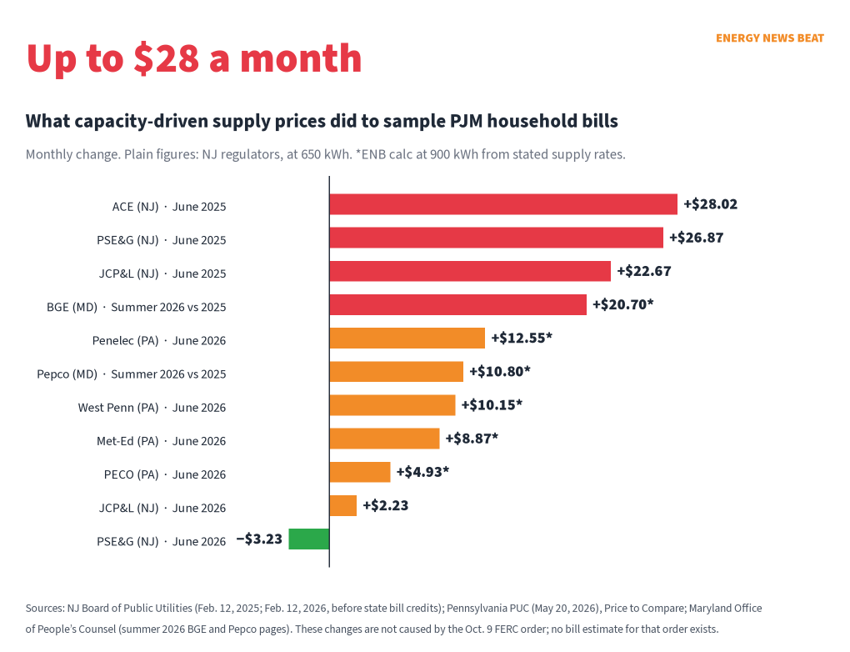
Look at your electric bill. In June 2025, the typical PSE&G bill in New Jersey jumped $26.87 a month, and the state’s regulators said why: “PJM’s recent capacity auction results are the main driver of these increases” (NJ Board of Public Utilities). In June 2026 it eased by $3.23, or 1.8% before state bill credits, which still leaves it about $24 above where it started (NJBPU; ENB calculation). In Maryland, the Office of People’s Counsel says BGE’s summer supply price went from about 10.2 cents a kilowatt-hour last year to about 12.5 cents this year, “largely due to the capacity market impacts of data centers and projected data center growth” (Maryland OPC). For a home using 900 kWh, that is about $20.70 a month (ENB calculation).
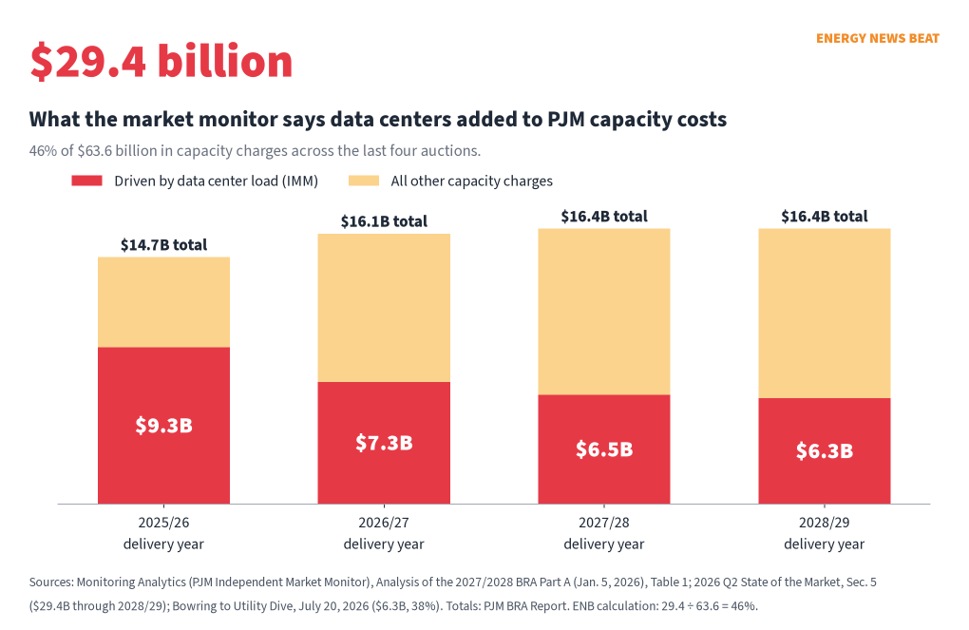
Behind those bills sits a number from the grid’s own watchdog. Monitoring Analytics, the independent market monitor for PJM, says putting data center load into the last four capacity auctions raised costs by $29.4 billion, an “irreversible” increase (IMM State of the Market). That is 46% of the $63.6 billion those four auctions cost (ENB calculation from PJM).
On Friday evening, the Federal Energy Regulatory Commission threw out most of PJM’s plan for handling that growth. FERC kept a registry of big new loads and rejected the parts that would have made new data centers bring their own capacity or be cut off first when the grid runs short (FERC order). Here is the plain answer for your wallet: no regulator, utility or analyst has published a bill estimate for this ruling, and ENB could not find one. The order changes no rate today. What it does is leave the bigger question, who pays for the power data centers need, wide open.
| The 60-second version
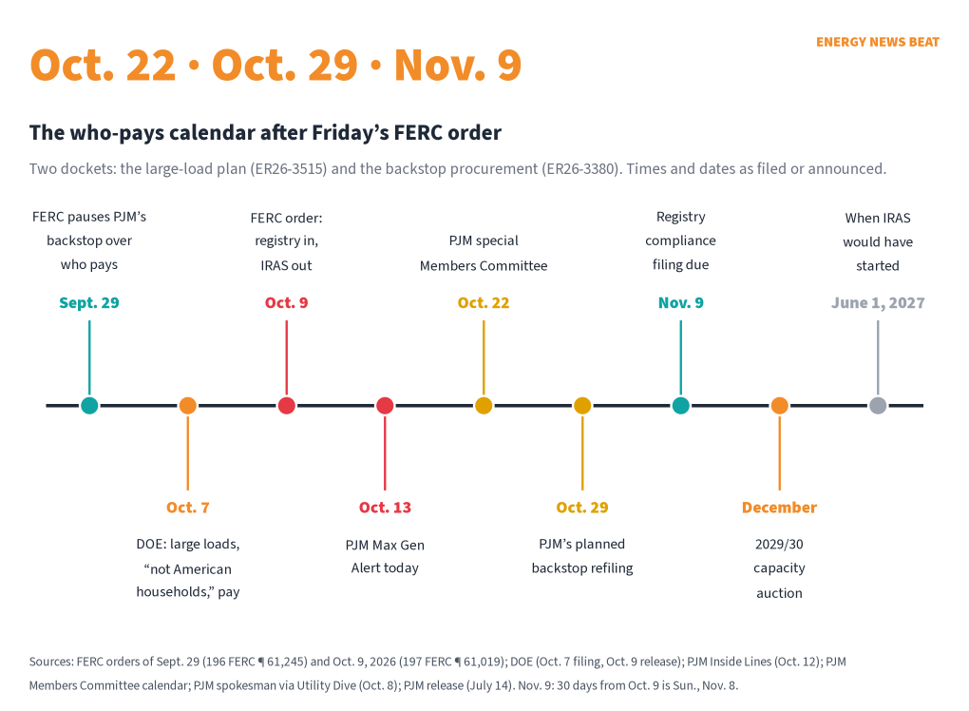
What FERC did: On Oct. 9, in Docket ER26-3515, FERC accepted PJM’s definition of a “Large Load” (50 MW or more at one site) and a Large Load Registry, effective Oct. 12. It rejected everything else, including the “IRAS” curtailment plan and the “bring your own new capacity” option (FERC order). The vote: All five commissioners. No dissent. Commissioner David Rosner wrote a concurrence (FERC order). Why: FERC said parts of the plan reached retail customers and set a retail rate, which is state turf, and that PJM had not proved the rest was just and reasonable (FERC order). Your bill: No estimate exists for this ruling. Capacity prices are already at the cap, $325 a megawatt-day for 2028/29, 11 times the 2024/25 price (PJM). Next: PJM’s special Members Committee meets Oct. 22 (PJM), PJM plans to refile its separate backstop power plan about Oct. 29 (Utility Dive), and the registry compliance filing is due about Nov. 9 (FERC order). |
What FERC decided Friday
PJM filed the plan on Aug. 13 (FERC order). It had three big pieces. First, a definition: any site with a combined peak of 50 megawatts or more is a Large Load, and affiliated buildings within a mile count as one site. Second, a registry so PJM can see those loads coming. Third, and most important, a new rule for data centers and other big loads arriving after June 1, 2027. If their power supplier did not line up new capacity for them, they would fall under “Interim Resource Adequacy Service,” or IRAS. In plain English, they could be asked to cut their power during emergencies, before PJM calls on the customers who volunteer for demand response (FERC order).
FERC kept the first two pieces and threw out the third. The commission accepted the Large Load definition and the registry, effective Oct. 12, and told PJM to file cleaned-up tariff language within 30 days. It rejected IRAS, the requirement to designate new capacity, the “Bring Your Own New Capacity” option known as BYONC, and a change that would have left eligible new large loads out of the auction demand curve starting with 2029/30. FERC said those pieces were “an integrated package that must be viewed as a whole” (FERC order).
The order was a notational vote of all five commissioners: Chairman Laura Swett and Commissioners David Rosner, Lindsay See, Judy Chang and David LaCerte. The record shows no dissent. It was issued Friday evening (FERC eLibrary).
Why FERC said no
The heart of it is jurisdiction. Data centers are mostly retail customers of a local utility, and states regulate retail service. FERC wrote:
“We find that several provisions of the proposed Tariff appear to place obligations directly on Eligible New Large Loads, which are, for the most part, retail customers; that certain other provisions appear to dictate which retail customers taking retail service will be curtailed; and that the proposed compensation framework appears to establish a retail rate.” (FERC order)
The commission did not wave away the problem. “While we recognize the imminent capacity shortfall in PJM,” it wrote, IRAS and BYONC “are either outside of the Commission’s authority or have not been sufficiently demonstrated to be just and reasonable… We do not take this decision lightly.” It added that states “have a crucial role to play in this challenge by designating which retail customers must be curtailed when the system is stressed, and we strongly encourage states to continue their important work on this issue.” And it left the door open: PJM “may consider refiling an alternative proposal” (FERC order).
Rosner went further in his concurrence. He objected to cutting off new loads before the people who sign up to be paid for cutting back. “PJM’s filing flips this paradigm,” he wrote. He also warned of a market that says PJM has plenty of capacity “while the region sheds thousands of megawatts of demand on an involuntary basis.” Then he drew a line for households:
“To be clear, in an emergency, data centers not serving critical functions should be shut off before ordinary customers (Hint: homes, hospitals, and schools should never be curtailed before data centers).” — Commissioner David Rosner (FERC order)
The fight had some unusual teams. Pennsylvania Gov. Josh Shapiro backed IRAS as a wholesale reliability product. Constellation and Google asked FERC to reject everything except the registry; the Data Center Coalition opposed IRAS and the one-mile rule. Consumer advocates wanted access to the registry data (FERC order).
What PJM says
PJM spokesman Jeffrey Shields told Utility Dive the grid operator is reviewing the order with “an eye toward how we can fulfill FERC’s requirements while recognizing the responsibilities FERC indicated belong to the states and honoring the concept that existing electricity customers should not be unfairly burdened by new, energy-intensive customers in the form of higher costs or decreased reliability” (Utility Dive).
PJM had asked for a ruling in time to change the demand curve for its 2029/30 auction, set to run in December 2026 (FERC order). That change is now off the table. After the July auction, PJM CEO David Mills said “demand for electricity continues to grow faster than electricity supply,” and that PJM “recognizes how this supply-and-demand imbalance impacts the reliability of the system and costs for consumers” (PJM).
What it means for your power bill
Start with what we know. Friday’s order sets no price and moves no rate. No commission, utility or consumer advocate has put out a bill estimate for it, and ENB found none in the order, PJM’s statements or the coverage. Anyone quoting a dollar figure for this ruling is guessing.
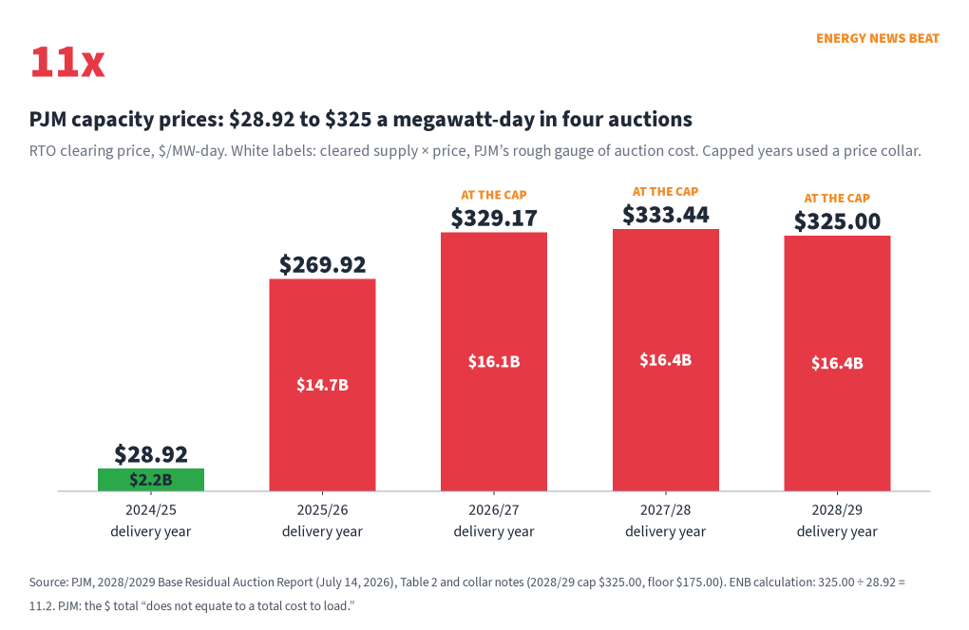
What the order does is remove one tool PJM hoped would keep new demand from pushing prices higher. Capacity is the money PJM pays power plants to be ready for the hottest and coldest days, and it flows into the supply part of your bill. That price went from $28.92 a megawatt-day for 2024/25 to $269.92 for 2025/26. The last three auctions cleared at or near a negotiated cap: $329.17, $333.44 and $325.00 for 2028/29 (PJM). The cap and floor, called a collar, has been extended through the 2029/30 auction (PJM).
The July auction also came up 6,831 megawatts short of PJM’s reliability requirement, after a shortfall of about 6,500 MW the year before. PJM says these are the first two auctions in its history to fall short region-wide. Only 524.7 MW of new or uprated generation cleared (PJM).
How does that reach a household? The market monitor estimates that data center load added $11.11 per megawatt-hour to the total wholesale cost of power in the first half of 2026, and noted that this “does not include the impact on energy or transmission costs” (IMM). Spread over 900 kWh a month, that works out to about $10 a month at the wholesale level. Treat that as an ENB illustration, not a bill forecast and not an estimate of Friday’s order. Retail rates pass through costs on their own schedules.
As of 7:00 a.m. CT Tuesday (latest filings and EIA data)
The utility filings show the same story in real bills:
- New Jersey: In June 2025, monthly bills at 650 kWh rose $26.87 for PSE&G, $28.02 for ACE and $22.67 for JCP&L (NJBPU). Rate Counsel’s Brian Lipman called it “an increase of over $20.00 per month” (NJBPU). This June, with the collar in place, PSE&G fell $3.23 and JCP&L rose $2.23, before state bill credits (NJBPU).
- Maryland: BGE’s summer supply price rose from about 10.2 to 12.5 cents/kWh, and Pepco’s from about 10.4 to 11.6 cents (OPC on BGE; OPC on Pepco). At 900 kWh, that is about $20.70 and $10.80 a month (ENB calculations).
- Pennsylvania: On June 1, default-service prices rose 88% at Penelec, 10.3% at West Penn, 7.6% at Met-Ed and 4.97% at PECO (PA PUC).
- Virginia: Dominion’s base-rate case adds $11.24 a month in 2026 and $2.36 in 2027 for a 1,000 kWh customer, VPM reported. The SCC rejected moving PJM capacity costs out of base rates, and the capacity share is not broken out (VPM).
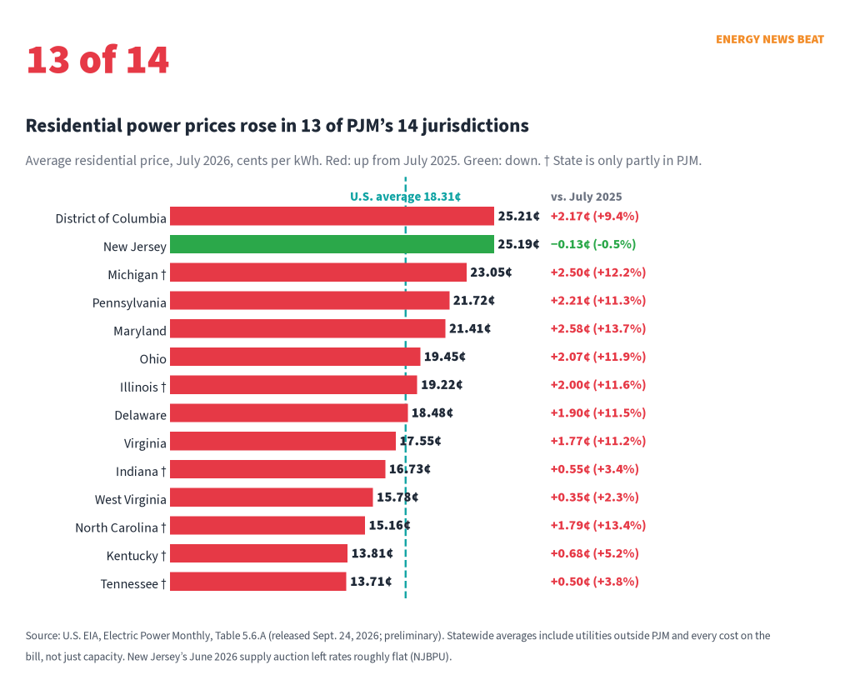
Statewide prices tell you where the pain is landing. In July, the average residential price rose from a year earlier in 13 of PJM’s 14 jurisdictions, by 11% or more in Pennsylvania, Ohio, Illinois, Michigan, Delaware, Maryland, Virginia and North Carolina. New Jersey was the exception, down 0.5%. The U.S. average rose 4.9% (EIA). Those statewide averages include utilities outside PJM and every part of the bill, so they do not isolate capacity.
The other clock: the backstop and who pays for it
Friday’s order is half the story. On Sept. 29, FERC accepted PJM’s “Reliability Backstop Procurement,” a one-time hunt for the power the July auction failed to buy, but suspended it for five months and set a hearing on how its costs get split (FERC). Commissioner See put it in kitchen-table terms: “Existing customers should not be left paying costs attributable to new demand” (FERC).
The Department of Energy jumped in on Oct. 7 with a filing in that backstop case. It said PJM should adopt FERC’s cost-allocation reforms so the costs of serving new data centers “are not unfairly shifted to PJM’s existing ratepayers” (DOE; DOE release). Energy Secretary Chris Wright said his department “supports having large electricity users pay for reliable new power generation” (DOE).
PJM has scheduled a special Members Committee meeting for Oct. 22, 9 a.m. to noon ET (PJM), and Shields told Utility Dive PJM aims to file a revised backstop plan Oct. 29 (Utility Dive). That is where the who-pays fight is live right now.
The demand behind it
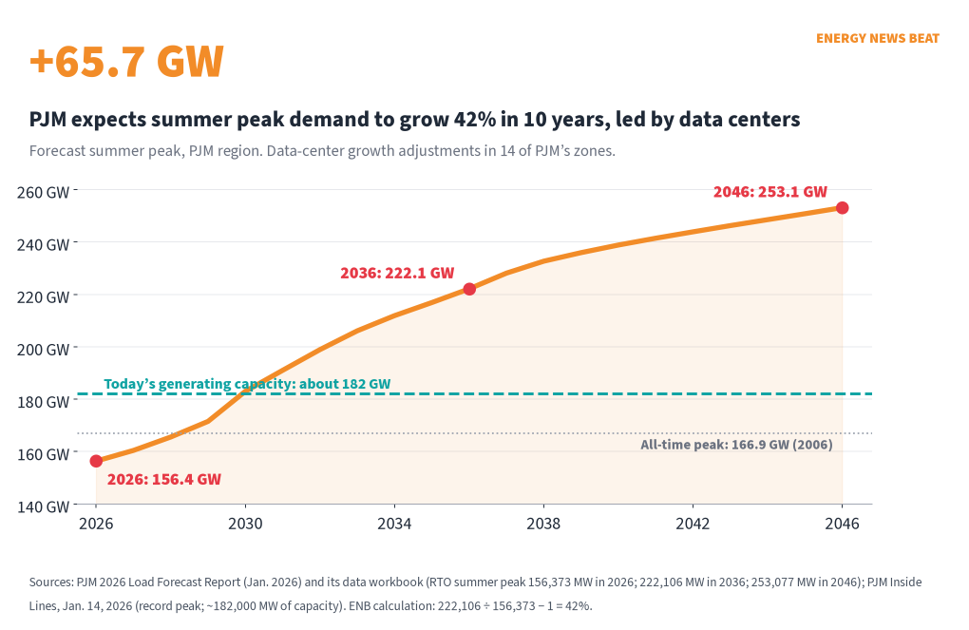
PJM’s January forecast has summer peak demand climbing from 156,373 MW this year to 222,106 MW in 2036, up 65,733 MW or 42% in a decade, and to 253,077 MW by 2046 (PJM load data). The record peak is 166,929 MW, set in 2006, and PJM has about 182,000 MW of generating capacity today (PJM Inside Lines). PJM adjusted the forecast for data center growth in 14 zones, from ComEd and AEP to Dominion and PSE&G (PJM).
As of PJM notice posted Oct. 12; no newer notice as of 7:00 a.m. CT Oct. 13
The squeeze is not theoretical. For today, Tuesday, PJM issued a Maximum Generation Alert and a Load Management Alert, extended a capacity advisory through Oct. 14, and said it had received an emergency order from DOE. It blamed unusually warm weather and planned fall maintenance (PJM Inside Lines; ENB).
Bringing your own power is already happening without a tariff rule. On Oct. 6, Google and Constellation announced 890 MW of nuclear uprates at 11 PJM units, more than $4.3 billion, with the first expected by 2028 (Google/Constellation).
How consumers and investors see it
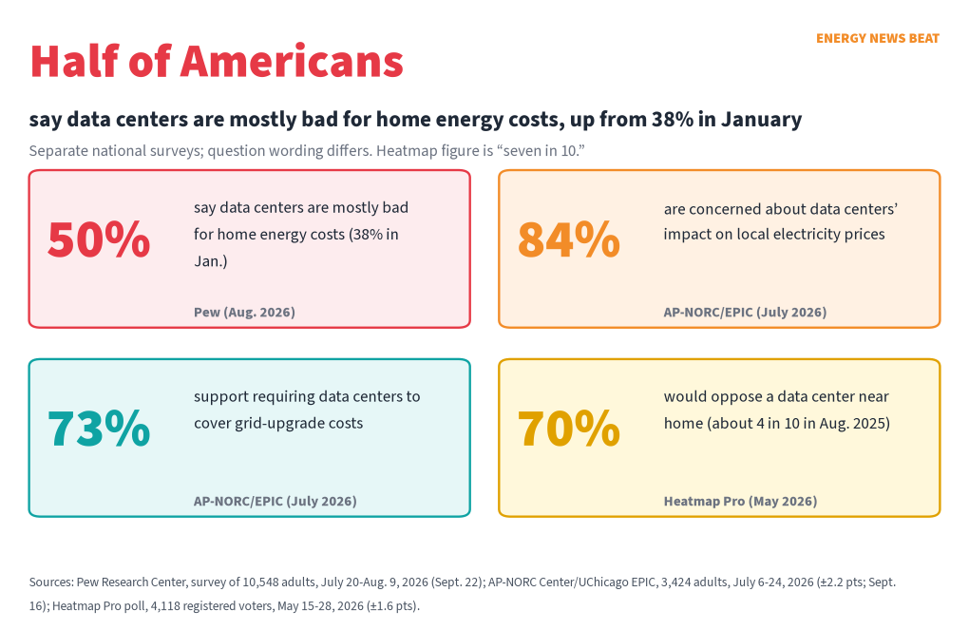
Consumers are worried, and getting more so. Half of Americans (50%) now say data centers are mostly bad for home energy costs, up from 38% in January, Pew found in a survey of 10,548 adults. That includes 44% of Republicans and 58% of Democrats (Pew). In an AP-NORC/EPIC poll, 84% said they were concerned about data centers’ impact on local electricity prices, and 73% backed making data centers cover grid-upgrade costs (AP-NORC). In a Heatmap Pro poll of 4,118 registered voters taken May 15-28, 2026, seven in 10 said they would oppose a data center near them, up from about four in 10 in August 2025 (Heatmap, June 3, 2026).
Consumer advocates have been blunt. New Jersey’s Rate Counsel called last year’s increase “over $20.00 per month” (NJBPU). Maryland’s People’s Counsel ties the summer jump to “the capacity market impacts of data centers” (OPC). Consumer advocates in the FERC case pushed for access to the registry data (FERC order).
As of Monday’s close, Oct. 12 (stock prices)
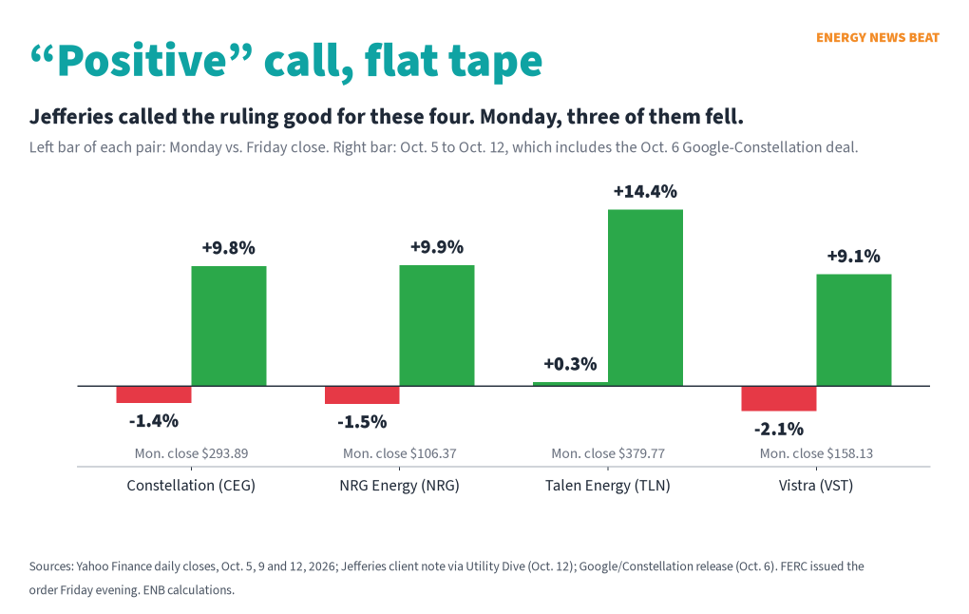
Investors got a different message. Jefferies analysts told clients the ruling “will potentially lead to higher capacity prices for longer” in PJM, which favors Constellation, NRG, Talen and Vistra, according to Utility Dive. “While there is still uncertainty within PJM’s market construct/rules, the latest development is positive for existing generation/IPPs,” they wrote. “We could see this proposal minimally revived in future iterations and likely led by efforts from states.” Utility Dive named Ohio and Pennsylvania as the key states to watch (Utility Dive). The market shrugged. On Monday, the first trading day after the order, CEG fell 1.4%, NRG 1.5% and VST 2.1%, while TLN edged up 0.3% (Yahoo Finance). All four were still up 9% to 14% from their Oct. 5 closes. The biggest one-day jump came Oct. 6, the day Google and Constellation announced their deal (ENB calculations).
| Stu’s Take
Folks, I keep coming back to this on the podcast: electricity generation is part of energy dominance, and energy security starts at home (ENB). You can measure dominance by what we export. But if grandma in Ohio can’t keep the lights on at a fair price, we are not dominant at anything. Here is what jumps out at me. The grid’s own watchdog says data centers added $29.4 billion to capacity costs. Prices went from $28.92 to $325 a megawatt-day. The July auction came up 6,831 MW short. And today PJM is on a Maximum Generation Alert in October. That is not a market sending a happy signal. FERC got the law right, in my view. Washington should not be telling a state which customer gets cut first. Rosner nailed it: homes, hospitals and schools come before data centers. Now the states have to do their homework, and fast. But the fix is not more rules about who gets shut off. The fix is more power plants. I have pushed co-location and “bring your own generation” for a long time, and Google and Constellation just showed it works with 890 MW of new nuclear. If you want to plug in a gigawatt, bring a gigawatt. Gas, nuclear, uprates, I don’t care. Just don’t send the bill to the folks who were here first. That is what DOE says, what Commissioner See says, and what 73% of Americans say. |
Corrections to early reports
Some early accounts of Friday’s order, including several that came to us second-hand, got these points wrong or left them fuzzy:
- “PJM will file its fix Oct. 29.” The Oct. 29 date is for PJM’s revised backstop procurement filing in a different case (ER26-3380), answering FERC’s Sept. 29 order (Utility Dive; FERC). Friday’s large-load order requires a compliance filing within 30 days, which falls on a Sunday, so about Nov. 9 (FERC order).
- “Oct. 22 is a FERC deadline.” It is a special PJM Members Committee meeting, by Webex, 9 a.m. to noon ET (PJM).
- “IRAS was a voluntary deal.” It was not opt-in. It would have applied by default to new loads of 50 MW or more, factories included, whose supplier did not bring new capacity, and curtailment would have come before voluntary demand response. Rosner called it curtailment “on a mandatory basis” (FERC order).
- “FERC left it all to the states.” FERC said states decide which retail customers are curtailed and “strongly encourage[d]” them to keep working. It set no state deadline, it is still deciding backstop cost allocation itself, and it invited PJM to refile (FERC order; FERC).
- “DOE filed in this case.” DOE’s Oct. 7 statement was filed in the backstop docket, ER26-3380, not ER26-3515 (DOE).
- “About five weeks after” the backstop order. The large-load order came 10 days after the Sept. 29 backstop order (FERC).
- “FERC rejected the whole plan.” It accepted the Large Load definition and the registry (FERC order). “Rejected most” is accurate.
- Timing and markets. The order was issued Friday evening (FERC eLibrary), and three of the four generators Jefferies called winners fell Monday (Yahoo Finance).
Confirmed as reported: the docket, the five-member vote with Rosner concurring, the IRAS and BYONC rejections, Jefferies’ view, and the PJM spokesman’s statement.
What to watch
- 22: PJM’s special Members Committee meeting on the backstop (PJM).
- 23: EIA’s next Electric Power Monthly, with August prices (EIA).
- About Oct. 29: PJM’s revised backstop filing and its cost-allocation plan (Utility Dive).
- About Nov. 9: PJM’s compliance filing on the registry (FERC order).
- December: the 2029/30 capacity auction, still under the collar (PJM).
- States: Ohio and Pennsylvania, which Utility Dive named as the key states to watch for any state-led revival (Utility Dive). Keep an eye on ENB’s data center coverage.
The bottom line
FERC told PJM it cannot decide which retail customers go dark first. That is a legal call, not a price change, and nobody has a bill number for it. The bill numbers that do exist come from the capacity auctions: $29.4 billion in data center-driven costs, by the market monitor’s count, and bills or supply costs that rose $10 to $28 a month at some utilities: $22.67 to $28.02 in New Jersey in June 2025 at 650 kWh, as stated by the state’s regulators, and about $10.80 to $20.70 at Pepco and BGE in Maryland for summer 2026 at 900 kWh, by ENB’s own calculation. The real fight now moves to the backstop filing and the statehouses, where the question is simple. Will the companies plugging in giant new loads pay for the power plants they need, or will the families who were already here? For background, see ENB on who is responsible for data center rates, the 76% bill jump and the 1,000% capacity increase.
Check out the World’s Greatest Podcast Show Notes at EnergyNewsBeat.co or EnergyNewsBeat.com. And subscribe to: The Energy News Beat Substack.
Appendices
At Energy News Beat we Make Appendices Great Again.
Times are U.S. Central (CDT, UTC−5) unless noted. Fast-moving items (grid alerts, stock prices) are current as of 7:00 a.m. CT, Tue., Oct. 13, 2026. Labels: [ENB CALC] = our arithmetic from the cited figures; [ENB READING] = our interpretation.
Download the data: every figure in the charts and tables is in the companion workbook, “FERC Rejects Most of PJM’s Data Center Plan and the $29.4 Billion Question of Who Pays Is Still Open – Data.xlsx,” with a source and URL for each sheet.
Appendix A. Sources
Appendix B. Key figures
| Figure | Value | Source |
| FERC order | 197 FERC ¶ 61,019; Docket ER26-3515-000; issued Friday evening, Oct. 9, 2026 | FERC eLibrary |
| Vote | Swett, Rosner, See, Chang, LaCerte; “By the Commission”; Rosner concurring; no dissent | FERC order |
| Accepted | Large Load definition (≥50 MW at a site; affiliated sites within 1 mile aggregate) and Large Load Registry, effective Oct. 12, 2026 | FERC order |
| Rejected | IRAS, new-capacity designation, BYONC, VRR-curve exclusion of eligible new large loads from 2029/30 | FERC order |
| Compliance filing | Within 30 days of Oct. 9 (day 30 is Sun., Nov. 8 → Mon., Nov. 9) [ENB CALC] | FERC order |
| Capacity price, 2024/25 → 2028/29 | $28.92 → $325.00/MW-day (11.2x) [ENB CALC for ratio] | PJM BRA report |
| 2025/26; 2026/27; 2027/28 | $269.92; $329.17 (cap); $333.44 (cap) | PJM BRA report |
| 2028/29 collar | Cap $325.00, floor $175.00; collar extended through 2029/30 | PJM |
| 2028/29 shortfall | 6,831 MW below the 156,013 MW requirement; reserve margin 14.7% vs 20% target; 524.7 MW new/uprated generation | PJM BRA report |
| Auction costs (four auctions) | $14.7B + $16.1B + $16.4B + $16.4B = $63.6B [ENB CALC] | PJM BRA report |
| IMM data center cost, 2025/26-2027/28 | $9.33B + $7.27B + $6.50B = $23.10B | IMM Part A |
| IMM data center cost through 2028/29 | $29.4B “irreversible total increase”; 2028/29 ≈ $6.3B (38%) | IMM SOM; Utility Dive |
| Data center share | 29.4 ÷ 63.6 = 46% [ENB CALC] | IMM; PJM |
| Wholesale cost, H1 2026 | $114.50/MWh, of which $11.11 (9.7%) from data center load in capacity | IMM SOM Sec. 1 |
| Household illustration | $11.11/MWh × 0.9 MWh ≈ $10.00/month, wholesale level only [ENB CALC] | IMM; OPC |
| PSE&G, June 2025 | +$26.87/mo ($155.84 → $182.71), +17.24%, 650 kWh | NJBPU |
| PSE&G, June 2026 | −$3.23/mo ($183.46 → $180.23), before credits | NJBPU |
| BGE / Pepco summer supply | ≈10.2¢ → 12.5¢; ≈10.4¢ → 11.6¢/kWh; +$20.70 and +$10.80 at 900 kWh [ENB CALC] | OPC BGE; OPC Pepco |
| PA default service, June 1 | Penelec +11.88%; West Penn +10.3%; Met-Ed +7.6%; PECO +4.97%; PPL +1.5%; Duquesne +2.84% | PA PUC |
| Dominion base rates | +$11.24/mo (2026), +$2.36 (2027), 1,000 kWh; capacity share not broken out | VPM |
| Bill impact of the Oct. 9 order | None published by any regulator, utility, PJM or analyst ENB reviewed | — |
| EIA residential, July 2026 | Up in 13 of 14 PJM jurisdictions; NJ −0.5%; U.S. 18.31¢ (+4.9%) | EIA |
| Load forecast | 156,373 MW (2026) → 222,106 MW (2036) → 253,077 MW (2046) | PJM load data |
| Backstop target | 6,831 MW; suspended to Feb. 28, 2027, subject to refund; paper hearing on cost allocation | FERC |
| Polls | Pew 50% (n=10,548); AP-NORC/EPIC 84% and 73% (n=3,424); Heatmap 7 in 10 (n=4,118) | Pew; AP-NORC; Heatmap |
| Stocks, Mon. Oct. 12 vs Fri. Oct. 9 | CEG −1.4%; NRG −1.5%; TLN +0.3%; VST −2.1% [ENB CALC] | Yahoo Finance |
Appendix C. Timeline
| Date | Event | Source |
| Jul. 14, 2026 | PJM 2028/29 auction clears at the $325 cap, 6,831 MW short | link |
| Aug. 13, 2026 | PJM files large-load plan (IRAS, bring-your-own-capacity, registry) | link |
| Sept. 29, 2026 | FERC accepts but suspends PJM’s backstop procurement; flags cost allocation | link |
| Oct. 6, 2026 | Google-Constellation deal: 890 MW of nuclear uprates for PJM | link |
| Oct. 7, 2026 | DOE files statement of position: large loads, “not American households,” must fund new generation | link |
| Oct. 9, 2026 | FERC order in ER26-3515: registry in, IRAS and BYONC out (issued Friday evening) | link |
| Oct. 12, 2026 | Large-load definition and registry take effect; Jefferies note | link |
| Oct. 13, 2026 | PJM Maximum Generation Alert and Load Management Alert | link |
| Oct. 22, 2026 | PJM special Members Committee meeting (9 a.m.-noon ET) | link |
| Oct. 29, 2026 | PJM’s planned revised backstop filing (30 days after Sept. 29 order) | link |
| Nov. 9, 2026 | Compliance filing on the registry due (30 days from Oct. 9 falls on Sun., Nov. 8) | link |
| December 2026 | 2029/30 capacity auction scheduled for December | link |
| Feb. 28, 2027 | Suspended backstop’s effective date, subject to refund | link |
| Jun. 1, 2027 | Date IRAS would have started (start of 2027/28 delivery year) | link |
Appendix D. Order excerpts
Summary (ER26-3515): “In this order, we accept PJM’s proposed Tariff revisions to establish a definition of Large Load and a Large Load Registry, effective October 12, 2026, as requested, and require PJM to submit a compliance filing within 30 days of the date of issuance of this order. We reject PJM’s remaining proposed Tariff revisions.” (FERC order)
Integrated package: “because the elements of PJM’s proposal other than the Large Load definition and Large Load Registry represent an integrated package that must be viewed as a whole, we reject the remainder of PJM’s proposal.” (FERC order)
Jurisdiction: “We find that several provisions of the proposed Tariff appear to place obligations directly on Eligible New Large Loads, which are, for the most part, retail customers; that certain other provisions appear to dictate which retail customers taking retail service will be curtailed; and that the proposed compensation framework appears to establish a retail rate.” (FERC order)
Retail rate: “The proposed Tariff language thus appears to establish a framework whereby retail customers will be paid by other retail customers for what PJM describes as a wholesale capacity service.” (FERC order)
Shortfall and states: “While we recognize the imminent capacity shortfall in PJM, we find that two key aspects of PJM’s proposal—IRAS and BYONC—are either outside of the Commission’s authority or have not been sufficiently demonstrated to be just and reasonable and not unduly discriminatory or preferential. We do not take this decision lightly.” … “States have a crucial role to play in this challenge by designating which retail customers must be curtailed when the system is stressed, and we strongly encourage states to continue their important work on this issue.” (FERC order)
Refiling: “Although we are rejecting PJM’s proposal, PJM may consider refiling an alternative proposal under FPA section 205 that considers the guidance provided herein.” (FERC order)
How IRAS would have worked (as summarized in the order): IRAS actions “would occur after PJM dispatchers have issued a NERC Energy Emergency Alert Level 1 (EEA1).” IRAS “would be suspended after three consecutive Delivery Years of PJM meeting its Reliability Requirements,” with maximum compensation “equal to 50% of the capacity performance Non-Performance Charge Rate.” (FERC order)
Rosner concurrence: “I agree with the decision to reject the bulk of PJM’s filing for the reasons articulated in today’s order. I write separately to emphasize that, if PJM chooses to refile its proposal, it must justify its proposal to curtail IRAS load on a mandatory basis before load that has voluntarily enrolled in a demand response program.” … “The result could be a capacity market signaling that PJM has more than enough capacity while the region sheds thousands of megawatts of demand on an involuntary basis. That’s not only economically inefficient, but also likely to prevent supply and demand from coming back into balance.” … “To be clear, in an emergency, data centers not serving critical functions should be shut off before ordinary customers (Hint: homes, hospitals, and schools should never be curtailed before data centers). We need state regulators to establish clear rules for which customers should be curtailed first when circumstances require it. … But such measures should only be taken when necessary to keep the system reliable, after voluntary demand response resources have been exhausted.” (FERC order)
Backstop order (ER26-3380), Commissioner See: “Existing customers should not be left paying costs attributable to new demand.” (FERC)
DOE statement of position (ER26-3380, Oct. 7): “PJM should implement the cost allocation and other reforms identified by the Commission to ensure that the costs of serving new data centers or other large electric energy loads are not unfairly shifted to PJM’s existing ratepayers.” (DOE)
Appendix E. Methodology
- Finding the order: ENB read the full order and concurrence from FERC eLibrary (accession 20261009-3055).
- Capacity prices: RTO clearing prices in $/MW-day UCAP from PJM’s 2028/2029 BRA report. “Auction cost” is PJM’s cleared-MW × price figure, which PJM says “does not equate to a total cost to load.”
- Data center cost: The $29.4B is the IMM’s counterfactual: auction results with and without data center load in the forecast. ENB did not re-run it. 2028/29 is $29.4B minus the $23.10B for the prior three auctions, which matches the IMM’s $6.3B quoted by Utility Dive.
- Bills: NJ figures are as stated by NJBPU for a 650 kWh customer. Maryland and Pennsylvania figures are ENB calculations: change in stated cents/kWh × 900 kWh (Maryland OPC’s average example). Supply prices include energy, capacity and (in Maryland) some transmission; the capacity piece cannot be separated from the public data. Pennsylvania prices apply only to default-service customers.
- EIA: Table 5.6.A, residential, July 2026 vs July 2025 (preliminary, released Sept. 24, 2026). Indiana, Kentucky, Michigan, North Carolina, Tennessee and Illinois are only partly in PJM; statewide averages include non-PJM utilities.
- Load forecast: RTO summer peak = the highest June-August monthly peak in PJM’s 2026 load-report data workbook (sheet PJM_RTO), which matches the report tables.
- Stocks: Daily closes from Yahoo Finance; percent changes are ENB calculations. Market moves have many causes and cannot be attributed to the order.
- Dates: Thirty-day periods counted from the order date; when day 30 falls on a weekend, FERC rules move it to the next business day [ENB READING].
Appendix F. Glossary
PJM: PJM Interconnection, the grid operator for 67 million people in 13 states and D.C.
Capacity market / BRA: PJM’s Base Residual Auction, which pays power plants to be available three years ahead.
$/MW-day: The capacity price: dollars per megawatt of available capacity per day.
Collar: The negotiated cap and floor on capacity prices for the 2026/27-2029/30 auctions.
Large Load: Under the accepted tariff, a site with a combined peak of 50 MW or more.
IRAS: Interim Resource Adequacy Service: PJM’s rejected plan to curtail new large loads without new capacity during emergencies.
BYONC: Bring Your Own New Capacity: PJM’s rejected option for loads to pair with new resources.
VRR curve: Variable Resource Requirement curve, the demand curve in the capacity auction.
Demand response: Customers paid to cut use when the grid is tight.
EEA1: NERC Energy Emergency Alert Level 1, the first level of a capacity emergency.
Maximum Generation Alert: A PJM warning that it may need all available generation.
Reliability Backstop Procurement (RBP): PJM’s one-time procurement for the 6,831 MW the 2028/29 auction did not buy.
IMM: Independent Market Monitor (Monitoring Analytics), PJM’s watchdog.
FPA section 205 / 206: The Federal Power Act sections for utility-proposed rate changes (205) and FERC-initiated changes (206).
Notational order: An order voted on paper rather than at an open meeting.
Price to Compare: Pennsylvania’s default-service supply price, in cents per kWh.
Appendix G. What ENB could not confirm
- Any bill impact of the Oct. 9 order. None has been published.
- The full Jefferies note, which is not public; ENB relied on quotes in Utility Dive.
- PJM’s Oct. 29 filing date, which comes from a PJM spokesman via Utility Dive, not a PJM filing.
- How much of any household bill is capacity alone; public supply rates bundle capacity with energy and, in Maryland, transmission.
- The capacity piece of Dominion’s Virginia increase, which the SCC did not break out (VPM).
- What the 2029/30 cap and floor will be in dollars.
- Whether any state will adopt curtailment-priority rules, and when.
- Why the generator stocks moved; ENB does not attribute Monday’s moves to the order.
The post FERC Rejects Most of PJM’s Data Center Plan, and the $29.4 Billion Question of Who Pays Is Still Open appeared first on Energy News Beat.