

Chinese refiners are set to slow the pace of inventory drawdowns this month as crude imports recover, according to Energy Aspects. More overseas crude is expected to arrive from November, allowing China to preserve its substantial stockpile buffer against further supply disruptions. Analyst Jianan Sun of Energy Aspects noted that recent purchases of Iraqi and other Middle Eastern barrels for delivery next month show refiners are already securing additional supplies. Tanker-tracking data cited in related reporting points to 96 supertankers (roughly 192 million barrels) due over the next three months—the highest volume since the Iran conflict began in late February—aided by fresh crude import quotas for private processors.Bloomberg
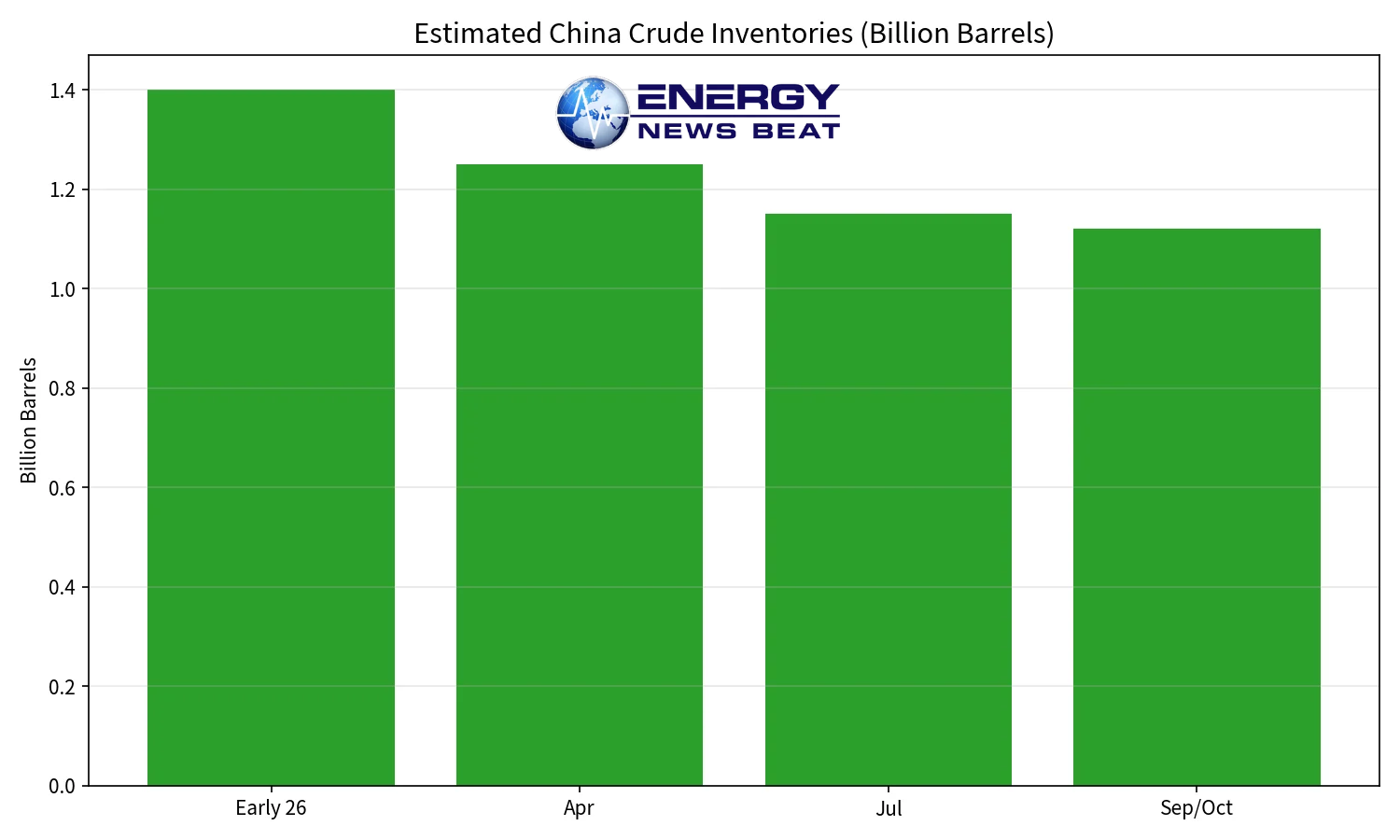
This shift comes against the backdrop of the ongoing Strait of Hormuz disruption from the Iran war. China entered the crisis with massive commercial and strategic inventories (estimates in the 1.2–1.4 billion barrel range, providing well over 100 days of import cover). It sharply cut seaborne imports from pre-war levels of around 11–12 million barrels per day (mb/d) to lows near 6–7 mb/d in June, relying instead on inventory draws (Vortexa and others estimated draws of roughly 1–1.5 mb/d for stretches of the spring and summer) while also curbing refinery runs and product exports. Inventories have declined (reports put current levels in the roughly 1.09–1.18 billion barrel area depending on the tracker), but remain elevated. Imports have since edged higher into the 7–9 mb/d range in recent months.Worldports
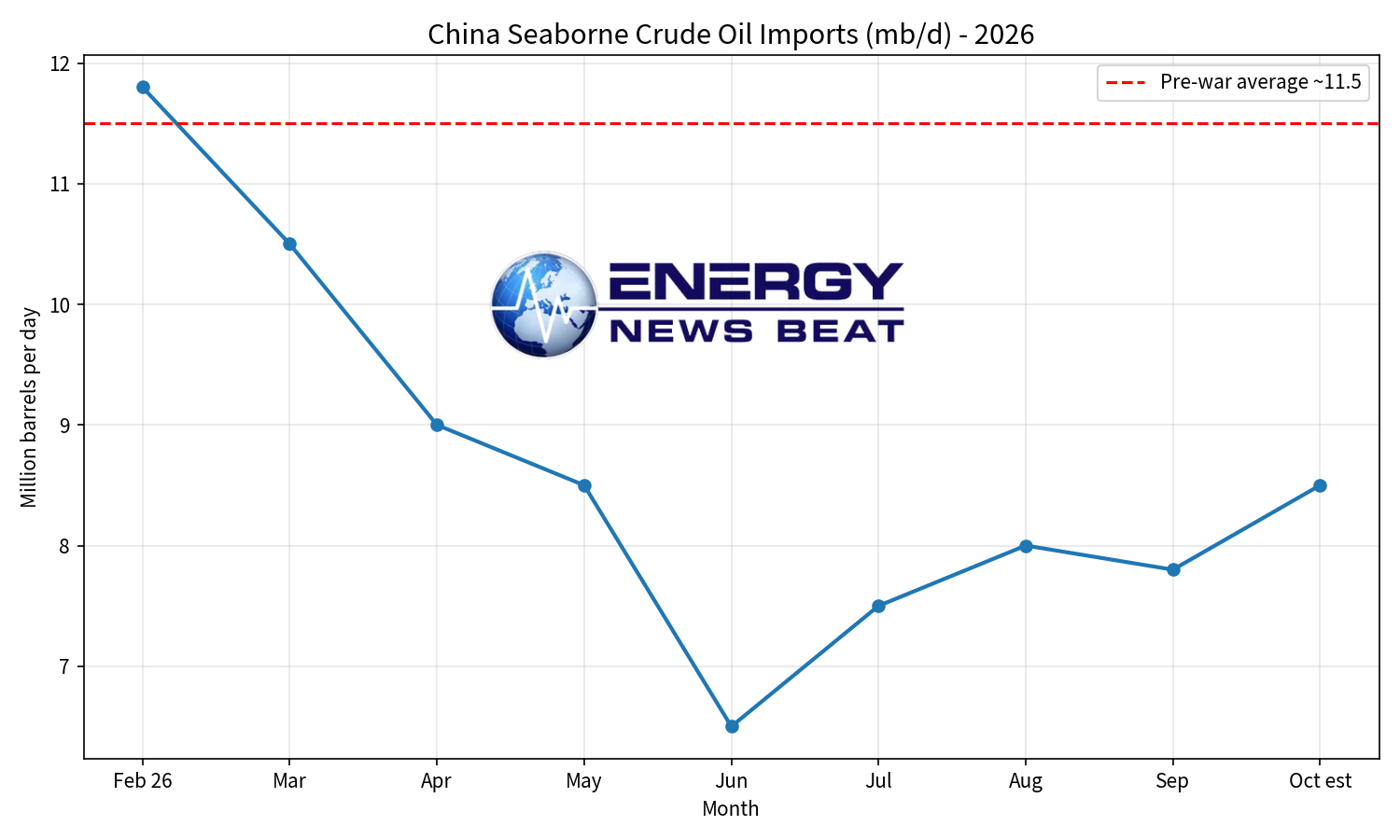
The chart above shows the approximate trajectory of China’s seaborne crude imports in 2026, highlighting the sharp drop and partial recovery relative to pre-war averages.
Sourcing, Prices, Freight, and Why Buying Remains Selective
China’s import mix has shifted. Official customs data continues to show no direct imports from Iran (or Venezuela in some periods), consistent with long-standing practice. Malaysia remains a key transshipment hub for Iranian (and other sanctioned) barrels via shadow fleets and ship-to-ship transfers, with Indonesia also used to mask flows. Russia has gained share (ESPO and other grades), while Middle Eastern volumes (Iraq, Saudi Arabia, UAE, etc.) have been constrained by Hormuz issues and are only partially recovering via STS workarounds outside the strait. Independent “teapot” refiners, previously heavy buyers of discounted Iranian and Venezuelan crude, have faced the sharpest squeeze and have scrambled for alternatives including West African, Canadian, and some Middle Eastern grades.Nst
Delivered prices and freight economics help explain why aggressive restocking has not materialized. Average Chinese customs import prices have been in a broad range consistent with elevated but not extreme levels (around the high $70s to low $90s per barrel in recent months depending on grade and timing, with conversions from USD/ton figures). However, spot differentials and specific cargoes have been far higher: some non-Gulf grades (e.g., certain UK, Niger, or Equatorial Guinea barrels) were reported above $130/bbl in mid-year periods, Brazilian cargoes around $115, and Russian ESPO at premiums of $10 or more to Brent for China delivery. Iraqi grades have traded at $12–20 premiums to Brent on a delivered basis in recent deals. Brent itself is currently trading near $104–105/bbl (well off the April peak near $126 but still elevated).
Freight is a major differentiator. VLCC rates from the Middle East to China have surged to the equivalent of roughly $30–35/bbl (and higher on some US Gulf-to-China routes, with lump sums reaching tens of millions of dollars), driven by STS inefficiencies around Hormuz, longer routes (including Cape of Good Hope detours in some cases), and tight vessel availability. In contrast, shorter-haul movements involving Malaysia or Singapore (as STS or re-export points for Iranian or other barrels) carry substantially lower freight costs. Previously, heavily discounted Iranian and Venezuelan barrels delivered via shadow fleets offered even more favorable net economics for Chinese buyers. Today’s combination of higher crude differentials plus elevated long-haul tanker rates makes many open-market barrels expensive on a delivered basis relative to the old sanctioned-oil model. Refiners (especially teapots) are therefore buying opportunistically where economics or quotas justify it, rather than racing to rebuild stocks aggressively. Remaining inventory buffers, price sensitivity, and structurally softer transportation fuel demand (from rising EV penetration) reinforce this caution.Rigzone
Analyst Views and Market Implications
Energy Aspects expects the import recovery to slow destocking at least through October and sees upside risks to Chinese crude imports as Saudi and other Middle Eastern flows via STS improve. Vortexa, Kpler, and others note that China still holds a meaningful buffer and has used stock management, run cuts, and export controls as levers. Many analysts emphasize that a full return to pre-war import levels is unlikely soon: China remains a price-sensitive buyer, inventories are still comfortable relative to needs, and longer-term demand growth is tempered by electrification and efficiency gains. Some see China’s return (or continued absence) as a key swing factor for global balances—partial recovery supports the market without immediately overwhelming available supply, while a more aggressive restocking would tighten the prompt physical market.
For the broader oil market, slower Chinese inventory draws paired with modestly higher imports reduce the risk of a sudden demand surge that could spike prices further, but also limit the downside that a prolonged Chinese absence would create. Freight and geopolitical risks around Hormuz and the Red Sea keep a floor under rates and delivered costs. The net effect is a more balanced but still tight environment in which China continues to act as a flexible swing consumer rather than a relentless buyer. Further escalation or a durable easing of Hormuz constraints will determine whether imports accelerate or remain subdued.
ENB Publishers Note: Nobody really knows what China’s inventories are. These are spitball estimates, looking for trends. Just saying. And Goldman was saying that as soon as the Red Sea was closed and China started buying again, we would see $200 oil. Well, tanker rates got in the way, and I don’t think we will get to $200 oil, as discounts are being applied to make up for the high tanker rates. And China is only buying tankers from shorter trips. Very smart. It is a partial recovery.
Check out the World’s Greatest Podcast Show Notes at EnergyNewsBeat.co or EnergyNewsBeat.com. And subscribe to: The Energy News Beat Substack.
Appendices
At Energy News Beat we Make Appendices Great Again.
- Bloomberg: Chinese Refiners to Slow Inventory Drawdowns as Imports Pick Up (Oct 13, 2026). https://www.bloomberg.com/news/articles/2026-10-13/chinese-refiners-to-slow-inventory-drawdowns-as-imports-pick-up
- Energy Aspects comments via Bloomberg and related coverage (Jianan Sun).
- Council on Foreign Relations: The Import Cut Beijing Did Not Order (Oct 6, 2026). https://www.cfr.org/articles/the-import-cut-beijing-did-not-order
- The Economist / related reporting on China’s inventory management and oil market role.
- Kpler and Vortexa analyses on Chinese inventories, imports, and days cover (multiple 2026 notes).
- Reuters and trade reporting on August import sources (Russia, Malaysia, Middle East volumes) and teapot purchases of Iraqi/Qatari crude.
- Institute of International Finance and customs-related data on import prices by origin (May–July 2026 ranges, including elevated non-Gulf cargoes).
- Freight assessments and reporting on VLCC rates (Middle East–China and Atlantic routes) from Argus, shipbrokers, and trade sources (Oct 2026).
- OilPrice.com, World Ports Organization, and other aggregators of Kpler/Vortexa/Chinese customs data on 2026 import volumes and recovery trends.
Data points are approximate and drawn from the cited public reporting and analyst summaries; official Chinese inventory figures are not published.
The post Chinese Refiners to Slow Inventory Drawdowns as Imports Pick Up: What It Means for the Oil Market appeared first on Energy News Beat.