

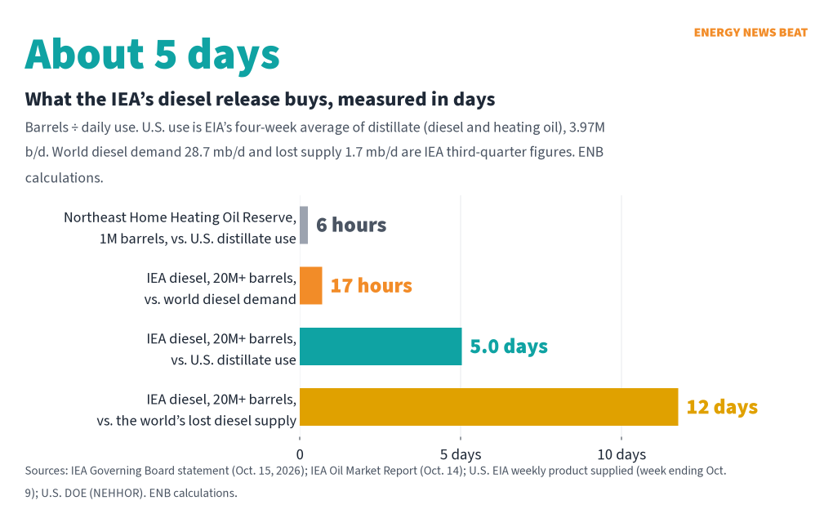
On Thursday, the International Energy Agency agreed to accelerate the release of more than 20 million barrels of diesel, with no timeline. By our math, that is about 17 hours of world demand, or five days of U.S. use. Emergency barrels help, but they do not build refineries. – The key is whether they actually do anything. They will want to stall or hinder President Trump at any turn, so we are betting nothing is released. The other huge story this week is how the Trump Administration can get infront of the Diesel crisis narrative. We covered that on the Energy News Beat Substack.
Squeezing Every Barrel Before the Midterms: An Action Plan for the Trump Administration to Unlock More Diesel via the Defense Production Act
By Stuart Turley, host of the Energy News Beat podcast • Published Oct. 16, 2026 • Prices 6:35–6:46 a.m. CT, Fri., Oct. 16, 2026 • Analysis and opinion: Stu’s views are labeled • Not investment advice
As of 6:46 a.m. CT Friday (AAA) and Oct. 12 (EIA heating oil)
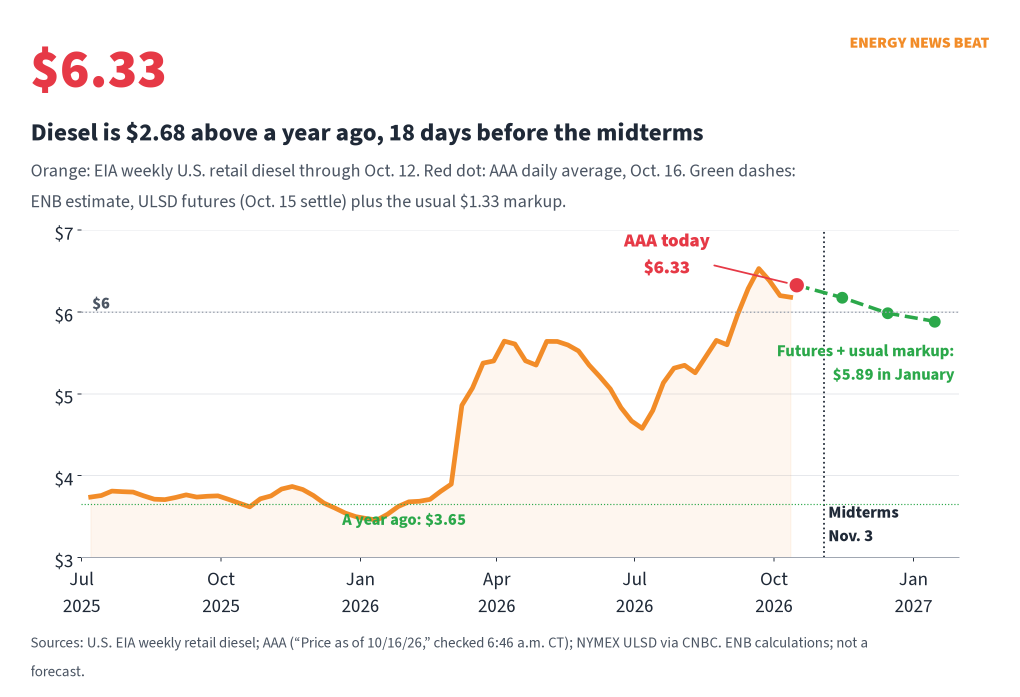
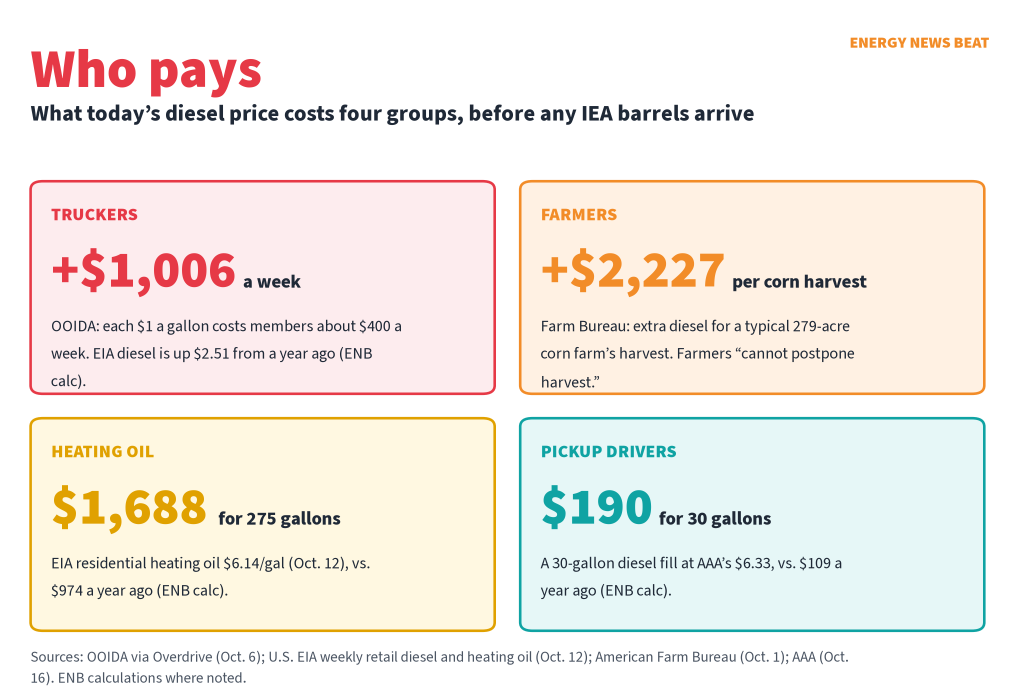
Filling a 30-gallon pickup tank with diesel this morning costs about $190. A year ago it was about $109. A trucker putting 200 gallons in a rig pays about $1,265, up from $730 (AAA; ENB calculation). And if your house heats with oil, a 275-gallon delivery at this week’s federal average of $6.14 runs about $1,688, against $974 last October (EIA; ENB calculation). The national diesel average is $6.33 a gallon, up $2.68, or 73%, in a year, and only 20 cents under the record set Sept. 22 (AAA). It has not come down this week. It is up almost 5 cents from a week ago.
So when the International Energy Agency said Thursday it would speed up its emergency diesel, the question in every truck stop, farm shop and Northeast kitchen was simple: does this get the price down before the Nov. 3 midterms? Our honest answer is a little, maybe, and not by much. More than 20 million barrels sounds like a lot. Spread across the world, it is about 17 hours of diesel demand. Measured against what Americans burn, it is about five days (ENB calculations from IEA and EIA data). CNBC ran the same comparison and got the same answer (CNBC).
| The 60-second version
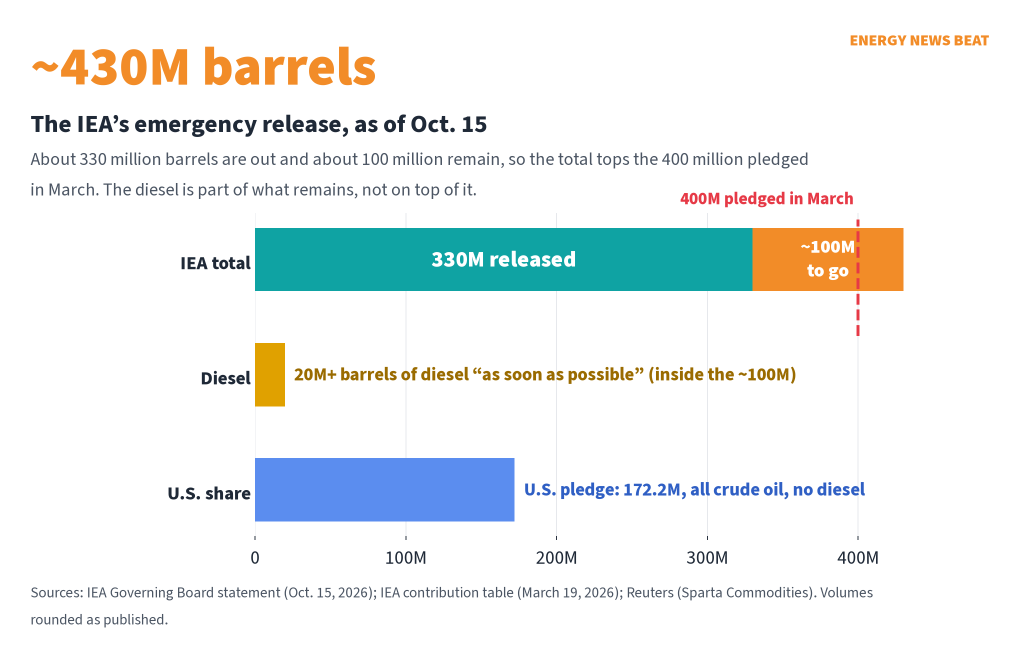
What happened: IEA members agreed Thursday to finish the remaining “around 100 million barrels” of their March emergency release and to accelerate “over 20 million barrels of diesel as soon as possible.” About 330 million barrels are already out, and the total will top the original 400 million. How big is it: 20 million barrels is about 17 hours of world diesel demand and about 5 days of U.S. distillate use (ENB calculations). Is it new oil: Not clearly. Sparta Commodities says the diesel looks like “an acceleration of existing commitments rather than genuinely new volumes” (Reuters). The U.S. share of the March pledge, 172.2 million barrels, is all crude, which still has to go through a refinery. What markets did: Diesel futures fell 8.2 cents Thursday. European diesel margins slipped nearly 2% to $78.67 a barrel Friday. Pump diesel is still $6.33. Before the midterms (ENB estimate): Thursday’s futures plus the usual pump markup work out to about $6.18 for November and $5.98 for December. That is some relief, not a reset. At home: U.S. distillate stocks fell to 102.6 million barrels, about 12% below the five-year average and the lowest for early October in EIA records back to 1982 (ENB calculation). |
What the IEA agreed on Thursday
As of IEA statement dated Oct. 15, 2026
The IEA’s Governing Board, the agency’s member governments, met in Paris on Thursday and put out a short statement (IEA). Here is what it says, in its own words:
- About 330 million barrels “have so far been released,” and members will “complete the remaining releases of around 100 million barrels in a timely manner consistent with national circumstances.”
- Because some members released more than they pledged, “the total amount of stocks to be released exceed[s] the original total of 400 million barrels.”
- Members “agreed to accelerate the release of the remaining volumes, with specific plans already in place, including over 20 million barrels of diesel as soon as possible.”
- Countries with production and refining capacity were encouraged “to boost supply of crude and refined products, particularly diesel.”
That 400 million barrels dates to March 11, when all 32 members agreed to the largest emergency release in the agency’s history after the Middle East war choked off the Strait of Hormuz (IEA). Two weeks ago the G7 leaders pushed for speed. They promised 100 million barrels over four months, “including a frontloaded substantial diesel release within the first 20 days” (G7).
Thursday’s statement drops that 20-day clock. It says “as soon as possible” and gives no timeline, a point both CNBC and Argus Media noticed (CNBC; Argus). Argus reads the statement to mean about half the diesel comes from France, which has pledged 10 million barrels from its strategic reserves between November and January (Argus). That would be about 109,000 barrels a day if spread evenly (ENB calculation). Spain said it would release 4.4 million barrels in October (Reuters).
The politics are in plain view. President Trump has pressed European governments to draw down their reserves or face a possible U.S. diesel export ban ahead of the midterms (Reuters). After the meeting, a U.S. Energy Department spokesperson said the administration “continues to hold European nations accountable for failing to fulfill their previous commitments” (Reuters).
How big is 20 million barrels?
As of IEA third-quarter demand estimates (Oct. 14) and EIA data for the week ending Oct. 9
Twenty million barrels is 840 million gallons, which sounds huge until you set it next to how much diesel the world burns. All of these are ENB calculations:
- World: the IEA puts global diesel and gasoil demand at 28.7 million barrels a day in the third quarter (IEA). Twenty million barrels is about 7 days, or 17 hours.
- United States: EIA’s four-week average of distillate use, which covers diesel and heating oil, is 3.97 million barrels a day (EIA). Twenty million barrels is about 0 days. Using last week alone, when use jumped to 4.32 million, it is 4.6 days.
- The hole it is trying to fill: the IEA says the world lost about 1.7 million barrels a day of diesel and gasoil supply in the third quarter versus a year earlier (IEA). The release covers about 12 days of that shortfall.
- Our own cushion:S. distillate stocks are about 14 million barrels below their five-year average for this week (EIA). Refilling just that gap would take about 71% of the whole IEA diesel release.
- America’s own diesel reserve: the Northeast Home Heating Oil Reserve holds about 1 million barrels (S. DOE). That is about 6 hours of U.S. distillate use.
None of this means the release does nothing. Sparta Commodities analyst Abhishek Kumar told Reuters before the meeting that a 20- to 30-day release “would represent a major intervention, while a draw spread over several months would have a relatively smaller impact” (Reuters). Thursday’s plan has no clock, and the French part runs through January. On his own numbers, Thursday’s version sits closer to the second case.
Will diesel ease before the midterms?
As of Oct. 13 settlements (as reported in ENB’s Oct. 14 piece) and Oct. 15 settlements; quotes 6:35–6:36 a.m. CT Oct. 16
There are 18 days until Nov. 3. Here is what the market is saying, and what it is not.
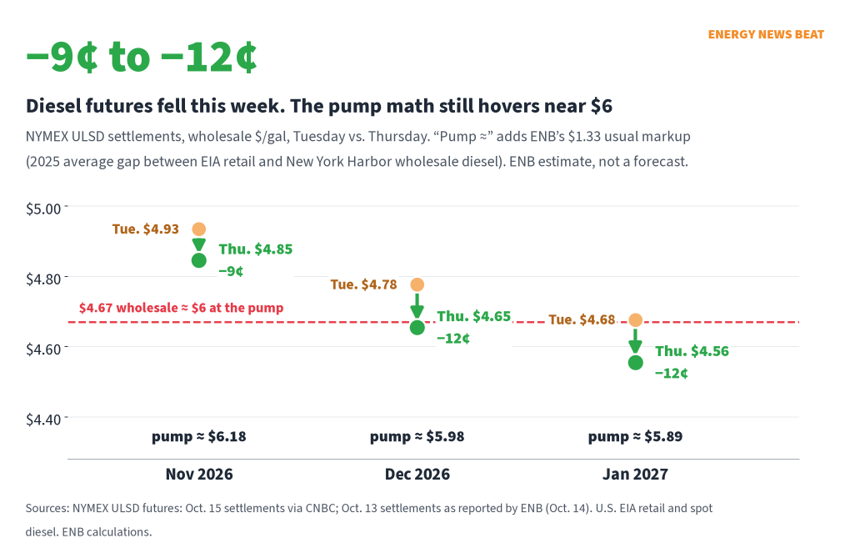
Wholesale is down. NYMEX diesel futures for November delivery settled Thursday at $4.8456 a gallon, down 8.2 cents on the day (@GasBuddyGuy; CNBC). Measured from Tuesday’s settlements, as reported in ENB’s Oct. 14 piece, the November contract is down about 9 cents, and December and January are each down about 12 cents (ENB; CNBC; CNBC). At 6:36 a.m. CT Friday, November was $4.858, up about a penny (CNBC). The IEA was not the only news. Saxo Bank’s Ole Hansen said reports that Washington may ease sanctions on some “shadow fleet” tankers were also weighing on prices (Reuters; ENB).
The pump-to-wholesale gap is about normal. On EIA’s Oct. 12 retail price of $6.179, the gap over Thursday’s wholesale settle is about $1.33, right at the 2025 average of $1.33 (ENB calculation from EIA data; CNBC). AAA’s daily $6.33 runs higher, at about $1.48 (AAA). If wholesale holds lower, stations usually pass it on with a lag.
ENB estimate: add the usual $1.33 markup to Thursday’s settlements and you get about $6.18 for November, $5.98 for December and $5.89 for January. On Wednesday we put January at about $6.01, using Tuesday’s settlements (ENB). The futures have taken about 12 cents off that outlook in two days. For pump diesel to drop under $6 by Election Day on the normal markup, November wholesale would need to fall to about $4.67, about 18 cents below Thursday’s settle (ENB calculation). This is arithmetic, not a forecast. EIA’s Oct. 6 outlook had $5.79 for November, per ENB’s Oct. 14 reading of the outlook (ENB; EIA), and GasBuddy’s Patrick De Haan said Thursday evening that diesel “should throttle back a good bit” (@GasBuddyGuy).
Our read [ENB analysis]: a dime or two of relief by early November looks plausible, and it would be welcome. Diesel back to last year’s $3.65 does not. Nothing in this week’s news changes the reason diesel costs so much. Europe’s diesel margin, the refiner’s take over crude, was still $78.67 a barrel on Friday. That is down nearly 2% on the day and off a September high of about $95, but still high (Reuters).
The stockpile problem at home
As of EIA weekly data for the week ending Oct. 9, released Oct. 15
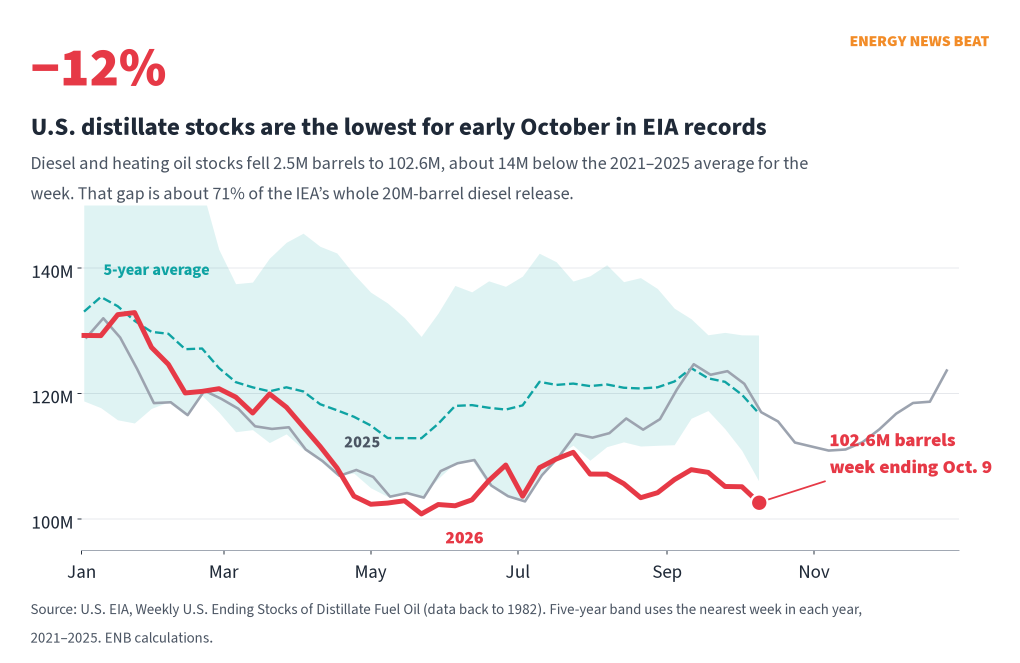
Thursday’s EIA report did not help. Commercial crude stocks fell 8.6 million barrels to 415.6 million, and distillate stocks, which include diesel and heating oil, fell 2.5 million barrels to 102.6 million (EIA). Oil & Gas 360’s summary of the same data had the identical figures (Oil & Gas 360).
By our math, distillate stocks are about 12% below the 2021–2025 average for the week (116.9 million) and 12% below a year ago (117.0 million). They are the lowest for early October in EIA’s weekly records back to 1982, below the previous low of 106.1 million in 2022 (EIA; ENB calculations). At the latest four-week pace of use, that is about 26 days of supply (EIA; ENB calculation).
Refineries are not loafing. They ran at 93.5% of capacity last week (EIA). The crude draw had a weather angle. Reuters tied it partly to “hurricane production shut-ins,” and EIA shows U.S. output down about 300,000 barrels a day to 13.68 million (Reuters; EIA). The Strategic Petroleum Reserve held 283.0 million barrels, down from 407.7 million a year ago (EIA).
Barrels in a tank are not a refinery
This is the heart of it. An emergency release moves oil that already exists from a government tank into the market. It does not add a single barrel a day of refining. Andy Lipow, president of Lipow Oil Associates, said the release does “not solve the basic problem which is how to increase production at refineries which are damaged in the Middle East or Russia, and operating at capacity in the USA” (CNBC).
The U.S. side of the March pledge shows why. All 172.2 million barrels were crude oil, with no diesel (IEA). Crude has to be refined before it does a trucker any good, and U.S. refineries are already near full. Most of the products in the release come from Europe, where the IEA said contributions would be “primarily” refined products (IEA).
Stu put it this way to the Daily Caller on Monday: “There’s only two ways diesel and gasoline prices can come down. One, demand destruction. Number two, … more refineries” (Daily Caller). The IEA’s own report on Wednesday named the same two doors. It said the diesel market depends on Middle East supply returning, and “failing this, further demand reductions and the heavy economic costs these will entail may be needed” (IEA).
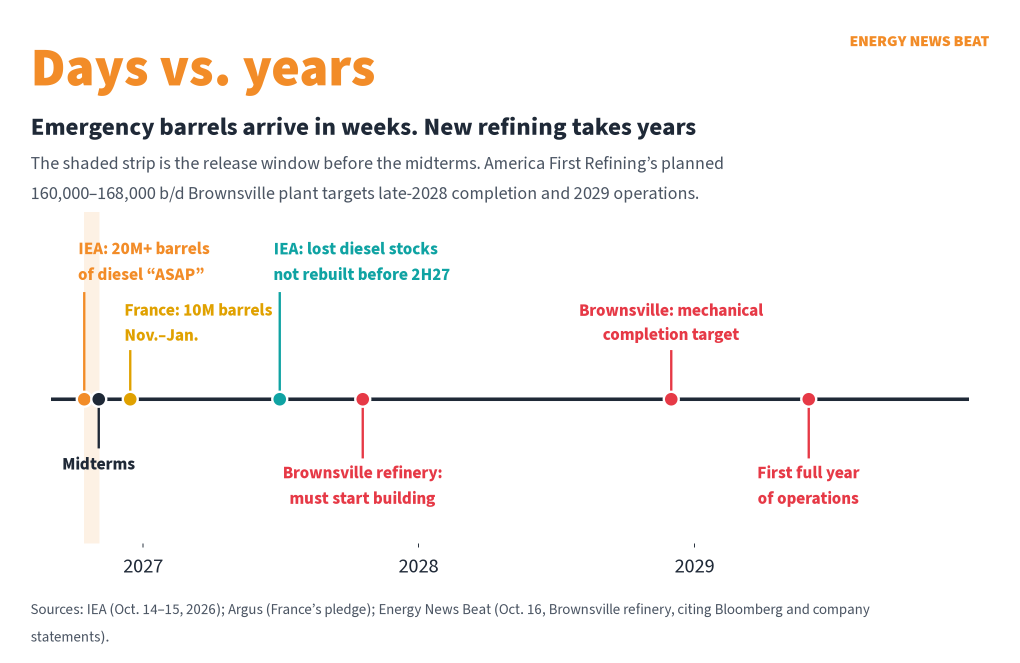
The refinery door is opening a crack, slowly. On Tuesday, Vice President JD Vance said the administration “has used” the Defense Production Act to expand Delek’s 74,000-barrel-a-day refinery in Tyler, Texas (ENB). On Thursday, America First Refining said Morgan Stanley is leading fundraising for its planned 160,000–168,000 barrel-a-day plant in Brownsville. That project is targeting mechanical completion in late 2028 and its first full year in 2029 (ENB). That is the timescale for new refining: years, not days.
Who pays
Truckers
As of EIA weekly retail diesel, Oct. 12
Todd Spencer of the Owner-Operator Independent Drivers Association said, “Every $1 increase per gallon in fuel costs our members around $400 more per week” (Overdrive). EIA’s weekly diesel price is up $2.51 from a year ago, so his rule of thumb comes to about $1,006 a week (ENB calculation from EIA). The American Transportation Research Institute put 2025 fuel costs at $0.482 a mile (ATRI). At today’s price, that is about $0.81 (ENB calculation; same fuel economy assumed). A release that takes a few cents off does not change that math much.
Farmers
Harvest is when farms burn the most diesel. The American Farm Bureau figures a $2.60-a-gallon jump adds about $2,227 to a typical 279-acre corn farm’s harvest fuel bill (AFBF). That is AFBF’s assumption; today’s change is $2.51 on EIA’s weekly price and $2.68 on AAA’s. Farm Bureau President Zippy Duvall wrote that farmers “cannot postpone harvest or simply stop using diesel when prices rise” (AFBF). One bit of real relief arrived this week. De Haan reported that the IRS will not penalize dyed diesel sold for highway use under the president’s order. He called it relief that “won’t fix underlying imbalance” (@GasBuddyGuy; see also U.S. DOE).
Heating oil homes
As of EIA weekly residential heating oil price, Oct. 12
EIA’s weekly residential heating oil price is $6.14 a gallon, up 73% from $3.54 a year ago (EIA). EIA’s winter outlook has oil-heated homes spending about $2,115 this winter, up 21% (EIA). Any easing in the diesel market reaches them too, and France’s barrels are timed for November through January, the start of the heating season (Argus). Still, America’s own heating oil reserve is about 1 million barrels, roughly six hours of U.S. distillate use (U.S. DOE; ENB calculation). ENB’s heating oil coverage has tips and state numbers.
How consumers and investors see it
Consumers: 74% of Americans told Pew Research Center they are very concerned about “the price of gas and energy,” up from 43% in January (Pew). AAA says gas prices “aren’t budging much as crude oil prices remain high” (AAA). GasBuddy’s Patrick De Haan noted Thursday that distillate stocks are “12% below avg” (@GasBuddyGuy). He also expects diesel to “throttle back a good bit” (@GasBuddyGuy). OOIDA’s Spencer warned that “sustained high prices will put many truck drivers out of business” (Overdrive).
Analysts: Sparta’s Kumar called the announcement “a step in the right direction, but falls short on the details the market was looking for” (Reuters). Saxo Bank’s Ole Hansen said the release is unlikely to ease the diesel supply tightness (Reuters). Kpler expects “a slower and more uneven recovery in Hormuz flows in the absence of a comprehensive political deal” (Reuters).
As of Thursday’s close, Oct. 15 (stock prices)
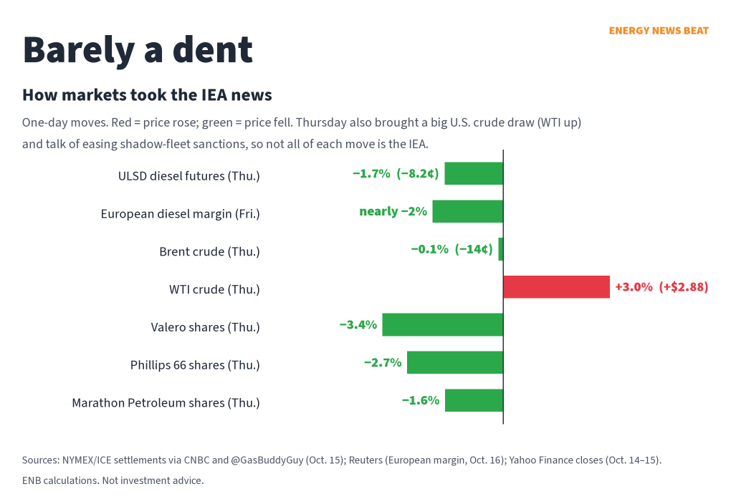
Investors: refiner shares dipped on the news day. Valero fell 3.4%, Phillips 66 2.7% and Marathon Petroleum 1.6% (Yahoo Finance; Yahoo Finance; Yahoo Finance; ENB calculations). They are still up 173%, 124% and 193% this year. U.S. crude went the other way, with WTI settling up $2.88, or 3%, on the big inventory draw (@GasBuddyGuy; Reuters). ENB does not pin any one-day stock move on a single headline, and none of this is investment advice.
| Stu’s Take
Folks, I am glad the IEA is moving barrels. Every gallon helps a trucker or a farmer somewhere. But let’s be honest about the size of this. More than 20 million barrels of diesel is about five days of what America burns, and about 17 hours for the world. Our own heating oil reserve is 1 million barrels. That is about six hours. Here is the part that matters. America’s share of the March release was 172.2 million barrels of crude, and crude is not diesel until a refinery makes it diesel. Our refineries ran at 93.5% last week. Andy Lipow said it well: the release does not fix refineries that are damaged overseas or already running flat out here. I keep saying there are only two ways prices come down: demand destruction or more refineries. A stock release is neither. It is a bridge. Diesel is still $6.33. Stockpiles are 102.6 million barrels, the lowest for this time of year since EIA started counting in 1982. Futures plus the usual markup still put pump diesel near $6.18 on the November contract. That is a little relief, if we are lucky, right before an election. So use the bridge, and build. The Defense Production Act order at Tyler is the right instinct. Brownsville is a refinery we can actually see on a calendar, late 2028. @TheFrackingGuy and I have talked on the podcast about the refineries blue states have closed. Until we reopen and build, the trucker paying about $1,006 more a week and the farmer out $2,227 at harvest will keep paying. Buckle up. |
Corrections to early reports
Some details in early accounts, including a summary that reached us second-hand, needed fixing or context:
- “IEA members agreed to front-load more than 20 million barrels of diesel.” The IEA’s words are “accelerate the release of the remaining volumes … including over 20 million barrels of diesel as soon as possible” (IEA). “Frontloaded” was the G7’s Oct. 2 wording, tied to a 20-day window (G7). Thursday’s statement gives no timeline (CNBC), and Argus says the IEA “appears to have withdrawn a timetable” (Argus).
- “More than 20 million extra barrels.” The diesel is part of the remaining ~100 million, not on top of it. Sparta Commodities called it “an acceleration of existing commitments rather than genuinely new volumes” (Reuters). The IEA said this week about 96 million barrels were still to go: 46 million in Europe, 40 million in the Americas and 10 million in Asia-Pacific (Argus).
- “Less than one day of global diesel demand, or about 5 days of U.S. use.” CNBC says “slightly more than five days” (CNBC). ENB’s math gives 0.70 days (about 17 hours) of world demand at the IEA’s 28.7 million barrels a day, and 5.03 days at EIA’s four-week U.S. distillate average of 3.97 million barrels a day. U.S. “use” here means distillate, which is diesel plus heating oil.
- European margins “fell nearly 2% Friday to $78.67/bbl.” Correct, but the figure comes from Reuters’ Friday oil report, not CNBC’s IEA story (Reuters). It measures European diesel futures against Brent futures and should not be mixed with the IEA’s separate refinery crack estimate, about $60 a barrel in early October (IEA).
- “Analysts such as Andy Lipow say the release doesn’t fix damaged or tight refining.” A fair paraphrase. His exact words are about refineries “damaged in the Middle East or Russia, and operating at capacity in the USA” (CNBC).
- EIA week ended Oct. 9. Crude −8.6 million barrels and distillates −2.5 million both check out against EIA’s own tables (−8.557 million and −2.527 million) (EIA). “About 12% below the five-year average” matches ENB’s nearest-week calculation (−12.2%). A strict calendar-week match gives −11.1% (EIA; see Appendix E). EIA’s narrative highlights page was not updated when we checked, so this comparison is our own.
- Brent “about $105” and WTI “about $97.” They moved overnight. Reuters had Brent at $105.14 and WTI at $96.98 at 4:27 a.m. CT. CNBC showed $106.52 and $98.16 at 6:35 a.m. CT (Reuters; CNBC; CNBC). WTI settled Thursday at $97.97, up 3%.
- “Diesel futures more than 1% lower Thursday at $4.86.” That was CNBC’s midday figure. The November contract settled at $4.8456, down 8.2 cents, or 1.7% (CNBC; @GasBuddyGuy).
Confirmed as relayed: the Oct. 15 meeting date; about 330 million barrels released; about 100 million remaining; a total above 400 million; AAA diesel at $6.3261 and regular at $4.3271 (“Price as of 10/16/26”); and ENB’s Oct. 14 headline.
What to watch
- Monday, Oct. 19: EIA’s weekly retail diesel price. Watch whether the pump starts following wholesale down (EIA).
- Wednesday, Oct. 21: EIA’s next weekly stocks report, in its new format (EIA). The test is whether distillates stop falling.
- Late October: any IEA country-by-country diesel schedule. Thursday’s statement did not include one (CNBC).
- 3: the midterms. Nov. 10: EIA’s next Short-Term Energy Outlook, the first to reflect this week’s moves (EIA).
- November–January: France’s 10 million barrels (Argus), the heating season, and any new strikes on Gulf or Russian refineries. Follow it all in ENB’s diesel coverage.
The bottom line
The IEA did something real on Thursday, and markets noticed for about a day. Diesel futures dropped, European margins dipped, and refiner shares slipped. But the release is about five days of U.S. diesel and heating oil use; it may be mostly barrels already promised, and it comes with no clock. By our math, it might take a dime or two off the pump before Nov. 3. It will not bring back $3.65 diesel, because emergency barrels are not refining capacity. That leaves the two doors Stu keeps naming. Right now we are walking through demand destruction, and the refinery door is still years away. For background, read Wednesday’s IEA analysis, the Tyler refinery story, the Brownsville refinery update and why the Fed can’t fix diesel inflation.
Check out the World’s Greatest Podcast Show Notes at EnergyNewsBeat.co or EnergyNewsBeat.com. And subscribe to: The Energy News Beat Substack.
Appendices
At Energy News Beat we Make Appendices Great Again. Times are U.S. Central (CDT, UTC−5) unless noted; timestamps published in ET or GMT have been converted. Fast-moving items (futures, crude, pump prices) are current 6:35–6:46 a.m. CT, Fri., Oct. 16, 2026 unless another time is shown; stock prices are Oct. 15 closes. Labels: [ENB CALC] = our arithmetic from the cited figures; [ENB READING] = our interpretation; [ENB ESTIMATE] = a calculation that rests on an assumption, such as the usual pump markup.
Download the data: every figure in the charts and tables is in the companion workbook, “The IEA Speeds Up 20 Million Barrels of Diesel – That Is About Five Days of U.S. Use, Not Cheap Diesel by the Midterms – Data.xlsx,” with a source and URL on each sheet.
Appendix A. Sources, with perspective labels
“Perspective” tells you who is speaking: official bodies, market data, news reports, industry groups that represent a side, analysts, or ENB itself. Industry groups and analysts have points of view; we quote them as such.
Appendix B. Key figures
| Figure | Value | Source |
| AAA national diesel, Oct. 16 | $6.3261/gal (yesterday $6.3173; week ago $6.2785; month ago $6.3103; year ago $3.6491) | AAA |
| Diesel vs. year ago / record | +$2.68, +73%; record $6.5276 on 9/22/26, now 20.2¢ below [ENB CALC] | AAA |
| AAA regular gasoline | $4.3271 (year ago $3.0570; +$1.27) [ENB CALC] | AAA |
| Fill-ups [ENB CALC] | 30 gal $190 vs $109; 200 gal $1,265 vs $730; heating oil 275 gal $1,688 vs $974 | AAA; EIA |
| IEA release status (Oct. 15) | ~330M released; ~100M remaining; total > 400M; 20M+ diesel “as soon as possible”; no timeline | IEA; CNBC |
| IEA March pledge | 400M barrels (March 11); contribution table 426M (301M crude, 125M products); U.S. 172.2M, all crude | IEA; IEA |
| Remaining by region (per Argus) | ~96M: Europe 46M, Americas 40M, Asia-Pacific 10M; France 10M diesel Nov.–Jan. (≈109 kb/d) [ENB CALC for rate] | Argus |
| G7 plan (Oct. 2) | 100M barrels over four months; “frontloaded substantial diesel release within the first 20 days” | G7 |
| Release in days [ENB CALC] | 20M ÷ 28.7 mb/d = 0.70 d (16.7 h); ÷ 3.974 mb/d = 5.03 d; ÷ 1.7 mb/d lost supply = 11.8 d; 100M ÷ 102.4 mb/d world oil = 0.98 d; NEHHOR 1M = 6.0 h | IEA; EIA; DOE |
| ULSD futures (NYMEX) | Nov: Tue $4.9344, Wed $4.9274, Thu $4.8456 (−8.2¢); Fri 6:36 a.m. CT $4.858. Dec: Tue $4.7766 → Thu $4.6545. Jan: $4.6766 → $4.5552 | CNBC; CNBC; CNBC; @GasBuddyGuy; ENB |
| Futures-implied pump [ENB ESTIMATE] | Settle + $1.33: Nov $6.18; Dec $5.98; Jan $5.89 (Tuesday basis: $6.26, $6.11, $6.01); $6 pump needs ≈ $4.67 wholesale; today’s gap $1.48 | CNBC; EIA; EIA |
| Crude | Brent Dec $106.52 (+$0.60), WTI Nov $98.16 (+$0.19) at 6:35 a.m. CT; Reuters 4:27 a.m. CT: $105.14 / $96.98; Thu settles Brent $105.92, WTI $97.97 (+$2.88, +3.0%) | CNBC; CNBC; Reuters |
| European diesel margin | $78.67/bbl Fri. (down nearly 2%); ~$85 Wed. Oct. 14; Sept. high ~$95 | Reuters; Reuters |
| EIA week ending Oct. 9 | Crude −8.557M to 415.6M; distillate −2.527M to 102.6M; year ago 117.0M (−12.3%); 2021–25 avg 116.9M (-12.2%) [ENB CALC]; ISO-week basis -11.1%; lowest for early Oct. since 1982 | EIA; EIA |
| Use, supply, refining | Distillate product supplied 4.323M b/d (week), 3.974M b/d (4-wk); 25.8 days of supply [ENB CALC]; utilization 93.5%; crude output 13.679M b/d (−300 kb/d); SPR 283.0M (year ago 407.7M) | EIA; EIA |
| EIA weekly retail diesel | $6.179 (Oct. 12); year ago $3.665; 2025 avg $3.660 | EIA |
| Truckers [ENB CALC] | OOIDA $400/wk per $1 × $2.514 = $1,006/wk; ATRI fuel $0.482/mi (2025) → ≈$0.81/mi | Overdrive; ATRI |
| Farmers | Corn farm +$2,227 harvest diesel (279 acres, 857 gal, +$2.60/gal) | AFBF |
| Heating oil | EIA residential $6.138 (Oct. 12) vs $3.543 (+73%); winter $2,115 (+21%); NEHHOR ≈1M bbl | EIA; EIA; DOE |
| Refiner shares | Thu. Oct. 15: VLO -3.4%, PSX -2.7%, MPC -1.6%; YTD VLO +173%, PSX +124%, MPC +193% [ENB CALC] | Yahoo Finance |
| Pew | 74% very concerned about “the price of gas and energy” (43% Jan.; 60% July); n=5,062, Sept. 28–Oct. 4 | Pew |
| Brownsville refinery | 160,000–168,000 b/d; Morgan Stanley leading fundraise; construction must start by Oct. 19, 2027; mechanical completion late 2028; first full year 2029 | ENB |
Appendix C. Timeline
| Date | Event | Type | Source |
| Feb. 28, 2026 | Middle East war begins; Hormuz flows collapse | Event | link |
| Mar. 11, 2026 | 32 IEA members agree to make 400M barrels available, the largest collective action ever | Policy | link |
| Mar. 19, 2026 | IEA contribution table totals 426M barrels; U.S. share 172.2M, all crude | Policy | link |
| Sep. 22, 2026 | AAA national diesel average sets record, $6.5276 | Price | link |
| Sep. 30, 2026 | European diesel margins near $95/bbl, the September high (approximate date) | Price | link |
| Oct. 2, 2026 | G7 leaders pledge 100M barrels over four months, “frontloaded” diesel within 20 days | Policy | link |
| Oct. 9, 2026 | Trump says Russia will supply diesel; ENB: first 300,000 tons is less than a day of U.S. demand | Policy | link |
| Oct. 14, 2026 | IEA Oil Market Report: diesel tight “well into 2027”; ENB’s futures analysis | Report | link |
| Oct. 15, 2026 | EIA: crude stocks −8.6M, distillates −2.5M to 102.6M barrels (week ending Oct. 9) | Data | link |
| Oct. 15, 2026 | IEA Governing Board: ~330M released, ~100M to go, 20M+ diesel “as soon as possible” | Policy | link |
| Oct. 15, 2026 | ULSD futures settle $4.8456, down 8.2 cents; refiner shares fall | Price | link |
| Oct. 16, 2026 | European diesel margins down nearly 2% to $78.67/bbl; AAA diesel $6.3261 | Price | link |
| Oct. 21, 2026 | Next EIA weekly petroleum report (new format) | Data | link |
| Nov. 3, 2026 | U.S. midterm elections | Event | link |
| Nov. 10, 2026 | Next EIA Short-Term Energy Outlook | Report | link |
| Nov. 15, 2026 | France’s pledged 10M barrels of diesel, November to January (midpoint shown) | Policy | link |
| Jul. 1, 2027 | IEA: rebuilding lost diesel stocks unlikely before 2H27 | Report | link |
| Oct. 19, 2027 | Brownsville refinery permit: construction must start by this date | Refining | link |
| Dec. 1, 2028 | Brownsville refinery mechanical completion target (late 2028); first full year 2029 | Refining | link |
Approximate or planned dates are marked as such in the event text. The Sept. 30 margin date stands for “late September.” The France entry is placed at the midpoint of its November–January window.
Appendix D. Key passages, verbatim
“Agreed to accelerate the release of the remaining volumes, with specific plans already in place, including over 20 million barrels of diesel as soon as possible.” (IEA Governing Board, Oct. 15)
“Acknowledged that approximately 330 million barrels have so far been released and agreed to take all necessary steps to complete the remaining releases of around 100 million barrels in a timely manner consistent with national circumstances.” (IEA Governing Board, Oct. 15)
“…a coordinated release through the IEA of 100 million barrels (MB) to begin immediately over 4 months, including a frontloaded substantial diesel release within the first 20 days by G7 members and partners.” (G7 Leaders’ Statement, Oct. 2)
“The IEA today said 20mn bl of diesel will be included in the G7-led oil stocks release, but it appears to have withdrawn a timetable for this.” (Argus Media, Oct. 15)
“The 20+ million barrels of diesel appear to be an acceleration of existing commitments rather than genuinely new volumes.” — Abhishek Kumar, Sparta Commodities (Reuters, Oct. 15)
“[The release does] not solve the basic problem which is how to increase production at refineries which are damaged in the Middle East or Russia, and operating at capacity in the USA.” — Andy Lipow, Lipow Oil Associates (CNBC, Oct. 15)
“European diesel refining margins declined by nearly 2% on Friday to $78.67 a barrel, after the IEA agreed on Thursday to release over 20 million barrels of diesel to the market.” (Reuters, Oct. 16)
“Failing this, further demand reductions and the heavy economic costs these will entail may be needed to balance markets.” (IEA Oil Market Report, Oct. 14)
“There’s only two ways diesel and gasoline prices can come down. One, demand destruction. Number two, … more refineries. It takes decades to build refineries.” — Stuart Turley (Daily Caller News Foundation, Oct. 12)
“Every $1 increase per gallon in fuel costs our members around $400 more per week, and sustained high prices will put many truck drivers out of business.” — Todd Spencer, OOIDA (Overdrive, Oct. 6)
Appendix E. Methodology and conversions
Days of supply [ENB CALC]: barrels ÷ daily use. World diesel and gasoil demand is the IEA’s third-quarter 2026 estimate, 28.7 mb/d. U.S. use is EIA’s four-week average of distillate product supplied for the four weeks ending Oct. 9, 3,974 kb/d (EIA’s proxy for consumption, which includes heating oil). CNBC’s independent figure, “slightly more than five days,” matches. Lost supply is the IEA’s estimate that diesel and gasoil availability fell 1.7 mb/d year on year in 3Q26.
Five-year comparison [ENB CALC]: EIA’s 2021–2025 average for the week was built by taking, for each year, the weekly reading closest to Oct. 9 (Oct. 8, 2021; Oct. 7, 2022; Oct. 6, 2023; Oct. 11, 2024; Oct. 10, 2025). Average 116.867M; 2026 is -12.2%. Matching by ISO calendar week 41 instead gives -11.1%. ENB’s Oct. 14 story used the ISO method (−11.3% for the week ending Oct. 2); this story uses the nearest-date method, which lines up with the “about 12%” in EIA-based summaries. The chart band uses the nearest-date method for every 2026 week.
Record check: compared every EIA weekly distillate stock reading dated Oct. 6–12 in each year since 1982; 2026 (102.6M) is the lowest, followed by 2022 (106.1M) and 1996 (111.4M).
Futures-implied pump price [ENB ESTIMATE]: NYMEX ULSD settlement plus $1.33/gal, the 2025 average of EIA weekly U.S. retail diesel minus EIA’s New York Harbor ULSD spot price on the nearest prior trading day. Futures are prices for later delivery, not forecasts; retail trails wholesale by days to weeks, and EIA expects retail margins to widen in 2027. Today’s actual gap is $1.48 (AAA $6.3261 − Thursday settle $4.8456). A $6 pump price on the normal markup requires about $4.67 wholesale.
Thursday and Wednesday settlements: Thursday’s settles come from CNBC’s “previous close” for each contract, checked Friday morning. Thursday’s November change (−8.2¢) is from Patrick De Haan’s market summary and matches Wednesday’s settle of $4.9274 (Yahoo Finance front-month series). Tuesday’s settles come from ENB’s Oct. 14 analysis and were not re-checked independently. EIA’s $5.79 November diesel forecast is also taken from ENB’s Oct. 14 reading of the October STEO; EIA’s STEO page returned an error when re-checked Friday morning.
Trucking [ENB CALC]: OOIDA rule of thumb ($400 a week per $1 a gallon) × change in EIA weekly retail diesel ($6.179 Oct. 12, 2026 − $3.665 Oct. 13, 2025) = $1,006. ATRI 2025 fuel cost $0.482/mi × ($6.179 ÷ 2025 average $3.660) = $0.814/mi, assuming the same fuel economy.
Fill-ups [ENB CALC]: 30 gal and 200 gal × AAA $6.3261 now and $3.6491 a year ago; heating oil 275 gal × EIA residential $6.138 (Oct. 12) and $3.543 (Oct. 13, 2025).
France’s rate [ENB CALC]: 10M barrels over November–January (92 days) ≈ 109,000 b/d, assuming an even pace; Argus does not give a schedule.
Refiner shares: Yahoo Finance daily closing prices for Dec. 31, 2025, Oct. 14 and Oct. 15, 2026. The one-day moves also reflect other news (crude draw, shadow-fleet reports, the broader market); ENB does not attribute them to the IEA alone.
Crude prices: CNBC quotes are for ICE Brent December 2026 and NYMEX WTI November 2026; Reuters’ 4:27 a.m. CT figures are front-month futures. Yahoo Finance’s continuous WTI and ULSD series had rolled to December contracts by Friday morning, so ENB did not use them for Friday quotes.
Rounding: per-gallon prices to the cent in text; percentages to whole numbers unless a decimal matters.
Appendix F. Glossary
Collective action: A coordinated emergency stock release by IEA member governments.
Distillate: The fuel family that includes diesel and heating oil; EIA reports them together.
Gasoil: The international trade name for diesel and heating oil.
ULSD: Ultra-low sulfur diesel; the NYMEX “heating oil” futures contract is ULSD in New York Harbor.
Diesel margin / crack: The price of diesel minus the price of crude, per barrel; roughly what refiners earn for turning crude into diesel.
Product supplied: EIA’s proxy for U.S. consumption.
SPR: The U.S. Strategic Petroleum Reserve, which holds crude oil only.
NEHHOR: The Northeast Home Heating Oil Reserve, about 1 million barrels of ultra-low sulfur diesel held for the Northeast.
Refinery utilization: The share of operable refining capacity in use.
Demand destruction: Lower fuel use forced by high prices.
mb/d, kb/d: Million and thousand barrels per day.
2H27: The second half of 2027.
Appendix G. Perspective guide: who said what
| Voice | Perspective | View in this story |
| IEA Governing Board | Official, intergovernmental | Release is accelerating; total will top 400M; diesel “as soon as possible” |
| U.S. Energy Department spokesperson | Official, U.S. government | Holding Europe “accountable” for unmet commitments |
| Andy Lipow, Lipow Oil Associates | Industry consultant | Release does not solve refinery damage or U.S. capacity limits |
| Abhishek Kumar, Sparta Commodities | Market analyst | “Step in the right direction,” but mostly existing volumes |
| Ole Hansen, Saxo Bank | Investor-side strategist | Release unlikely to ease diesel tightness |
| Kpler | Market data firm | Hormuz recovery slower and more uneven without a deal |
| Patrick De Haan, GasBuddy | Consumer-side analyst | Diesel should “throttle back a good bit”; dyed-diesel ruling won’t fix imbalance |
| Todd Spencer, OOIDA | Trucker advocacy group | High fuel prices threaten small carriers |
| Zippy Duvall, Farm Bureau | Farmer advocacy group | Farmers cannot postpone harvest |
| Pew Research Center | Public opinion survey | 74% very concerned about gas and energy prices |
| Stuart Turley, ENB | Opinion (labeled) | Two ways to lower prices: demand destruction or more refineries |
Appendix H. What ENB could not confirm
- A country-by-country schedule for the 20M+ barrels of diesel; the IEA statement gives none, and the France split is Argus’s reading.
- Whether any of the diesel is new volume beyond March pledges; Sparta says it appears not, and the IEA did not say.
- How much of the release, if any, will reach U.S. terminals; the U.S. pledge was all crude.
- EIA’s own narrative wording on the five-year comparison for the week ending Oct. 9; the highlights page had not been refreshed when we checked, so “about 12%” is ENB’s calculation, matched by EIA-based summaries.
- The context of a separate Oct. 15 De Haan post quoting a “100 trillion barrels” remark; we did not use it.
- How fast lower futures will pass through to the pump; the $1.33 markup is an average, not a rule.
- Pew’s publication date (Oct. 8), taken from the report’s URL.
- The Brownsville refinery’s financing close and schedule; ENB’s Oct. 16 report relies on company statements and Bloomberg. Bloomberg’s story is paywalled and could not be read directly, and the financing has not closed.
- EIA’s $5.79 November diesel forecast, relayed from ENB’s Oct. 14 piece; EIA’s STEO page returned an error when re-checked.
The post The IEA Speeds Up 20 Million Barrels of Diesel. That Is About Five Days of U.S. Use, Not Cheap Diesel by the Midterms appeared first on Energy News Beat.