
Europe’s remaining coal plants are generating unexpected profits while Asia burns more coal to fill an LNG gap created by Middle East disruptions. Global demand is heading for a record high in 2026. The rebound is real but uneven, largely temporary in the West, and more structural in Asia—until nuclear and cleaner alternatives scale meaningfully.
The Immediate Drivers: Gas Disruption and Winter Demand
A conflict affecting the Strait of Hormuz has sharply reduced Persian Gulf LNG flows. Asian spot LNG prices have pushed above $26/MMBtu while European benchmark gas has traded above €81/MWh. Coal, by comparison, has been roughly 80% cheaper on a delivered basis in key markets.Oilprice
Jack Prandelli noted on X that Asia has split into two camps for the winter. China filled storage early and stockpiled enough gas to cover expected demand. South Korea is explicitly turning toward coal; its energy minister has said the country “must somehow reduce LNG demand” in the short term. Korea accounted for 11% of world LNG shipments last year. Rystad Energy expects Asia to burn roughly 70 million tonnes more coal in 2026 under a sustained tight-gas scenario as existing plants run harder, with Korean coal imports already up more than 50% year-on-year in May. China’s early buying has left more spot cargoes available for Europe (whose storage sits at about 74% versus an 89% norm), but any return by China to the spot market later in winter would intensify competition.X
Bloomberg reported that Europe’s dwindling coal fleet is reaping a windfall. Soaring gas prices, cold weather, and fading solar output have flipped the economics. In Germany, one measure of lignite profitability has surged to €64 per megawatt-hour this month from virtually zero a year earlier, according to Energy Aspects. Hard-coal plants have also returned to positive margins.Bloomberg
How Fast Is the Rebound?
The International Energy Agency’s Coal Mid-Year Update revised its 2026 outlook from a slight decline to a 1.2% increase, projecting global demand at a record 8.94 billion tonnes. Higher gas prices are the main swing factor, prompting greater coal-fired generation in Europe, Japan, Korea, China, and elsewhere. Additional support comes from chemical use in China and weather-related demand in India and Vietnam.Iea
In Europe, the response is sharp but capacity-constrained. Analysts have projected coal-fired generation could rise by about 25% over the next six months as gas generation falls by a similar amount. Coal is expected to remain cheaper than gas for power generation through next year and potentially until March 2028. Yet the EU’s coal share of electricity had already fallen to 9.2% in 2025 from more than one-third in 1990. Many plants have been closed or are scheduled for phase-out (Germany’s eastern lignite plants generally run toward 2038). Remaining units are running closer to practical limits; upside is real but capped.Oilprice
Asia’s increase is larger in absolute terms. Existing fleets are simply utilized more intensively rather than through major new capacity additions in most markets. Newcastle thermal coal futures have risen more than 40% this year to two-year highs. Supply has also tightened: Chinese mine safety inspections reduced domestic output, Indonesian export quotas and logistics issues constrained shipments, and diesel costs rose. India has drawn down stocks and faces risks of further power cuts if winter or cooling demand strengthens.
Clean Coal Technology: Incremental Improvements, Not a Full Reset
“Clean coal” technologies continue to advance and can extend the viable life and lower the emissions intensity of existing plants. High-efficiency, low-emissions (HELE) designs—supercritical and ultra-supercritical boilers, circulating fluidized bed systems—improve efficiency and cut CO₂ and other pollutants relative to older subcritical units. Carbon capture, utilization, and storage (CCUS) projects are progressing, co-firing with biomass or ammonia is being tested, and coal gasification is moving forward in India and elsewhere.
Recent examples include:
- South Africa’s Eskom advancing HELE-CFB localization, CCUS feasibility work, and biomass co-firing pilots, with a demonstration plant targeted later this decade.
- China breaking ground on a utility-scale supercritical CO₂ power cycle paired with molten-salt storage that uses surplus power from existing coal units.
- Chinese processes converting coal into higher-value carbon materials (graphene, carbon fiber, foam) with claimed emissions reductions.
- U.S. Department of Energy funding for efficiency, reliability, and retrofit projects at existing coal plants.
- Ongoing Japanese and other Asian CCUS pilots and India’s large coal-gasification investments aimed at chemicals and reduced import dependence.
These technologies can cut emissions intensity by meaningful percentages and improve flexibility, but deployment remains uneven. Financing constraints, cost, and policy preferences for full phase-outs limit new HELE builds in Europe. In Asia, where young coal fleets and rising demand coexist with energy-security concerns, HELE and selective CCUS retrofits offer a more practical bridge. Global CCUS capacity is still far below net-zero pathways, though operational and under-construction volumes have grown.
Until Nuclear Can Be Reestablished
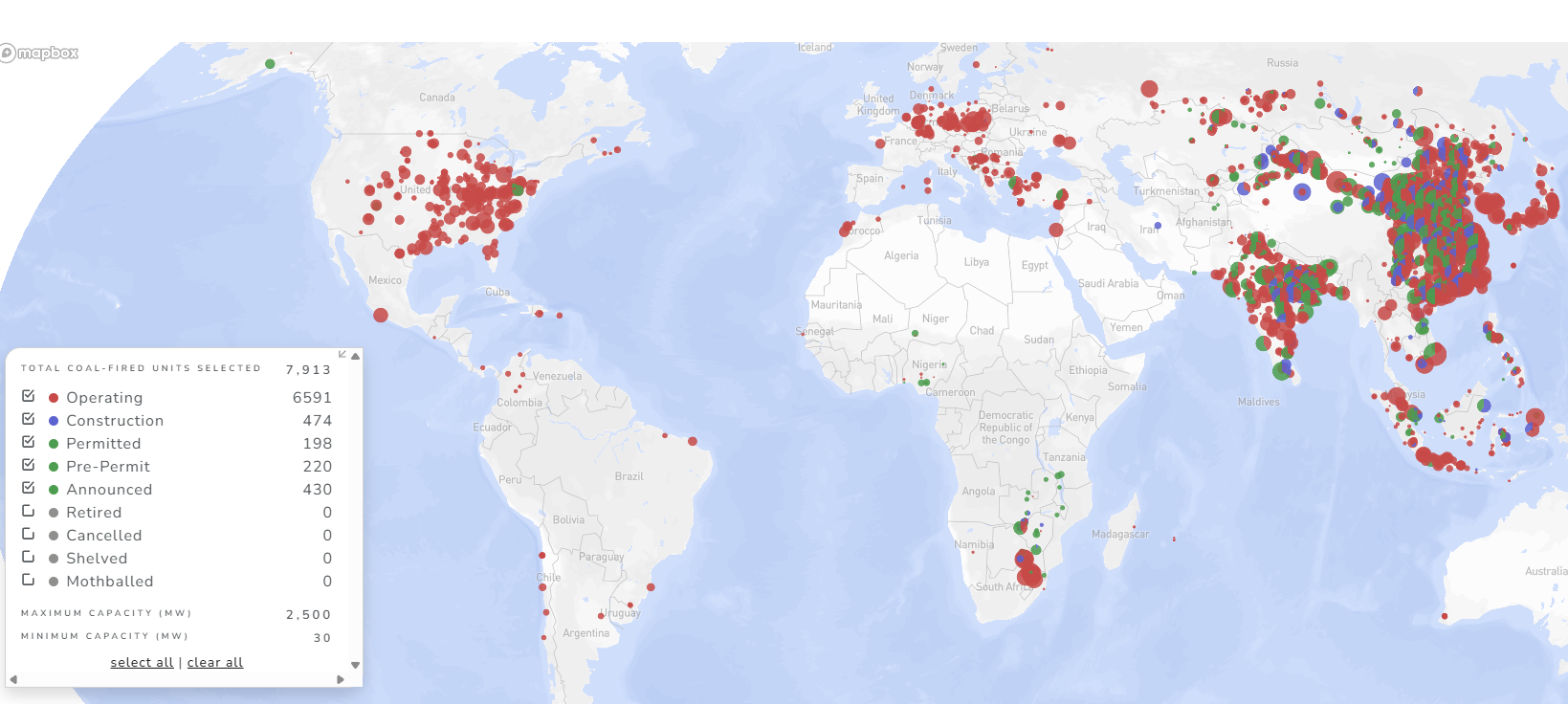
Nuclear is the clearest low-carbon baseload alternative that can displace both coal and gas at scale, but reestablishment is slow outside a few countries. Global operating capacity has been roughly flat near 420 GW in recent years, with new additions largely offset by retirements. Roughly 78 GW is under construction worldwide; about half of that is in China. Asia accounts for the large majority of reactors under construction and planned. China is on track toward 100 GW by around 2030. India, South Korea, Turkey, Egypt, and others are advancing projects, though delays are common.
In Europe, the picture is different. Germany completed its nuclear phase-out in 2023, reducing system flexibility. Poland’s first large plant has slipped to a 2036 commercial start. France is extending existing reactor lives and pursuing new builds, but timelines stretch into the 2030s. The UK’s Hinkley Point C has faced repeated delays. Small modular reactors are advancing in several countries (including early projects in China, Canada, and planned units in Europe), yet they are not yet contributing meaningful capacity. Construction times for large reactors frequently exceed a decade; even aggressive programs deliver incremental rather than transformative additions in the near term.
Data-center and AI-driven electricity demand is adding urgency, particularly in the United States, where gas is the fuel that can be deployed fastest (subject to turbine and pipeline constraints). Nuclear remains the preferred long-term solution for many planners, but it will not close the near-term gap created by gas supply disruptions or rising firm-power needs.
How Long Does the Comeback Last?
In Europe the coal rebound is primarily a short-to-medium-term price response. As long as LNG remains constrained through Hormuz and gas stays expensive, remaining plants will run hard and generate windfall margins. Analysts see coal staying competitive versus gas into 2027–early 2028 under current forward curves. Once gas supply normalizes and carbon prices or phase-out policies reassert themselves, the structural decline resumes. Europe simply does not have the fleet left for a sustained coal revival.
In Asia the duration is longer. Higher utilization of existing plants can persist while LNG is tight and nuclear restarts or new builds take time. Rystad has flagged additional cumulative coal demand through 2030 under tight-gas scenarios. China and India dominate global coal use; their growth trajectories, domestic production, and renewable/nuclear build-outs will determine the global peak. The IEA notes that 2027 demand hinges heavily on whether Hormuz LNG flows recover.
Clean-coal upgrades and selective new HELE capacity can keep coal competitive longer in Asia by lowering emissions and operating costs, but they do not reverse the broader energy-transition pressure. Nuclear’s contribution will grow steadily—especially in China—but will not fully reestablish baseload capacity in Europe or fully displace coal in developing Asia on a short timetable.
In short, coal is making a fast, opportunistic comeback driven by gas scarcity and winter demand. It is limited and reversible in Europe, more durable in Asia, and will continue to bridge the gap until nuclear, advanced renewables plus storage, and sufficient low-carbon firm power are available at scale. Energy security has reasserted itself as a precondition for orderly decarbonization.
Check out the World’s Greatest Podcast Show Notes at EnergyNewsBeat.co or EnergyNewsBeat.com. And subscribe to: The Energy News Beat Substack.
Appendix: Sources and Links
- Jack Prandelli X post (16 October 2026): https://x.com/jackprandelli/status/2111017743927431509
- Bloomberg: “Dwindling Coal Fleet in Europe Reaps Windfall From Gas Rally” (16 October 2026): https://www.bloomberg.com/news/articles/2026-10-16/dwindling-coal-fleet-in-europe-reaps-windfall-from-gas-rally
- IEA: “Global coal demand set to increase this year amid Middle East conflict” / Coal Mid-Year Update 2026: https://www.iea.org/news/global-coal-demand-set-to-increase-this-year-amid-middle-east-conflict and https://www.iea.org/reports/coal-mid-year-update-2026/overview
- Rystad Energy analyses on Asia coal demand (+~70 Mt in 2026; cumulative to 2030): reported in Hellenic Shipping News, Natural Gas Intelligence, Bernama, and related coverage.
- OilPrice.com: “Global Coal Demand Rises as LNG Shortage Deepens” and “Europe’s Soaring Gas Bill Is Sending Utilities Back to Coal.”
- Reuters and Veyt/ICIS analyses on European coal-versus-gas switching and 25% generation shift.
- World Nuclear Association and World Nuclear Industry Status Report 2026 materials on construction timelines and regional growth.
- South China Morning Post on China’s supercritical CO₂ + molten salt project.
- Eskom / Coaltech materials on South African HELE and CCUS progress.
- U.S. DOE funding notices for coal-plant efficiency and retrofit projects.
- Additional market data from Energy Aspects, Kpler, and commodity reporting on Newcastle prices, Korean/Japanese imports, and European storage levels.
The post Coal Making a Comeback: How Fast and How Long? appeared first on Energy News Beat.