

A mild weather outlook pushed U.S. gas futures to a more-than-two-week low while oil and European gas stayed expensive. Cheaper gas is only part of your bill, and America’s storage cushion is thinner than it looks.
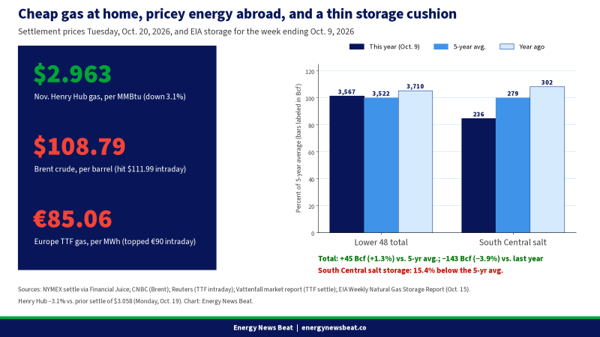
Here’s some welcome news as the furnace season starts. U.S. natural gas futures slipped below $3 on Tuesday. The November Henry Hub contract settled at $2.963 per million British thermal units (NYMEX via Financial Juice), down 3.1% (Daily Digest Invest) from a $3.058 settle on Monday, Oct. 19 (Premier Energy Management). Reuters said the contract touched its lowest level since Oct. 2 as forecasts for warmer-than-normal weather through early November curbed expectations for heating demand (Reuters).
Prices in this story are as of Tuesday’s close. November gas was trading around $2.96 to $2.97 early Wednesday (WSJ market data; ENGIE Resources/CME).
LSEG expects Lower 48 gas demand, including exports, to rise from 106 billion cubic feet a day this week to 110 Bcf/d next week, still below the five-year average of 117 Bcf/d for that week (Reuters).
What the analysts are saying
Consultancy Ritterbusch and Associates said in a note that the market “appears to be focused on unusually mild temperature trends that are now stretching into next month instead of longer-term patterns capable of spiking the winter gas contracts into fresh multi-month highs on first indication of a sustained cold spell” (Reuters). The firm added: “The fact that this market is seeing only limited downside reaction to the surge in oil prices is now suggesting some lower for longer gas prices than we had expected.”
In other words, a cold snap could still flip the script. That’s why the storage numbers matter.
A thinner cushion than it looks
The latest EIA storage report shows 3,567 Bcf of working gas in the Lower 48 as of Oct. 9, after a 67 Bcf weekly build. That’s only 45 Bcf, or 1.3%, above the five-year average, and 143 Bcf, or 3.9%, below a year ago (EIA). The South Central region, home to the Gulf Coast salt caverns that can deliver gas quickly in a cold snap, is the soft spot: salt storage sits at 236 Bcf, 15.4% below its five-year average (EIA). The next report comes out Thursday, Oct. 22.
EIA’s October outlook expects inventories to reach 3,850 Bcf by the end of October, about 2% above the five-year average. It also warns that “prolonged periods of cold weather could increase withdrawals beyond our forecast.” In January 2026, after Winter Storm Fern, the Henry Hub spot price averaged $7.72 per MMBtu (EIA STEO).
Meanwhile, the rest of the world is paying up
Oil is a different story. Brent crude for December fell 0.7% to settle at $108.79 a barrel on Tuesday, well off a session high of $111.99 (CNBC). Reuters said Brent hit a five-month high as traders priced in a risk premium from Houthi attacks on Saudi infrastructure and reported vessel attacks in the Gulf (Reuters).
In Europe, the benchmark Dutch TTF gas contract traded above €90 per megawatt-hour on Tuesday for the first time since December 2022 (Reuters). It peaked at €90.24 before settling at €85.06, and Europe’s storage is about 74.6% full, its lowest for this time of year since 2011, according to Vattenfall’s weekly report. That settle works out to roughly €25 per million Btu (ENB unit conversion), compared with under $3 here.
What it means for you
- Households: Cheaper wholesale gas helps, but it’s only part of your bill. EIA says what consumers pay has two main parts, the cost of the gas itself and the cost to move and deliver it, plus taxes and fees (EIA).
- Watch November: Mild weather is what’s holding prices down. The storage cushion is only 1.3% above normal, so a sustained cold snap could change the picture quickly.
| Stu’s Take (opinion)
This is what American energy abundance looks like. While Europe pays €85.06 per megawatt-hour and Brent sits at $108.79, American families are heating with gas that settled at $2.963. Our producers and pipelines did that, and it’s a big win for anyone with a gas furnace. But don’t get comfortable. Storage is only 45 Bcf above normal, South Central salt storage is 15.4% below average, and we all remember this past January, when the Henry Hub spot price averaged $7.72 after Winter Storm Fern. Enjoy the mild weather, check whether your utility offers a budget plan, and keep an eye on November. |
Sources
- EIA Weekly Natural Gas Storage Report, week ending Oct. 9, 2026 (released Oct. 15)
- EIA Short-Term Energy Outlook, natural gas (Oct. 6, 2026)
- Reuters via Business Recorder: US natgas falls on mild weather outlook (Oct. 21, 2026)
- Financial Juice: NYMEX Natural Gas November futures settle at $2.9630/MMBtu (Oct. 20, 2026)
- Daily Digest Invest: Warm November Forecasts Push US Natural Gas to Two-Week Low (Oct. 20, 2026)
- Premier Energy Management: Natural Gas MarketWatch (Oct. 20, 2026; Monday settle)
- CNBC: Oil prices fall as traders hope for diplomatic progress in Middle East (Oct. 20, 2026)
- Vattenfall MarktRapport, week 43, 2026 (TTF and EU storage; in Dutch)
- EIA: Natural gas prices explained
- WSJ market data: Natural Gas Nov 2026 (NGX26)
- ENGIE Resources: Natural gas futures report (CME data)
The post Natural Gas Dips Below $3: Good News for Heating Costs, but Watch November appeared first on Energy News Beat.