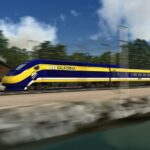
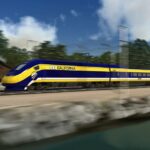
The California High-Speed Rail Authority (CHSRA) could exhaust its available funding as soon as December 2027 unless it secures financing, according to the state’s Inspector General for High-Speed Rail. A cumulative funding gap of $9.5 billion from fiscal years 2027-28 through 2031-32 threatens construction schedules, with $2.2 billion specifically required in 2027-28 alone to stay on track. Long-term identified funding of about $39.3 billion (including roughly $1 billion annually from the Cap-and-Invest program through 2045) arrives too slowly for peak construction years. Hat tip to the California Globe. We recommend their great publication.
This warning, detailed in a July 31, 2026, review of the Authority’s 2026 Business Plan by Inspector General Benjamin Belnap and covered by the California Globe, underscores persistent transparency and cost issues on a project that has yet to deliver passenger service more than 15 years after voter approval.
Funding Gap, Hidden Costs, and Timeline Slippage
The Merced-to-Bakersfield segment (now reduced to about 162 miles from an earlier 171) is budgeted at $35.7 billion. That figure excludes substantial additional costs: $3.6 billion to $6.6 billion in potential interest on borrowed funds, a $1.2 billion contingency gap, $816 million in third-party construction costs, and $1.7 billion for required infrastructure. Together these could push the segment’s true cost up by $7.3 billion to $10.3 billion (a 20–29% increase).
The Authority targets initial service in 2032–33. The Inspector General estimates September 2034 as more realistic and notes that even this window may prove insufficient. A nine-month schedule slip went largely unexplained. Relocating the Merced station risks violating legal requirements to connect with Amtrak and Altamont Corridor Express services. The Authority has reduced its initial train order from six to three trainsets (with an option for 19 more), delayed delivery to February 2030, dropped Buy America requirements for the first trains after federal funding changes, and is exploring a lease-purchase structure. These steps lower near-term outlays but do not accelerate track completion.
Federal grants of roughly $4 billion were withdrawn in 2025; California has challenged the action in court. The Inspector General has criticized the Authority for obscuring basic facts, producing draft plans that lacked statutory elements, and leaving many prior recommendations unimplemented—complicating informed financing decisions by lawmakers. Potential options include internal borrowing, revenue bonds, or private financing, each adding interest not fully reflected in current estimates. The next governor and Legislature will inherit the situation amid projected state budget deficits of $25–30 billion annually.
The Authority has said it values constructive oversight and attributes some differences to interpretation. A project budget is only as honest as what it leaves out.
The Morocco Contrast: SNCF Left California for a “Less Politically Dysfunctional” Environment
Energy News Beat previously highlighted a stark contrast. France’s SNCF, involved in early California planning in the 2000s, withdrew around 2011 after frustration with political interference, route changes driven by local interests, high costs, and over-engineering. Project manager Dan McNamara told The New York Times (October 2022): “There were so many things that went wrong. SNCF was very angry. They told the state they were leaving for North Africa, which was less politically dysfunctional. They went to Morocco and helped them build a rail system.”
In Morocco, SNCF provided design, construction, and operational expertise for the Al Boraq line—Africa’s first high-speed rail. The roughly 350 km Tangier–Rabat–Casablanca corridor opened in November 2018 after about a decade of work. It cut Tangier–Casablanca travel times from roughly five hours to about 2 hours 10 minutes at speeds up to 320 km/h. Costs were among the lowest globally for high-speed rail, on the order of €9 million per kilometer (or roughly $15 million per mile in some analyses). While not perfectly on the original schedule or budget, the project was completed successfully and has operated reliably. Morocco is now expanding its network further, including toward Marrakech, with international contractors and financing.
California’s economy is more than 20 times larger than Morocco’s, yet the first Central Valley segment alone is projected at more than $200 million per mile in some estimates—orders of magnitude higher than Morocco’s. California’s full Phase 1 scope has been estimated as high as $231 billion (or an “optimized” $126 billion), with full service potentially not until around 2040. Voters approved Prop 1A in 2008 for a $33–45 billion system with San Francisco–Los Angeles service in under 2 hours 40 minutes by 2020. Billions have been spent; no high-speed passenger service exists.
Implications for Energy, Infrastructure, and Accountability
High-speed rail is frequently promoted as a tool for reducing emissions and congestion in a state that also faces grid reliability, generation, and transmission challenges. Persistent cost overruns, schedule slips, and incomplete disclosure make it harder to evaluate whether scarce public capital is delivering value compared with other energy or mobility investments. The Inspector General’s recommended steps for clearer accounting—publishing all-in cost ranges (including interest, contingency, and third-party costs) updated quarterly, deciding financing structure before peak contracts, seeking a lifetime-cost analysis from the Legislative Analyst, and publicly tracking open recommendations—would improve transparency.
The Authority’s next revised train solicitation and March 1, 2027, project update report will be watched closely. Without financing or accelerated access to Cap-and-Invest proceeds, further scope reductions or delays are possible. Morocco’s experience, enabled in part by the same French expertise that exited California, illustrates that political will, focused partnerships, and resistance to constant redesign can produce operating high-speed service. California’s cash clock is now ticking toward December 2027.
Check out the World’s Greatest Podcast Show Notes at EnergyNewsBeat.co or EnergyNewsBeat.com. And subscribe to: The Energy News Beat Substack.
Appendices
At Energy News Beat we Make Appendices Great Again.
- California Globe, Jose Navarro, “The Bullet Train’s Cash Clock: Funding Could Run Out by December 2027” (October 9, 2026): https://californiaglobe.com/fl/the-bullet-trains-cash-clock-funding-could-run-out-by-december-2027/
- Energy News Beat, Clark Savage, “California High-Speed Rail project soars to $231 Billion – ‘We left to work in Morocco as it is a better work environment’” (June 16, 2026): https://energynewsbeat.co/electric-vehicles/california-high-speed-rail-project-soars-to-231-billion-we-left-to-work-in-morocco-as-it-is-a-better-work-enviornment/
- California Office of the Inspector General, High-Speed Rail, review of 2026 Business Plan (July 31, 2026) and related reporting (CBS News, KCRA, Sacramento Bee, Bond Buyer, etc., August–September 2026).
- The New York Times, Ralph Vartabedian, “How California’s Bullet Train Went Off the Rails” (October 2022) — SNCF/Dan McNamara account.
- California High-Speed Rail Authority 2026 Business Plan materials (hsr.ca.gov).
- Morocco Al Boraq project summaries (SNCF, ONCF, and contemporaneous reporting on cost, timeline, and operations).
- Additional contemporaneous coverage: Streetsblog California, Newsweek, International Railway Journal, and Legislative A
The post California’s Bullet Train Faces a Cash Cliff by December 2027 — While Morocco’s French-Built Line Runs On Time and Under Budget appeared first on Energy News Beat.