
A worldwide diesel crunch, driven by wartime disruptions, is giving fresh political momentum to Brazil’s state oil company Petrobras and its long-debated push for greater domestic refining. The same supply tightness is exposing the United States’ own refining constraints—constraints that have accumulated for decades and are heavily concentrated in states with stricter environmental rules. In both countries, the path forward on new or expanded refining capacity is now tied to election outcomes.
Bloomberg reported on October 3, 2026, that the diesel shortage is reviving Petrobras’ plans for higher domestic fuel output and energy self-reliance ahead of Brazil’s presidential election. Petrobras CEO Magda Chambriard has said the company is studying investments, likely to be confirmed in its 2027–2031 business plan, that would move Brazil toward 100 percent diesel self-sufficiency. The company currently supplies roughly 70 percent of domestic diesel demand and has increased imports, including from the United States. President Luiz Inácio Lula da Silva has pledged to expand Petrobras refining capacity. Opposition candidate Flávio Bolsonaro has leaned toward private investment, partnerships, or reduced state ownership; a campaign adviser has previously criticized Petrobras building additional refineries. Brazil’s first-round vote is October 4.
The global backdrop is a genuine product shortage. Ukrainian strikes have repeatedly hit Russian refineries, and Russia has restricted diesel exports. Conflict involving Iran has disrupted Middle East refining and shipping through the Strait of Hormuz. Industry estimates put lost diesel supply at 1.6–3 million barrels per day at times in 2026. U.S. distillate stocks have been historically tight for the time of year, retail diesel prices have set records above $6 per gallon in places, and refinery utilization has run in the mid-to-high 90 percent range. The shortage is expected to persist into 2027 absent a sharp easing of the conflicts.
The United States faces a parallel structural problem: too little spare refining capacity after decades of closures and almost no large new plants.
Sixty years of U.S. refining numbers
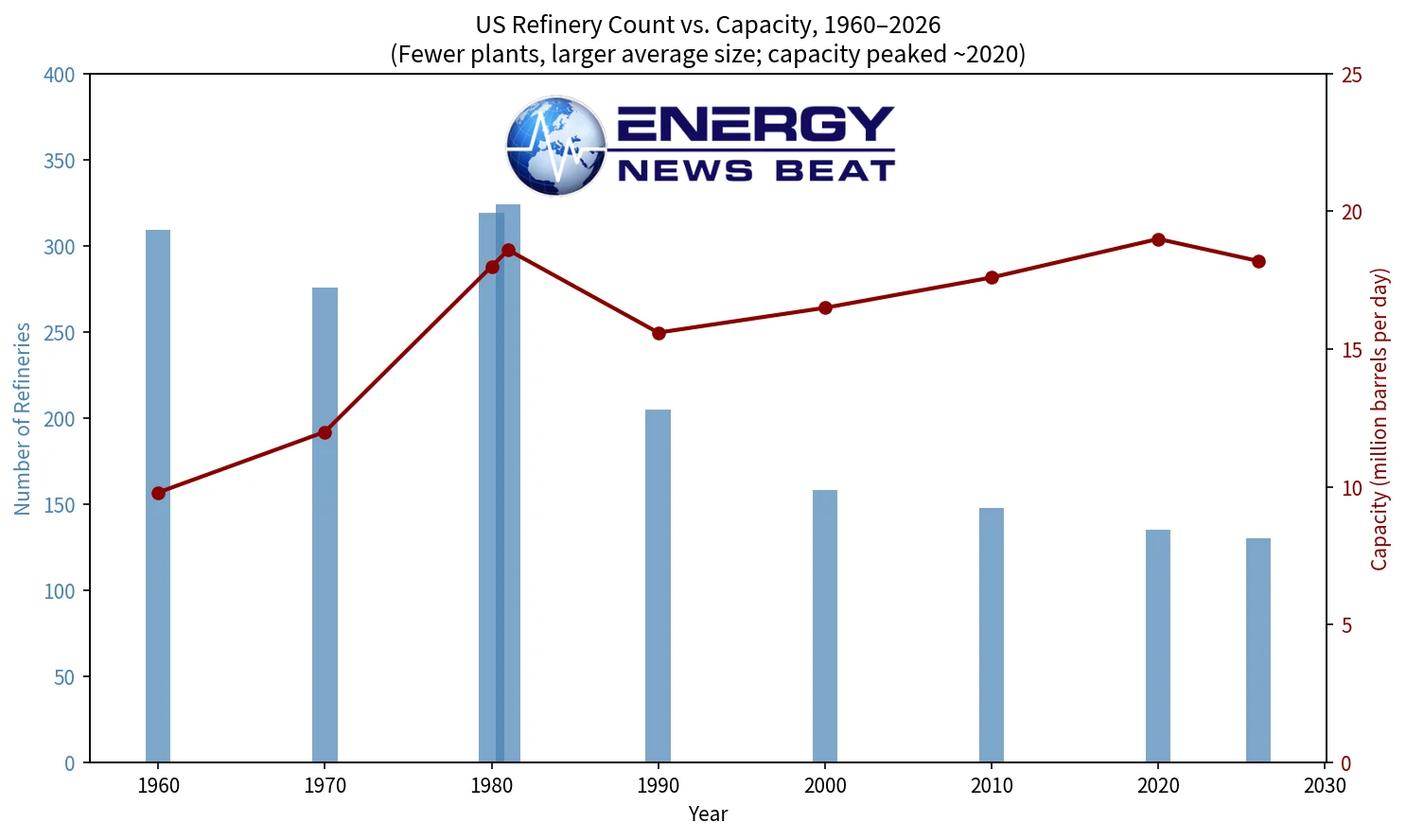
EIA data show the long-term pattern clearly. In 1960 the United States had roughly 309 operable refineries with about 9.8 million barrels per day of crude distillation capacity. The number of plants peaked near 324 in 1981 as capacity reached about 18.6 million b/d. A wave of closures followed in the 1980s. By 1990 there were 205 operable refineries and capacity had fallen to roughly 15.6 million b/d. Capacity later recovered through expansions and complexity upgrades at surviving sites even as the plant count kept falling: about 158 refineries and 16.5 million b/d in 2000, 135 refineries and a record near 19 million b/d in early 2020, and 130 operable refineries with about 18.2 million b/d as of January 1, 2026.
From 1990 to 2026, the EIA register lists 90 permanent shutdowns in the 50 states totaling about 3.55 million b/d of crude capacity. Net national capacity still rose because remaining plants expanded. The average refinery grew from roughly 76,000 b/d to about 140,000 b/d. The post-2020 period reversed the capacity gains: operable capacity fell about 800,000 b/d from the early-2020 peak. The newest refinery of any size is a 45,000 b/d plant in Galveston, Texas, that started in 2022. The last large grassroots refinery with significant downstream capacity was Marathon’s Garyville, Louisiana, facility, which came online in 1977 and has since been expanded to more than 600,000 b/d. Major capacity additions in recent years (Motiva Port Arthur, ExxonMobil Beaumont) have been expansions inside existing Gulf Coast complexes, overwhelmingly in Texas and Louisiana.
Closures concentrated in blue-state regulatory environments
Shutdowns have not been evenly distributed. California alone accounts for 17 of the 90 post-1990 entries and roughly 688,000 b/d—about 19 percent of the national shutdown total—according to the EIA compilation. Pennsylvania’s two large closures (Philadelphia Energy Solutions at 335,000 b/d in 2019 and Sunoco Marcus Hook at 178,000 b/d in 2011) removed more than half a million barrels per day. New Jersey also lost multiple plants. Gulf Coast states recorded some closures (Shell Convent and Phillips 66 Alliance in Louisiana, LyondellBasell Houston in 2025), but those losses have been more than offset by expansions. East and West Coast PADDs have borne the brunt of net petroleum-refining losses since 2010.
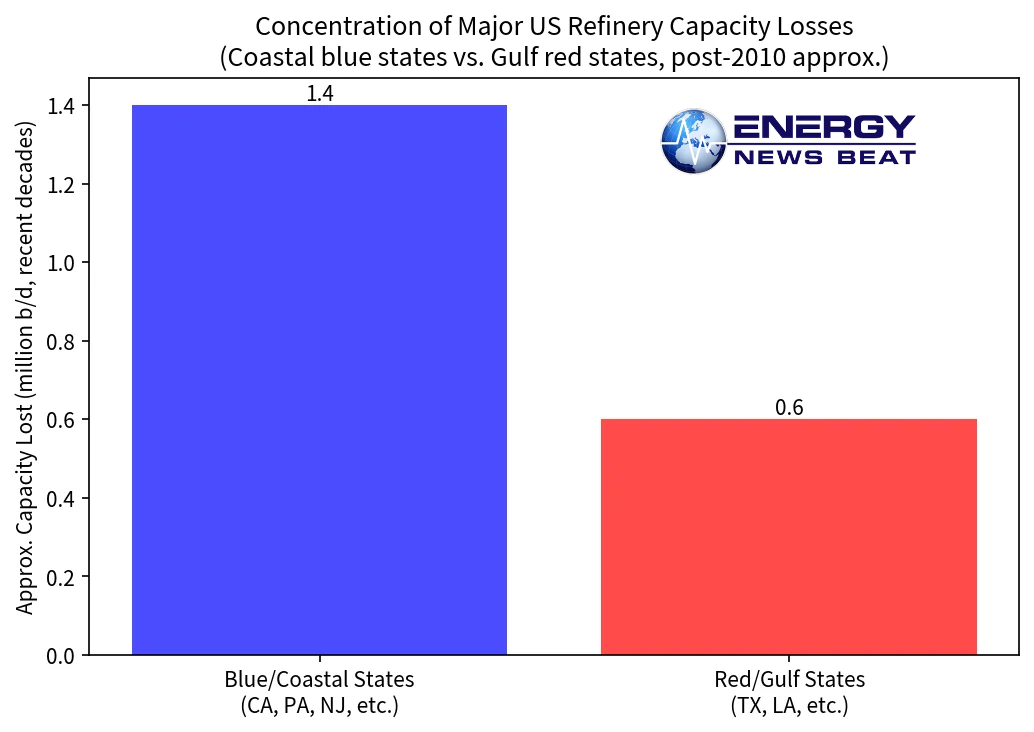
The chart above is an approximate illustration of the geographic pattern documented in EIA Table 13 and company announcements: the largest recent permanent losses and renewable conversions cluster in coastal states long governed by Democrats and subject to the strictest fuel specifications, permitting timelines, and climate policies. Texas and Louisiana, under Republican leadership for most of the period, host the majority of U.S. capacity and the bulk of expansions.
California’s Net Zero-driven exits
California is the clearest case. Phillips 66 ended crude processing at its Los Angeles-area refinery (about 139,000 b/d) in late 2025. Valero ceased fuel production at its 145,000 b/d Benicia refinery in April 2026 after citing the state’s regulatory and enforcement environment as the most difficult in North America. Together, the two plants represented roughly 17 percent of California’s refining capacity. Earlier, Marathon’s Martinez refinery (161,000 b/d) and Phillips 66’s Rodeo plant were converted to renewable diesel. State data and company statements link the decisions to high operating costs, unique CARB fuel rules that isolate the market, and policies aimed at reducing petroleum demand under climate targets. California refining capacity has fallen by about 30 percent over five years in some tallies. The state is increasingly reliant on imports, including from Asia, and fuel prices remain the highest in the country. Transition planning has also discussed additional facilities, as petroleum demand is expected to decline under existing Net Zero-aligned statutes.
These closures matter nationally because U.S. refiners already run at high utilization and the coasts are poorly connected by product pipelines to the Gulf Coast surplus. When global diesel is short, the loss of domestic capacity amplifies price spikes and forces greater import dependence precisely where regulations are tightest.
Election consequences
Brazil’s election will decide whether Petrobras proceeds with a state-led refining buildout for diesel self-sufficiency or whether private capital and a smaller state role prevail. The U.S. parallel is straightforward. Large new refineries have not been built in decades anywhere; the economics and permitting hurdles are steepest under the regulatory regimes that prevail in Democratic-led coastal states. Expansions have occurred where policy is more permissive. Further California closures or conversions tied to climate mandates would remove still more diesel and gasoline capacity. A policy environment that continues to treat new or expanded petroleum refining as incompatible with Net Zero goals makes additional domestic capacity unlikely. The current global diesel crisis shows the cost of that choice when supply disruptions hit: higher prices, tight inventories, and political pressure for export restrictions that can themselves reduce refinery runs.
The numbers over 60 years are unambiguous. The United States refined more crude with far fewer plants by making the survivors larger and more complex, until coastal closures and the absence of new construction ended the capacity growth. Whether that trend reverses depends, as in Brazil, on the election.
Making Appendices Great Again
Check out the World’s Greatest Podcast Show Notes at EnergyNewsBeat.co or EnergyNewsBeat.com.
Appendix: Sources
- Bloomberg, “Global Diesel Crisis Boosts Petrobras’ Hot-Button Refining Plan,” October 3, 2026: https://www.bloomberg.com/news/articles/2026-10-03/global-diesel-crisis-boosts-petrobras-hot-button-refining-plan
- Bloomberg Línea summary of Petrobras plans, Chambriard comments, and candidate positions: https://www.bloomberglinea.com.br/negocios/escassez-global-de-diesel-pressiona-a-petrobras-as-vesperas-da-eleicao/
- EIA Refinery Capacity Report and historical operable refineries/capacity: https://www.eia.gov/petroleum/refinerycapacity/ and https://www.eia.gov/dnav/pet/pet_pnp_cap1_dcu_nus_a.htm
- EIA Annual Energy Review historical table (refineries and capacity back to 1949): https://www.eia.gov/totalenergy/data/annual/showtext.php?t=ptb0509
- EIA FAQ, newest U.S. refineries: https://www.eia.gov/tools/faqs/faq.php?id=29&t=9
- Compilation of EIA Table 13 shutdowns since 1990 (90 sites, 3.55 million b/d, California concentration): https://eco3min.fr/en/every-us-refinery-shutdown-since-1990/
- EIA number of operable refineries series: https://www.eia.gov/dnav/pet/hist/LeafHandler.ashx?n=PET&s=8_NA_8O0_NUS_C&f=A
- Reuters and industry reporting on global diesel shortage lasting into 2027 (Iran and Ukraine/Russia disruptions): https://www.reuters.com/business/energy/global-diesel-shortage-likely-last-into-2027-storage-tanks-drain-2026-09-21/
- Institute for Energy Research summary of diesel price drivers: https://www.instituteforenergyresearch.org/fossil-fuels/gas-and-oil/why-are-diesel-prices-so-high/
- Valero Benicia closure reporting: https://www.worldports.org/valero-ends-fuel-production-at-benicia-refinery/
- S&P Global on California capacity drop and price effects: https://www.spglobal.com/energy/en/news-research/latest-news/crude-oil/052026-californias-refinery-closures-create-volatile-fuel-prices-supply-gaps
- California Energy Commission refinery history: https://www.energy.ca.gov/data-reports/energy-almanac/californias-petroleum-market/californias-oil-refineries/california-oil
- R-Squared Energy analysis of recent U.S. closures and California exception: https://www.rrapier.com/2026/09/why-high-fuel-prices-dont-prevent-refinery-closures/
The post Global Diesel Crisis Boosts Petrobras’ Hot-Button Refining Plan — Just Like the US, It Depends on the Election appeared first on Energy News Beat.