
Britain’s downstream oil sector is shrinking in real time. Two refineries closed in 2025—Grangemouth in April and Lindsey in August—leaving only four operating sites: Fawley, Humber, Pembroke, and Stanlow. Liquid fuels still account for 47 percent of UK final energy consumption. There are no scalable near-term substitutes for diesel in freight, agriculture, and construction or for jet fuel in aviation. The result is a growing import deficit. In 2025, the UK imported 15.5 million tonnes more petroleum products than it exported, the largest gap since becoming a net importer in 2013.
We will be talking with Kathryn on her report, and hope to have her on the Energy News Beat or Energy Realities Podcast soon.
Kathryn Porter’s August 2026 Watt-Logic report, Fuel, Refineries and the UK ETS: What Policymakers Need to Know, argues the UK Emissions Trading Scheme is now the decisive cost that is making remaining plants uncompetitive. Based on recent carbon prices, the four surviving refineries face a net ETS cash cost of about £200 million a year and a gross carbon-cost disadvantage of roughly £540 million a year versus refiners operating outside carbon-pricing regimes. ExxonMobil UK’s Paul Greenwood told Parliament the company was already paying £70–80 million a year in CO2 costs, a figure expected to rise toward £150 million, while overseas competitors pay nothing. Those costs cannot be passed through because refined products are globally traded and fungible; importers simply undercut domestic producers.
The ETS is not delivering additional abatement in refining. Efficiency gains were largely achieved before the scheme existed. Carbon capture and hydrogen projects remain contingent on government support that has not materialized at commercial scale. Because refined products are excluded from the UK Carbon Border Adjustment Mechanism, the policy exports emissions rather than reducing them. Production moves to the United States, the Middle East, India, and Asia; territorial UK emissions fall while global emissions and shipping emissions rise. Porter’s conclusion is blunt: exclude refineries from the ETS or abolish the scheme. An environmental policy that destroys domestic industry, increases import dependence, and raises global emissions is irrational.
U.S. blue states are running the same experiment with the same results.
California: the most advanced version of the playbook
California has layered cap-and-trade (now rebranded Cap-and-Invest and extended through 2045), the Low Carbon Fuel Standard, unique CARB gasoline specifications, and aggressive net-zero statutes. The number of refineries in the state has fallen from 23 in 2000 to 11. Phillips 66 ceased crude processing at its Wilmington/Carson complex in late 2025; Valero’s Benicia plant closed in April 2026. Those two sites represented roughly 17–20 percent of remaining in-state capacity. Additional plants have already converted to renewable diesel, shrinking gasoline and conventional diesel output further.
The market is isolated by fuel-spec rules, so lost barrels are not easily replaced from the Gulf Coast. Imports rise. Gasoline prices in California averaged $5.70 per gallon on 1 September 2026 according to AAA, versus a national average of $4.10. Diesel stood at $7.37. Los Angeles jet-fuel prices more than doubled year-on-year in spring 2026, reaching roughly $4.70–$4.80 per gallon at a time when Gulf Coast jet-fuel spot prices were far lower. Cap-and-trade alone was already adding an estimated 23 cents per gallon at then-prevailing allowance prices; tighter budgets and higher LCFS credit costs raise that further. Studies of the two latest closures projected additional price increases of $0.40 immediately and as much as $1.21 over subsequent months. Consumers, not “Big Oil,” absorb the difference.
New York and Colorado: the same logic, earlier in the sequence
New York already prices carbon on power generators through RGGI. Its Climate Leadership and Community Protection Act requires 40 percent emissions cuts by 2030 and 85 percent by 2050. An economy-wide Cap-and-Invest program was supposed to follow.
A NYSERDA analysis and subsequent political debate produced a warning that the program could add as much as $2.23–$2.26 per gallon to gasoline. Governor Hochul has delayed full implementation, citing affordability. New York regular gasoline still averaged $4.24 on 1 September 2026—well above most red-state markets—while diesel was $5.78. Fuel suppliers will face mandatory GHG reporting beginning with 2026 data. The direction of policy is identical to California’s: raise the cost of domestic fossil supply and hope demand destruction or imports fill the gap.
Colorado has imposed GHG intensity rules on oil and gas, industrial credit trading, and EPA-mandated reformulated gasoline in Front Range ozone non-attainment counties. The state’s single large refinery (Suncor Commerce City) sits inside that regulatory stack. Analyses of RFG implementation projected tens of millions of dollars in extra seasonal costs for gasoline and diesel, with shortfall risks of 15–44 thousand barrels per day.
Colorado regular gasoline averaged $4.27 and diesel $5.49 on 1 September 2026—again higher than neighboring energy-producing states with lighter regulatory loads. Restricting in-state production does not reduce consumption; it shifts barrels to higher-intensity basins and increases truck and rail movements.
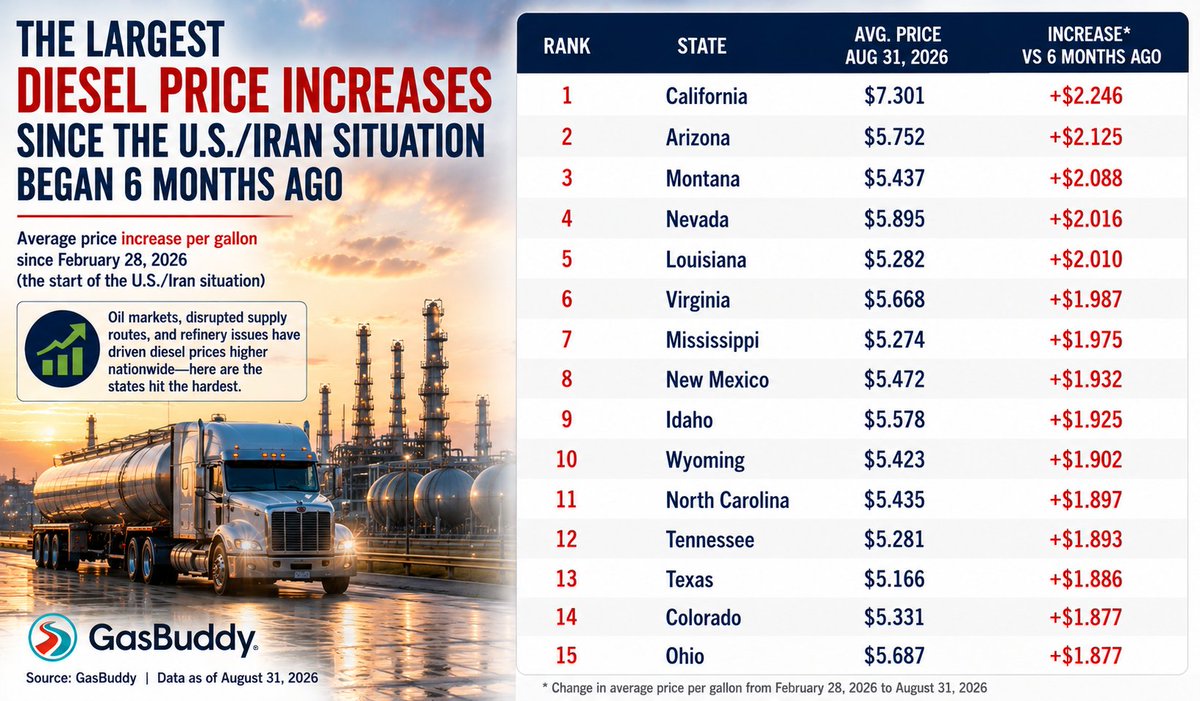
The price gap is measurable
AAA data for 1 September 2026 show a clear pattern:California: regular $5.70, diesel $7.37
New York: regular $4.24, diesel $5.78
Colorado: regular $4.27, diesel $5.49
National average: regular $4.10
A mid-2026 analysis of unified partisan control found Democratic-controlled states averaging $3.69 per gallon versus $3.14 in Republican-controlled states—a 55-cent gap driven by taxes, carbon programs, and refinery attrition. The West Coast premium versus the rest of the country widened sharply after 2022 as California and Washington carbon programs tightened and capacity left the region. Jet fuel follows the same geography: isolated West Coast markets pay a structural premium that widens when local refineries close.
State fuel taxes amplify the difference. California’s combined state taxes and fees are among the highest in the country. Carbon-allowance and LCFS costs sit on top. Red states with large refining complexes—Texas, Louisiana, Oklahoma—keep both tax and regulatory wedges smaller and retain spare capacity.
Fewer refineries do not solve the problem. They move it and destroy security
Closing a refinery in California or Scotland does not retire the demand for diesel, jet fuel, or gasoline. The molecules are produced somewhere else—often in larger, newer plants on the U.S. Gulf Coast, in the Middle East, India, or Asia that face no equivalent carbon price. Shipping those products adds emissions. Skills, turnaround expertise, and local supply-chain relationships disappear and are not easily rebuilt. Once a complex shuts, restart costs and lost free-allowance baselines (the “ratchet” effect under ETS-style schemes) make reversal unlikely.
The UK is already a structural importer of diesel and kerosene. California is becoming one for gasoline and jet fuel. That is not decarbonization; it is carbon leakage plus higher consumer prices plus reduced resilience to geopolitical shocks. A Hormuz disruption or a Gulf Coast hurricane now hits isolated high-cost markets harder because they no longer have surplus local capacity.
The playbook is consistent across jurisdictions: impose a carbon cost that domestic refiners cannot pass through, exclude or delay equivalent charges on imports, celebrate falling territorial emissions, and treat the resulting price spikes as someone else’s problem. Households and businesses that still need liquid fuels pay the bill. Energy security is treated as an afterthought.
Porter’s report and the experiences of California, Colorado, New York, and other Blue States point to the same conclusion. If the goal is lower global emissions and affordable energy, carbon pricing that only hits domestic refining fails both tests. If the goal is simply to shrink the industry inside politically convenient borders, the policy is succeeding—at the expense of the people who buy the fuel.
Make no mistake, the leaders tell you openly that you will own nothing and be happy. The Carbon and Net Zero taxing and regulatory reach is just the hammer. The sad part is that the world emits more CO2 than plants can absorb, and humans themselves create it through industrialization. It’s about the particulate matter that can be filtered, or the plastics that are left to float into the oceans. And what countries are doing most of that? Not the United States. We should focus more on the upcoming waste from wind turbines and solar farms, as we do not have paid-for recycling or a working model.
So – Go ahead and vote in people that will virtue signal their way into deindustrialization and high Carbon Taxes while they don’t miss a private flight.
“Strong is the Hypocrisy Blue States They Are” – Stu Turley on the Energy News Beat podcast using his best Yoda voice.
Appendix: Sources and Links
Watt-Logic article and report
- https://watt-logic.com/2026/08/31/refineries-report-says-abolish-the-ets/
- Full report PDF: https://watt-logic.com/wp-content/uploads/2026/08/Refinery-report-FINAL.pdf
UK official and industry data
- DUKES Chapter 3: https://assets.publishing.service.gov.uk/media/6a69f02d16bc92f51e1a4337/DUKES_2026_Chapter_3.pdf
- Future of the UK downstream oil sector call for evidence: https://www.gov.uk/government/calls-for-evidence/future-of-the-uk-downstream-oil-sector/future-of-the-uk-downstream-oil-sector-call-for-evidence
- Fuels Industry UK carbon leakage position: https://www.fuelsindustryuk.org/media/cfoahduj/policy-position-paper-carbon-leakage-pdf.pdf
- Parliamentary evidence on ETS costs: https://committees.parliament.uk/writtenevidence/160967/html/
California refinery closures and prices
- OilPrice.com on capacity loss and jet/gasoline imbalance: https://oilprice.com/Energy/Energy-General/California-Refineries-Max-Out-Jet-Fuel-While-Gasoline-Starves.html
- Breakthrough Fuel on closure impacts: https://www.breakthroughfuel.com/blog/how-to-navigate-the-impact-of-closing-oil-refineries-in-california/
- S&P Global on post-closure volatility: https://www.spglobal.com/energy/en/news-research/latest-news/crude-oil/052026-californias-refinery-closures-create-volatile-fuel-prices-supply-gaps
- LAO on cap-and-trade gasoline cost: https://lao.ca.gov/Publications/Report/5042
- USC/Mische price projections and legislative comparison PDF referenced in contemporaneous reporting
New York Cap-and-Invest and RGGI
- Empire Center on RGGI and cap-and-invest costs: https://www.empirecenter.org/publications/it-is-time-to-rethink-the-regional-greenhouse-gas-initiative/
- NY Senate/NYSERDA cost memo coverage: https://www.nysenate.gov/newsroom/press-releases/2026/mario-r-mattera/senate-and-assembly-conferences-join-together-fight
- Syracuse.com explainer: https://www.syracuse.com/state/2025/01/what-is-new-yorks-cap-and-invest-carbon-pricing-plan.html
Colorado policy and fuel costs
- Common Sense Institute on production-shift emissions: https://commonsenseinstituteus.org/colorado/research/energy-and-our-environment/impact-of-sb24-159-on-the-economy-revenue-and-emissions/
- Colorado fuel tax and fee rates: https://tax.colorado.gov/fuel-tax-and-fee-rates
U.S. retail fuel prices
- AAA state averages (1 September 2026 snapshot used in article): https://gasprices.aaa.com/state-gas-price-averages/
- EIA weekly retail gasoline and diesel: https://www.eia.gov/dnav/pet/pet_pri_gnd_a_EPM0_PTE_Dpgal_m.htm
- IER / Center Square blue-state vs red-state analysis: https://www.thecentersquare.com/national/article_0cf99ec8-9d00-49d2-965a-2a18e0fc5c7a.html
- Forbes summary of the same study: https://www.forbes.com/sites/davidblackmon/2026/07/14/high-blue-state-gasoline-prices-new-study-details-the-causes/
Jet fuel benchmarks
- EIA / FRED Gulf Coast kerosene-type jet fuel: https://fred.stlouisfed.org/series/MJFUELUSGULF
- OPIS Worldwide Jet Fuel Report excerpts circulating May 2026
State carbon-pricing overviews
- State Climate Policy Dashboard: https://www.climatepolicydashboard.org/policies/cross-sector/carbon-pollution-pricing
- ICAP California program profile: https://icapcarbonaction.com/en/compare/43/45/50
Additional contemporaneous reporting
- The Times (UK) on carbon tax and remaining refineries
- GB News coverage of the Watt-Logic report
- Chemistry World on Stanlow decarbonization costs
- Energy Institute at Haas on California cap-and-invest revisions
The post UK refineries are being killed off by high carbon costs. How U.S. Blue States are following the same playbook appeared first on Energy News Beat.