

Vice President JD Vance says the administration “has used” the Defense Production Act to expand Delek’s 74,000-barrel-a-day plant in East Texas. Diesel is $6.32 and nobody has published the dollars, the barrels or the start date. Here is what is real, what is not yet, and whether one small refinery can be the start of something bigger.
By Stuart Turley, host of the Energy News Beat podcast • Published Oct. 15, 2026 • Prices as of 6:40 a.m. CT Oct. 15 (AAA) • Company and government records checked through 7:10 a.m. CT Oct. 15 • Analysis and opinion: Stu’s views are labeled • Not investment advice
As of 6:40 a.m. CT, Oct. 15, 2026 (AAA “Price as of 10/15/26”)
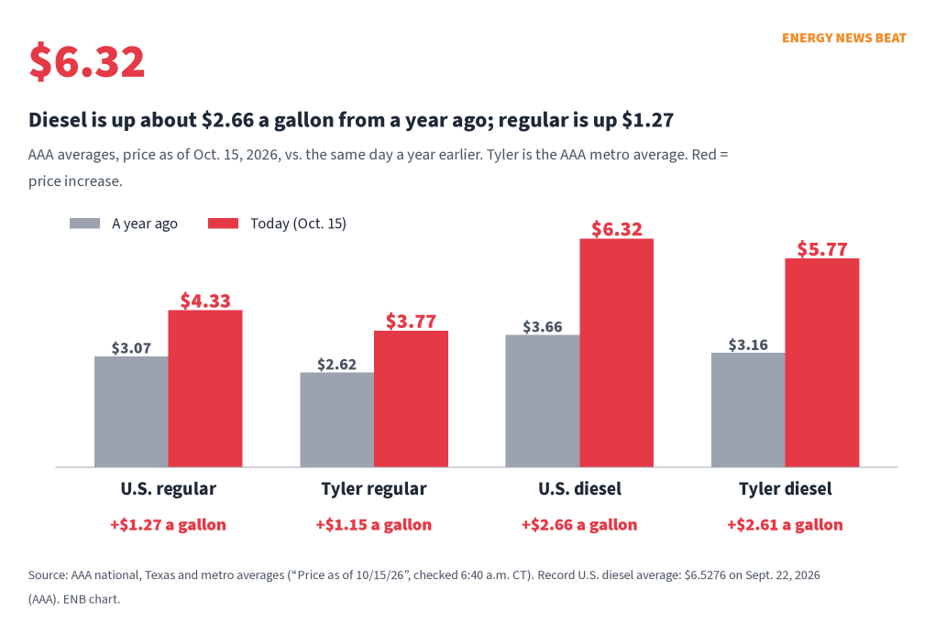
If you filled a 15-gallon tank with regular this morning, you paid about $65.02 at the national average of $4.334 a gallon. A year ago the same tank cost $46.01 (AAA). If you run a farm truck, a delivery van or a rig, it is worse. Diesel is $6.317, up from $3.655 a year ago, so 100 gallons now costs $631.73 instead of $365.54 (AAA; ENB calculation). AAA’s headline this week: “Pump Prices Remain at Record Highs for Autumn” (AAA).
In Tyler, Texas, it is a little gentler: $3.77 for regular and $5.77 for diesel (AAA Texas metro averages). On Tuesday, Vice President JD Vance stood at Tyler Pounds Regional Airport and told a rally that help was coming from the refinery down the road. “The Trump administration, working with the refinery at Delek, has used the Defense Production Act, and we are going to expand the refinery right here in Tyler, Texas,” he said (transcript; pool report).
That is a big sentence. It is also, so far, a sentence without numbers. No dollar figure, no added barrels, no start date and no federal document has been published. Delek has not issued a press release or a securities filing about it. Below we walk through what we could verify, what we could not, and what it would take for this to matter at your pump.
| The 60-second version
What’s real: Vance announced it on Oct. 13 in Tyler, and the quote is on video and in the transcript (White House Rapid Response; transcript). The plant is real and full. EIA rates it at 74,000 b/d, Delek’s nameplate is 75,000, and it ran 75,525 b/d of crude in the second quarter (EIA; Delek Q2). What’s missing: the money, the mechanism (grant, loan, purchase commitment or permitting help), the added capacity, the timeline and the job count. Reuters asked the White House and Delek about funding and capacity; neither “immediately” responded (Reuters). As of 7:10 a.m. CT Oct. 15 we found no Delek release, no 8-K, no DOE or Pentagon statement and no White House fact sheet (Delek IR; SEC EDGAR). How much could it move prices? On its own, very little nationally. A 15,000-b/d expansion, the size of Tyler’s last one, equals about 1.5 minutes of America’s daily gasoline, diesel and jet use (ENB calculation from EIA). The bigger question is whether Tyler becomes a template. The awkward part: Delek recognized a $356.1 million reduction in its 2025 cost of materials from Renewable Fuel Standard credits returned under past small-refinery exemptions (Q3 2025 and Q4 2025 results, SEC Form 8-K). The law caps a “small refinery” at 75,000 b/d of crude (42 U.S.C. 7545). Making Tyler bigger and keeping it “small” pull in opposite directions. |
What was actually announced
As of transcript and pool report, Oct. 13, 2026
Vance spoke for roughly half an hour at what KLTV called a historic GOP midterm rally. He took the podium shortly before noon and finished at 12:26 p.m. CT, according to the White House travel pool (KLTV; pool report). The refinery announcement comes at about 14 minutes on the transcript’s timestamps. Right after it, he said (transcript, 00:14:53–00:15:53):
“We want millions of gallons of commercial grade and military spec fuel to come out of this refinery in addition to what it’s already producing. And what that means for you and your families is lower costs to fly from one place to another. It means lower costs to drive your car into work every single day. It means a more reliable energy supply, but also, a stronger national defense. And it will also mean hundreds of good paying new jobs, just like Austin’s, right here in Smith County.”
He went on to say the project would mean more opportunities for Texans and their children to build their lives at home, then turned to the Senate race (transcript).
The White House Rapid Response account posted the clip on X the same day (X). The Tyler Morning Telegraph’s story carries a 2:58 p.m. CT timestamp (Tyler Morning Telegraph). Reuters and Bloomberg followed later on Oct. 13 (Reuters; Bloomberg); we did not confirm their exact publication times. Reuters added three things worth holding onto:
- The refinery “currently processes about 74,000 barrels per day.”
- Refinery expansions “take many months, if not years.”
- President Trump was expected to sign a directive “in the coming days” telling agencies to use the DPA to raise oil and fuel output (Reuters, Oct. 9). We found no signed order as of Oct. 15.
The Hill summed up the open question: “It’s unclear whether the use of the Defense Production Act will go beyond just this one refinery” (The Hill). Argus reported that Energy Secretary Chris Wright had said last month the U.S. “maybe” would use DPA funds, and that the administration had used the law in March to restart Sable Offshore’s California pipeline (Argus).
What we know and what we don’t
As of 7:10 a.m. CT, Oct. 15, 2026
| Question | What the record shows | Status |
| Did the administration invoke the DPA for Tyler? | Vance said it “has used” the DPA (transcript). No written action, agreement or award is public. | Claimed; no document |
| How much money? | Not disclosed (Reuters). Congress gave the DPA $1 billion, which OMB shows was moved to DOE (OpenOMB); DOE has since committed up to $500 million of DPA money to coal projects (DOE). How much remains is unverified, and no Tyler draw is reported. USAspending shows no grant or loan to Delek entities. | Unknown |
| What mechanism? | Title III allows purchases, purchase commitments, loans and guarantees (CRS). The April 20 refining determination waived some Title III limits (White House). Which tool applies to Tyler is not public. | Unknown |
| How many added barrels? | Not disclosed. Vance: “millions of gallons,” no time unit (transcript). | Unknown |
| When? | No date. Reuters: “many months, if not years” (Reuters). | Unknown |
| How many jobs? | Vance: “hundreds.” Delek has published no count; it reports 1,902 full-time employees company-wide (10-K). | Claim only |
| Delek’s side? | No release on its IR page or 8-K as of Oct. 15 (Delek IR; EDGAR). | Silent |
Corrections to early reports
The story reached us as a relay of early coverage. We checked each detail against the transcript, company filings and government data. Most of it held up. These items did not, or needed context:
| What was reported | What the record shows |
| The administration “will use” the DPA at Tyler. | Vance used the past tense: “has used” (transcript). But no DPA document, agreement or funding figure has been released, so “announced” is the accurate verb, not “awarded.” |
| KTBS: the administration “has previously used the federal authority to boost domestic refining capacity.” | We found no earlier DPA refinery award. Reuters reported in September that the DPA “has never been used to add refining capacity” (Reuters; ENB’s DPA analysis). The March use Argus cites was a pipeline restart, not a refinery (Argus; KTBS). |
| The Tyler paper called Delek “the Tyler company.” | Delek US Holdings is headquartered in Brentwood, Tenn.; its Aug. 31 release carries that dateline (Delek; Tyler Morning Telegraph). Tyler is home to its flagship refinery. |
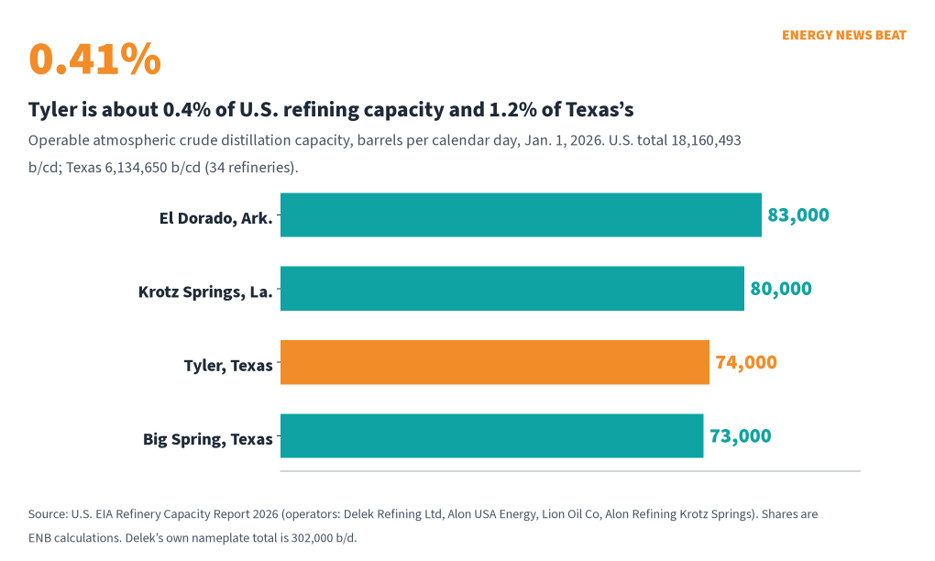
| Rig & Refinery: Tyler sits in a portfolio that “includes larger facilities.” | Only slightly. EIA lists El Dorado at 83,000 and Krotz Springs at 80,000 b/d; Big Spring, at 73,000, is smaller than Tyler’s 74,000 (EIA; Rig & Refinery). On Delek’s own nameplate figures, only El Dorado is larger (10-K). |
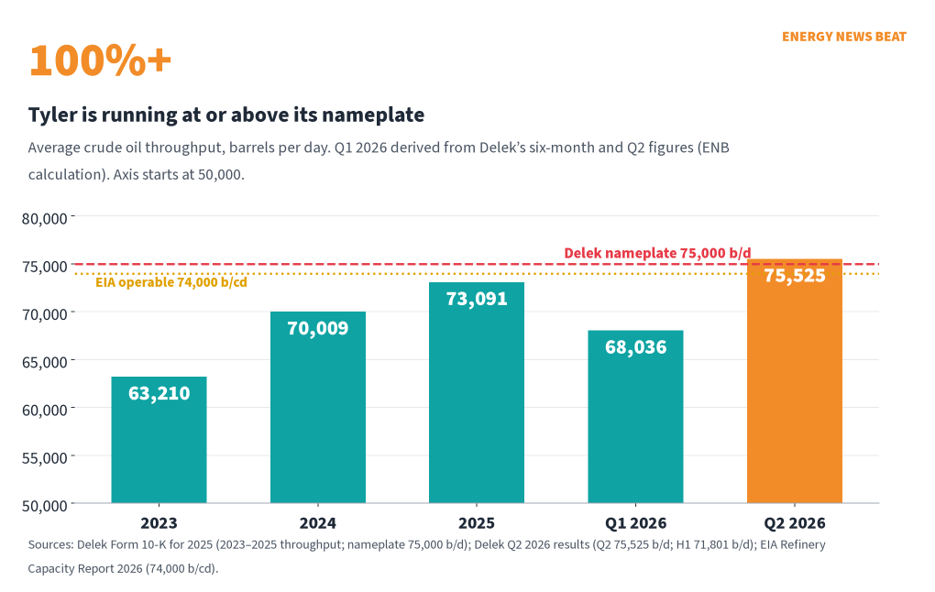
| A 74,000-b/d refinery. | Correct on EIA’s calendar-day basis (EIA). Delek lists nameplate at 75,000 b/d, and the plant ran 75,525 b/d of crude in Q2 2026, slightly over nameplate (10-K; Q2). |
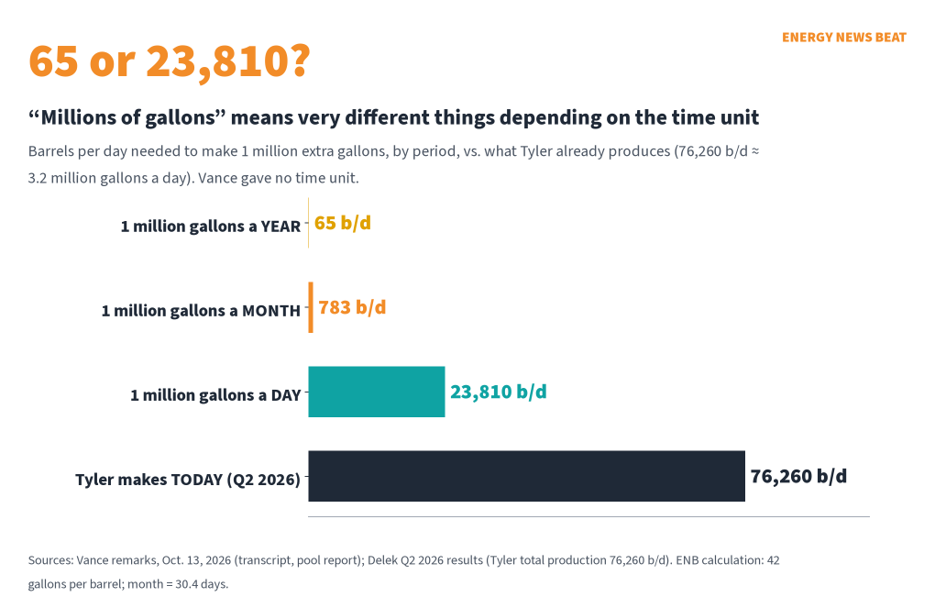
| “Millions of gallons” of new fuel. | The quote is accurate, but Vance gave no time unit. Tyler already makes about 3.2 million gallons of products every day (ENB calculation from Delek Q2). “Millions a year” could be less than one day of current output. |
| New “military spec fuel.” | Context, not an error: Tyler already produces “military specification jet fuel,” commercial jet and ultra-low-sulfur diesel (10-K). Federal records show past Defense Logistics Agency jet fuel orders to Delek units (USAspending). |
| National average $4.334 regular, $6.317 diesel. | Verified: $4.3344 and $6.3173, AAA “Price as of 10/15/26,” checked 6:40 a.m. CT (AAA). |
How big is Tyler, really?
As of EIA capacity Jan. 1, 2026; Delek Q2 2026
Tyler is a midsize, inland refinery. It runs light sweet crude, has a complexity rating of 9.4 and serves East Texas mostly by truck and rail. Delek calls it the “only major distributor of a full range of refined petroleum products within a radius of approximately 100 miles” (10-K). It is about 0.41% of U.S. refining capacity and 1.2% of Texas’s (ENB calculation from EIA).
It is also running hard. Crude throughput climbed from 63,210 b/d in 2023 to 73,091 in 2025 and 75,525 in the second quarter of 2026, just over the 75,000 nameplate (10-K; Q2). Delek’s numbers suggest little slack is left: the plant averaged about 97.5% of nameplate in 2025 and about 100.7% in Q2 (ENB calculation). Our reading: more fuel from Tyler likely means more steel.
One more limit matters for your wallet. Delek’s own risk factors say the lack of pipelines out of Tyler “may limit the refinery’s ability to increase the production of petroleum products” (10-K). If new barrels can only leave by truck or rail, most of the benefit stays regional.
“Millions of gallons,” decoded
Gallons sound big. Barrels per day are how the industry measures. A barrel is 42 gallons. So “a million gallons” means very different things depending on the clock (ENB calculations):
- A million gallons a year is about 65 b/d. That is a rounding error at a plant this size.
- A million gallons a month is about 783 b/d.
- A million gallons a day is about 23,810 b/d. That would be roughly a one-third (about 32%) expansion of Tyler (ENB calculation on EIA’s 74,000 b/cd).
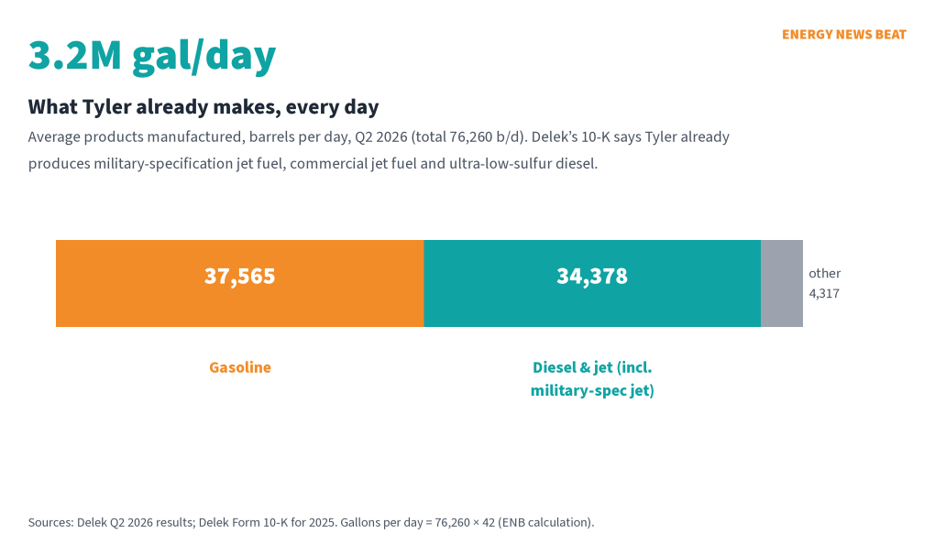
For scale, Tyler already turns out about 3.2 million gallons a day: roughly 37,565 b/d of gasoline and 34,378 b/d of diesel and jet (Q2). The 2015 expansion, which we cover below, added 15,000 b/d. If Washington and Delek go for something like that again, that is about 630,000 gallons a day (ENB calculation). That would be real for East Texas. It would not be a national game changer.
Can one expansion move what you pay?
As of EIA weekly data, four weeks ending Oct. 2, 2026 (released Oct. 7)
America burned about 14.3 million barrels a day of gasoline, diesel and jet fuel over the four weeks ending Oct. 2. That is about 600 million gallons a day (EIA). Refineries ran at 92.7% of capacity that week (EIA). Against that, here is what different Tyler expansions would add (ENB scenarios, not company figures):
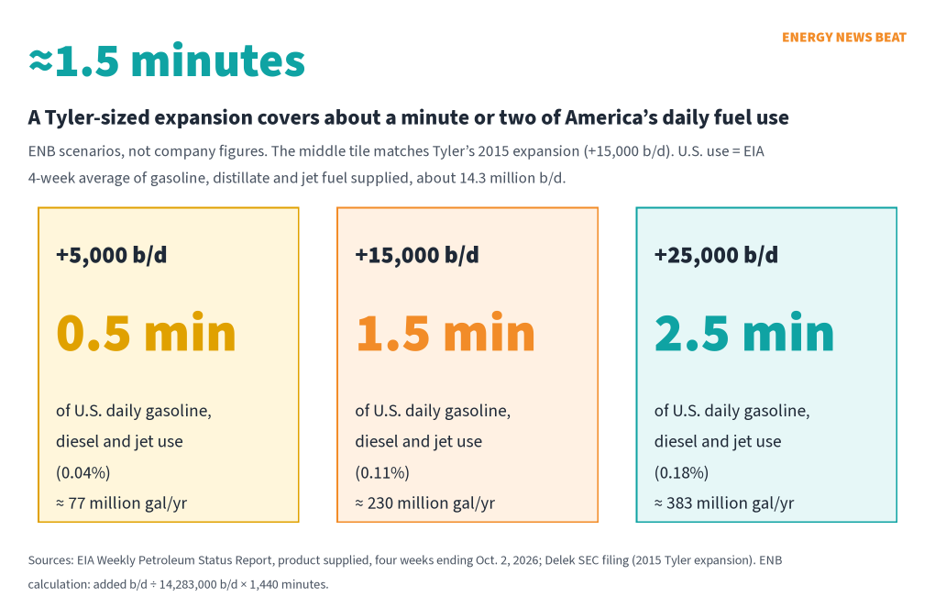
We are not putting a cents-per-gallon number on this, and here is why. The volume has not been disclosed. Fuel prices are set in a connected Gulf Coast and global market, not inside one county. A simple supply-and-demand model would overstate the effect of a few thousand barrels. The people who watch this every day agree:
- Rig & Refinery: “One small refinery in East Texas will not move national diesel supply meaningfully” (Rig & Refinery).
- com: new output “is unlikely to hit the market within three weeks” and lower prices before the Nov. 3 midterms (Oilprice).
- Tom Kloza of Gulf Oil, as quoted by Oilprice.com, said the $6.53 diesel record could be topped by the midterms (Oilprice).
- Patrick De Haan of GasBuddy, as quoted by Oilprice.com, reacting Tuesday to the Russia diesel news: “$6/gal diesel may be here to stay for now” (Oilprice; see also ENB on the Russian diesel deal).
Locally it could be different. Tyler is the only major full-range supplier within about 100 miles (10-K). Extra diesel there, sold by truck and rail, could ease East Texas racks before it shows up anywhere else. That is a real benefit. It is just a local one.
The bigger picture: 301 refineries then, 130 now
As of EIA, Jan. 1, 2026 (verified in ENB’s Oct. 10 DPA analysis)
In ENB’s earlier look at the DPA and refineries, we laid out the long squeeze. The U.S. had 301 operable refineries in 1982 and 130 on Jan. 1, 2026. Capacity fell by about 263,000 b/d in 2025 to 18.16 million b/cd (EIA; EIA). That is still slightly above the 17.89 million b/cd of 1982: fewer plants, each much bigger (EIA). EIA lists 77 permanent shutdowns from 1990 through 2025. The survivors are bigger, but the margin for error is thin.
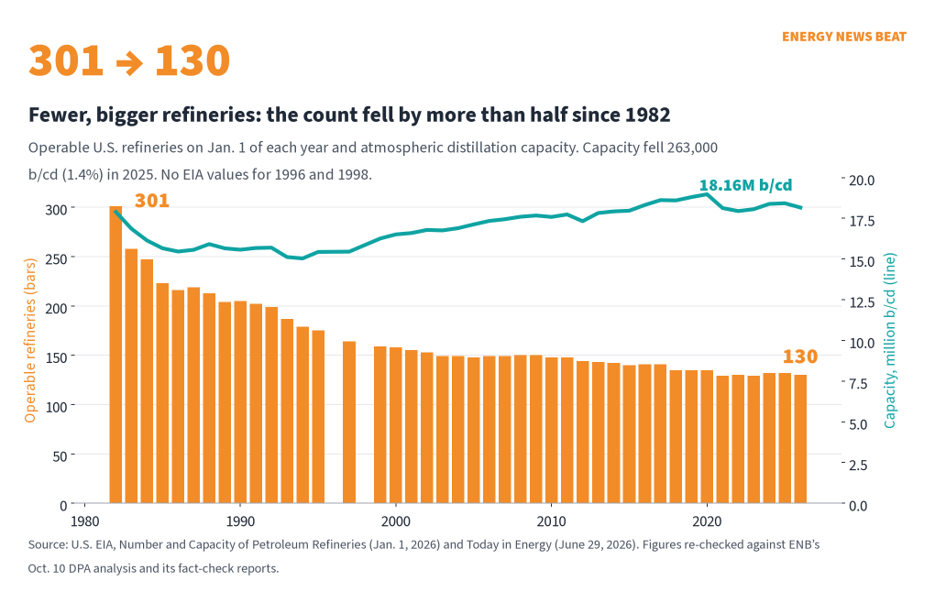
Recent losses include LyondellBasell’s 263,776-b/cd Houston plant (March 2025), the largest, and Phillips 66’s 138,700-b/cd Los Angeles refinery (late 2025) (EIA). Valero also idled 145,000-b/cd Benicia in April 2026 while keeping its permits (ENB). Mizuho says U.S. utilization hit a record 96.3% in the third quarter, with fuel inventories “near the bottom of their historical ranges” (Mizuho via Yahoo Finance). For the global side of the diesel squeeze, see ENB on the IEA’s 2027 outlook and on why the refinery shortage is the fear that sticks.
Is Tyler a template?
Here is the case for “yes.” The cheapest barrel of new refining capacity is almost always the one squeezed out of a plant that already exists. Tyler proved that a decade ago.
In early 2015 Delek took Tyler down for a turnaround that began Jan. 23, added equipment, and restarted in late March. Nameplate went from 60,000 to 75,000 b/d. Delek said the project was “expected to cost approximately $70.0 million,” with $58.4 million spent by March 31, 2015 (Delek Q1 2015); Oil & Gas Journal noted no final cost was disclosed (OGJ). On that estimate, it works out to roughly $4,667 per barrel per day of new capacity (ENB calculation, 2015 dollars).
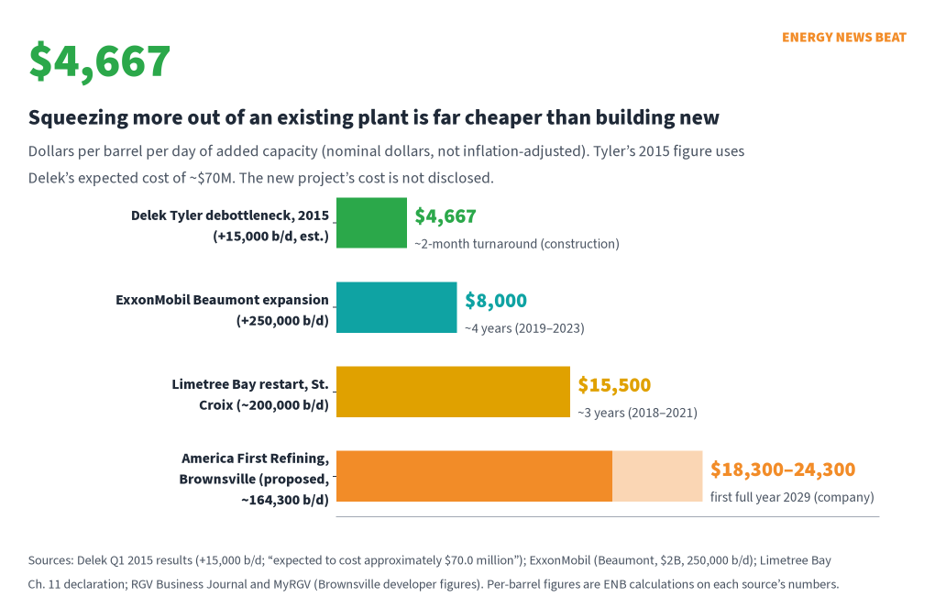
Compare that with ExxonMobil’s $2 billion Beaumont expansion, which ExxonMobil says added 250,000 b/d, about $8,000 per b/d on its figures (ExxonMobil). The Limetree Bay restart works out to at least $15,500 per b/d based on its bankruptcy filing (Limetree), and the proposed Brownsville refinery to $18,300 to $24,300 based on developer figures reported by local press (RGVBJ; MyRGV). All per-barrel figures are ENB calculations. One independent site, The Pricer, says it estimates a new Tyler project at $100 million to $200 million, with about $150 million as its central guess (The Pricer). That is their estimate, built on assumptions, not a disclosed figure.
Now the DPA mechanics. Title III lets the government buy, commit to buy, lend or guarantee to expand production for national defense (CRS; DOE). On April 20, the President signed a determination covering domestic petroleum refining and waived several of Title III’s usual limits (White House). Congress provided $1 billion for the DPA in the July 2025 tax-and-spending law, and OMB records show it was realigned to the Energy Department (OpenOMB). On June 4, DOE committed up to $500 million of that DPA money to 13 coal plants and a coal export terminal (DOE). How much is left is unverified. A refinery-by-refinery program could, in theory, repeat Tyler at dozens of small inland plants, each adding a few thousand barrels at a few thousand dollars per barrel.
| The template test, in plain numbers
What is left of the fund is unverified. If DOE’s coal commitment of up to $500 million is fully used, about $500 million would remain (OpenOMB; DOE). We use that as an illustration (ENB scenario, not a confirmed balance). At Tyler’s estimated 2015 rate of $4,667 per b/d, $500 million would cover about 107,000 b/d, roughly 0.6% of U.S. capacity (ENB calculation, 2015 dollars, best case). At the Beaumont rate, $8,000 per b/d, it buys about 62,500 b/d (ENB calculation). For scale: that is less than the 263,000 b/d of capacity the country lost in 2025 alone (EIA). Reality check: DPA money doesn’t have to pay for the whole project. A purchase commitment or loan guarantee can unlock private money. But none of those terms are public for Tyler. |
The counterarguments, taken seriously
- Time. CNN, citing industry analysts: “it takes at least three years to significantly expand existing oil refineries,” and longer for a new one (CNN). Rig & Refinery says a small expansion “typically runs 18 to 36 months from sanction to startup” (Rig & Refinery). Tyler’s 2015 job fit inside a two-month turnaround, but that was planned well in advance and engineered around an existing outage. Either way, Oilprice.com says new output “is unlikely to hit the market within three weeks,” before the Nov. 3 election, and Reuters says expansions take “many months, if not years” (Oilprice; Reuters).
- The clock on the law itself. DPA authorities expire on Dec. 11, 2026 unless Congress renews them (50 U.S.C. 4564). The same section says contracts or commitments made before that date are not affected. So if Tyler has a real agreement, it survives. If it is still a handshake on Dec. 11, it may not.
- The taxpayer’s role. We don’t know whether a single federal dollar is involved. Delek raised $460 million in zero-coupon convertible notes on Sept. 29 and had $628.6 million in cash at June 30 (Delek 8-K; 10-Q). Tyler earned a refining margin of $23.30 a barrel in Q2 (Q2). If public money goes to a profitable refiner at record margins, taxpayers deserve to see the terms.
- Politics. The announcement came at a campaign rally for Ken Paxton three weeks before the midterms, with Texas early voting days away (KTBS; KLTV). Democratic Senate candidate James Talarico’s campaign called the visit a cover-up for “their corrupt candidate” and promised to “lower costs for working people” (KLTV). Timing does not make a policy wrong. It does mean the details should be published, not just applauded.
- The “small refinery” paradox. The Renewable Fuel Standard defines a small refinery as one whose average daily crude throughput for a calendar year “does not exceed 75,000 barrels” (42 U.S.C. 7545). Tyler averaged 73,091 b/d in 2025 and 75,525 in Q2 2026 (10-K; Q2). An expansion that pushes yearly crude runs past 75,000 could cost Tyler its eligibility for exemptions worth real money (ENB reading; it depends on whether the project adds crude capacity or upgrades what is already run). That is the next section.
The small-refinery exemptions that have helped Delek
As of EPA decisions Aug. 31, 2026; Delek filings through Q2 2026
Every refiner must blend biofuels or buy credits, called RINs, under the RFS. Small refineries can ask EPA for a hardship exemption, called an SRE. Delek runs four plants, all near the 75,000-b/d line, and all four have been in the fight.
- 31, 2026: EPA ruled on 34 petitions: 18 full grants, 11 partial, 3 denials and 2 found ineligible. All four Delek refineries (Tyler, Big Spring, Krotz Springs and El Dorado) received full 2025 grants (EPA decisions; EPA). Delek’s CEO said, “We remain committed to investing in our assets” (Delek).
- Money already booked: Delek recognized a $356.1 million reduction in its 2025 cost of materials ($280.8 million in Q3 and $75.3 million in Q4) from valid RINs returned under 2019–2024 small-refinery exemptions (Q3 2025; Q4 2025 results, SEC Form 8-K). That is an accounting reduction in costs, not cash received. In November 2025 it told investors to “expect proceeds of ~$400 million” from those historical grants over six to nine months (Q3 2025).
- Current-year estimate: Delek’s adjusted results assume about half of its current-year obligation is exempted. That was worth $234.2 million pre-tax for 2025 and $230.9 million for the first half of 2026 (Q4 2025; Q2). These are non-GAAP estimates.
- What’s at stake: On its Q1 2026 call, Delek put its full 2026 RVO compliance cost at “close to $750 million” at a $1.50 RIN (call transcript).
- The other shoe: EPA granted 1.76 billion RINs of relief, versus the 990 million it had estimated, and said it will propose reallocating 100% of the difference into the 2026 and 2027 obligations (EPA). Larger refiners pick up that tab. In May 2026, Delek petitioned the D.C. Circuit to review EPA’s earlier reallocation rule (10-Q). For background, see ENB on big refiners vs. small ones.
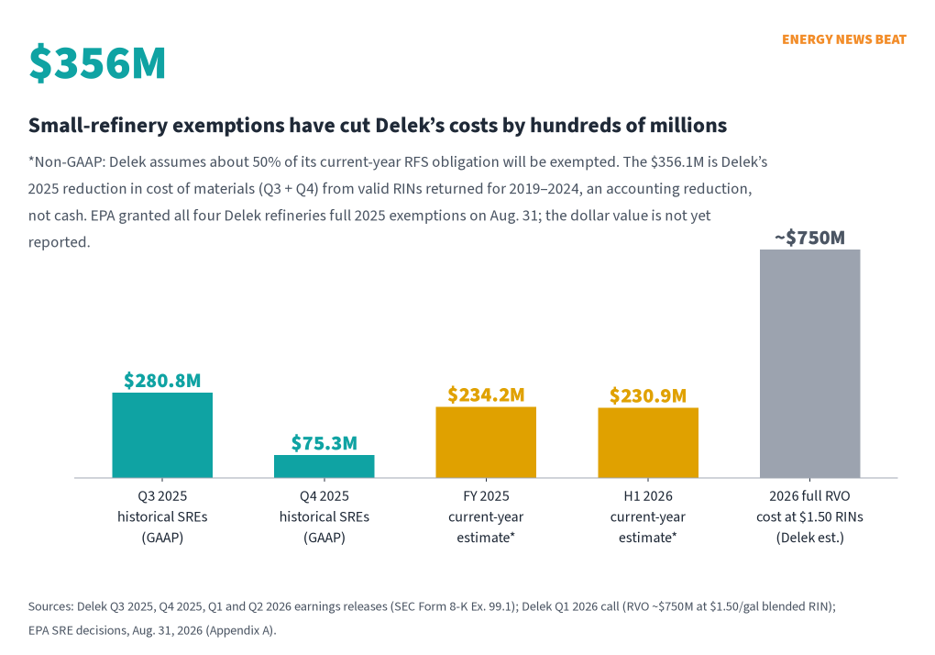
Why this matters here: the same administration is helping Delek on two fronts. One makes small refineries cheaper to run. The other, if it means adding crude capacity at Tyler, could eventually make Tyler too big to qualify. Delek can likely engineer around that by upgrading yields rather than adding crude runs. But it is a fair question to ask the company when it finally speaks.
How consumers and investors are reading it
As of market closes Oct. 14; analyst actions through Oct. 15, 2026
Consumers. Pocketbooks are the story. In AP-NORC’s Sept. 24–28 poll, about half of adults said they were “extremely” or “very” concerned about affording gas, up from 39% in July (AP-NORC). In East Texas, Railroad Commissioner Wayne Christian said he applauds the decision “to expand refining capacity right here in our backyard,” adding that it would “support our military, and improve domestic fuel affordability” (KLTV). The Talarico campaign’s response, above, was about the candidate, not the refinery.
Investors. Delek shares rose 4.4% on Oct. 13 to $80.75, then fell 2.2% to $78.97 on Oct. 14 (Yahoo Finance; GBAF; Benzinga). But the whole group moved. Based on Yahoo Finance daily closes, Valero rose 4.7%, PBF 7.2% and Par Pacific 8.1% that day while the S&P 500 was flat (ENB calculation from Yahoo Finance). We do not attribute Delek’s move to the DPA news. The stock is up about 166% this year.
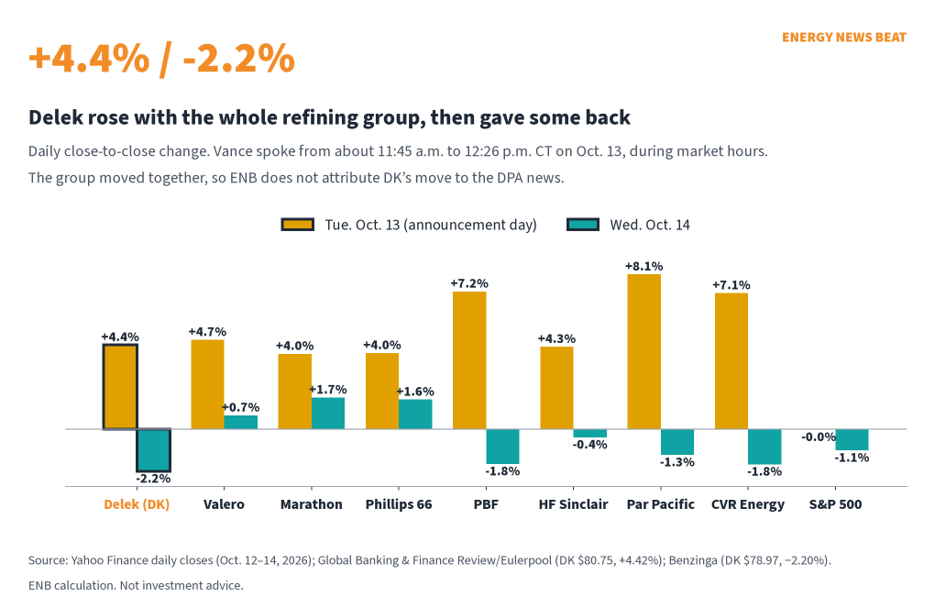
Wall Street’s recent notes are about margins and exemptions, not Washington. None of the actions below, as reported, cited the DPA (StockAnalysis; Mizuho via Yahoo Finance):
| Firm | Analyst | Rating | Price target | Date |
| Goldman Sachs | Alexa Petrick | Buy | $83 → $97 | Oct. 15, 2026 |
| Wells Fargo | Sam Margolin | Buy (Overweight) | $82 → $95 | Oct. 14, 2026 |
| Morgan Stanley | Joe Laetsch | Hold | $81 | Oct. 12, 2026 |
| Mizuho | Nitin Kumar | Downgraded to Neutral | $66 → $83 | Oct. 8, 2026 |
| Freedom Capital Markets | Sergey Pigarev | Hold (initiated) | $86 | Oct. 6, 2026 |
Mizuho, in downgrading the stock on Oct. 8, said “a key catalyst, small refinery exemptions, has already been granted for 2025” (Mizuho via Yahoo Finance). The consensus target is $78.54 from 13 analysts (StockAnalysis). Not investment advice.
| Stu’s Take
There are only two ways to lower fuel prices: demand destruction, or more refineries. Demand destruction is what happens when a trucker parks the rig because diesel is $6.32 (AAA). I don’t want that. So I want more refineries, and expanding the ones we already have is the fastest, cheapest way to get there. Tyler is the right kind of project. Delek added 15,000 b/d there in 2015 at an expected cost of about $70 million (Delek). On that estimate, that’s roughly $4,667 per barrel of daily capacity (ENB calculation from Delek’s filing). Nobody is going to build a new $2 billion Beaumont every year (ExxonMobil), but we can do Tylers. But I want the paperwork. Vance said “has used” (transcript). Show us the agreement, the dollars and the barrels. The law sunsets Dec. 11 (50 U.S.C. 4564) Congress put $1 billion into the DPA and it went to DOE (OpenOMB), but DOE has already committed up to $500 million of it to coal (DOE). Nobody has said what is left. If that money is in play, taxpayers get to see the deal. And be honest about scale. Tyler is 0.41% of U.S. capacity (ENB calculation from EIA). We went from 301 refineries to 130 (EIA). One expansion is a start, not a fix. Do this at 20 plants, and now we are talking. Energy security starts at home. A refinery that already makes military jet fuel (10-K) in the middle of East Texas is national security. Just don’t let the small-refinery rules (42 U.S.C. 7545) punish the plant for growing. If Washington wants bigger refineries, the RFS can’t reward staying small. We have to change the rules. The market has changed, and the Trump Administration has to raise the 75,000-barrel-per-day exemption limit and find a way to grant more exemptions to larger refineries so they won’t fight the exemption in Congress. We all know how political hands get influenced by lobbiest – let’s just get the DPA used to squeeze more out of refineries faster. |
What to watch
- Delek’s first statement or 8-K. It would show the mechanism, the dollars and whether this adds crude capacity or upgrades output (Delek IR; EDGAR).
- The Trump directive Reuters said was coming “in the coming days,” and whether it names more refineries (Reuters).
- 11, 2026. The DPA sunset. Watch for reauthorization in Congress and for signed commitments before that date (50 U.S.C. 4564).
- EPA’s reallocation proposal for the 2026–2027 obligations, which decides who pays for the exemptions (EPA).
- The next EIA weekly report, for diesel stocks and utilization (EIA), and AAA’s daily average (AAA).
- Delek’s third-quarter results and call, the first chance for analysts to ask about Tyler on the record.
The bottom line
Diesel at $6.32 is a real tax on everyone who eats food or buys anything that came on a truck. Expanding Tyler is the right instinct: build on a plant that is already full, already makes military jet fuel and already proved it can grow cheaply. But as of this morning, the announcement is a sentence, not a project. Until Delek and Washington publish the barrels, the dollars and the timeline, the honest answer to “what does this mean for my fuel bill?” is: not much yet, and maybe something in a few years if it becomes the first of many. For the full case on using the DPA for refining, read ENB’s earlier analysis, and for the president’s refinery talks, see Trump to meet with refiners.
Check out the World’s Greatest Podcast Show Notes at EnergyNewsBeat.co or EnergyNewsBeat.com. And subscribe to: The Energy News Beat Substack.
Appendix: Sources and Links
At Energy News Beat we Make Appendices Great Again. All times are U.S. Central (CDT, UTC−5) unless noted. Labels: [ENB CALC] = our arithmetic from cited figures; [ENB SCENARIO] = an illustrative case, not a company or government figure; [ENB READING] = our interpretation. Every source is tagged with its perspective in Appendix A.
Download the data: every figure in the charts and tables is in “What the Defense Production Act Push at Delek’s Tyler Refinery Means for Your Fuel Bill – Data.xlsx.”
Appendix A. Sources and perspective labels
Appendix B. Key figures
| Figure | Value | Source |
| AAA U.S. regular / diesel (Oct. 15) | $4.3344 / $6.3173 | AAA |
| AAA U.S. regular / diesel, one year ago | $3.0674 / $3.6554 | AAA |
| AAA U.S. yesterday / week ago (regular) | $4.3333 / $4.3612 | AAA |
| Record U.S. diesel / regular | $6.5276 (Sept. 22, 2026) / $5.0165 (June 14, 2022) | AAA |
| AAA Texas regular / diesel | $3.8324 / $5.7966 | AAA Texas |
| AAA Tyler metro regular / diesel (year ago) | $3.7724 / $5.7650 (rounds to $5.77) ($2.6180 / $3.1576) | AAA Texas |
| 15-gal fill: U.S. now / year ago / Tyler now | $65.02 / $46.01 / $56.59 | ENB CALC from AAA |
| Tyler capacity, EIA (calendar / stream day) | 74,000 b/cd / 77,500 b/sd | EIA |
| Tyler nameplate (Delek) | 75,000 b/d; complexity 9.4 | 10-K |
| Tyler crude throughput 2023 / 2024 / 2025 | 63,210 / 70,009 / 73,091 b/d | 10-K |
| Tyler crude Q2 2026 / H1 2026 / Q1 2026 (derived) | 75,525 / 71,801 / 68,036 b/d | Q2; ENB CALC |
| Tyler production Q2 2026 (gasoline / diesel-jet) | 76,260 b/d (37,565 / 34,378) | Q2 |
| Tyler production in gallons per day | 3.20 million | ENB CALC |
| Tyler refining margin Q2 2026 | $23.30/bbl | Q2 |
| Delek four-refinery EIA capacity | Tyler 74,000; Big Spring 73,000; El Dorado 83,000; Krotz Springs 80,000 b/cd | EIA |
| U.S. / Texas capacity, Jan. 1, 2026 | 18,160,493 b/cd / 6,134,650 b/cd (34 plants) | EIA |
| Tyler share of U.S. / Texas | 0.41% / 1.21% | ENB CALC |
| U.S. refineries 1982 / 2026 | 301 / 130 | EIA |
| U.S. gasoline + distillate + jet supplied, 4 wks to Oct. 2 | 14,283 kb/d (8,776 + 3,768.5 + 1,739) | EIA |
| Refinery utilization, week ending Oct. 2 | 92.7% | EIA |
| 2015 Tyler expansion | 60,000 → 75,000 b/d; expected cost ~$70.0M ($58.4M spent by Mar. 31, 2015); ~$4,667 per b/d on the estimate | Delek; OGJ; ENB CALC |
| Reduction in cost of materials from returned SRE RINs, Q3 / Q4 2025 (GAAP) | $280.8M / $75.3M (2025 YTD $356.1M, per Delek) | Q3 2025; Q4 2025 |
| SRE current-year accrual FY2025 / Q1 2026 / Q2 2026 (non-GAAP) | $234.2M / $82.3M / $148.6M | Q4 2025; Q1; Q2 |
| Delek 2026 RVO compliance cost estimate | “close to $750 million” at $1.50/gal RIN | Q1 call |
| EPA 2025 SRE decisions | 34 petitions: 18 full, 11 partial, 3 denied, 2 ineligible; 1.76B RINs vs. 0.99B estimated | EPA; EPA |
| DK close Oct. 12 / 13 / 14 | $77.33 / $80.75 (+4.42%) / $78.97 (-2.20%) | Yahoo Finance |
| Delek convertible notes / cash | $460M 0.00% notes due 2031 / $628.6M cash (June 30) | 8-K; 10-Q |
| DPA fund / sunset | $1B realigned to DOE; up to $500M committed to coal (June 4); remainder unverified / Dec. 11, 2026 | OpenOMB; DOE; 50 U.S.C. 4564 |
| Small refinery definition | ≤75,000 b/d average daily crude throughput per calendar year | 42 U.S.C. 7545 |
Appendix C. Timeline
| Date / time (CT) | Event | Source |
| Jan.–Mar. 2015 | Tyler turnaround and expansion, 60,000 → 75,000 b/d, expected cost ~$70M | Delek; OGJ |
| Nov. 7, 2025 | Delek reports a $280.8M reduction in cost of materials from returned SRE RINs; guides to ~$400M of proceeds | Q3 2025 |
| Jan. 1, 2026 | EIA: 130 operable U.S. refineries; Tyler 74,000 b/cd | EIA |
| Apr. 20, 2026 | Presidential Determination under DPA Section 303 on domestic petroleum refining | White House |
| May 2026 | Delek petitions D.C. Circuit over EPA “Set 2” reallocation rule | 10-Q |
| June 4, 2026 | DOE commits up to $500M of DPA Title III money to 13 coal plants and a coal export terminal | DOE |
| June 30, 2026 | OMB apportionment shows DPA purchases moved to DOE | OpenOMB |
| Aug. 31, 2026 | EPA rules on 2025 SREs; all four Delek refineries get full grants | EPA; Delek |
| Sept. 11, 2026 | Reuters: White House weighs DPA for refining; DPA “has never been used to add refining capacity” | Reuters |
| Sept. 22, 2026 | Record U.S. diesel average, $6.5276 | AAA |
| Sept. 29, 2026 | Delek closes $460M convertible notes | 8-K |
| Oct. 8, 2026 | Mizuho downgrades DK to Neutral, raises target to $83 | Mizuho |
| Oct. 9, 2026 | Reuters: Trump to push agencies to use DPA to raise oil and fuel output | Reuters |
| Oct. 13, shortly before noon | Vance takes the podium at Tyler Pounds Regional Airport | KLTV; pool |
| Oct. 13, ~12:10 p.m. (ENB estimate) | DPA line, about 14 minutes into the speech | transcript |
| Oct. 13 (time not confirmed) | White House Rapid Response posts the clip | X |
| Oct. 13, 12:26 p.m. | Vance finishes speaking | pool |
| Oct. 13, 2:58 p.m. (story timestamp) | Tyler Morning Telegraph story | Tyler Morning Telegraph |
| Oct. 13, market close | DK closes at $80.75 (+4.42%) as refiners rally | Yahoo Finance |
| Oct. 13 (time not confirmed) | Reuters story | Reuters |
| Oct. 13 (time not confirmed) | Bloomberg story | Bloomberg |
| Oct. 14 | Wells Fargo raises DK target to $95; DK closes $78.97 (−2.20%) | StockAnalysis; Yahoo Finance |
| Oct. 14 | Oilprice.com analysis | Oilprice |
| Oct. 15, 6:40 a.m. | AAA: $4.3344 regular, $6.3173 diesel | AAA |
| Oct. 15, 7:10 a.m. check | Goldman raises DK target to $97; no Delek release or 8-K on DPA | StockAnalysis; Delek IR; EDGAR |
| Nov. 3, 2026 | Midterm elections | Oilprice |
| Dec. 11, 2026 | DPA authorities terminate unless renewed; prior contracts survive | 50 U.S.C. 4564 |
Appendix D. Methodology and ENB calculations
- Fill-ups: 15 gallons × AAA average. 100 gallons × AAA diesel. [ENB CALC]
- Gallons to barrels per day: 1,000,000 ÷ 42 ÷ 365 = 65 b/d (per year); ÷ 30.4 days = 783 b/d (per month); ÷ 1 = 23,810 b/d (per day). [ENB CALC]
- S. daily fuel use: average of EIA weekly product supplied for gasoline, distillate and jet fuel, four weeks ending Sept. 11 through Oct. 2, 2026 = 14,283 kb/d, × 42 = about 600 million gallons a day. [ENB CALC]
- Minutes of U.S. use: added b/d ÷ 14,283,000 b/d × 1,440 minutes. Scenarios of +5,000, +15,000 and +25,000 b/d are illustrative; +15,000 matches the 2015 Tyler project. [ENB SCENARIO]
- Shares of capacity: Tyler 74,000 b/cd ÷ U.S. 18,160,493 and ÷ Texas 6,134,650 (EIA, Jan. 1, 2026). [ENB CALC]
- Q1 2026 Tyler throughput: (H1 average × 181 days − Q2 average × 91 days) ÷ 90 days. [ENB CALC]
- Cost per barrel per day: project cost ÷ capacity added, nominal dollars, not inflation-adjusted. Tyler uses Delek’s 2015 cost estimate (“expected to cost approximately $70.0 million”), not a final cost. Beaumont uses ExxonMobil’s $2 billion and 250,000 b/d; Limetree is a lower bound from its bankruptcy filing; Brownsville uses developer figures for 164,300 b/d as reported by local press. ENB did not independently verify these project costs. [ENB CALC]
- Template test: Congress provided $1 billion; DOE committed up to $500 million to coal on June 4; the remaining balance is unverified. Illustration: $500,000,000 ÷ $4,667 = ~107,000 b/d; ÷ $8,000 = 62,500 b/d. Best case, 2015/2023 costs, ignores inflation and private co-funding. [ENB SCENARIO]
- Throughput vs. nameplate: 2025 73,091 ÷ 75,000 = 97.5%; Q2 2026 75,525 ÷ 75,000 = 100.7%. [ENB CALC]
- A million gallons a day vs. Tyler: 23,810 ÷ 74,000 EIA = 32.2%; ÷ 75,000 nameplate = 31.7%; “about a third”. [ENB CALC]
- Stock moves: close-to-close percentage changes from Yahoo Finance daily closes. Not investment advice. [ENB CALC]
- Why no cents-per-gallon estimate: the added volume is undisclosed, and prices are set in a regional and global market where a closed-market elasticity would overstate the effect. [ENB READING]
- Small-refinery tension: comparing Tyler’s crude throughput to the 75,000-b/d statutory limit is our reading of 42 U.S.C. 7545(o)(1)(K). How EPA would treat a specific project depends on its design. [ENB READING]
Appendix E. Verification log
| Claim checked | How we checked | Result |
| Vance’s wording | Timestamped transcript (00:14:15), White House Rapid Response video, WSJ-led pool report | “has used” confirmed |
| AAA prices | AAA national and Texas metro pages, “Price as of 10/15/26,” read 6:40 a.m. CT | $4.3344 / $6.3173 confirmed |
| 74,000 b/d | EIA Refinery Capacity Report 2026, Table 3 | Confirmed (b/cd); nameplate 75,000 per 10-K |
| Delek statement | Delek IR press-release feed, SEC EDGAR filing index and EDGAR full-text search for “Defense Production Act,” rechecked 7:10 a.m. CT Oct. 15 | None found; latest IR item Sept. 24; latest filing a 13G/A Oct. 5 |
| Vance passage | Re-read transcript 00:14:53–00:15:53 after ENB fact-check | Body quote now verbatim; remainder paraphrased |
| SRE $356.1M | Delek Q4 2025 release: “bringing the YTD reduction to $356.1 million” | Described as a reduction in cost of materials, not cash |
| Federal funding | USAspending award search for Delek entities, queried Oct. 15; DOE and White House news pages | No grant or loan found; reporting lags |
| Prior DPA refinery use | Reuters, Sept. 11; ENB’s Oct. 10 analysis | None found; KTBS line corrected |
| DPA sunset | Cornell LII text of 50 U.S.C. 4564 | Dec. 11, 2026; a search summary saying it had already expired was wrong |
| SRE amounts | Delek 8-K earnings exhibits Q3 2025–Q2 2026; Q1 2026 call; EPA decision document | Confirmed as listed |
| 130 vs. 301, 263,000 b/d | ENB’s Oct. 10 article and its two fact-check reviews; EIA tables | Confirmed |
| The Hill quote | Article blocks automated readers; text confirmed through search-engine copies of the article | Quote confirmed, page not loaded directly |
| Analyst actions | StockAnalysis ratings page; Yahoo Finance writeup of Mizuho | Confirmed; none found citing the DPA |
| X handles | Looked up on X, Oct. 15 | See Publish Kit |
Appendix F. What ENB could not confirm
- The DPA mechanism (purchase, commitment, loan, guarantee or permitting) and any federal dollar amount.
- The added capacity in barrels per day, the product mix and whether it adds crude runs or upgrades yields.
- A start date or construction timeline.
- The “hundreds of jobs” figure. Delek publishes only a company-wide total (1,902 full-time); published Tyler headcounts we found were inconsistent, so we did not use them.
- Any DOE, Pentagon or Defense Logistics Agency statement on Tyler. None found as of 7:10 a.m. CT Oct. 15.
- How much of the $1 billion DPA appropriation remains after DOE’s coal commitment.
- Exact publication times for the Reuters, Bloomberg and Oilprice stories and the White House Rapid Response post.
- The Pricer’s $100–200 million estimate and the Beaumont, Limetree and Brownsville project costs, which come from those sources and were not independently re-verified.
- The De Haan and Kloza quotes, which we cite as quoted by Oilprice.com; we did not see their original posts.
- Whether the Trump directive reported by Reuters on Oct. 9 has been signed.
- Reasons behind the Goldman and Wells Fargo target changes; we saw only the rating actions.
- The exact date Phillips 66’s Los Angeles refinery stopped crude runs (reported as expected around mid-October 2025).
- EIA weekly data for the week ending Oct. 9 had not been released when we checked.
Appendix G. Glossary
- b/d, b/cd, b/sd: barrels per day; per calendar day (allows for downtime); per stream day (maximum when running).
- Debottleneck: adding or upgrading equipment at an existing plant so it can process more.
- DPA Title III: the part of the Defense Production Act that lets the government buy, commit to buy, lend or guarantee to expand domestic production.
- Presidential Determination: a finding by the President that unlocks Title III for a specific industry.
- RFS, RVO, RIN: the Renewable Fuel Standard; each refiner’s Renewable Volume Obligation; the credits (Renewable Identification Numbers) used to prove compliance.
- SRE: small refinery exemption, a hardship waiver for refineries at or below 75,000 b/d of crude throughput.
- Reallocation: EPA adding exempted volumes to everyone else’s future obligations.
- Military-spec jet fuel: jet fuel made to Defense Department specifications (for example JP-8).
- Refining margin: what a refiner earns per barrel after crude cost, before other expenses.
Appendix H. Chart notes and data links
| Chart | What it shows | Sources |
| 1. Delek refineries | EIA capacity of Delek’s four plants | EIA |
| 2. Throughput | Tyler crude runs vs. nameplate | 10-K; Q2 |
| 3. Millions of gallons | b/d needed per time unit | transcript; Q2 |
| 4. Product slate | Tyler daily output, Q2 2026 | Q2 |
| 5. Minutes of use | Expansion scenarios vs. U.S. daily use | EIA |
| 6. Pump prices | Today vs. a year ago, U.S. and Tyler | AAA; AAA Texas |
| 7. Refinery count | 301 → 130 and capacity | EIA |
| 8. Cost per b/d | Tyler 2015 vs. other projects | Delek; ExxonMobil; Limetree; RGVBJ |
| 9. SRE dollars | Delek SRE benefits and RVO cost | Q3 2025; Q4 2025; Q2; Q1 call |
| 10. Stock reaction | Refiner moves Oct. 13–14 | Yahoo Finance |
Related ENB coverage: Should the Trump administration use the DPA to expand refineries? • IEA: diesel squeeze into 2027 • Russia’s first 300,000 tons of diesel • The refinery shortage is the fear that sticks • Trump to meet refiners • Big vs. small refiners
The post What the Defense Production Act Push at Delek’s Tyler Refinery Means for Your Fuel Bill appeared first on Energy News Beat.