

The White House’s decision this week to step back from a blunt 90-day diesel export ban is one of the most important energy-security signals of 2026. Record pump prices invited a political shortcut. The administration, led by Energy Secretary Chris Wright, instead chose the harder and more honest path: keep the refining system running and treat diesel as the global commodity it actually is.
That is the correct call. Energy security starts at home. Energy dominance is displayed through exports. Stu Turley has made that point for years on the Energy News Beat Podcast Channel, and this week’s diesel fight is a live demonstration of why the slogan is not a talking point. It is plumbing.
A ban would not flood Midwestern harvest fields or New England terminals with cheap gallons. It would strand surplus diesel on the Gulf Coast, force refiners to cut crude runs, shrink gasoline and jet-fuel output, and yank the single largest seaborne diesel supply off a market already missing Russian and Middle Eastern barrels. The people who would feel that first are American farmers, truckers, and airlines — plus every ally that now depends on U.S. product.
What actually happened this week
Politico reported Wednesday that the administration was preparing a 90-day diesel export ban to bring down prices ahead of the midterms. President Trump had said a day earlier that he had “called for that” and told aides, “let’s not send out the diesel.” Treasury Secretary Scott Bessent said the team was examining whether a full or partial restriction would work.
Then the White House denied a flat ban was in motion. Wright was more direct: “The blunt tool of banning diesel exports definitely doesn’t work.” What is being discussed, he said, is the most efficient way to get more diesel into the United States while keeping gasoline and jet-fuel flows at maximum. Voluntary cooperation with refiners, not a shutdown of the export dock, is the working concept.
David Blackmon flagged the same pivot in 5 Big Energy Stories — 9.24.2026, grouping the White House denial with the Iran-war supply shock that created the price spike in the first place. The politics are real. The physics of a refinery are more real.
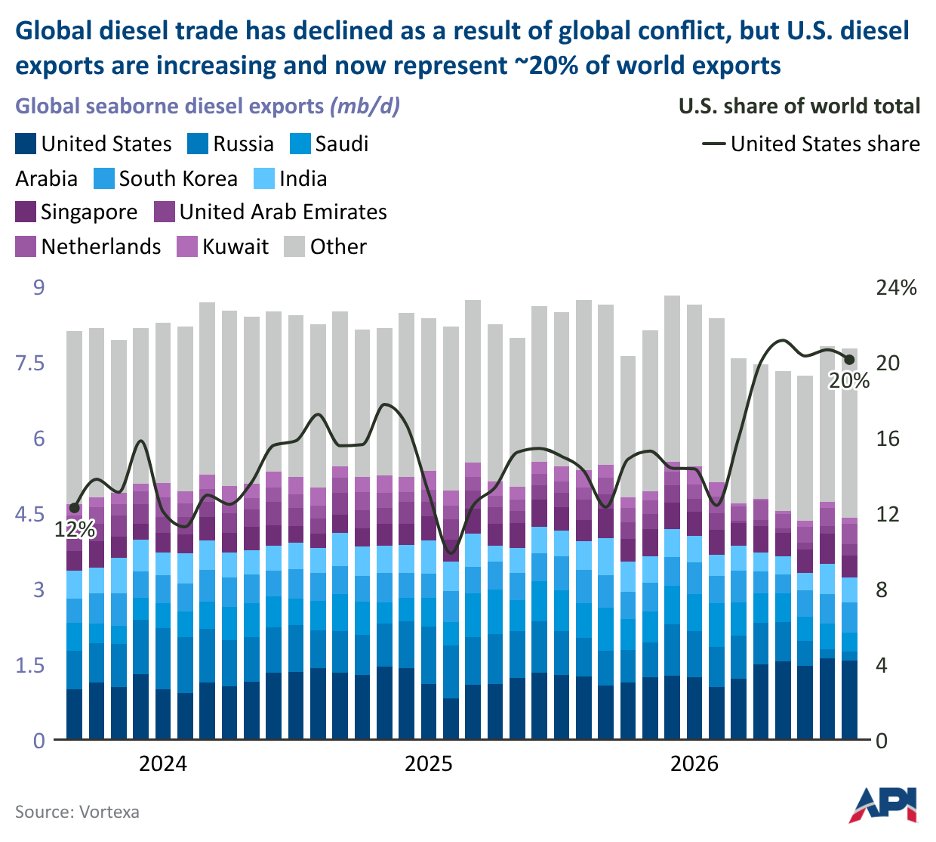
How the diesel market changed — and why the U.S. is now ~20% of global seaborne supply
Before the Iran war and Ukraine’s campaign against Russian refineries, the United States was a large diesel exporter. It is now the swing supplier.API’s latest trade chart is the picture that should end the ban debate. Global seaborne diesel trade has shrunk because of conflict. U.S. volumes have risen. The U.S. now supplies about 1.5 million barrels per day of the roughly 8 million barrels per day that move by sea — about 20% of the traded market. Vortexa data put U.S. year-to-date seaborne diesel and gasoil at about 1.4 million b/d, or 18% of global seaborne volume, up from 14% in 2025. August shipments hit a record near 1.6 million b/d. EIA weekly distillate exports were still 1.33 million b/d in the week ended September 18 after several weeks above 1.6 million.
That is dominance. It is also why a U.S. ban would not be a local price tweak. It would be a supply shock.
Diesel prices have decoupled from crude because the shortage is in refining, not oil in the ground. API’s futures chart shows diesel far outrunning crude since January. Retail diesel tells the same story. AAA put the national average at $6.51–$6.52 a gallon this week, with a recent print of $6.5141 on September 24. EIA’s weekly on-highway average for the week of September 21 was $6.529 — a record in that series, up $2.78 from a year earlier. California printed $8.246. The Midwest, heading into harvest, was $6.680.
The price chart since 2006 is not subtle. This is not a 2022-style crude spike with diesel tagging along. This is a refined-product crisis.
U.S. refiners have answered by running hard. Distillate production has been near 5.2 million b/d. Utilization has been near or above nameplate in several districts. Exports are the safety valve that lets those plants keep running when Gulf Coast tanks fill. Ban the valve and the plants slow down. S&P Global Energy has estimated that absorbing a sudden diesel surplus could require crude-run cuts on the order of 2 million b/d. Those cuts would take gasoline and jet fuel with them.
Where in the world is diesel supply most critical?
The shortage is not evenly distributed. The barrels that left the U.S. Gulf this year went to the places that lost Russia and the Persian Gulf.
Europe is the most exposed large market. Russia was once the backbone of EU diesel imports. Moscow banned producer diesel exports in July and has extended product restrictions. Middle East net diesel and gasoil exports collapsed to about 390,000 b/d in August — roughly a quarter of pre-war levels. Combined Middle East and Russian net exports in August were 1.6 million b/d below February, when those two sources were nearly 45% of seaborne trade. The United States became Europe’s main external supplier; Kpler put August U.S. diesel into Europe near 506,000 b/d. A U.S. ban would reopen a hole Europe cannot fill from Asia at the same speed or price.
Latin America is next, and it is tightly bound to the U.S. Gulf. Vortexa has 62% of U.S. seaborne diesel year-to-date going to South and Central America and the Caribbean. Mexico is the top destination, followed by Chile, Brazil, Ecuador, and Peru. Mexico already runs on imported diesel — on the order of seven in ten liters — and days of supply have been thin. Brazil lost Russian barrels and has been taking about three-quarters of its August imports from the U.S. Gulf during planting season. Peru and Ecuador have little storage cushion. A U.S. ban would hit food and freight systems that feed back into U.S. grocery inflation.
Africa has also absorbed displaced demand as Middle East barrels vanished. Volumes from the U.S. to Africa are up sharply versus 2025. East and southern Africa historically leaned on Gulf product. That pipe is pinched.
Australia and parts of Asia sit at the end of long supply lines. Australia imports the large majority of its diesel. When Gulf and Russian product disappears, every remaining cargo is bid by Europe and Latin America first.
The global export stack makes the point visually: U.S. barrels are the dark band that grew as Russia, Saudi Arabia, and the UAE shrank.
Where in the U.S. supply is actually at risk
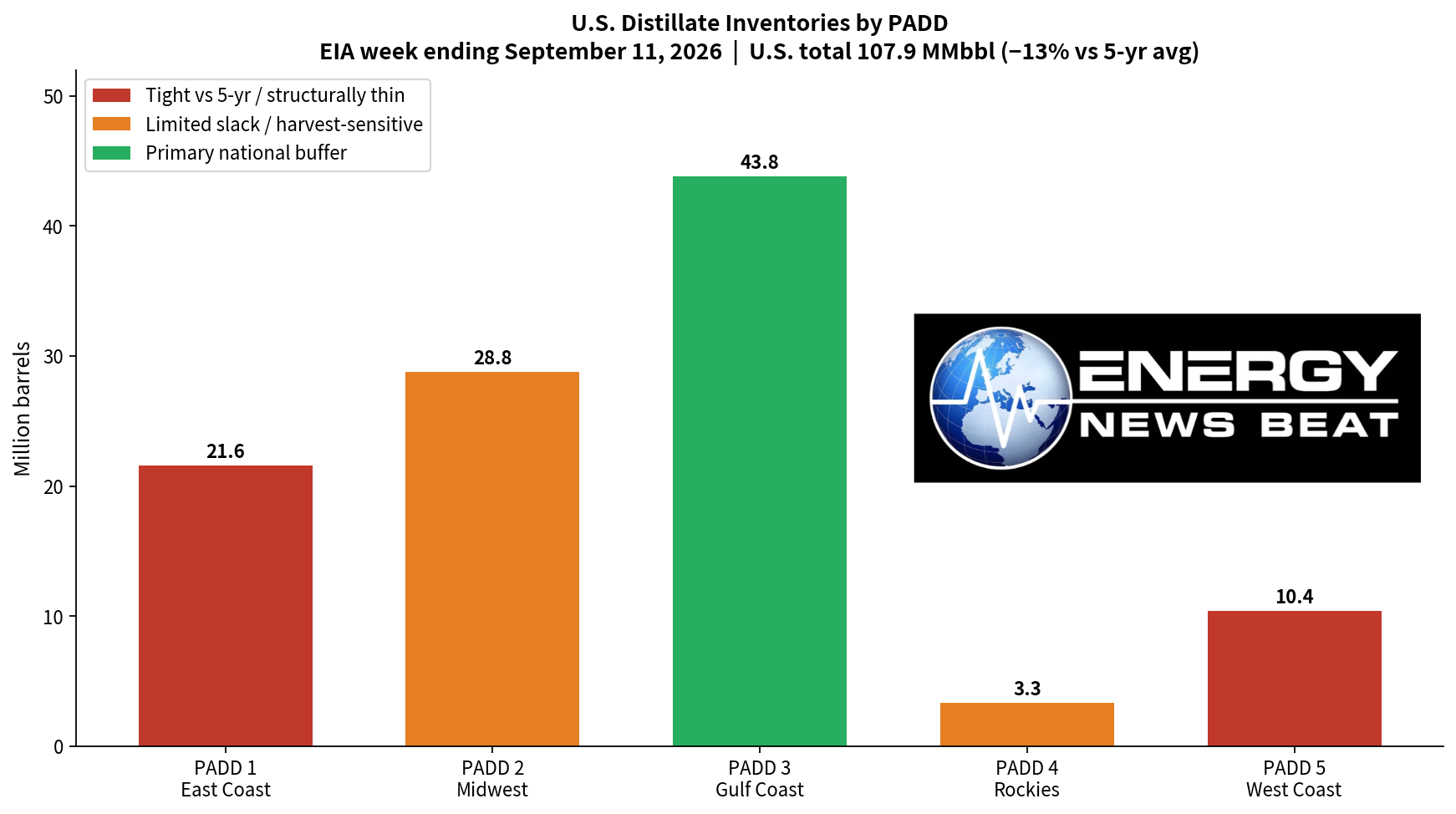
The United States is not one diesel market. It is five PADDs connected by pipelines, Jones Act ships, and barges that do not move surplus overnight.EIA stocks for the week ended September 18: U.S. distillate inventories 107.4 million barrels, about 12% below the five-year average. The national number hides the map.PADD 3 (Gulf Coast): 44.4 million barrels. This is the surplus region and the export dock. About 54% of U.S. refining capacity sits here. A ban would pile barrels in Houston and Louisiana tanks first.
- PADD 1 (East Coast): 22.2 million barrels. Structurally tight, still well below normal. The East Coast relies on Colonial Pipeline barrels from the Gulf plus imports for roughly 10% of diesel. New England and the Central Atlantic are the thin spots heading into heating season.
- PADD 2 (Midwest): 27.2 million barrels. Harvest-sensitive. Joliet and other Midwest outages have already shown how fast this region can tighten. Farmers pushing for a ban live here — and they are the ones who need Gulf refiners to keep running, not shut in.
- PADD 5 (West Coast): 10.3 million barrels. Thin versus the five-year norm, and California is an island market with the highest retail prices in the country.
- PADD 4 (Rockies): 3.3 million barrels. Small system, limited slack.
The Energy News Beat regional inventory snapshot from mid-September already showed the pattern: Gulf Coast as the national buffer, East and West Coasts marked tight, Midwest harvest-exposed.
A ban’s “winners” would be a couple of Gulf Coast tank farms for a few weeks. The losers would be the deficit coasts, the Midwest harvest, and every product that comes out of the same crude barrel. Wright’s point is the one refiners have been making to the White House: you cannot export only the molecule you do not want. If diesel has nowhere to go, utilization falls and gasoline and jet rise. That is not theory. It is how a complex refinery is built.
Senator Ted Cruz put it in one sentence: the U.S. refines more diesel than it consumes, and a ban would force refiners to reduce production. It would backfire. API’s thread this week said the same thing the industry has said since the idea surfaced: removing 20% of seaborne diesel from a market already in a refining crisis is not a consumer-relief program. It is a shortage multiplier.
Why restraint is the America First move
The instinct to “keep it here” sounds patriotic. In refined products, it is often the opposite.
Energy security starts at home means permitting, running, and expanding U.S. refining so American plants can process American crude. Energy dominance through exports means those plants stay full because the world will pay for the barrel the Gulf Coast cannot store. That is how the United States replaced lost Russian and Middle East diesel without rationing at home.
A 90-day ban would have been the first U.S. energy-export restriction since the crude-export ban was lifted in 2015. It would have told every buyer in Mexico City, Rotterdam, and Santiago that American supply is a political switch. Prices abroad would spike. Some of that spike would come home in higher import costs, weaker allies, and eventually lower U.S. runs.
Wright’s voluntary track — more diesel into tight U.S. regions without wrecking throughput — is the grown-up version of the same goal farm-state Republicans actually want: more gallons where combines and trucks are running. Louisiana’s dyed-diesel flexibility for farm and timber traffic is the kind of targeted relief that does not blow up the Atlantic Basin balance.
The White House showed restraint. Keep it. The diesel market has already changed. The United States is no longer just another exporter. It is roughly one-fifth of the seaborne system. That is not a problem to be banned. That is the leverage.
Making Appendices Great Again
Check out the World’s Greatest Podcast Show Notes at EnergyNewsBeat.co or EnergyNewsBeat.com.
Appendix: Sources and links
White House / policy
- Politico, “White House preparing plan for 90-day diesel exports ban,” Sept. 23, 2026: https://www.politico.com/news/2026/09/23/white-house-ban-diesel-01089294
- Reuters, “White House denies report US is considering a diesel export ban,” Sept. 23, 2026: https://www.reuters.com/world/us/white-house-denies-report-us-is-considering-a-diesel-export-ban-2026-09-23/
- Reuters, “US diesel futures fall after report of export ban plan,” Sept. 23, 2026: https://www.reuters.com/business/energy/us-diesel-futures-fall-after-report-export-ban-plan-which-white-house-denies-2026-09-23/
- OilPrice.com, “White House Rules Out Diesel Export Ban,” Sept. 23, 2026: https://oilprice.com/Energy/Energy-General/White-House-Rules-Out-Diesel-Export-Ban-as-Prices-Surge-Above-650.html
- Forbes, “Trump Wants Diesel Export Ban—But White House Reportedly Denies,” Sept. 23, 2026: https://www.forbes.com/sites/zacharyfolk/2026/09/23/white-house-reportedly-denies-its-working-on-diesel-export-ban-trump-wants/
- Politico, “Trump says decision on possible diesel export ban to come ‘fast,’” Sept. 22, 2026: https://www.politico.com/news/2026/09/22/trump-decision-diesel-export-ban-soon-01087925
Industry and market analysis
- API, “A Diesel Export Ban Would Wreak Havoc at Home and Abroad. Here’s Why.” Sept. 22, 2026: https://www.api.org/news-policy-and-issues/news/2026/09/22/a-diesel-export-ban-would-wreak-havoc-at-home-and-abroad-heres-why
- API, “WHAT THEY ARE SAYING: U.S. Diesel Export Ban Is a Bad Idea,” Sept. 23, 2026: https://www.api.org/news-policy-and-issues/news/2026/09/23/what-they-are-saying-us-diesel-export-ban-is-a-bad-idea
- API on X, Sept. 23, 2026 (20% seaborne share): https://x.com/APIenergy/status/2102828208953626642
- Reuters explainer, “US diesel exports ban would hurt global fuel markets,” Sept. 22, 2026: https://www.reuters.com/world/us/ban-us-diesel-exports-would-hurt-not-help-fuel-markets-analysts-say-2026-09-22/
- FreightWaves, “Export ban talk sinks diesel, boosts gasoline,” Sept. 24, 2026: https://www.freightwaves.com/news/export-ban-talk-sinks-diesel-boosts-gasoline-as-white-house-eyes-options
- Lloyd’s List, “How would US diesel export restriction impact tanker shipping rates?” Sept. 24, 2026: https://www.lloydslist.com/LL1158524/How-would-US-diesel-export-restriction-impact-tanker-shipping-rates
- Atlantic Council, “A diesel export ban could disrupt US supply chains,” Sept. 23, 2026: https://www.atlanticcouncil.org/dispatches/a-diesel-export-ban-could-disrupt-us-supply-chains/
- S&P Global, “Why the Americas are not prepared for peak diesel demand season”: https://www.spglobal.com/energy/en/news-research/latest-news/crude-oil/090326-why-the-americas-are-not-prepared-for-peak-diesel-demand-season
Data
- EIA Weekly Petroleum Status Report: https://www.eia.gov/petroleum/supply/weekly/
- EIA distillate stocks by PADD: https://www.eia.gov/dnav/pet/pet_stoc_wstk_a_epd0_sae_mbbl_w.htm
- EIA distillate exports: https://www.eia.gov/dnav/pet/pet_move_wkly_a_epd0_eex_mbblpd_w.htm
- EIA WPSR summary, week ended Sept. 18, 2026: https://ir.eia.gov/wpsr/summary.txt
- AAA Fuel Prices (national diesel $6.5141 as of Sept. 24, 2026): https://gasprices.aaa.com/?Country=US
- EIA/USDA weekly regional diesel prices, week of Sept. 21, 2026: https://agtransport.usda.gov/Fuel/Weekly-Regional-On-Highway-Diesel-Fuel-Prices/2rsf-2i73
Commentary referenced in this piece
- David Blackmon, “5 Big Energy Stories — 9.24.2026: Iran Blames Canada, White House Reconsiders Diesel Ban,” Sept. 24, 2026: https://blackmon.substack.com/p/5-big-energy-stories-9242026-iran
- Stu Turley / Energy News Beat Podcast: “Texas Gets A Refinery — Energy Security Starts at Home — Energy Dominance is displayed through your exports”: https://www.iheart.com/podcast/269-energy-news-beat-podcast-109166644/episode/texas-gets-a-refinery-energy-security-starts-at-home-energy-dominance-is-displayed-through-your-exports-327304976
- Stu Turley, “Energy Security is Center Stage”: https://theenergynewsbeat.substack.com/p/energy-security-is-center-stage
- Energy News Beat related coverage: https://energynews
The post White House Showing Restraint on a Diesel Export Ban Is the Right Call for American Energy Dominance appeared first on Energy News Beat.