
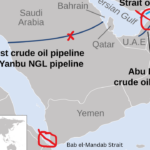
Oil prices jumped more than 3% in early Asian trade Monday as weekend attacks by Yemen’s Iran-aligned Houthis and strikes in the Strait of Hormuz compounded an already fragile supply picture. By mid-session, Brent was trading near $107–$109 a barrel and WTI around $102–$104, levels last seen in the spring.
The immediate catalyst was a cluster of incidents: Houthi missile and drone claims against a Saudi military base in Sharurah and reported projectiles in Jazan; a UKMTO alert of a vessel struck in the Strait of Hormuz; an Iranian cargo ship hit off Qeshm Island; and, most consequentially for volumes, the continued shutdown of Saudi Arabia’s East-West Pipeline after drone strikes last week. Diplomacy offered no relief. A planned Gulf states–Iran meeting in Oman was postponed for lack of consensus.
This is not an isolated flare-up. It is the latest widening of a conflict that began earlier this year with the effective closure of the Strait of Hormuz and has now opened a second front on the Red Sea and Bab el-Mandeb.
The Pipeline That Became the Lifeline
For months, the 1,200-kilometer East-West Pipeline (Petroline) has been Saudi Arabia’s primary workaround for Hormuz disruption. It has been moving roughly 4 million barrels per day—about 4% of global supply—from eastern fields to the Red Sea port of Yanbu. Capacity is listed at around 7 million bpd.
Satellite imagery showed a pumping station heavily blackened by fire, with spilled crude visible in the desert. Yanbu storage can support exports for only five to seven days. Additional stocks at Egypt’s Ain Sukhna and Sidi Kerir buy a little more time but are not full. If the line stays down, traders warn Saudi export volumes could drop sharply.
Repair timelines vary. Industry sources cited by Reuters put full restoration at five to six weeks in some cases, with others saying limited pumping could resume sooner while work continues. Official Saudi statements have not given a public timetable. A similar strike in April 2026 was repaired to full 7 million bpd capacity within days, showing Aramco can move quickly when conditions allow—but the current damage assessment and security environment are different. Some market participants have floated longer windows of two to three months if multiple stations or associated infrastructure prove more extensively hit.
Houthi advances compound the problem. The group has taken Perim Island and tightened control over the Bab el-Mandeb, the “Gate of Tears” at the southern entrance to the Red Sea. That route had become an alternative corridor for Saudi and other Gulf barrels after Hormuz traffic collapsed. Red Sea shipments had already fallen to about 2 million bpd in August.
What Analysts Are Saying
The consensus among traders and banks is that the market is no longer pricing a short “sprint” shock. Reuters described the latest Yemen and pipeline developments as evidence that the Iran war has become a “marathon.” Asia physical premiums for Dubai and Oman crude jumped to their highest since March on tight supply and high freight. Strong refining margins are still supporting prompt buying.
Forecast ranges remain wide because they hinge on when (or whether) Hormuz flows normalize and how long secondary routes stay constrained:S&P Global Energy: base case under $100 next year, $120 if Hormuz disruptions persist, or below $60 in a rapid-recovery scenario.
Wood Mackenzie: Dated Brent near $110 around end-2026/early 2027 before declining toward $60 by early 2028 if Hormuz fully reopens in January 2027.
Goldman Sachs, HSBC, Bank of America and others have raised 2027 forecasts in recent weeks; some scenario work still flags $120–$150 if infrastructure damage deepens or recovery stays gradual.
President Trump has said the conflict will end after the November midterms and that gasoline will “drop like a rock.” Markets have so far treated that as a political statement rather than a near-term supply schedule. Inventories are already low, strategic stocks have been drawn, and logistical lags (insurance, tanker repositioning, field ramp-ups) mean even a diplomatic breakthrough would take weeks to months to show up in barrels.
The Real Bottleneck: Refining, Not Just Crude
Crude prices above $100 grab headlines. The more persistent squeeze is downstream. Diesel crack spreads have printed record highs above $100 per barrel. The 3-2-1 crack (three barrels of crude into two of gasoline and one of diesel) has traded in the mid-$60s to $70 range. U.S. Gulf Coast diesel cracks closed near $108 recently.
That is not a demand boom. It is lost conversion capacity.
Middle East refinery runs fell roughly 27% in Q2 2026 to around 6.5 million bpd after Hormuz closure and attacks on Gulf plants; later data showed regional runs still near 7.3 million bpd versus 9.9 million pre-war. The IEA and others estimate global refining output was cut by about 4.5–5 million bpd (5–6%) in the second quarter from a combination of Middle East damage/export constraints, Ukrainian strikes on Russian plants, and earlier permanent closures in the Atlantic Basin. Product exports from Russia, the Middle East, and Asia dropped sharply.
U.S. refiners have responded by running 96–98% of operable capacity—near practical limits. High cracks give every incentive to maximize throughput, but little spare hardware remains. Europe has seen some simple-margin compression as crude costs outran gasoline cracks, raising the risk of run cuts in certain configurations even while distillate remains tight.
Does Lost Refining Capacity Cut Crude Demand—and Can Refiners Keep the Spreads?
Yes and no.
Refineries that cannot export products or receive crude (much of the Gulf, parts of Iran) have already cut runs. That reduces their crude offtake. At the same time, every barrel that can be processed in the United States, parts of Asia, and functioning European plants is being processed. Record product prices and thin inventories keep those refiners bidding for crude. The net effect so far has been tight crude balances and even tighter product balances.High end-user fuel prices (U.S. diesel above $6/gallon) will eventually destroy some demand—trucking, shipping, industry. That is the classic demand-destruction feedback. But it has not yet been large enough to collapse cracks. Refiners can charge the elevated spreads because finished-fuel demand has held up better than the available conversion capacity. Until damaged Middle East and Russian units return and chokepoints reopen, the product market remains the tighter of the two.Peace or a pipeline restart would be more immediately bearish for crude than for diesel cracks. Conversion capacity does not reappear the day a ceasefire is announced.Weeks or Months?The East-West outage itself looks like a weeks-to-low-months event if the April 2026 precedent and the more optimistic industry sources hold.
Traders speaking to Reuters most often cite five to six weeks; partial flows could come sooner. A two-to-three-month full outage is possible if damage or security conditions are worse than publicly known, but it is not the base case from available reporting.
The broader price spike is unlikely to be “just a few weeks.” Layered risks—Hormuz still operating at a fraction of pre-war capacity, Houthi control of Bab el-Mandeb, damaged refining assets that take months (sometimes longer) to restore, and depleted inventories—point to elevated volatility and a higher floor through the fourth quarter and into 2027 under most analyst base cases. A credible, verified reopening of major routes plus visible pipeline and refinery recovery would be required to unwind the risk premium quickly.For now the market is treating Yemen’s advance and the pipeline hit as confirmation that the supply shock has a second act, not a curtain call.
Making Appendices Great Again
Appendix: Sources and Links
- OilPrice.com: “Oil Prices Surge as Middle East Attacks Continue and Diplomacy Stumbles” (Sept. 13, 2026) — https://oilprice.com/Energy/Energy-General/Oil-Prices-Surge-as-Middle-East-Attacks-Continue-and-Diplomacy-Stumbles.html
- Al Jazeera: “US says it’s clearing Hormuz traffic: Why are oil futures beyond $100?” (Sept. 14, 2026) — https://www.aljazeera.com/news/2026/9/14/us-says-its-clearing-hormuz-traffic-why-are-oil-futures-beyond-100
- Reuters: “Oil markets survived the Iran war sprint. Now comes the marathon” (Sept. 14, 2026) — https://www.reuters.com/commentary/reuters-open-interest/oil-markets-survived-iran-war-sprint-now-comes-marathon-2026-09-14/
- Reuters: “Asia’s oil traders, seeing no quick end to Middle East war, stay bullish on prices” (Sept. 14, 2026) — https://www.reuters.com/business/energy/asias-oil-traders-seeing-no-quick-end-middle-east-war-stay-bullish-prices-2026-09-14/
- Siasat / Reuters satellite reporting: “Satellite images show severe damage to Saudi oil pipeline” — https://www.siasat.com/satellite-images-show-severe-damage-to-saudi-oil-pipeline-3541813/
- Business Standard / Reuters: “Saudi Arabia pipeline outage threatens loss of 4% of global oil supply” — https://www.business-standard.com/economy/news/saudi-arabia-pipeline-outage-threatens-loss-of-4-of-global-oil-supply-126091400004_1.html
- Profit by Pakistan Today / Reuters: “Saudi pipeline outage puts 4% of global oil supply at risk” — https://profit.pakistantoday.com.pk/2026/09/13/saudi-arabia-risks-4m-bpd-export-loss-as-key-red-sea-oil-route-remains-shut
- Columbia SIPA CGEP: “Beyond Crude: Iran War Reveals Refined Products as an Energy Security Blind Spot” (Aug. 28, 2026) — https://www.energypolicy.columbia.edu/publications/beyond-crude-iran-war-reveals-refined-products-as-an-energy-security-blind-spot/
- RBN Energy: “Basket Case – With U.S. Refiners Already Running Hard, Relief on Diesel Remains Elusive” (Sept. 14, 2026) — https://rbnenergy.com/daily-posts/blog/us-refiners-already-running-hard-relief-diesel-remains-elusive
- Atlantic Council: “No quick fixes for the squeeze on refined products” (Sept. 9, 2026) — https://www.atlanticcouncil.org/blogs/energysource/no-quick-fixes-for-the-squeeze-on-refined-products/
- Forbes: “Refining Stocks Soar As Crack Spread Hits Record High In 2026” — https://www.forbes.com/sites/garthfriesen/2026/07/23/refining-stocks-soar-as-crack-spread-hits-record-high-in-2026/
- Kpler: Middle East refining analysis and European margins notes
- Business Insider: “Oil Price Forecast: Why Wall Street Sees a Longer Global Crude Shock” (Sept. 10, 2026) — https://www.businessinsider.com/oil-price-forecasts-global-shock-iran-war-wall-street-outlook-2026-9
- Additional contemporaneous coverage: Reuters, Al-Monitor, Nikkei Asia, Time, CNN, BBC, The Economic Times, Trading Economics, and IEA-referenced data cited in the above reports.
The post Yemen and Iranian Attacks Send Oil Spiking – For How Long? appeared first on Energy News Beat.