
Exxon, Chevron, Shell and BP report this week. Crude slipped last quarter, but diesel did not. Refiners’ margins roughly tripled from a year ago, and EIA data show refining now takes a bigger slice of every gallon you buy.
By Energy News Beat. AAA prices read Oct. 27, 2026, 6:57 a.m. CT; EIA data checked 6:57 a.m. CT
| The short version
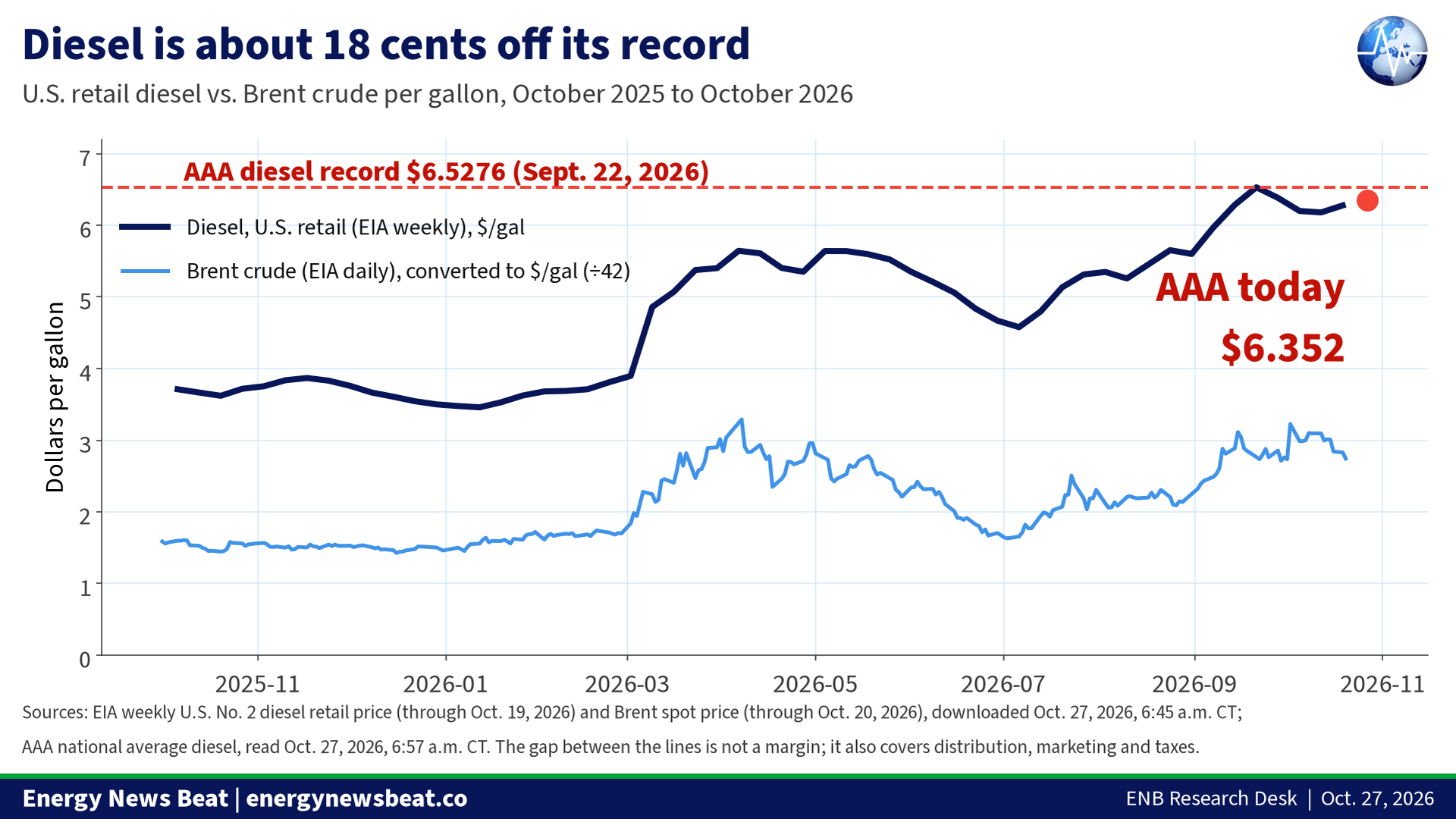
Diesel averaged $6.352 a gallon nationally this morning (AAA, Oct. 27), about 18 cents below its $6.5276 record of Sept. 22. A year ago it was $3.662. Valero earned a refining margin of $39.24 per barrel in the third quarter, up from $13.14 a year earlier. Eni’s benchmark margin was $28.10 vs. $8.90. ExxonMobil’s own SEC filing estimates refining and fuels margins added about $4.5 billion versus the second quarter, while lower oil prices took away about $1.3 billion. In EIA’s latest breakdown (May 2026), refining took 25 cents of every diesel dollar, up from 19.2 cents on average in 2025. |
If you filled a truck, a tractor or a heating-oil tank this fall, you already know the number. AAA’s national average for diesel was $6.352 a gallon at 6:57 a.m. CT today, Oct. 27 (unchanged from our 6:43 a.m. read). That is about 18 cents below the $6.5276 record set on Sept. 22, and up from $3.662 a year ago. This week the oil majors tell us how much of that landed on their side of the pump. Crude is only part of the story. Oil prices dipped in the third quarter, yet diesel climbed to a record in September. The gap between what crude costs and what diesel and gasoline sell for is the refiner’s margin, and that is where this year’s windfall sits.
The earnings week lineup
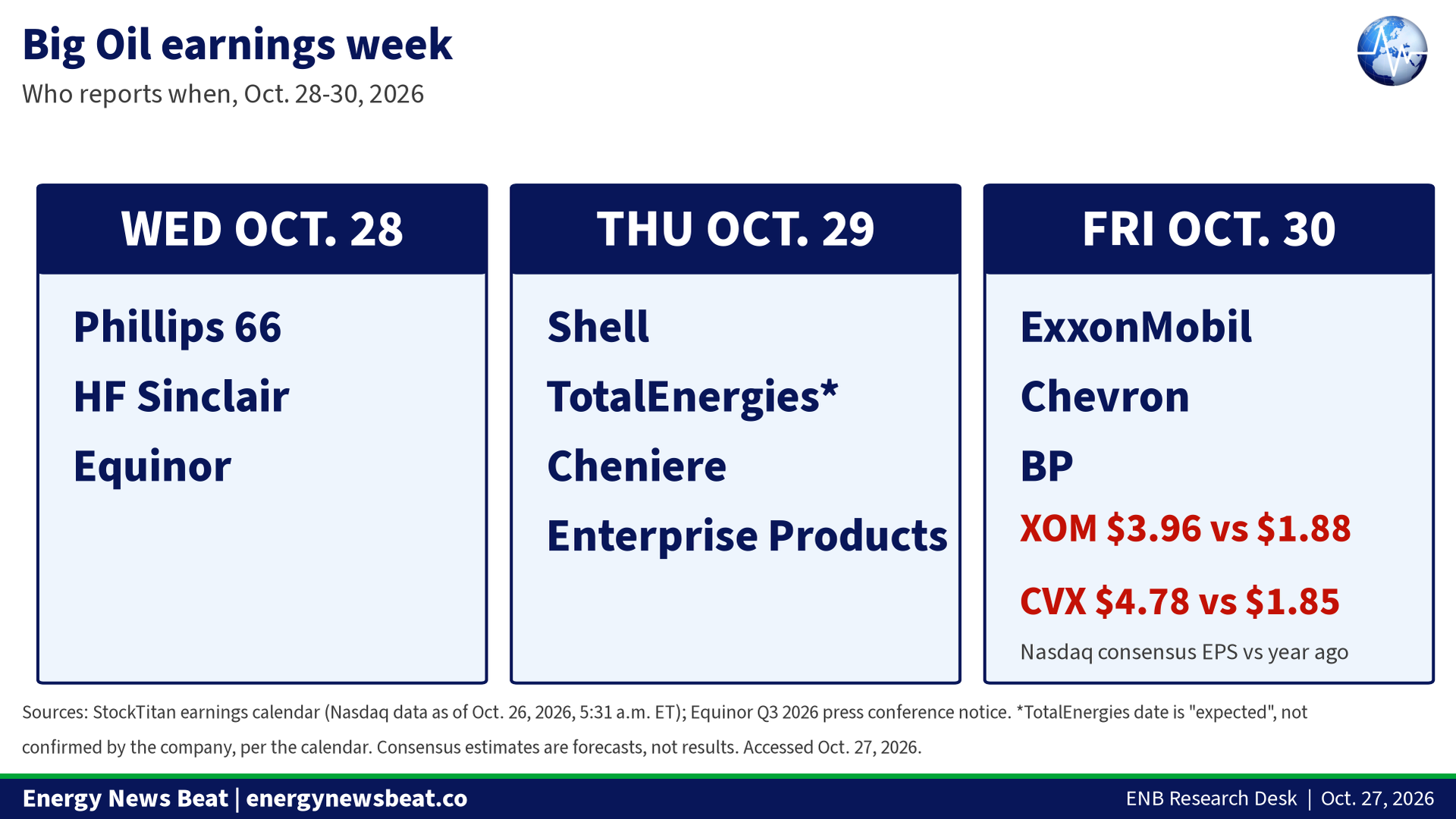
Phillips 66 and HF Sinclair report Wednesday, Oct. 28, according to the StockTitan earnings calendar, and Equinor presents its third quarter the same day. Shell, Cheniere and Enterprise Products report Thursday, with TotalEnergies listed as expected that day but not yet confirmed. ExxonMobil, Chevron and BP close the week Friday, Oct. 30.
Analyst consensus compiled by Nasdaq puts ExxonMobil at $3.96 a share, against $1.88 a year ago, and Chevron at $4.78 against $1.85. [ENB ANALYSIS] That is roughly 2x and 2.5x last year’s third quarter. Phillips 66, a big refiner, carries a consensus of $12.02 vs. $2.52.
Exxon already showed its hand
ExxonMobil filed an 8-K exhibit with the SEC on Oct. 16 listing the market factors it expects to move third-quarter results against the second quarter. Change in margins adds an estimated $4.5 billion in its Energy Products segment, which holds refining and fuels. Change in liquids prices takes away $1.3 billion in Upstream. Chemical margins are a $0.6 billion drag, specialty products add $0.5 billion, and gas prices add $0.3 billion.
“These are current estimates and are not a comprehensive list of all items affecting 3Q results, and actual results may vary, either positively or negatively, from these estimates.” (ExxonMobil, 8-K Exhibit 99.1)
The filing also lists an estimated $2.5 billion negative from timing effects in the quarter, mostly from crude and product trading, which Exxon says arise from the timing of derivatives against their physical shipments and are typically negative when prices rise.
In plain terms, Exxon is telling investors that refining more than made up for cheaper crude. EIA data show Brent averaged about $96 a barrel in the third quarter, down from about $103 in the second (ENB averages of daily prices). Other items in the same table, including timing effects, take back much of that gain, so the filing does not mean a matching jump in reported profit.
Refining margins roughly tripled
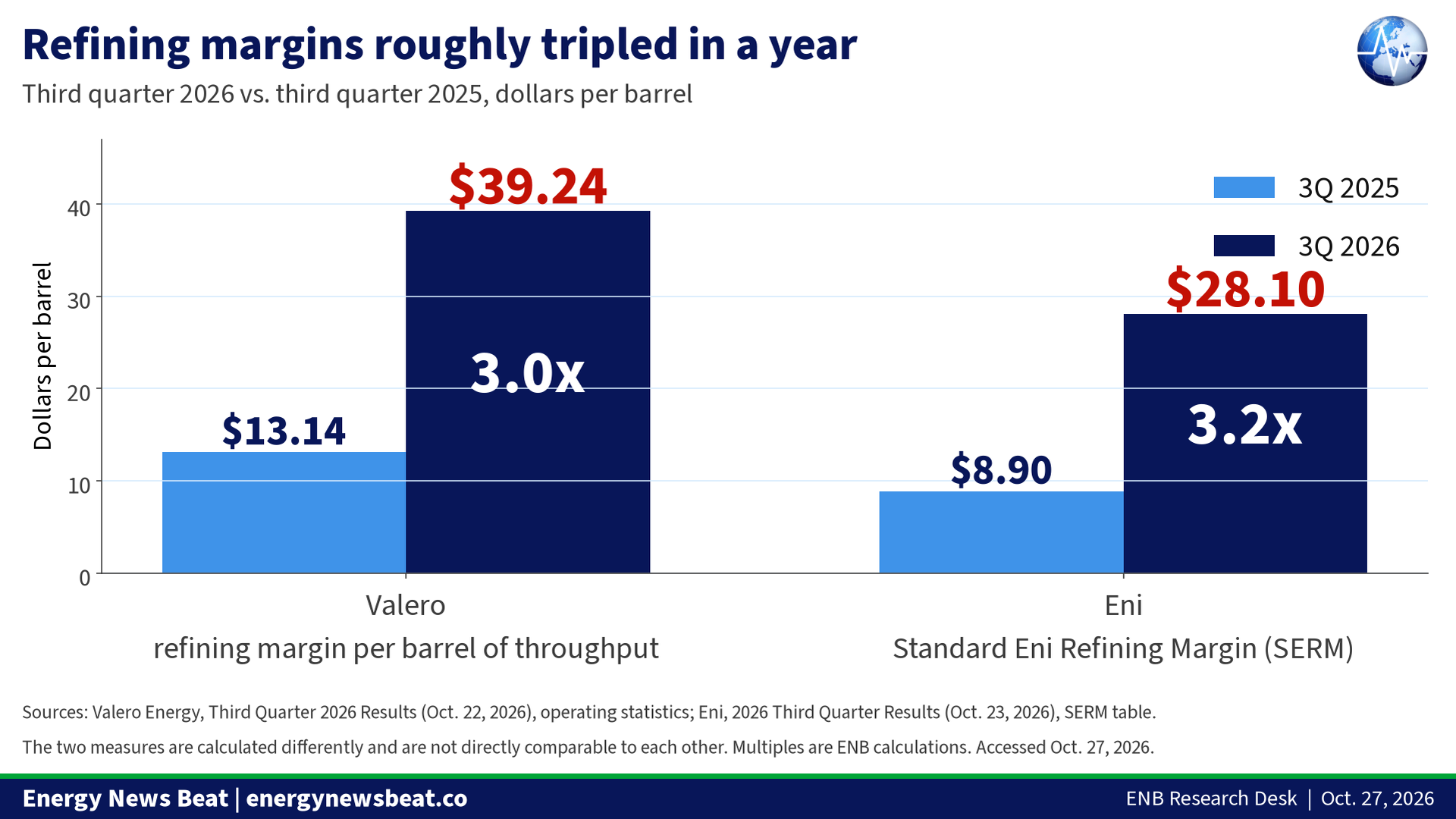
The refiners that already reported show how big the swing is. Valero, one of the largest U.S. refiners, reported a refining margin of $39.24 per barrel of throughput in the third quarter, against $13.14 a year earlier. Its net income attributable to stockholders was $6.8 billion, up from $1.1 billion.
In Europe, Eni’s Standard Eni Refining Margin averaged $28.10 a barrel vs. $8.90 in the third quarter of 2025 (Eni says it adjusted the benchmark’s method this year for market volatility), and its adjusted net profit more than doubled to €2.8 billion. Portugal’s Galp reported RCA net income of €682 million for the quarter.
Where your diesel dollar goes
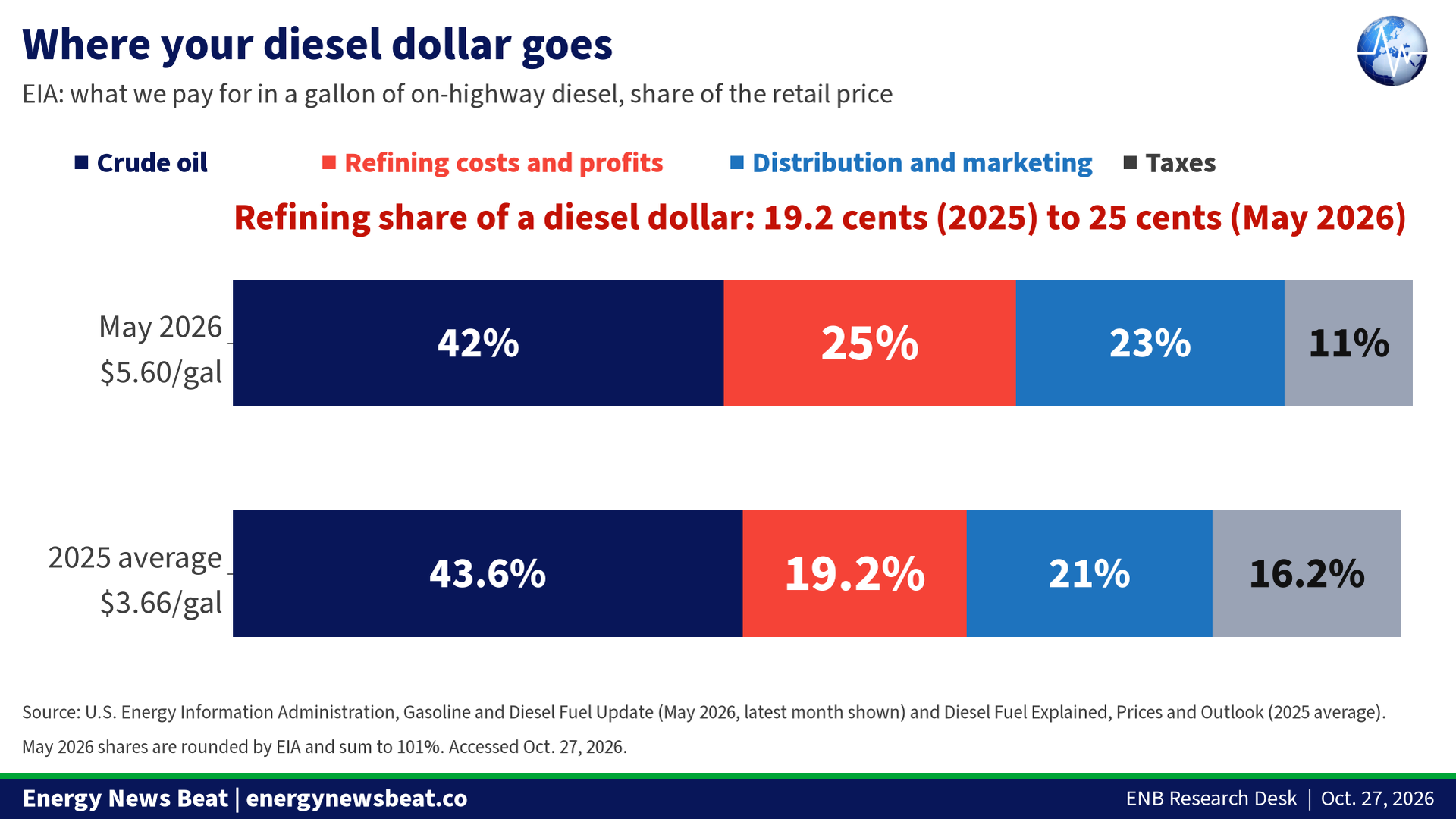
EIA breaks the retail price into four parts: crude oil, refining costs and profits, distribution and marketing, and taxes. In the latest month EIA shows, May 2026, diesel averaged $5.60 a gallon. Crude was 42%, refining 25%, distribution and marketing 23%, and taxes 11% (EIA’s rounded shares).
For all of 2025, when diesel averaged $3.66, EIA put refining at 19.2% and crude at 43.6%, with taxes at 16.2% and distribution and marketing at 21.0%.
So refiner’s slice of each dollar rose from about 19 cents to 25 cents. On a $5.60 gallon, that is about $1.40 for refining, against about 70 cents on the 2025 average gallon.
Taxes barely move with price. The federal tax on on-highway diesel is 24.4 cents a gallon, and state taxes and fees averaged 35.86 cents as of January 2026.
As the price climbs, taxes shrink as a share, and the extra money goes mostly to crude and refining.
Diesel and heating oil stay high
EIA’s weekly survey had retail diesel at $6.276 on Oct. 19, after a $6.529 peak in the week of Sept. 21. Brent fell from $129.95 on Oct. 12 to $118.82 on Oct. 19, yet EIA’s diesel average rose 9.7 cents between its Oct. 12 and Oct. 19 surveys. EIA’s Oct. 26 survey had not been posted as of 6:57 a.m. CT today.
Heating oil tells the same story for Northeast homes. EIA’s residential heating oil average was $6.190 a gallon on Oct. 19, up $2.664 from a year earlier. [ENB ANALYSIS] That is about 76% higher than the $3.526 of October 2025.
What it means for you
For consumers: A refinery margin is not something you can shop around, but timing and volume still help. Fleet and farm buyers can compare cash and card prices and lock in contracts when the futures market dips. Heating-oil customers can ask dealers about budget plans before the cold arrives. This is not personal financial advice.
For investors: Refining is doing the heavy lifting this quarter. Exxon has signaled the direction in its filing, so Friday’s market reaction may depend more on buybacks, spending plans and comments on how long margins last. Chevron gave no similar margin estimate in our sources, so its refining numbers are less known.
Caveats and the other side
- Refining is cyclical. Valero’s 2025 nine-month margin was $11.82 a barrel, and EIA puts refining’s average share of a diesel dollar at 9% over 2016-2025, well below today’s 25%. A good quarter is not a new normal.
- Consensus estimates are forecasts, not results. Nasdaq’s $3.96 for Exxon differs from a FactSet consensus of about $3.87 cited by The Jolt Journal from Stocktwits. Actual results arrive Friday.
- Exxon calls its 8-K numbers limited estimates, not an earnings forecast, and timing effects can swing the reported figure.
- Valero and Eni measure margins differently, so the two figures should not be compared with each other. EIA’s breakdown is a monthly national average, and local prices vary.
- A refining margin is not pure profit. It must cover the cost of running the plant: Valero reported operating expenses of $5.03 a barrel of throughput in the third quarter, plus depreciation.
Stu’s Take
| Stu’s Take (ENB opinion)
Diesel at $6.352 is what moves food, freight and every farm in America, and it sat just 18 cents off the $6.5276 record this morning. When Valero’s refining margin is $39.24 a barrel instead of $13.14, that is real money coming out of truckers’ and farmers’ pockets. I am not against profits. Refiners keep the lights on in this country. But Exxon’s own filing shows $4.5 billion from margins against a $1.3 billion hit from cheaper oil, and that tells you crude is not the whole story at the pump. Refiner’s share of a diesel dollar went from 19.2 cents to 25 cents. We have not built enough refining capacity, and consumers pay for that every time supply gets tight. Heating oil at $6.19 heading into winter is going to hurt. So when the billions of dollars are due to repair the refineries this winter, the government needs to keep their “Windfall Profits” conversations in the back of their minds, and look at how we got here. We got here because of Decades of Net Zero and regulatory over reach by the climate change fearmongering groups like the UN, EU, and Al Gore. |
Check out the World’s Greatest Podcast Show Notes at EnergyNewsBeat.co or EnergyNewsBeat.com. And subscribe to: The Energy News Beat Substack.
The post Big Oil’s Windfall Is in the Refinery: Where Your Diesel Dollar Goes appeared first on Energy News Beat.