

PJM wants up to 6.8 GW of new backstop power to cover a shortfall driven by data centers. FERC put the plan on hold over who gets the bill, and DOE says households should not.
This was first run on the Energy News Beat Substack.
Here is what is at stake for the 13 states and D.C. on the PJM grid.
The short version
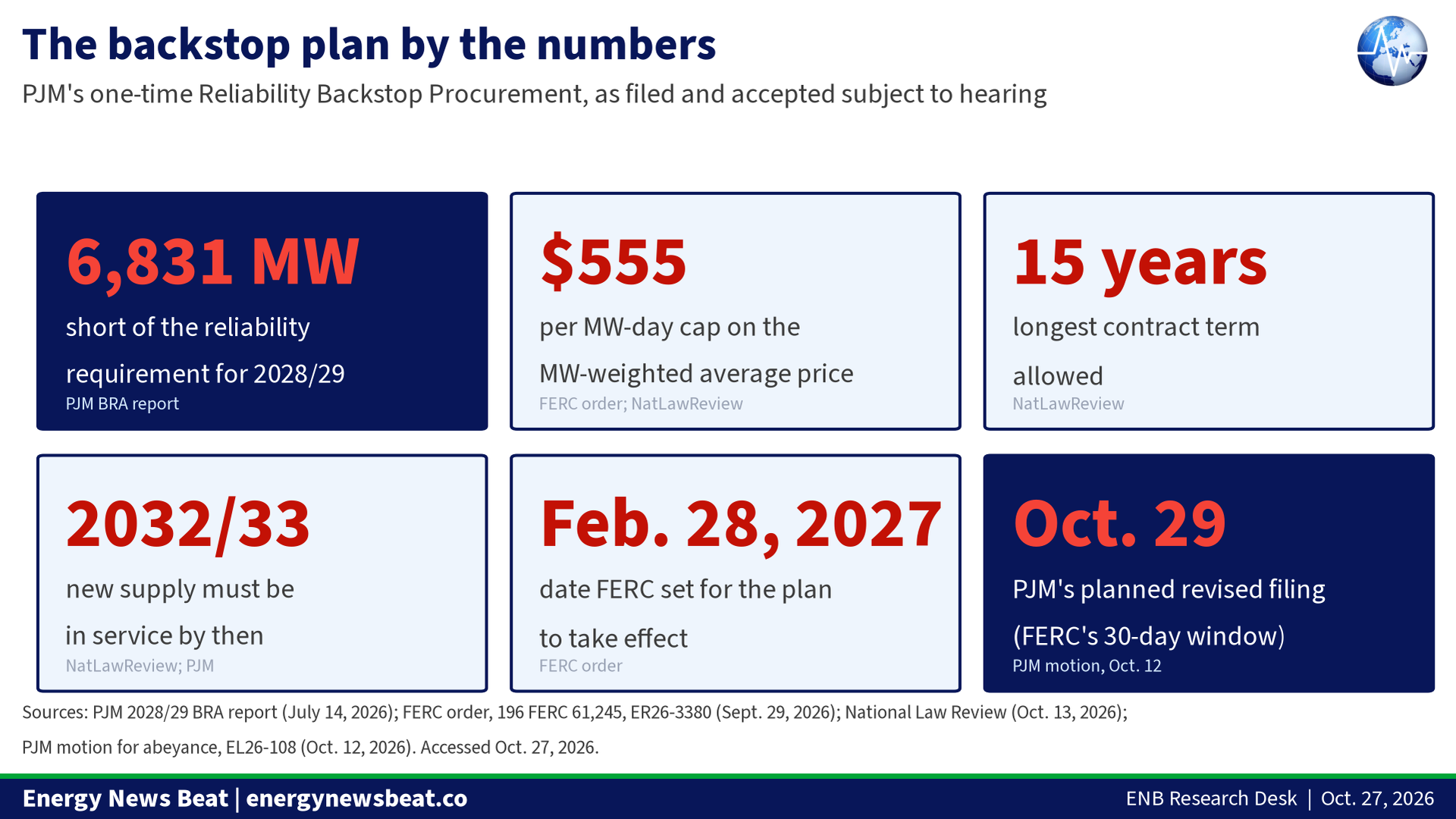
PJM’s last capacity auction came up 6,831 MW short of what it needs for reliability in 2028/29. Its answer is a one-time Reliability Backstop Procurement for about 6.8 GW of new supply (Utility Dive).
On Sept. 29, FERC accepted the plan but suspended it for five months, largely over who pays, plus collateral and transmission-owner exit rules. FERC said PJM’s cost allocation “may be unjust and unreasonable.”
The Department of Energy filed a rare statement saying large loads, “not American households,” must fund the power their projects need. Utility Dive says it appears to be DOE’s first such FERC filing in at least five years.
PJM has said it will file a revised plan by Oct. 29. The result matters to customers in 13 states and D.C.
PJM runs the grid from New Jersey to Illinois. For two auctions in a row, it has failed to buy all the power plants it says it needs, and FERC points to the surge of data centers and other large loads. Now the fight is over who pays for the fix. PJM says it will file its fix with federal regulators on Thursday, inside a 30-day window FERC offered.
How we got here
PJM pays power plants to be ready to run through its capacity auction. The price was $28.92/MW-day for 2024/25. It then went to $269.92, $329.17, and $333.44, and the 2028/29 auction cleared at the $325.00 cap. The total cost went from $2.2 billion to $16.4 billion a year.
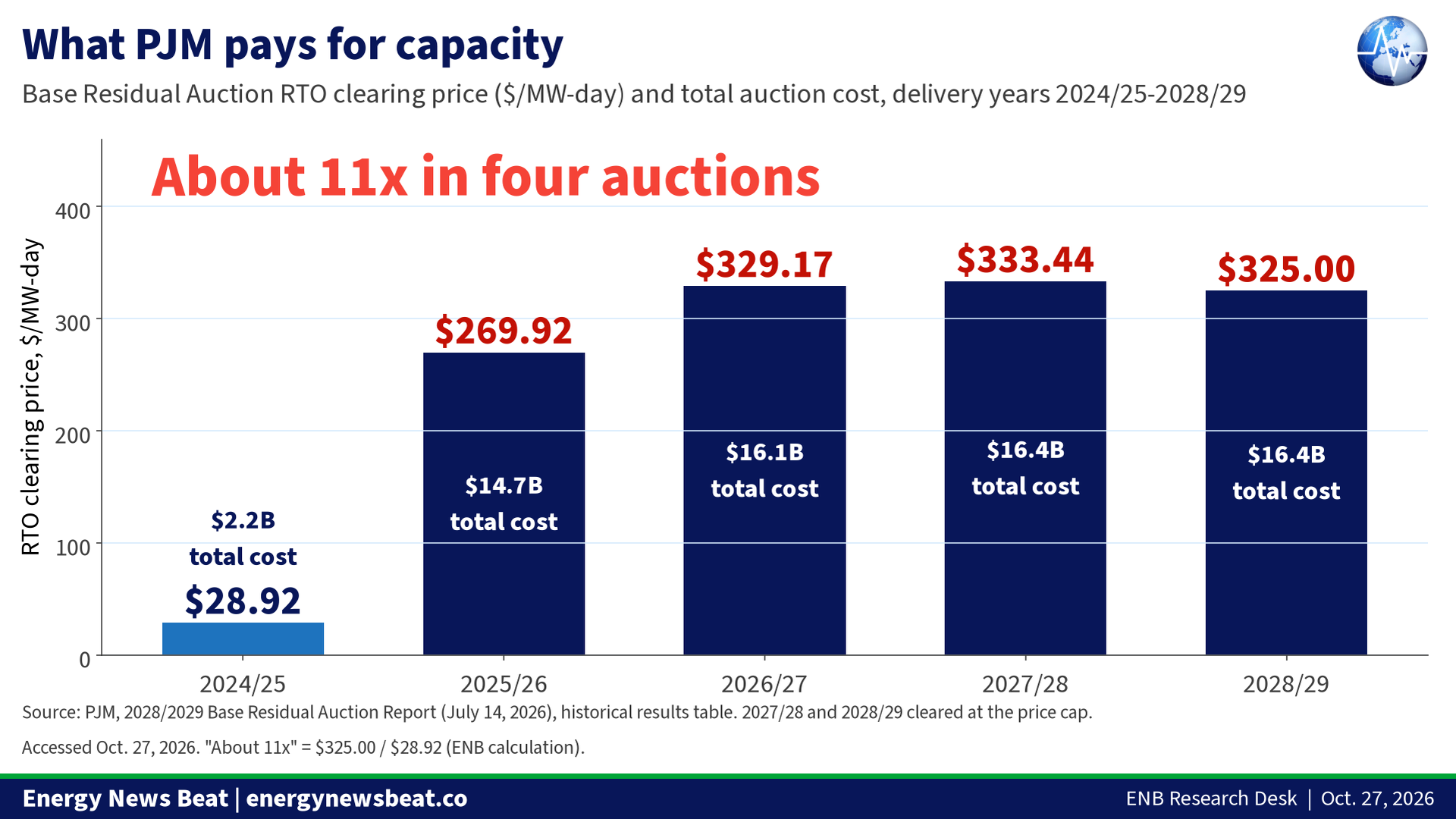
Even at the cap, the 2028/29 auction bought 149,181.6 MW, which was 6,831.3 MW short. The cleared reserve margin was 14.4% against a 20% target. FERC said the market “has failed to keep pace with the unprecedented influx of large load.”
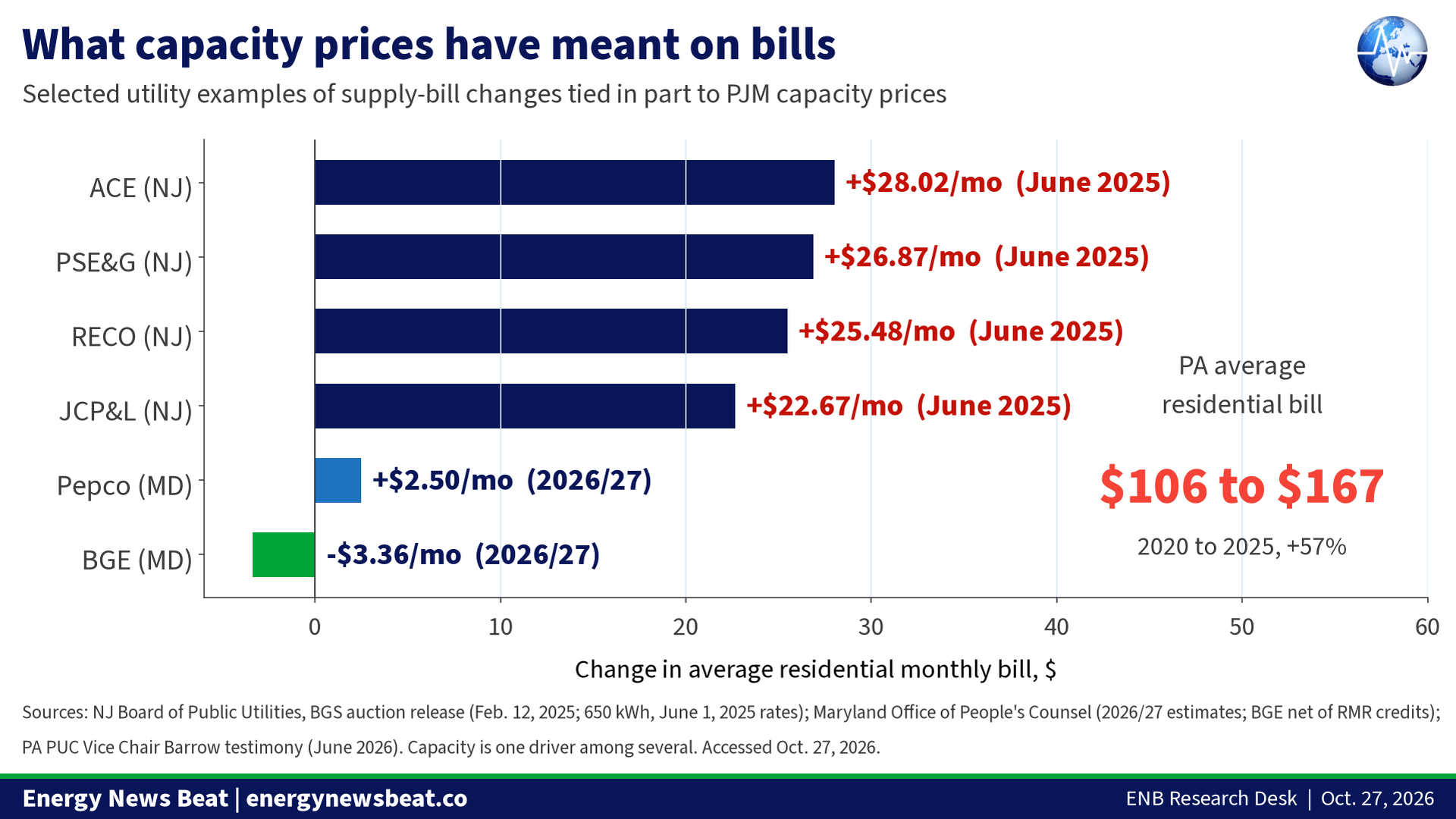
Capacity costs end up on household supply bills. In June 2025, New Jersey’s state utility board said PJM capacity prices were “the main driver” of increases of $22.67 to $28.02 a month. In Pennsylvania, June 2026 price-to-compare changes included +10.3% at West Penn and +11.88% at Penelec. PA PUC Vice Chair Kimberly Barrow testified the average residential bill rose from $106.03 in 2020 to $166.73 in 2025. Maryland’s consumer advocate expects a +$2.50/month change for Pepco customers in 2026/27, while BGE customers see a $3.36 drop after credits.
The backstop plan by the numbers
PJM would run a one-time, pay-as-bid auction for new supply that must be online by June 1, 2032. The MW-weighted average price is capped at $555/MW-day, and contracts can run up to 15 years. Under the original plan, costs went to zones and then to load-serving entities pro rata (PJM).
In practice, that spreads the cost across all customers in each zone. The same who-pays fight over data centers also plays out on the transmission side, which ENB covered in Who Pays for the Wires?
If the full 6,831 MW cleared at the $555 cap, the bill would be about $1.38 billion a year, or about $20.8 billion over 15 years. That is our ceiling estimate, before offsetting revenue the new plants would earn in PJM’s regular capacity auction, not a forecast. The real target will be lower after offsets, and the price may be well under the cap.
Who should pay: FERC and DOE
FERC said “it appears some large loads may never have been accounted for” as load adjustments, so households could end up paying for data center growth. It also questioned an opt-out for co-ops and munis and the $1.5 million-per-MW collateral. It set a paper hearing and signaled it would likely pause the hearing’s briefing if PJM refiled within 30 days.
“Large electric energy loads—not American households or other business ratepayers—must fund the electric energy generation and related infrastructure that such new large load projects require.” (U.S. Department of Energy, Oct. 7 filing)
PJM previewed its fix at an Oct. 22 stakeholder meeting. Costs would follow each zone’s share of large-load growth from 2026/27 to 2028/29, based on firm service agreements. Collateral would drop to 40% of the discounted obligation, about $0.68 million per MW in PJM’s example. The co-op and muni opt-out would go away, and the bid window would move to March 1-22, 2027.
The Texas comparison
Texas took a different route. SB 6 sets rules for loads of 75 MW or more. They include requiring some large loads to use backup generation or curtail during grid emergencies. The voter-approved Texas Energy Fund offers 20-year loans at 3%. It has signed 9 gas plant loans for 5,446 MW and $4.1 billion. [ENB ANALYSIS] That puts the cost on the state treasury, not on capacity charges in monthly bills. Texas has no capacity market, so the comparison is imperfect.
Consumer and investor views
For consumers: The cost allocation is the key point. Under PJM’s revised approach, zones with the most data center growth would pay the most, which should shield households in slower-growing zones. The final allocation inside each zone will be up to state regulators and utilities.
For investors: A 15-year contract at up to $555/MW-day is a strong signal to build new gas and other firm power. The sticking points are the March 2027 timeline and the data center developers who would carry more of the cost.
Caveats and the other side
- Large-load forecasts fell from 14.8 GW to 6.8 GW in one protest’s telling (FERC order). If those forecasts are too high, the backstop could buy more than is needed.
- Capacity is only part of a bill. Energy prices, transmission and state policy also move rates, and the examples above mix years and utilities.
- The backstop is not a done deal. FERC can still impose its own version in EL26-108.
What to watch Thursday, Oct. 29
· Whether PJM files on time, and the final cost-allocation formula.
· How the new target is recalculated, and how much bilateral deals reduce it.
· Whether FERC pauses the paper hearing, and whether states, consumer advocates or data center groups protest.
· The Ratepayer Protection Pledge signers in PJM: AEP, Dominion, Exelon, FirstEnergy and others (Utility Dive).
Stu’s Take
Stu’s Take (ENB opinion)
PJM capacity went from $28.92 to $325 a MW-day in four auctions, and households have been paying for it. New Jersey bills went up as much as $28.02 a month in one year.
DOE got this right: whoever builds the data center should build, bring or buy the power. Charging large loads for the 6,831 MW gap is fair. A backstop that could run up to $555/MW-day for 15 years should not land on households.
Texas used $4.1 billion in state loans for 5,446 MW of gas plants, through the state budget rather than a capacity charge on bills. PJM states should take not
We have several Ginormous Podcasts rolling out. Charlie Garcia, Larry Schweikart, and David Blackmon are coming on later this week, and next week we have Steve Reese, Rey Trevino, and Senator Allan Armstrong on a huge panel.
We have launched Market Watch and are setting up federal and state key legislation and regulatory ruling trackers. We will be reporting on key stories impacting consumers and investors. Paid Energy News Beat Subscribers can request research and articles on specific projects impacting their local communities.
Check out the World’s Greatest Podcast Show Notes at EnergyNewsBeat.co or EnergyNewsBeat.com. And subscribe to: The Energy News Beat Substack.
The post Who Pays for the Data Center’s Power Plant? PJM Owes FERC an Answer Thursday appeared first on Energy News Beat.