Poland expects to sign a Westinghouse–Bechtel contract for three AP1000 reactors by the end of the first quarter of 2027. The official investment figure is about EUR 42 billion. U.S. export credit is already in the deal.
On Friday morning, James Hopf, a retired nuclear engineer, wrote that Poland would soon sign a roughly $50 billion contract with Westinghouse and Bechtel to build its first nuclear plant — three AP1000 reactors, 3,750 megawatts, with the first unit due in 2036. He had the story right, with one important caveat. The contract is not signed yet.
Polskie Elektrownie Jądrowe, or PEJ, the state company building the plant, is in the final stages of negotiating an engineering, procurement and construction contract. PEJ’s president, Marek Woszczyk, said, in The Jerusalem Post’s account of a Dow Jones Newswires interview, that a signing by the end of the first quarter of 2027 now looks most likely, later than a prior year-end 2026 hope. He said the delay would not change the construction schedule.
That is still a U.S. export story worth taking seriously. Energy security starts at home, and energy dominance is displayed through your exports. A proven American reactor, a U.S. constructor, and U.S. export credit, on Poland’s Baltic coast, is how that line gets measured — once the papers are actually signed.
The plant, and where it actually stands
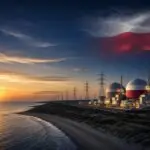
The site is Lubiatowo-Kopalino, on the Pomeranian coast. The design is three Westinghouse AP1000 units, a combined 3,750 megawatts, built with Bechtel. PEJ, which is wholly owned by the Polish State Treasury, has no operating commercial nuclear plant today. This would be Poland’s first.
The official schedule, restated in PEJ’s March 31, 2026, construction-license filing and in Woszczyk’s interview, calls for commercial operation in 2036, 2037 and 2038. “First nuclear concrete,” the formal start of construction, is targeted for the fourth quarter of 2028. Those are targets, not a promise of on-time delivery. Earlier Polish aims had pointed to a first unit around 2033.
Main commercial terms of the EPC were agreed on Sept. 23, 2026. A construction-license application of more than 40,000 pages is already with Poland’s National Atomic Energy Agency, the PAA; the agency has up to 24 months to review it, not counting time for supplements. On Nov. 19, PEJ and the consortium signed a letter of intent to extend engineering work and order the next batch of long-lead parts. That is a framework, not the EPC.
Hopf suggested a first-of-a-kind plant would cost more because Poland would have to “create a regulatory regime.” The newcomer costs are real. The blank-sheet picture is not. The PAA already exists, and the construction-license application is on file.
Three numbers, kept apart
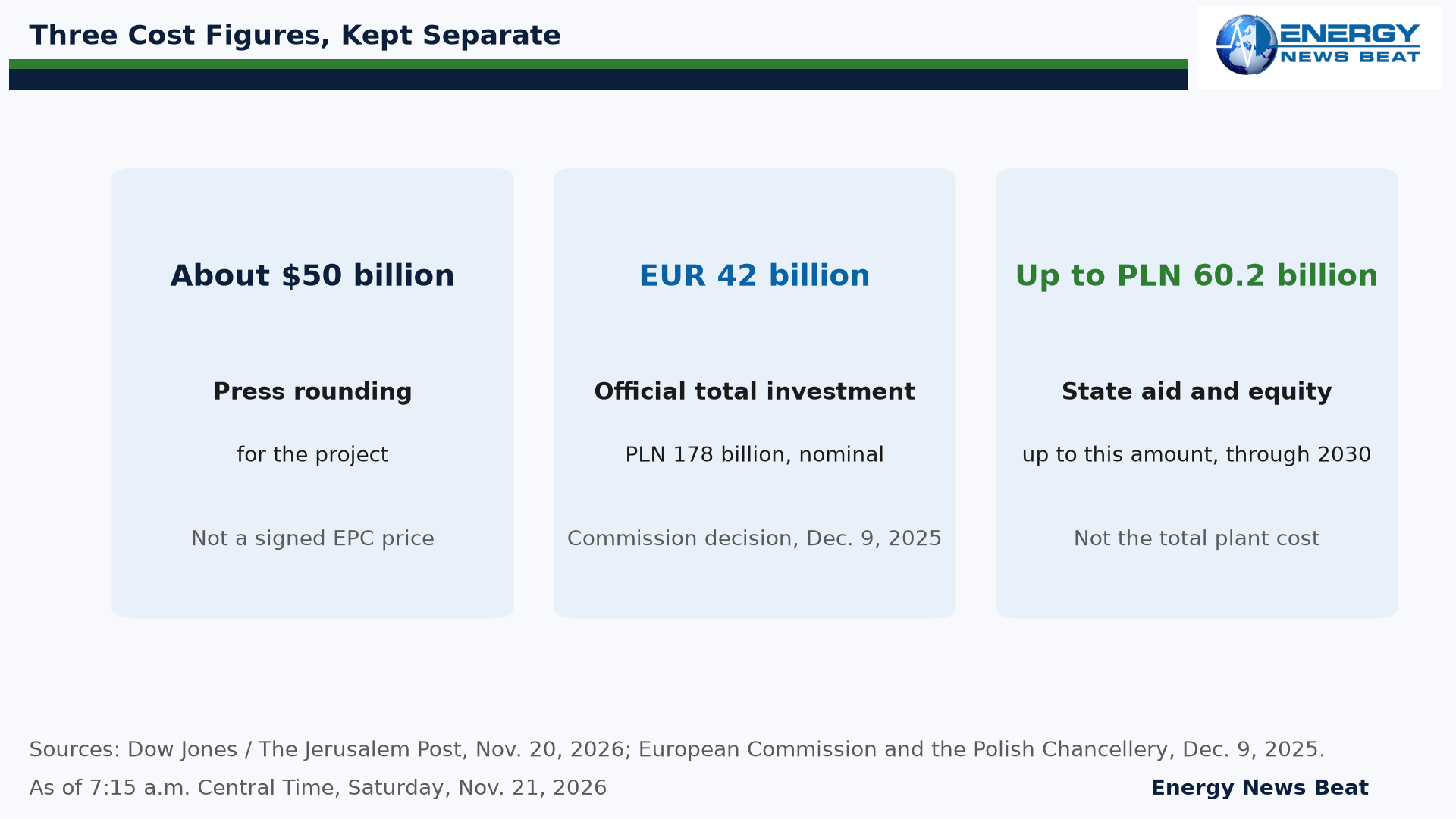
The figure traveling with this story is a “roughly $50 billion project,” in the Dow Jones interview. That is press rounding for the project. It is not a disclosed, firm price on a signed EPC contract.
The official number sits next to it, in different units. When the European Commission approved Poland’s state-aid package on Dec. 9, 2025, it put nominal total investment costs at about EUR 42 billion, or PLN 178 billion. Keep a third figure out of that bucket: public support of up to PLN 60.2 billion through 2030 is the state-aid and equity package, not the cost of the plant.
PEJ has said the financing plan is about 70 percent debt and 30 percent state-budget equity, with a 40-year two-way contract for difference and a full state guarantee of project debt. The Commission approved that structure after Poland shortened the contract for difference from 60 years to 40. Who ultimately pays is Polish taxpayers and electricity customers, not U.S. ratepayers.
Washington is already in the deal
U.S. public finance is already attached, which is the export mechanism. PEJ cites a $17.8 billion letter of interest from the U.S. Export-Import Bank. On Jan. 29, 2026, EXIM signed a first direct-loan agreement under its Engineering Multiplier Program — a facility that supports pre-construction engineering by Westinghouse and Bechtel. The dollar amount of that first loan was not disclosed. It is a down payment on export credit, not the $17.8 billion letter converted into a construction loan.
A DFC letter of interest, dated Nov. 12, 2024, covers the equivalent of more than PLN 4 billion, and PEJ says 11 export-credit agencies have letters totaling more than PLN 100 billion. Those are interest, not closed loans.
The Energy Department, in an April 2025 release, said construction “will generate almost 40,000” U.S. manufacturing, engineering and related jobs. That is a projection; the release does not show the method. The same statement said the initiative “could ultimately accommodate” six AP1000s at two sites. A second Polish plant is still in talks. It is not a signed contract.
The export is also a fuel-cycle story
This is a contest over who builds the next wave of large reactors, and who fuels them. At this week’s Partnership for Transatlantic Energy Cooperation meeting in Poland, Poland’s energy minister, Miłosz Motyka, said, “Russia used energy sources like a weapon,” and that there was no going back to doing business with Moscow.
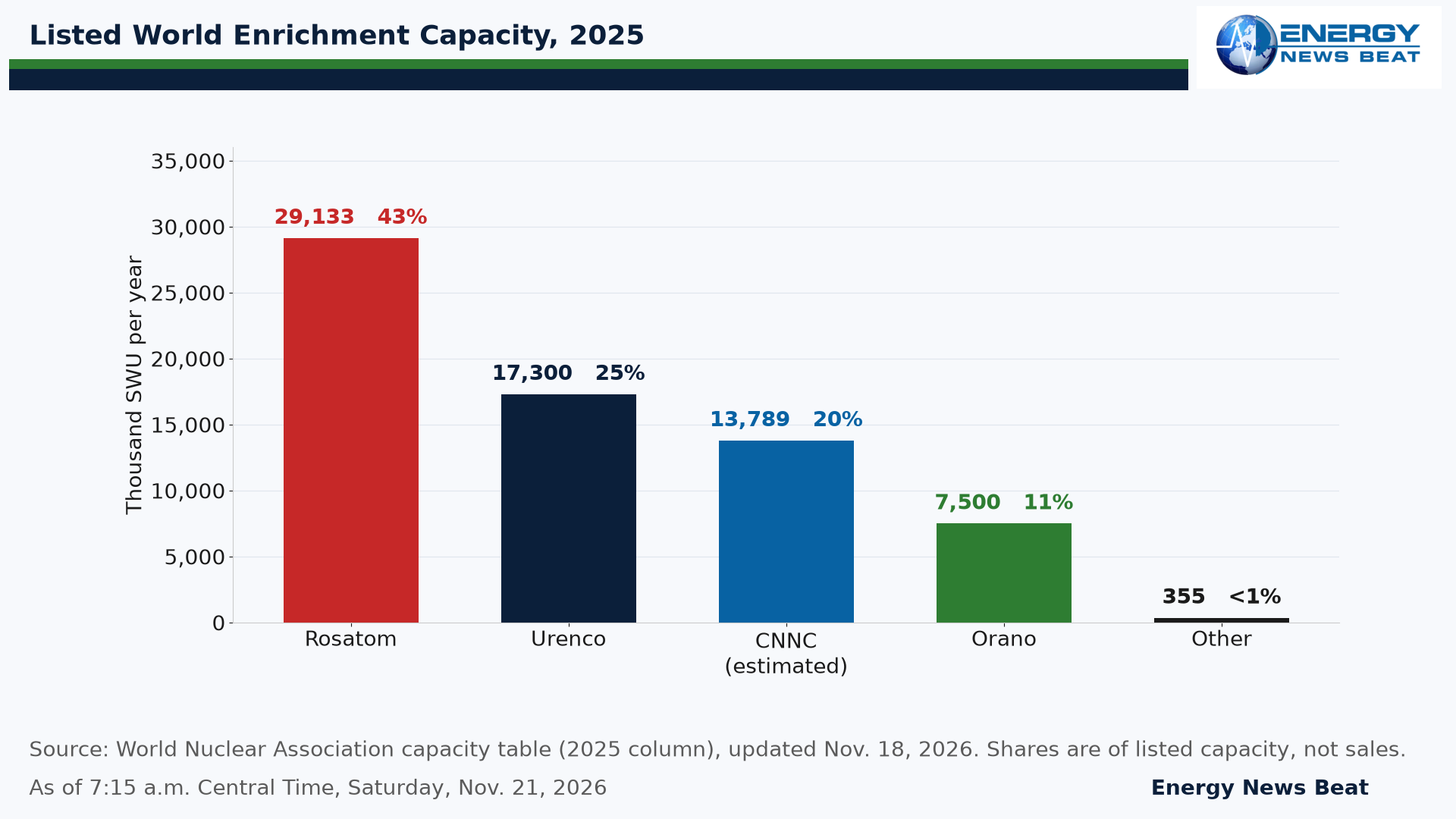
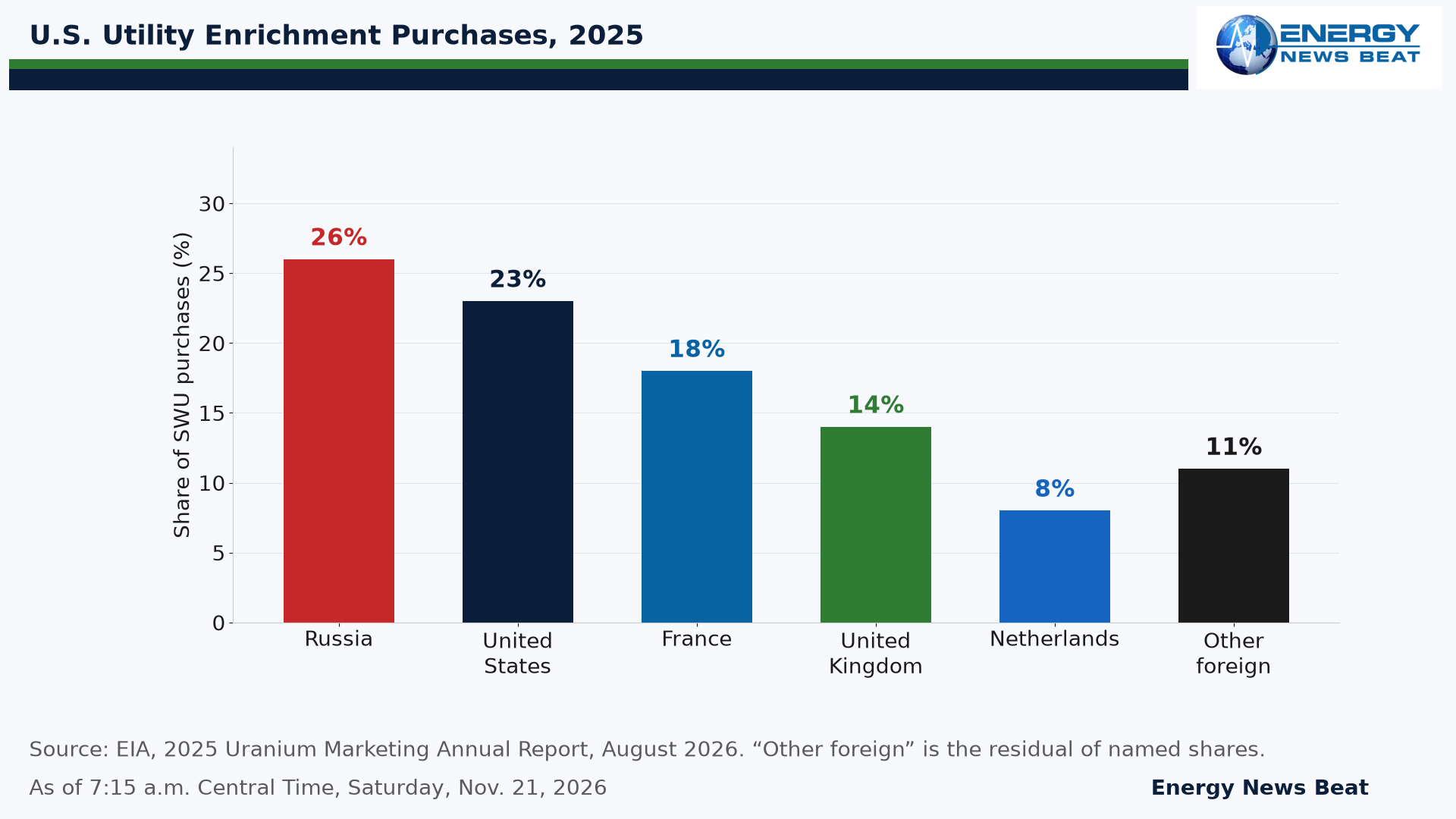
The fuel-cycle numbers explain the urgency. In 2025, U.S. utilities still bought 26 percent of their enrichment services from Russia, according to the Energy Information Administration’s Uranium Marketing Annual Report, published in August 2026. A 2024 law banned imports of unirradiated Russian low-enriched uranium from Aug. 11, 2024, but allowed Energy Department waivers through no later than Jan. 1, 2028, which is why that share can still look large. Worldwide, the World Nuclear Association’s 2025 capacity table, updated Nov. 18, 2026, puts Rosatom at about 43 percent of listed enrichment capacity. That is a capacity share, not a sales share.
PEJ says it plans to buy fuel from several suppliers and store it on site so the plant is never dependent on a single source. Woszczyk said the AP1000 was chosen because it is proven technology and because Poland wants to strengthen ties with the United States.
The Vogtle comparison, with Hopf’s own caveat
Hopf’s cost comparison is in the right neighborhood only with the caveat he already supplied. If the $50 billion figure is all or most of the total cost, he wrote, the cost per reactor is similar to the U.S. Vogtle units — and “we’re comparing an initial cost estimate vs. Vogtle’s final cost.”
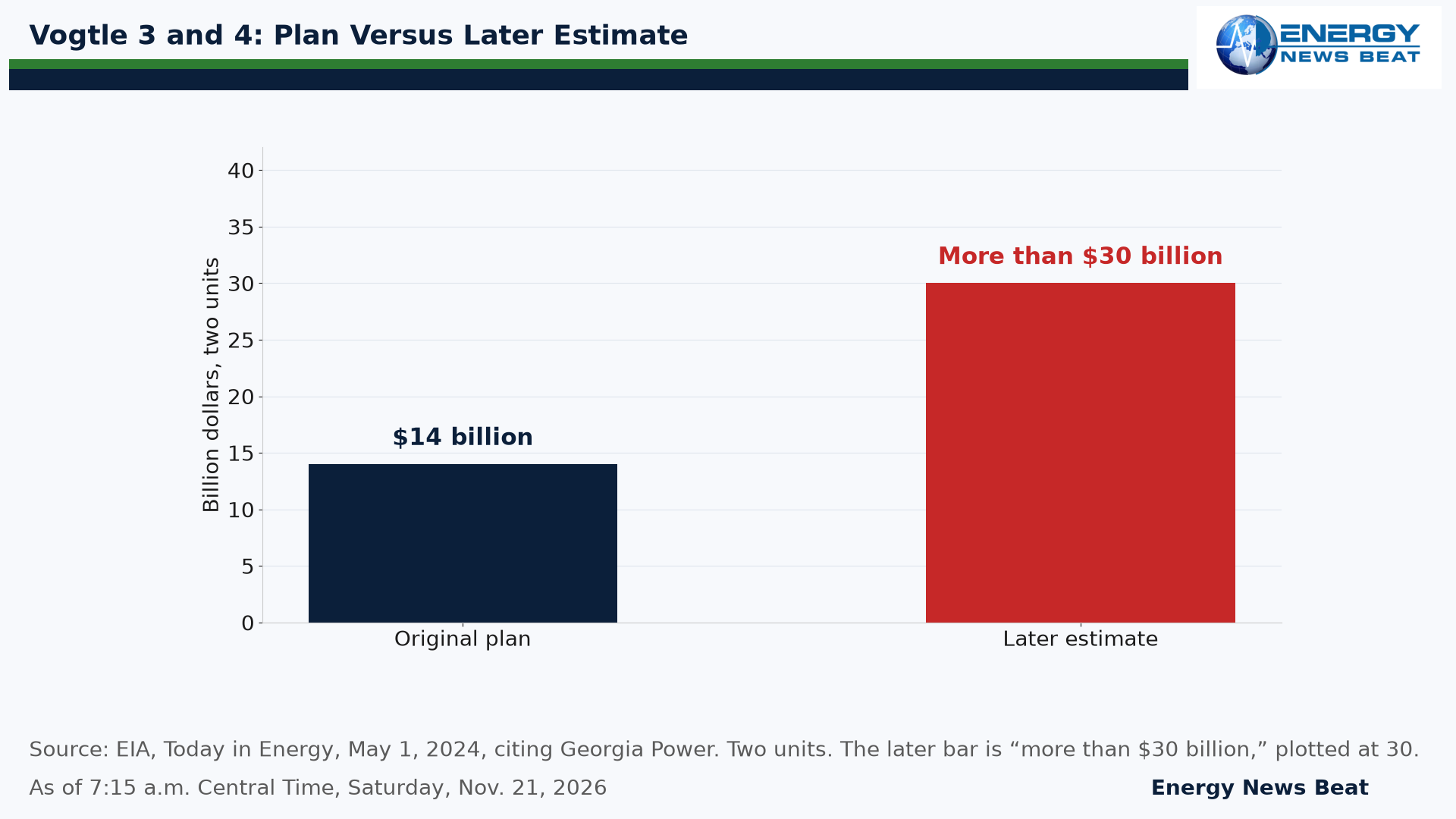
The Energy Information Administration reported on May 1, 2024, that Georgia Power estimated the total project cost for Vogtle units 3 and 4 at more than $30 billion for two units, against an original $14 billion estimate. Unit 3 entered commercial operation on July 31, 2023; Unit 4 on April 29, 2024. A simple $50 billion divided by three is about $16.7 billion per unit, near $30 billion-plus divided by two. Financing, inflation, scope and first-of-a-kind effects are not lined up.
Whether later AP1000 experience will keep Poland off Vogtle’s overrun path is an open question, not a fact. It is a fair one to keep asking after the contract is signed.
Consumer View and Investor View
For U.S. households, this plant will not show up on the electric bill. The consumer stake is whether a revived export pipeline supports American manufacturing, engineering and fuel-cycle work that also matters at home. Public support for nuclear is near multi-decade highs: Gallup, in a March 2025 survey published April 9, found 61 percent of U.S. adults in favor of using nuclear energy for electricity. Pew Research Center, in a spring 2025 survey published Oct. 16, found 59 percent in favor of more nuclear plants, up from 43 percent in 2020.
In Poland, the bill is local. A ministry-commissioned ASM Research survey, published Jan. 26, 2026, reported 91.9 percent support; that is a sponsored poll, not an independent series like Gallup or Pew. PEJ says the Commission-verified financial model assumes a strike price of less than PLN 500 per megawatt-hour.
For investors, Westinghouse is not a public company. Cameco, which trades as CCJ in New York, and Brookfield closed their purchase on Nov. 7, 2023. Cameco owns 49 percent, Brookfield 51 percent. Cameco’s equity check was $2.1 billion, on an $8.2 billion enterprise value, with Westinghouse retaining $3.8 billion of debt. A signed Poland EPC would be commercially relevant to Westinghouse and therefore to Cameco. An unsigned one is not an earnings event. Bechtel is privately held. Not investment advice.
Timeline
Key dates for Poland’s first nuclear plant, U.S. export credit, and the Vogtle comparison. Times are Central where a clock time is given.
2009 / March 2013. Site construction begins at Vogtle units 3 and 4 (2009); first nuclear concrete for Unit 3 is poured in March 2013.
Oct. 19–22, 2020. The United States and Poland sign a civil nuclear cooperation intergovernmental agreement, separate from the U.S.–Euratom 123 agreement that covers Poland.
November 2022. Poland selects the Westinghouse AP1000 for its first nuclear plant.
July 31, 2023. Vogtle Unit 3 enters commercial operation.
Nov. 7, 2023. Cameco (49 percent) and Brookfield (51 percent) close their purchase of Westinghouse.
April 29, 2024. Vogtle Unit 4 enters commercial operation. EIA later reports Georgia Power’s total project-cost estimate at more than $30 billion for two units, versus an original $14 billion plan.
Aug. 11, 2024. A U.S. ban on imports of unirradiated Russian low-enriched uranium takes effect, with Energy Department waivers allowed through Jan. 1, 2028.
Nov. 12–13, 2024. The U.S. International Development Finance Corporation signs a letter of interest for the equivalent of more than PLN 4 billion. PEJ later cites a $17.8 billion EXIM letter of interest.
April 28, 2025. PEJ, Westinghouse and Bechtel sign an Engineering Development Agreement in Warsaw.
Dec. 9, 2025. The European Commission approves Poland’s state-aid package. Official nominal total investment: about EUR 42 billion, or PLN 178 billion.
Jan. 29, 2026. EXIM signs a first Engineering Multiplier Program direct-loan agreement with PEJ. The amount is undisclosed. The $17.8 billion figure remains a letter of interest.
March 31, 2026. PEJ files a construction-license application with the PAA. Official construction start: first nuclear concrete in the fourth quarter of 2028; commercial operation targeted for 2036, 2037 and 2038.
Sept. 23, 2026. Westinghouse, Bechtel and PEJ agree on the main commercial terms of the EPC and hope to finish remaining terms by year-end 2026.
Nov. 19, 2026. PEJ and the consortium sign a letter of intent on additional long-lead procurement. In the same period, Woszczyk tells Dow Jones that a signing by the end of the first quarter of 2027 now looks most likely.
Nov. 20, 2026, 9:34 a.m. Central. James Hopf posts about a roughly $50 billion Westinghouse–Bechtel contract and later links a Jerusalem Post rewrite of the Dow Jones interview.
Caveats and Criticism
The EPC contract is not signed. Treat the end of the first quarter of 2027 as PEJ’s current most-likely date, not a closing. The “roughly $50 billion” figure is press rounding for the project; the Commission’s official nominal total investment is about EUR 42 billion, or PLN 178 billion; up to PLN 60.2 billion is state aid and equity, not total cost. EXIM’s $17.8 billion is a letter of interest; the January 2026 loan is a separate, undisclosed engineering-phase facility. The Energy Department’s “almost 40,000” U.S. jobs figure is a projection, and its April 2025 line that construction would begin in 2026 is out of date; PEJ’s official start is first nuclear concrete in the fourth quarter of 2028. The “about 10 percent of Poland’s electricity” line in coverage of the interview is a forecast, not a measured share of today’s demand. Vogtle’s “more than $30 billion” is Georgia Power’s estimate as reported by EIA in May 2024 for the two-unit project, not a later slice of one owner’s costs.
Stu’s Take
Energy security starts at home, and energy dominance is displayed through your exports. A three-reactor American plant on Poland’s Baltic coast is that idea in steel and concrete — or it will be, once the contract is actually signed.
The project is real. The technology is chosen. A construction-license application is already in. The Export-Import Bank has a $17.8 billion letter of interest and has already written a first engineering loan. What is not signed is the engineering, procurement and construction contract itself. PEJ says the end of the first quarter of 2027 is now the most likely date.
Call the press figure a roughly $50 billion project, and keep the official number next to it: about EUR 42 billion in total investment, approved in Brussels. Do not confuse that with the state-aid envelope. And do not treat an initial estimate as Vogtle’s final bill. Exporting nuclear is a good thing. Signing is still the test.
Appendix A. Sources
Primary and contemporaneous sources used for this article, with access dates. Project status and the unsigned EPC follow PEJ releases and Marek Woszczyk’s Dow Jones interview as rewritten by The Jerusalem Post on Nov. 20, 2026. Official investment and state-aid figures follow the European Commission decision of Dec. 9, 2025. Enrichment shares follow EIA’s 2025 Uranium Marketing Annual Report and the World Nuclear Association capacity table updated Nov. 18, 2026. Accessed Nov. 21, 2026.
- James Hopf, @HopfJames, X post, Nov. 20, 2026, 9:34 a.m. Central, and a follow-up post 21 seconds later with the article link. Accessed Nov. 21, 2026. https://x.com/HopfJames/status/2123802061951422552
- The Jerusalem Post Staff, “Poland expects to sign $50 billion nuclear plant deal with Westinghouse, Bechtel early next year,” Nov. 20, 2026, a rewrite of a Dow Jones Newswires interview with Marek Woszczyk. Accessed Nov. 21, 2026. https://www.jpost.com/international/article-915555
- Polskie Elektrownie Jądrowe, “Polskie Elektrownie Jądrowe applied for a construction license to build a nuclear power plant in Pomerania,” March 31, 2026. Accessed Nov. 21, 2026. https://pej.pl/en/press-center/news/polskie-elektrownie-jadrowe-applied-for-a-construction-license-to-build-a-nuclear-power-plant-in-pomerania/
- Westinghouse, “Westinghouse-Bechtel and PEJ Agree on Main Commercial Terms to Deliver First Polish Nuclear Power Plant,” Sept. 23, 2026. Accessed Nov. 21, 2026. https://info.westinghousenuclear.com/news/westinghouse-bechtel-and-pej-agree-on-main-commercial-terms-to-deliver-first-polish-nuclear-power-plant
- Polskie Elektrownie Jądrowe, “PEJ signed a letter of intent with the Westinghouse-Bechtel consortium regarding contracts for the key components of the Lubiatowo-Kopalino nuclear power plant,” Nov. 19, 2026. Accessed Nov. 21, 2026. https://pej.pl/en/press-center/news/pej-signed-a-letter-of-intent-with-the-westinghouse-bechtel-consortium-regarding-contracts-for-the-key-components-of-the-lubiatowo-kopalino-nuclear-power-plant/
- European Commission, IP/25/2963, state-aid decision on Poland’s nuclear power plant, Dec. 9, 2025. Official German-language text used for the nominal total investment figure of about EUR 42 billion (PLN 178 billion). Accessed Nov. 21, 2026. https://ec.europa.eu/commission/presscorner/api/files/document/print/de/ip_25_2963/IP_25_2963_DE.pdf
- Chancellery of the Prime Minister of Poland, “We have a green light for the construction of a nuclear power plant in Poland,” Dec. 9, 2025, including the up-to-PLN 60.2 billion public-support envelope. Accessed Nov. 21, 2026. https://www.gov.pl/web/premier/mamy-zielone-swiatlo-na-budowe-elektrowni-jadrowej-w-polsce
- Polskie Elektrownie Jądrowe, “Green light from the European Commission for nuclear power in Poland,” Dec. 9, 2025. Accessed Nov. 21, 2026. https://pej.pl/en/press-center/news/green-light-from-the-european-commission-for-nuclear-power-in-poland-brussels-agrees-to-state-aid-for-the-nuclear-power-plant-in-pomerania/
- Polskie Elektrownie Jądrowe, “PEJ receives interest in financing for the first Polish nuclear power plant,” Nov. 13, 2024, on a DFC letter of interest of more than PLN 4 billion signed Nov. 12, and an earlier EXIM declaration for the equivalent of about PLN 70 billion. Accessed Nov. 21, 2026. https://pej.pl/en/press-center/news/pej-receives-interest-in-financing-for-the-first-polish-nuclear-power-plant/
- Export-Import Bank of the United States, “EXIM Powers American Nuclear Exports to Poland, Supporting U.S. Jobs and Energy Dominance,” dated Jan. 30, 2026, on the Jan. 29 Engineering Multiplier Program direct-loan agreement. The loan amount is not disclosed. Accessed Nov. 21, 2026. https://www.exim.gov/news/exim-powers-american-nuclear-exports-poland-supporting-jobs-and-energy-dominance
- Polskie Elektrownie Jądrowe, “PEJ signed its first loan agreement with US EXIM,” Jan. 30, 2026, including the previously issued USD 17.8 billion EXIM letter (PEJ calls it a letter of intent). Accessed Nov. 21, 2026. https://pej.pl/en/press-center/news/pej-signed-its-first-loan-agreement-with-us-exim/
- U.S. Department of Energy, “United States Signs Agreement to Advance American Civil Nuclear Deal in Poland,” April 28, 2025, including the “almost 40,000” U.S. jobs projection and a possible six-unit, two-site program. Accessed Nov. 21, 2026. https://www.energy.gov/articles/united-states-signs-agreement-advance-american-civil-nuclear-deal-poland
- U.S. Energy Information Administration, “Plant Vogtle Unit 4 begins commercial operation,” Today in Energy, May 1, 2024, reporting Georgia Power’s Vogtle 3 and 4 cost estimate of more than $30 billion versus an original $14 billion plan. Accessed Nov. 21, 2026. https://www.eia.gov/todayinenergy/detail.php?id=61963
- Georgia Power, “Vogtle Unit 4 enters commercial operation,” April 29, 2024. Accessed Nov. 21, 2026. https://www.georgiapower.com/news-hub/press-releases/vogtle-unit-4-enters-commercial-operation.html
- U.S. Energy Information Administration, 2025 Uranium Marketing Annual Report, published August 2026. Accessed Nov. 21, 2026. https://www.eia.gov/uranium/marketing/pdf/umar.pdf
- World Nuclear Association, “Uranium Enrichment,” capacity table (2025 column), page updated Nov. 18, 2026. Accessed Nov. 21, 2026. https://world-nuclear.org/information-library/nuclear-fuel-cycle/conversion-enrichment-and-fabrication/uranium-enrichment
- U.S. Department of Energy, “Biden-Harris Administration Enacts Law Banning Importation of Russian Uranium,” May 14, 2024, on the Aug. 11, 2024, effective date and waivers through no later than Jan. 1, 2028. Accessed Nov. 21, 2026. https://www.energy.gov/articles/biden-harris-administration-enacts-law-banning-importation-russian-uranium
- Cameco, “Cameco and Brookfield complete acquisition of Westinghouse Electric Company,” Nov. 7, 2023. Accessed Nov. 21, 2026. https://www.cameco.com/media/news/cameco-and-brookfield-complete-acquisition-of-westinghouse-electric-company
- Gallup, “Nuclear Energy Support Near Record High in U.S.,” April 9, 2025, reporting a March 3–16, 2025, survey. Accessed Nov. 21, 2026. https://news.gallup.com/poll/659180/nuclear-energy-support-near-record-high.aspx
- Pew Research Center, “Support for expanding nuclear power is up in both parties since 2020,” Oct. 16, 2025, reporting an April 28–May 4, 2025, survey. Accessed Nov. 21, 2026. https://www.pewresearch.org/short-reads/2025/10/16/support-for-expanding-nuclear-power-is-up-in-both-parties-since-2020/
- Polish Ministry of Energy, commissioned ASM Research survey, published Jan. 26, 2026. Accessed Nov. 21, 2026. https://www.gov.pl/web/energia/energetyka-jadrowa-z-niezwykle-silnym-mandatem-spolecznym-ponad-90-proc-polek-i-polakow-stawia-na-atom
- U.S. Department of Energy / NNSA, “123 Agreements for Peaceful Cooperation,” page updated July 11, 2025, with a June 18, 2026, footer note, used only for background on the U.S.–Euratom 123 agreement covering Poland. Accessed Nov. 21, 2026. https://www.energy.gov/nnsa/123-agreements-peaceful-cooperation
- U.S.–Poland civil nuclear cooperation intergovernmental agreement, signed Oct. 19–22, 2020. Accessed Nov. 21, 2026. https://www.state.gov/wp-content/uploads/2021/05/21-224-Poland-Nuclear-Energy.pdf
- Idaho National Laboratory, INL/RPT-25-84701, “AP1000 Lessons,” June 12, 2025, for March 2013 first nuclear concrete at Vogtle Unit 3 and later owner-cost slices of about $31 billion (2024 dollars, excluding financing) and an overall figure approaching $35 billion. Accessed Nov. 21, 2026. https://sai.inl.gov/content/uploads/29/2025/06/M3_SAI-AP1000_Lessons_Rev6-nocomments-002.pdf
- Westinghouse, “Westinghouse Signs Contract for Engineering of AP1000 Reactors in Bulgaria,” Nov. 4, 2024. Accessed Nov. 21, 2026. https://info.westinghousenuclear.com/news/westinghouse-signs-contract-for-engineering-of-ap1000-reactors-in-bulgaria
- GE Vernova, “Deployment of BWRX-300 small modular reactor in Poland: major step forward in design development,” Feb. 24, 2026. Accessed Nov. 21, 2026. https://www.gevernova.com/news/press-releases/deployment-bwrx-300-small-modular-reactor-poland-major-step-forward-design-development
- World Nuclear News, “PEJ signs first loan agreement with US export credit agency,” Jan. 30, 2026, on PEJ as a special-purpose vehicle 100 percent owned by Poland’s State Treasury, the November 2022 AP1000 selection, and an earlier first-unit target of 2033. Accessed Nov. 21, 2026. https://www.world-nuclear-news.org/articles/pej-signs-first-loan-agreement-with-us-export-credit-agency
- Westinghouse, “Westinghouse Congratulates Energoatom on Start of AP1000 Work at Khmelnytskyi NPP,” April 15, 2024, on a 2022 memorandum for nine AP1000 reactors in Ukraine and Westinghouse VVER fuel deliveries. Accessed Nov. 21, 2026. https://info.westinghousenuclear.com/news/westinghouse-congratulates-energoatom-on-start-of-ap1000-work-at-khmelnytskyi-npp
Appendix B. Key excerpts
James Hopf, X, Nov. 20, 2026. “Poland will soon sign a ~$50 billion contract with Westinghouse and Bechtel to build its first nuclear plant. The plant would have three AP1000 reactors, and would produce 3,750 MW of power.” “If the $50 billion is all or most of the total cost, the cost per reactor is similar to that of the US Vogtle reactors.” “Then again, we’re comparing an initial cost estimate vs. Vogtle’s final cost.”
The Jerusalem Post, Nov. 20, 2026, citing Dow Jones / Woszczyk. Poland “expects to sign” a contract “early next year” with Westinghouse Electric and Bechtel. The piece describes a “roughly $50 billion project” and says PEJ is in the “final stages” of negotiating an EPC contract. Woszczyk said a signing “by the end of the first quarter of 2027 now looks most likely,” later than a prior hope of signing by the end of 2026, and that the delay would not affect the project’s timeline. Three AP1000 reactors, combined capacity 3,750 megawatts; first reactor scheduled online 2036, second 2037, third 2038. “Under current forecasts, the plant will provide about 10% of Poland’s electricity.”
European Commission, IP/25/2963, Dec. 9, 2025. The decision states nominal total investment costs (“nominale Gesamtinvestitionskosten”) of about EUR 42 billion (PLN 178 billion). The approved aid structure includes a 40-year two-way contract for difference, after Poland shortened that term from 60 years, a 100 percent state guarantee of project debt, and an equity injection on the order of 30 percent.
PEJ, March 31, 2026, construction-license application. PEJ applied to the PAA President for a construction license for the Lubiatowo-Kopalino plant, three AP1000 units totaling 3,750 MWe. The application is described as more than 40,000 pages, the first such application in the post-1989 history of Poland. Official construction start is first nuclear concrete in the fourth quarter of 2028; commercial operation targets remain 2036, 2037 and 2038. The PAA has up to 24 months to review the application, excluding time for supplements.
Export-Import Bank of the United States, Jan. 30, 2026. EXIM announced a direct-loan credit agreement with PEJ under the Engineering Multiplier Program, signed Jan. 29, 2026, to support pre-construction engineering by Westinghouse and Bechtel. The release does not state the dollar amount of this first loan. PEJ separately describes a $17.8 billion EXIM letter of interest for later phases.
U.S. Department of Energy, April 28, 2025. The department said project construction “will generate almost 40,000 well-paying U.S. manufacturing, engineering and related jobs that support the project,” and that the initiative “could ultimately accommodate a total of six AP-1000s across two sites.” The same release said “Actual construction is expected to begin in 2026,” a line that is out of date relative to PEJ’s later Q4 2028 first-nuclear-concrete date and is not used as the current official start.
EIA, Today in Energy, May 1, 2024. “Georgia Power now estimates the total cost of the project to be more than $30 billion.” The project was “Originally expected to cost $14 billion.” Unit 3 entered commercial operation on July 31, 2023; Unit 4 on April 29, 2024 (dates: Georgia Power).
EIA, 2025 Uranium Marketing Annual Report, August 2026. U.S. owners and operators purchased 12,710 thousand SWU in 2025 at an average $108.70 per SWU. U.S.-origin SWU were 23 percent; foreign-origin 77 percent. Foreign-origin included 26 percent from Russia (3,284 thousand SWU), 18 percent France, 14 percent United Kingdom, and 8 percent Netherlands.
World Nuclear Association, Uranium Enrichment, updated Nov. 18, 2026. 2025 capacities, thousand SWU per year: Rosatom 29,133; Urenco 17,300; CNNC 13,789 (estimated); Orano 7,500; other 355; total 68,076. Rosatom is about 43 percent of listed 2025 capacity. These are capacity shares, not sales shares.
Cameco, Nov. 7, 2023. Cameco and Brookfield completed the acquisition of Westinghouse. Cameco owns 49 percent, Brookfield 51 percent. Final enterprise value was $8.2 billion after working-capital adjustment; Westinghouse retained $3.8 billion of debt. Cameco’s 49 percent equity check was $2.1 billion.
Gallup, April 9, 2025, and Pew, Oct. 16, 2025. Gallup, March 3–16, 2025, n=1,002 adults, margin of error ±4 points: 61 percent favor the use of nuclear energy for U.S. electricity; 35 percent oppose. Pew, April 28–May 4, 2025, n=5,085 U.S. adults: 59 percent favor more nuclear power plants, up from 43 percent in 2020.
The post Energy Dominance, Measured in Exports: America’s $50 Billion Nuclear Bet in Poland appeared first on Energy News Beat.