
Russell Hardy did not wake up on October 6 and decide to scare a room full of energy executives. He runs Vitol, the biggest independent oil trader on the planet, and he was describing what his people are actually seeing when they try to move barrels.
The seven-month war involving the United States, Israel, and Iran started as a crude problem. It became a products problem. Now, he told the Energy Intelligence Forum in London, it is a shipping problem. More oil is leaving the Gulf than a few months ago—about 12 million barrels a day of crude and another 2 million of refined fuels, by his count—because the U.S. Navy opened a protected shuttle through the Strait of Hormuz. Buyers still cannot find enough ships. Charter rates have gone “pretty parabolic.” Refiners are the ones feeling it.
Then he said the line that traveled. Without that flow, “you do have that $200-a-barrel scenario.” Western inventories are already gone. “There aren’t any more inventories to drain in the West. We drained the available inventory.”
Brent was under $98 when he spoke. It has since drifted around $100 to $102. The futures screen looks calm. The physical market does not.
The ships are the bottleneck
The system holding this together is clumsy on purpose. Tankers run the strait under naval cover, then sit for days or weeks transferring cargo to a second set of ships in the Gulf of Oman. Every vessel parked in a shuttle is a vessel that cannot haul oil anywhere else. Attacks have not stopped; at least a dozen tankers have been hit in the strait since late September. Owners price that risk in, or they stay away.
The numbers are hard to believe if you have followed tankers for any length of time. Average global crude-tanker earnings cleared $500,000 a day in early October, roughly ten times the 2025 average, according to Clarksons data. Middle East-to-Asia VLCC rates touched about $1.27 million a day in late September. Fixtures out of the Gulf of Oman were still printing above $1 million a day this week, including one DHT Holdings ship at roughly $1.16 million a day to South Korea. A year ago the Baltic VLCC time-charter average was under $80,000.
War-risk insurance did the rest. Before the fighting, cover for a Hormuz transit ran about 0.15 to 0.25 percent of the hull’s value. Quotes have been reported in the 3 to 10 percent range. On a ship worth $130 million to $200 million, that is several million dollars added to a single voyage. Freight that used to add a couple of dollars a barrel on a long haul can now add tens.
Hardy put the uncertainty plainly: nobody knows their shipping cost to the nearest $2 to $4 a barrel. That is not a market. That is a guess with a ship attached.
Old tankers are worth more than new ones
Owners who already have ships are in no hurry to sell them, and buyers who need ships cannot wait for a yard. Clarksons put the cost of ordering a new VLCC near $131 million at the start of September. Five-year-old ships were valued around $151 million. Several older supertankers have changed hands at $150 million or more, and at least one deal approached $200 million. Fifteen-year-old tonnage is up about 61 percent in a year.
The logic is simple. A ship on the water can earn $500,000 to more than $1 million a day starting tomorrow. A ship ordered today arrives in 2028 or 2029. Yards are full. The orderbook has swollen to somewhere between 28 and 38 percent of the existing fleet, depending on who is counting and which segment, the highest in years and, in some cuts, on record. The fleet is also old—average age above 13 years. Those new ships will matter later. They do not move a barrel this winter.
Demand is already blinking
Here is the part Hardy’s headline number skips past. High prices are already doing damage.
The IEA’s September report cut 2026 demand by 2.5 million barrels a day and supply by 5.7 million barrels a day, to about 100.7 million. A full Gulf recovery is pushed into 2027. Refinery runs are down sharply. The EIA lifted its 2026 Brent average into the mid-to-high $90s and sees the fourth quarter near $105, with U.S. diesel still painful into next year. China drew stocks hard in May and June and acted as the market’s shock absorber. That cushion is thinner now.
OPEC is less gloomy on demand, but the direction of the agency revisions is the same: expensive fuel and missing products are shrinking consumption. That is the brake on $200 oil. The price that would get you there is also the price that makes people drive less, factories slow down, and emerging-market buyers walk away.
The refinery problem outlasts the tanker problem
Even if the shuttle keeps working and crude settles, gasoline, diesel, and jet fuel have their own shortage. Hardy said the world is still short of refining capacity because of strikes on Russian plants and five months of lost runs in the Middle East. European diesel was trading at a premium of about $70 a barrel to crude the day he spoke. North Sea barrels had traded as high as $145 the week before.
Goldman Sachs has been blunt about what comes next. Diesel and jet crack spreads may need to stay above $40 a barrel through 2027—more than double the old normal—just to keep demand from overwhelming what is left of the refining system. The bank expects another year of shrinking capacity outside China and notes roughly 2 million barrels a day of Middle East refining still offline. Product stocks could end 2026 at some of the tightest levels in a decade.
A new refinery is not a quick fix. From a firm decision to steady operation is the better part of a decade. The projects already underway are not enough to replace what has been knocked out. So the paths back to cheaper diesel and gasoline are narrow: build more refineries over many years, or keep prices high enough that demand stays destroyed. Freight and insurance sit on top of that. Pump prices can stay ugly even when the Brent contract looks reasonable.
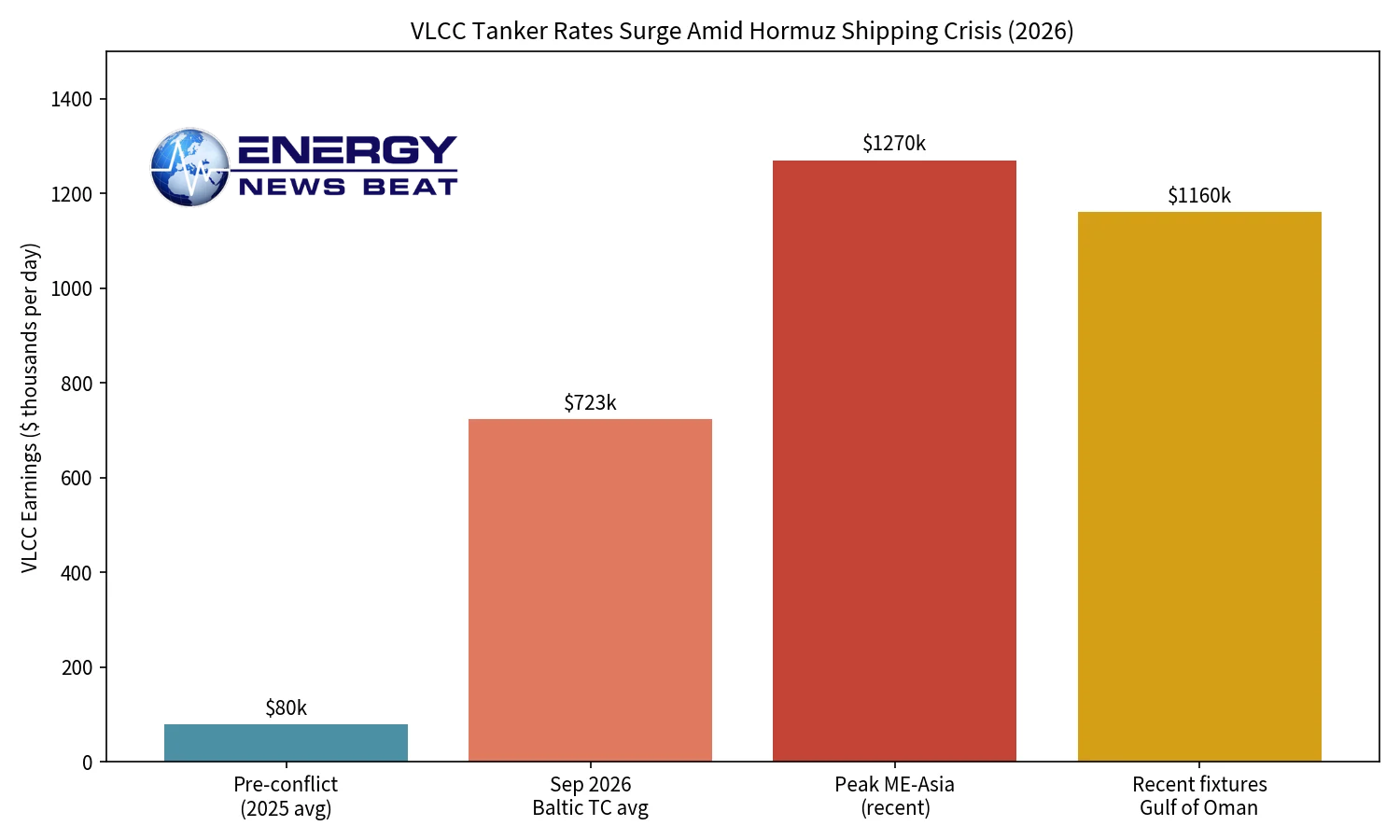
VLCC earnings, approximate composites from Baltic Exchange, LSEG, Clarksons, and recent fixture reports. The point is the scale of the move, not a single official print.
What the pricing actually says
Hardy’s $200 case is real, and it is conditional. It shows up if the 10 to 14 million barrels a day now leaving the Gulf gets cut while stocks are empty. As long as the shuttle holds, most baselines sit much lower—EIA in the $90s to around $105 late this year, then lower in 2027; some bank views near $80 once flows look normal. The premium that does not fade quickly is in the products.
That split is already visible. Futures ease when headlines say more oil is moving. The barrels that reach a refinery still carry a fat freight bill, and the fuels that leave the refinery still carry a fat crack. Diesel is the tell.
Conclusion
The market is not one crisis. It is three, stacked. Crude got scarce, then products got scarcer, and now the ships that connect them are the scarce thing. The $200 figure is the tail risk if the Hormuz shuttle fails. The more likely path is uglier in a quieter way: crude well below that number, diesel and jet stubbornly expensive, and consumers and businesses doing the rationing that policymakers would rather not announce.
New tankers are on order in record numbers. They arrive too late for this winter. New refineries are not on order in anything like the volume required, and they would arrive even later. Until one of those gaps closes, or until high prices close demand instead, the squeeze Hardy described does not really end. It just changes which invoice hurts most.
If you want the weekly version of this—tanker fixtures, crack spreads, and which forecasts are quietly being walked back—subscribe to Energy News Beat. The next move in this market will not be announced in a futures settlement. It will show up first in a ship that cannot find cover, or a refinery that cannot find a barrel it can afford to run. The Energy News Beat Substack.
Check out the World’s Greatest Podcast Show Notes at EnergyNewsBeat.co or EnergyNewsBeat.com. And subscribe to: The Energy News Beat Substack.
Appendices
Appendix: Sources
- Financial Times, “Vitol chief warns of tanker shortage and risk of $200-a-barrel oil,” 6 October 2026: https://www.ft.com/content/95db1fbd-4e1f-45cf-b678-c40635f59197
- Reuters, “Around 14 million barrels per day leaving Middle East, Vitol CEO says,” 6 October 2026: https://www.reuters.com/world/middle-east/around-14-million-bpd-leaving-middle-east-vitol-ceo-says-2026-10-06/
- Bloomberg, Hardy on exhausted Western inventories, 6 October 2026
- TradeWinds, “Strait of Hormuz tanker shuttles preventing $200-per-barrel scenario, Vitol boss says,” 7 October 2026
- ING Think, “Record-breaking tanker rates pile pressure on already high fuel prices,” October 2026: https://think.ing.com/articles/record-breaking-tanker-rates-pile-pressure-on-high-fuel-prices/
- Insurance Business, “Supertanker values overtake newbuilds,” September 2026: https://www.insurancebusinessmag.com/nz/news/breaking-news/supertanker-values-overtake-newbuilds-what-it-means-for-hull-and-risk-cover-591401.aspx
- Seatrade Maritime, VLCC Gulf of Oman fixtures, 7 October 2026
- IEA Oil Market Report, September 2026: https://www.iea.org/reports/oil-market-report-september-2026
- EIA Short-Term Energy Outlook, October 2026: https://www.eia.gov/outlooks/steo/
- CNBC / Goldman Sachs on diesel cracks and refining capacity, 6 October 2026: https://www.cnbc.com/2026/10/06/diesel-oil-refinery-price-capacity-demand.html
The post The $200 Oil Warning Is the Wrong Fear. The Refinery Shortage Is the One That Sticks. appeared first on Energy News Beat.